Organic Fast Moving Consumer Goods Market Overview
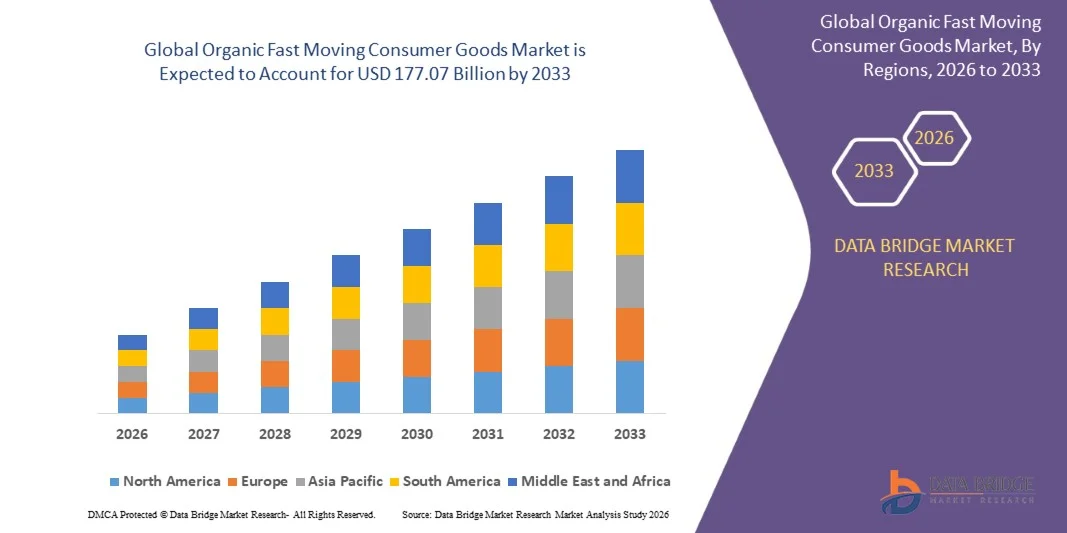
The Organic Fast Moving Consumer Goods Market was valued at USD 116.70 billion in 2025 and is projected to reach USD 177.07 billion by 2033, growing at a CAGR of 5.35% from 2026 to 2033. The market is experiencing steady growth driven by increasing consumer awareness regarding health and wellness, rising demand for clean-label and chemical-free products, and expanding availability of organic food, beverages, personal care, and household products through both online and offline retail channels.
The growing prevalence of lifestyle-related health concerns, combined with increasing preference for sustainable and environmentally responsible consumption, is encouraging consumers to shift toward organic FMCG products. Manufacturers are expanding their organic product portfolios and investing in transparent sourcing, eco-friendly packaging, and certification compliance to meet evolving consumer expectations. In addition, the rapid growth of e-commerce platforms, rising disposable incomes in emerging economies, and stronger regulatory support for organic farming and food safety standards are further accelerating market adoption across residential and commercial consumer segments worldwide.
Key Market Trends & Insights
- North America dominated the organic fast moving consumer goods market with the largest revenue share of 37.8% in 2025, supported by strong consumer awareness regarding health and wellness, high demand for organic food and personal care products, well-established retail distribution networks, and the presence of leading organic product manufacturers.
- Asia-Pacific is expected to be the fastest-growing region, recording a CAGR of 6.7% from 2026 to 2033. Growth is driven by rising disposable incomes, rapid urbanization, increasing awareness regarding nutrition and product safety, growing adoption of healthy lifestyles, and expanding government support for organic farming and sustainable agriculture.
- The Food & Beverage segment held the largest market revenue share of approximately 58.6% in 2025 driven by strong consumer demand for organic dairy products, fruits and vegetables, packaged foods, snacks, and beverages. Growing awareness regarding food safety, clean-label ingredients, and nutritional benefits continues to support widespread adoption of organic food and beverage products across both developed and emerging markets.
- The Personal Care segment is projected to register the fastest growth at a CAGR of 6.4% from 2026 to 2033, driven by increasing consumer preference for natural skincare, haircare, and cosmetic products free from synthetic chemicals and artificial additives. Rising demand for sustainable beauty products and expanding availability through online retail channels are accelerating segment expansion.
- The Supermarkets & Hypermarkets segment accounted for the largest market revenue share of approximately 42.9% in 2025 due to extensive product availability, strong brand visibility, and growing consumer preference for one-stop shopping experiences. Major retail chains continue to expand dedicated organic product sections to meet rising demand for certified organic consumer goods.
- The E-commerce segment is anticipated to witness the fastest growth at a CAGR of 7.2% from 2026 to 2033 driven by increasing digital adoption, convenient home delivery services, wider product selection, and enhanced access to niche organic brands. Growing consumer reliance on online platforms for health and wellness purchases continues to support rapid segment growth globally.
Market Size & Forecast
- Global Market Value (2025): USD 116.70 Billion
- Expected Market Value (2033): USD 177.07 Billion
- Forecast CAGR (2026–2033): 5.35%
- Leading Region in 2025: North America
- Fastest Growing Region: Asia-Pacific
Report Scope and Organic Fast Moving Consumer Goods Market Segmentation
|
Attributes |
Organic Fast Moving Consumer Goods Key Market Insights |
|
Segments Covered |
· By Type: Food & Beverage, Personal Care, Health Care, and Home Care · By Distribution Channel: Supermarkets & Hypermarkets, Grocery Stores, Specialty Stores, E-commerce, and Others |
|
Countries Covered |
North America · U.S. · Canada · Mexico Europe · Germany · France · U.K. · Netherlands · Switzerland · Belgium · Russia · Italy · Spain · Turkey · Rest of Europe Asia-Pacific · China · Japan · India · South Korea · Singapore · Malaysia · Australia · Thailand · Indonesia · Philippines · Rest of Asia-Pacific Middle East and Africa · Saudi Arabia · U.A.E. · South Africa · Egypt · Israel · Rest of Middle East and Africa South America · Brazil · Argentina · Rest of South America |
|
Key Market Players |
• Procter & Gamble Co. (U.S.) |
|
Market Opportunities |
|
|
Value Added Data Infosets |
In addition to the insights on market scenarios such as market value, growth rate, segmentation, geographical coverage, and major players, the market reports curated by the Data Bridge Market Research also include in-depth expert analysis, pricing analysis, brand share analysis, consumer survey, demography analysis, supply chain analysis, value chain analysis, raw material/consumables overview, vendor selection criteria, PESTLE Analysis, Porter Analysis, and regulatory framework. |
Organic Fast Moving Consumer Goods Market Trends
Trend: Rising Consumer Preference For Clean-Label And Sustainable Organic Products
Consumers are increasingly seeking food, beverage, personal care, and household products made with natural ingredients, transparent sourcing practices, and environmentally responsible production methods. Growing concerns regarding synthetic additives, pesticide residues, artificial preservatives, and long-term health impacts are encouraging consumers to shift toward certified organic FMCG products that align with wellness and sustainability goals. Retailers and manufacturers are responding by expanding organic product portfolios and introducing eco-friendly packaging solutions to strengthen brand differentiation.
Major FMCG companies are increasingly launching organic product lines, For instance organic dairy products, plant-based beverages, baby food, and personal care items, to meet evolving consumer preferences. Supermarkets and e-commerce platforms are also dedicating larger shelf space to organic offerings, improving product accessibility across urban and suburban markets. The continued growth of clean-label certifications and sustainability-focused purchasing behavior is further supporting market expansion. Industry surveys conducted during 2025 indicated that more than 60% of health-conscious consumers in North America and Europe actively reviewed ingredient labels before purchasing packaged consumer goods, highlighting the growing influence of transparency and organic certifications on buying decisions.
Organic Fast Moving Consumer Goods Market Dynamics
Key Market Driver: Increasing Consumer Awareness Regarding Health And Wellness
Rising awareness regarding nutrition, preventive healthcare, and the potential risks associated with synthetic chemicals is significantly increasing demand for organic FMCG products worldwide. Consumers are actively seeking products produced without synthetic fertilizers, pesticides, hormones, or genetically modified ingredients, creating strong demand across food, beverage, personal care, and household product categories.
Manufacturers are increasingly investing in certified organic sourcing and product innovation, For instance introducing organic snacks, beverages, skincare products, and nutritional supplements to address growing consumer demand. Health-conscious millennials and younger consumers are emerging as major contributors to market growth due to their preference for natural and sustainable consumption patterns. According to industry retail data reported during 2024, organic food and beverage sales in several developed markets recorded annual growth rates exceeding 7–9%, reflecting strong consumer adoption and expanding penetration of organic FMCG products across mainstream retail channels.
Key Restraint/Challenge: Higher Product Prices And Limited Supply Chain Availability
Organic FMCG products typically involve higher production, certification, and distribution costs compared to conventional alternatives, resulting in premium pricing that may limit adoption among price-sensitive consumers. Organic farming practices often generate lower yields and require stricter compliance standards, creating supply constraints that affect product availability and cost competitiveness.
In addition, fragmented supply chains, certification complexities, and limited organic farming acreage in several regions continue to challenge large-scale market expansion. Small and medium-sized manufacturers often face difficulties maintaining consistent supply while meeting regulatory requirements and quality standards. Market assessments indicate that certified organic FMCG products are commonly priced 20–50% higher than conventional alternatives across several product categories, creating affordability concerns in emerging economies where purchasing decisions remain highly price dependent.
Key Market Opportunity: Expansion Of E-Commerce And Private Label Organic Products
The rapid growth of digital retail channels, direct-to-consumer platforms, and private label organic brands is creating substantial growth opportunities across the organic FMCG market. Consumers increasingly prefer online purchasing channels that offer wider product selections, subscription services, transparent ingredient information, and convenient home delivery options.
Retailers and FMCG companies are expanding private label organic offerings, For instance organic packaged foods, beverages, household cleaners, and personal care products, to improve affordability and attract value-conscious consumers. Growing penetration of smartphones and digital commerce platforms is enabling organic brands to reach underserved markets and new consumer segments. In addition, investments in sustainable packaging, regenerative agriculture, and traceability technologies are strengthening consumer confidence and brand loyalty. E-commerce sales data reported during 2025 indicated that organic consumer goods purchases grew by more than 15% year-over-year across major online retail platforms in North America and Europe, demonstrating the increasing importance of digital channels in driving future market growth.
Organic Fast Moving Consumer Goods Market Scope
The market is segmented on the basis of type and distribution channel.
- By Type
On the basis of type, the organic fast moving consumer goods market is segmented into Food & Beverage, Personal Care, Health Care, and Home Care. The Food & Beverage segment held the largest market revenue share of approximately 58.6% in 2025 driven by strong consumer demand for organic dairy products, fruits and vegetables, packaged foods, snacks, and beverages. Growing awareness regarding food safety, clean-label ingredients, and nutritional benefits continues to support widespread adoption of organic food and beverage products across both developed and emerging markets.
The Personal Care segment is projected to register the fastest growth at a CAGR of 6.4% from 2026 to 2033, driven by increasing consumer preference for natural skincare, haircare, and cosmetic products free from synthetic chemicals and artificial additives. Rising demand for sustainable beauty products and expanding availability through online retail channels are accelerating segment expansion.
- By Distribution Channel
On the basis of distribution channel, the organic fast moving consumer goods market is segmented into Supermarkets & Hypermarkets, Grocery Stores, Specialty Stores, E-commerce, and Others. The Supermarkets & Hypermarkets segment accounted for the largest market revenue share of approximately 42.9% in 2025 due to extensive product availability, strong brand visibility, and growing consumer preference for one-stop shopping experiences. Major retail chains continue to expand dedicated organic product sections to meet rising demand for certified organic consumer goods.
The E-commerce segment is anticipated to witness the fastest growth at a CAGR of 7.2% from 2026 to 2033 driven by increasing digital adoption, convenient home delivery services, wider product selection, and enhanced access to niche organic brands. Growing consumer reliance on online platforms for health and wellness purchases continues to support rapid segment growth globally.
Organic Fast Moving Consumer Goods Market Regional Analysis
North America Organic Fast Moving Consumer Goods Market Insight
North America dominated the organic fast moving consumer goods market with the largest revenue share of 37.8% in 2025, supported by strong consumer awareness regarding health, wellness, and sustainable consumption. Consumers across the region increasingly prefer organic food, beverages, personal care, and household products due to concerns regarding synthetic ingredients and environmental impact. The presence of established organic brands, well-developed retail networks, and high purchasing power continues to strengthen market growth across residential and commercial consumer segments.
U.S. Organic Fast Moving Consumer Goods Market Insight
The U.S. organic fast moving consumer goods market captured the largest revenue share in 2025 within North America, fueled by rising demand for clean-label products and growing adoption of organic lifestyles. Consumers are increasingly seeking organic packaged foods, beverages, nutritional products, and personal care items that align with health-conscious purchasing habits. The rapid expansion of e-commerce platforms, private-label organic products, and sustainability-focused product innovation continues to support market expansion throughout the country.
Europe Organic Fast Moving Consumer Goods Market Insight
The Europe organic fast moving consumer goods market is expected to witness significant growth from 2026 to 2033, primarily driven by strong environmental awareness, stringent organic certification standards, and increasing consumer preference for natural products. Growing demand for sustainable food production, eco-friendly packaging, and ethically sourced consumer goods is accelerating market adoption. The region continues to experience rising consumption of organic products across food, personal care, healthcare, and home care categories.
U.K. Organic Fast Moving Consumer Goods Market Insight
The U.K. organic fast moving consumer goods market is expected to witness the fastest growth rate from 2026 to 2033, driven by increasing consumer focus on nutrition, sustainability, and product transparency. Growing awareness regarding ingredient sourcing and environmental responsibility is encouraging consumers to purchase certified organic products. The expansion of online grocery retailing and broader availability of organic product ranges are expected to further stimulate market growth across the country.
Germany Organic Fast Moving Consumer Goods Market Insight
The Germany organic fast moving consumer goods market is expected to witness strong growth from 2026 to 2033, fueled by increasing demand for sustainable consumption and premium organic products. Germany's well-established organic food industry, combined with strong government support for sustainable agriculture and environmental initiatives, continues to promote market expansion. Consumers increasingly prefer organic food and personal care products that align with health, quality, and sustainability expectations.
Asia-Pacific Organic Fast Moving Consumer Goods Market Insight
The Asia-Pacific organic fast moving consumer goods market is expected to witness the fastest growth rate from 2026 to 2033, supported by rising disposable incomes, rapid urbanization, and growing awareness regarding healthy lifestyles. Consumers across the region are increasingly adopting organic food, beverages, and personal care products as awareness regarding nutrition and product safety continues to improve. Government initiatives supporting organic farming and sustainable agriculture are further contributing to regional market growth.
Japan Organic Fast Moving Consumer Goods Market Insight
The Japan organic fast moving consumer goods market is expected to witness significant growth from 2026 to 2033 due to increasing consumer preference for premium-quality, safe, and naturally sourced products. The country's strong focus on food safety, wellness, and healthy aging is encouraging adoption of organic consumer goods across multiple product categories. Growing demand for organic packaged foods, beverages, and personal care products continues to support market expansion throughout Japan.
China Organic Fast Moving Consumer Goods Market Insight
The China organic fast moving consumer goods market accounted for the largest market revenue share in Asia-Pacific in 2025, attributed to the country's expanding middle-class population, rising health awareness, and increasing spending on premium consumer products. China has emerged as one of the largest markets for organic food and personal care products, supported by rapid urbanization and growing demand for safe, high-quality consumer goods. The expansion of digital retail platforms and domestic organic product manufacturing continues to propel market growth across the country.
Organic Fast Moving Consumer Goods Market Share
The Organic Fast Moving Consumer Goods industry is primarily led by well-established companies, including:
• Procter & Gamble Co. (U.S.)
• Unilever PLC (U.K.)
• The Coca-Cola Company (U.S.)
• PepsiCo, Inc. (U.S.)
• Baxter International Inc. (U.S.)
• Drive Medical GmbH & Co. KG (Germany)
• Medline Industries, LP (U.S.)
• Abbott Laboratories (U.S.)
• Henkel AG & Co. KGaA (Germany)
• Hard Manufacturing Co., Inc. (U.S.)
• Kao Corporation (Japan)
• Hollister Incorporated (U.S.)
• Invacare Corporation (U.S.)
• Procter & Gamble Co. (U.S.)
• Graham-Field Health Products, Inc. (U.S.)
• Henkel AG & Co. KGaA (Germany)
• Church & Dwight Co., Inc. (U.S.)
• The Clorox Company (U.S.)
• DeVilbiss Healthcare LLC (U.S.)
• Unilever PLC (U.K.)
• Patanjali Ayurved Limited (India)
• Keurig Dr Pepper Inc. (U.S.)
• Revlon, Inc. (U.S.)
• Johnson & Johnson (U.S.)
• Nestlé S.A. (Switzerland)
Latest Developments in Organic Fast Moving Consumer Goods Market
- In July 2023, PepsiCo expanded its organic snack portfolio through the introduction of minimally processed and preservative-free snack products designed to address growing consumer demand for healthier food alternatives. The development strengthened the company’s presence in the premium organic snacks segment, improved access to clean-label products, and supported broader market growth by encouraging innovation in sustainable and nutrient-rich snacking solutions.
- In February 2021, The Coca-Cola Company expanded its focus on organic functional beverages, including kombucha and cold-pressed juice offerings, to cater to rising consumer interest in wellness-oriented lifestyles. The initiative enhanced product diversification within the organic beverage category, increased availability of natural and clean-label drink options, and contributed to the growing adoption of health-focused organic FMCG products across global markets.

- Interactive Data Analysis Dashboard
- Company Analysis Dashboard for high growth potential opportunities
- Research Analyst Access for customization & queries
- Competitor Analysis with Interactive dashboard
- Latest News, Updates & Trend analysis
- Harness the Power of Benchmark Analysis for Comprehensive Competitor Tracking
Data collection and base year analysis are done using data collection modules with large sample sizes. The stage includes obtaining market information or related data through various sources and strategies. It includes examining and planning all the data acquired from the past in advance. It likewise envelops the examination of information inconsistencies seen across different information sources. The market data is analysed and estimated using market statistical and coherent models. Also, market share analysis and key trend analysis are the major success factors in the market report. To know more, please request an analyst call or drop down your inquiry.
The key research methodology used by DBMR research team is data triangulation which involves data mining, analysis of the impact of data variables on the market and primary (industry expert) validation. Data models include Vendor Positioning Grid, Market Time Line Analysis, Market Overview and Guide, Company Positioning Grid, Patent Analysis, Pricing Analysis, Company Market Share Analysis, Standards of Measurement, Global versus Regional and Vendor Share Analysis. To know more about the research methodology, drop in an inquiry to speak to our industry experts.
Data Bridge Market Research is a leader in advanced formative research. We take pride in servicing our existing and new customers with data and analysis that match and suits their goal. The report can be customized to include price trend analysis of target brands understanding the market for additional countries (ask for the list of countries), clinical trial results data, literature review, refurbished market and product base analysis. Market analysis of target competitors can be analyzed from technology-based analysis to market portfolio strategies. We can add as many competitors that you require data about in the format and data style you are looking for. Our team of analysts can also provide you data in crude raw excel files pivot tables (Fact book) or can assist you in creating presentations from the data sets available in the report.