


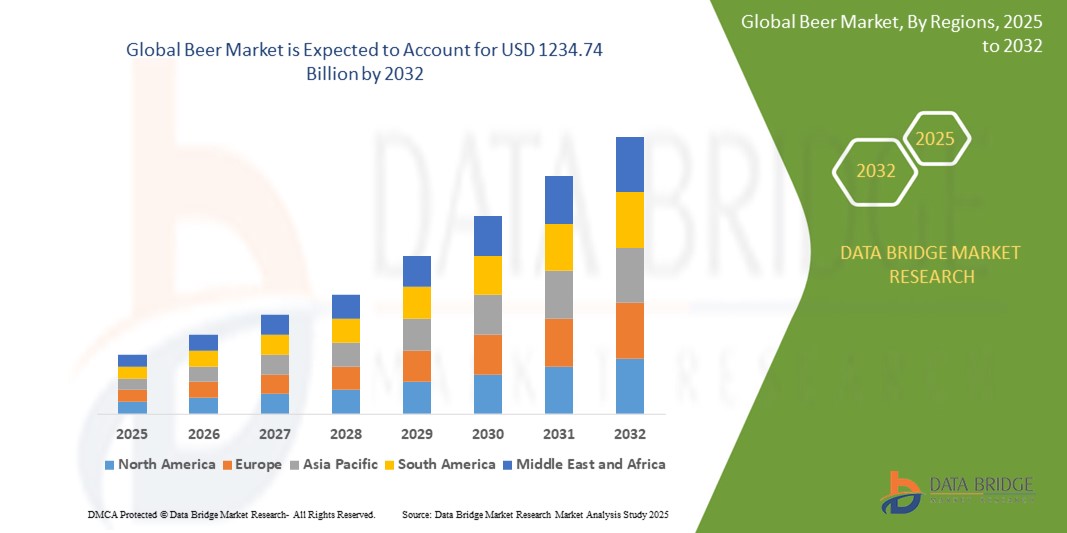
Beer Market Size
- The global beer market size was valued at USD 800.90 billion in 2024 and is expected to reach USD 1234.74 billion by 2032, at a CAGR of 5.56% during the forecast period
- The market growth is largely fuelled by the rising demand for craft and premium beers, growing young adult population, and increasing social consumption trends across emerging economies
- Expanding distribution channels, including e-commerce platforms and convenience stores, are making beer more accessible to consumers, further boosting market growth
Beer Market Analysis
- The beer market is experiencing a rise in demand for premium and craft varieties as consumers seek unique flavours and brewing techniques for a personalized drinking experience
- Growing health awareness is driving demand for low-alcohol and alcohol-free beer options, appealing to a wider range of lifestyle-conscious consumers
- North America dominates the global beer market with the largest revenue share of 35.2% in 2024, driven by a well-established beer culture, premiumization trends, and a robust craft brewing sector across the region
- Asia-Pacific region is expected to witness the highest growth rate in the global beer market, driven by rapid urbanization, rising disposable incomes, and increasing demand for premium and craft beers
- The lager segment dominates the market by holding the largest revenue share of 76.4%, due to its mild taste, wide availability, and appeal to a broad consumer base. Its light and refreshing flavour profile suits diverse consumer preferences across different regions. In In In addition, major beer producers focus on lager varieties, ensuring strong distribution and marketing support. This segment also benefits from being a staple in both on-trade and off-trade channels, reinforcing its market leadership
Report Scope and Beer Market Segmentation
|
Attributes |
Beer Key Market Insights |
|
Segments Covered |
|
|
Countries Covered |
North America
Europe
Asia-Pacific
Middle East and Africa
South America
|
|
Key Market Players |
|
|
Market Opportunities |
|
|
Value Added Data Infosets |
In addition to the insights on market scenarios such as market value, growth rate, segmentation, geographical coverage, and major players, the market reports curated by the Data Bridge Market Research also include in-depth expert analysis, pricing analysis, brand share analysis, consumer survey, demography analysis, supply chain analysis, value chain analysis, raw material/consumables overview, vendor selection criteria, PESTLE Analysis, Porter Analysis, and regulatory framework. |
Beer Market Trends
“Rising Popularity of Craft and Artisanal Beer”
- Consumers are increasingly favoring craft beer due to its unique flavors, authenticity, and local brewing origins
- Small-batch breweries are thriving as they focus on high-quality ingredients and personalized brewing techniques
- For instance, BrewDog in the U.K. has built a global reputation by offering bold flavors and sustainable brewing practices
- The trend also reflects a growing consumer desire to support local businesses and eco-friendly production methods
- Major beer brands are adjusting their strategies and launching craft-style lines to align with evolving consumer preferences
Beer Market Dynamics
Driver
“Rising Demand for Premium and Flavored Beer”
- Consumers are increasingly seeking premium and flavored beer due to rising disposable incomes and evolving taste preferences
- Premium beers, including craft and imported varieties, are viewed as lifestyle products that offer superior quality and social appeal
- Flavored beers, such as fruit-infused lagers and spice-enhanced ales, are especially popular among younger consumers and new beer drinkers
- For instance, AB InBev’s Bud Light Seltzer and Heineken’s Desperados have seen success by targeting new taste segments with bold, innovative flavors
- Bars and restaurants are boosting premium beer exposure through curated menus and pairings, encouraging consumer experimentation and loyalty
Restraint/Challenge
“Rising Health Concerns and Regulatory Constraints”
- Rising health awareness is leading many consumers to cut back on alcohol or switch to low-alcohol and alcohol-free alternatives
- Wellness trends and mindful drinking movements, especially among younger demographics, are impacting traditional beer consumption
- Government regulations, such as age limits, advertising bans, and excise taxes, are creating barriers to market growth and brand visibility
- For instance, countries such as India and Thailand have imposed high alcohol taxes and strict advertising rules, limiting beer affordability and marketing efforts
- Regulatory hurdles and health concerns are pressuring both large and small breweries to innovate, ensure compliance, and shift toward responsible branding strategies
Beer Market Scope
The global beer market is segmented on the basis of type, taste, category, packaging, production, and distribution channel.
- By Type
On the basis of type, the beer market is segmented into lager, ale, stout and porter, malt, and others. The lager segment dominates the market by holding the largest revenue share of 76.4%, due to its mild taste, wide availability, and appeal to a broad consumer base. Its light and refreshing flavour profile suits diverse consumer preferences across different regions. In In In addition, major beer producers focus on lager varieties, ensuring strong distribution and marketing support. This segment also benefits from being a staple in both on-trade and off-trade channels, reinforcing its market leadership.
The ale segment is expected to witness fastest growth rate from 2025 to 2032 forecast period, driven by increasing consumer interest in bold and complex flavours. Its rich taste and variety of styles attract craft beer enthusiasts seeking unique and innovative brews. The rise of microbreweries and craft breweries is also fuelling ale’s popularity by offering limited-edition and artisanal options. In addition, ale’s strong presence in on-trade venues such as bars and pubs helps boost its visibility and consumption among younger demographics.
- By Taste
On the basis of taste, the beer market is segmented into is segmented into strong beer, light beer, and regular beer. Regular beer segment dominates the market because of its balanced flavour and moderate alcohol content, making it a preferred choice for traditional beer drinkers. Its wide availability and consistent taste profile cater to a large, loyal consumer base. In addition, regular beer is often more affordable, further strengthening its position in both developed and emerging markets. This segment remains a staple for everyday consumption and social occasions.
The light beer segment is expected to witness fastest growth rate from 2025 to 2032 forecast period in popularity as health-conscious consumers seek lower-calorie and lower-alcohol alternatives. This trend is particularly strong among younger drinkers and those adopting healthier lifestyles. Brands are innovating to improve the taste and variety of light beers, making them more appealing without compromising on flavour. The rise of fitness culture and wellness movements continues to drive demand for light beer options in both on-trade and off-trade channels.
- By Category
On the basis of category, the beer market is segmented into regular, premium, and super premium. Regular segment dominates the market and remains the staple choice for many consumers due to its affordability and widespread availability. Its balanced flavour and moderate alcohol content appeal to traditional beer drinkers who prefer a familiar taste. This segment benefits from strong brand loyalty and consistent demand across various markets. Despite the rise of specialty and craft beers, regular beer maintains steady sales due to its accessibility and comfort factor.
The premium segment is expected to witness fastest growth rate from 2025 to 2032 forecast period, driven by increasing consumer interest in higher-quality ingredients and unique flavour profiles. Consumers are willing to pay more for beers that offer distinctive taste experiences and craftsmanship. This growth is also supported by rising disposable incomes and the influence of global beer culture. Premium beers are increasingly seen as lifestyle products that enhance social status, encouraging brands to innovate and expand their offerings.
- By Packaging
On the basis of packaging, the beer market is segmented into glass bottles, PET bottles, canned beer, and draught beer. Glass bottles hold the largest market share of 46.3%, favoured for their ability to preserve beer flavour and provide a classic drinking experience. Consumers often associate glass packaging with higher quality and premium appeal. In addition, glass bottles are recyclable and reusable, aligning with growing environmental concerns. The traditional look and feel of glass also enhance brand perception and consumer satisfaction.
Canned beer is expected to witness fastest growth rate from 2025 to 2032 forecast period due to convenience, portability, and improved packaging technology that protects taste. Cans are lightweight, easy to transport, and offer better protection against light and oxygen, which can degrade beer quality. The rising popularity of outdoor activities and festivals is driving demand for canned beer. Moreover, advancements in can lining and design have helped overcome past taste concerns, making cans a preferred choice for many younger consumers.
- By Production
On the basis of production, the beer market is segmented into macro-brewery, micro-brewery, craft brewery, and others. Macro-brewery dominates the market by holding a market share of 67.6%, due to large-scale production capacity, broad distribution networks, and strong brand recognition. Their ability to produce consistent quality at competitive prices allows them to maintain a substantial market presence globally. These breweries often invest heavily in marketing and sponsorships, further strengthening consumer loyalty. Their extensive product portfolios also cater to diverse consumer preferences, ensuring widespread appeal.
The craft brewery segment is expected to witness the fastest growth rate from 2025 to 2032, appealing to consumers interested in artisanal, innovative, and small-batch beers. Craft breweries emphasize unique flavour’s, traditional brewing methods, and local ingredients, attracting a dedicated and growing customer base. This segment benefits from consumer trends favouring authenticity and experiential products. In addition, craft breweries often foster strong community ties and engage customers through taproom experiences and limited-edition releases, driving loyalty and brand differentiation.
- By Distribution Channel
On the basis of distribution channel, the beer market is segmented into on-trade and off-trade. On-trade dominates the market by holding a market share of 51.5%, including bars, restaurants, and pubs, are important for offering curated beer experiences and premium options. The on-trade segment is growing as consumers seek social and tasting experiences, which help promote brand awareness and loyalty. These venues provide opportunities for brewers to showcase limited-edition or seasonal offerings that may not be available in retail. Events such as beer tastings and brewery collaborations also enhance the appeal of on-trade settings, encouraging higher spending per visit and deeper consumer engagement.
Off-trade is expected to witness fastest growth rate from 2025 to 2032 forecast period, such as supermarkets and liquor stores, generate the majority of sales because of convenience and affordability for consumers. These outlets provide a wide variety of brands and packaging options, making it easier for consumers to purchase beer in bulk or on the go. The expansion of e-commerce platforms and online alcohol delivery services has further boosted off-trade sales. Promotional pricing and discounts in retail chains also attract price-sensitive customers and drive volume purchases.
Beer Market Regional Analysis
- North America dominates the global beer market with the largest revenue share of 35.2% in 2024, driven by a well-established beer culture, premiumization trends, and a robust craft brewing sector across the region
- Consumers in North America value innovative flavour’s, authenticity, and variety, leading to a surge in demand for craft, organic, and low-alcohol beer offerings
- The market is further supported by high disposable incomes, an extensive distribution network, and a growing preference for healthier alternatives and experiential consumption, positioning beer as a staple in both social and personal settings
U.S. Beer Market Insight
The U.S. beer market captured the largest revenue share of 81% in 2024 within North America, fuelled by the strong presence of microbrewery, shifting consumer preferences toward artisanal and premium beer, and growing demand for non-alcoholic and flavoured variants. Innovation in packaging, online alcohol delivery, and the proliferation of local taprooms contribute significantly to the market. The expanding millennial and Gen Z customer base, along with rising health consciousness, continues to reshape the beer landscape with an emphasis on quality and lifestyle alignment.
Europe Beer Market Insight
The Europe beer market is expected to witness fastest growth rate from 2025 to 2032 forecast period, sustained by deep-rooted beer traditions, innovation in craft brewing, and strong exports. Consumers in key markets such as Germany, the U.K., and the Netherlands are increasingly interested in low-alcohol and specialty beer types. The market is further bolstered by tourism, seasonal festivals, and premium product offerings, with a notable rise in sustainable brewing practices and eco-friendly packaging reflecting evolving consumer values.
Germany Beer Market Insight
The Germany beer market remains a strong region of the Europe beer industry, supported by a rich heritage, quality standards, and diverse product offerings. While traditional styles such as pilsner and Weissbier remain popular, there is growing demand for regional and craft varieties. Germany’s focus on purity laws, environmental sustainability, and technological advancement in brewing continues to shape its competitive edge. In In addition, cultural events such as Oktoberfest continue to enhance domestic and international demand.
U.K. Beer Market Insight
The U.K. beer market is expected to witness fastest growth rate from 2025 to 2032 forecast period, fuelled by rising demand for premium, low-alcohol, and craft beer options. Consumers are increasingly experimenting with unique flavour’s, formats, and local brews. The prevalence of gastropubs and the convenience of online alcohol sales contribute to evolving consumption trends. A strong focus on sustainability, coupled with innovations in ingredients and packaging, is expected to shape the future of the beer industry in the U.K.
Asia-Pacific Beer Market Insight
The Asia-Pacific beer market is expected to witness fastest growth rate from 2025 to 2032 forecast period, driven by rapid urbanization, rising middle-class population, and changing lifestyle trends in countries such as China, India, and Vietnam. Consumers in the region are increasingly drawn to premium, flavoured, and craft beer options, supported by Western influence and expanding retail infrastructure. The region’s growth is further propelled by a surge in tourism, favourable demographic trends, and government initiatives supporting domestic brewing industries, making APAC a key growth engine in the global beer market.
China Beer Market Insight
The China beer market accounted for the largest revenue share in Asia-Pacific in 2024, driven by the shift from mass-market lagers to premium and craft varieties. Consumers are seeking unique flavours and higher quality, while domestic and international brands compete for market share. China's growing e-commerce ecosystem and urban lifestyle trends are reshaping consumption patterns. Strong domestic production capabilities and rising disposable incomes continue to support the expansion of the premium beer segment, particularly in major urban centers.
Japan Beer Market Insight
The Japan beer market is expected to witness fastest growth rate from 2025 to 2032 forecast period, this growth is driven by shifting consumer preferences towards premium and craft beer offerings, as well as the introduction of innovative flavour’s and low-alcohol options. Japanese consumers are increasingly seeking unique and high-quality beer experiences, leading to a surge in demand for craft beers. The market's expansion is further supported by the proliferation of microbreweries, the popularity of beer festivals, and the convenience of online retail channels. These factors collectively contribute to the dynamic growth of Japan's beer industry.
Beer Market Share
The Beer industry is primarily led by well-established companies, including:
- Lindemans (Australia)
- LOST COAST BREWERY (U.S.)
- Magic Hat Brewing Company (U.S.)
- New Belgium Brewing Company, Inc. (U.S.)
- Brewery Ommegang (U.S.)
- All Saints Brewing Company (U.S.)
- Shipyard Brewing Company (U.S.)
- Unibroue (Canada)
- Abita Brewing Company (U.S.)
- HokkaidoBrewing (Japan)
- Rhinegeist Brewery (U.S.)
- Boston Beer Corporation (U.S.)
- JESTER KING CRAFT BREWERY LLC. (U.S.)
- Dogfish Head Craft Brewery, Inc. (U.S.)
- Heineken Holding N.V. (Netherlands)
- Sierra Nevada Brewing Co. (U.S.)
Latest Developments in Global Beer Market
- In October 2022, Victoria introduced "Vicky Chamoy," a chamoy-flavored beer, to the U.S. market. This 24-ounce single-serve beer, imported from Mexico, blends sour, salty, spicy, and sweet notes to appeal to adventurous palates. The launch represents Victoria’s diversification strategy aimed at reaching new consumer segments and expanding its footprint in the flavored beer category. It highlights the growing trend of unique, culturally inspired flavor profiles, contributing to overall market dynamism and sales growth in the U.S. beer segment.
- In September 2022, Heineken Group launched "Heineken Silver," an innovative addition to its portfolio. Crafted by experienced master brewers using pure malt and the brand’s proprietary A-yeast, Heineken Silver offers a smoother, more refreshing taste. This launch aligns with the company’s strategy to innovate using natural ingredients while catering to evolving consumer tastes. The product strengthens Heineken’s premium positioning and supports growth through product differentiation in a competitive global beer market
- In 2022, Anheuser-Busch InBev introduced "Seven Rivers" in the Indian market as part of its expansion strategy. Positioned alongside established brands such as Budweiser and Corona Extra, Seven Rivers was initially rolled out in select areas of Maharashtra and Karnataka. The launch reflects the company’s intent to deepen its presence in high-potential regional markets. By catering to local preferences with a new offering, AB InBev aims to boost its market share and support the broader growth of premium beer consumption in India.

- Interactive Data Analysis Dashboard
- Company Analysis Dashboard for high growth potential opportunities
- Research Analyst Access for customization & queries
- Competitor Analysis with Interactive dashboard
- Latest News, Updates & Trend analysis
- Harness the Power of Benchmark Analysis for Comprehensive Competitor Tracking
Global Beer Market, Supply Chain Analysis and Ecosystem Framework
To support market growth and help clients navigate the impact of geopolitical shifts, DBMR has integrated in-depth supply chain analysis into its Global Beer Market research reports. This addition empowers clients to respond effectively to global changes affecting their industries. The supply chain analysis section includes detailed insights such as Global Beer Market consumption and production by country, price trend analysis, the impact of tariffs and geopolitical developments, and import and export trends by country and HSN code. It also highlights major suppliers with data on production capacity and company profiles, as well as key importers and exporters. In addition to research, DBMR offers specialized supply chain consulting services backed by over a decade of experience, providing solutions like supplier discovery, supplier risk assessment, price trend analysis, impact evaluation of inflation and trade route changes, and comprehensive market trend analysis.
Data collection and base year analysis are done using data collection modules with large sample sizes. The stage includes obtaining market information or related data through various sources and strategies. It includes examining and planning all the data acquired from the past in advance. It likewise envelops the examination of information inconsistencies seen across different information sources. The market data is analysed and estimated using market statistical and coherent models. Also, market share analysis and key trend analysis are the major success factors in the market report. To know more, please request an analyst call or drop down your inquiry.
The key research methodology used by DBMR research team is data triangulation which involves data mining, analysis of the impact of data variables on the market and primary (industry expert) validation. Data models include Vendor Positioning Grid, Market Time Line Analysis, Market Overview and Guide, Company Positioning Grid, Patent Analysis, Pricing Analysis, Company Market Share Analysis, Standards of Measurement, Global versus Regional and Vendor Share Analysis. To know more about the research methodology, drop in an inquiry to speak to our industry experts.
Data Bridge Market Research is a leader in advanced formative research. We take pride in servicing our existing and new customers with data and analysis that match and suits their goal. The report can be customized to include price trend analysis of target brands understanding the market for additional countries (ask for the list of countries), clinical trial results data, literature review, refurbished market and product base analysis. Market analysis of target competitors can be analyzed from technology-based analysis to market portfolio strategies. We can add as many competitors that you require data about in the format and data style you are looking for. Our team of analysts can also provide you data in crude raw excel files pivot tables (Fact book) or can assist you in creating presentations from the data sets available in the report.













