Organic Hair Care Market Analysis and Size
The global organic hair care market is primarily driven by the increasing demand for natural ingredients, mostly merchandise, since they're probably healthy for hair. The transition from chemical to organic product use is strong due to its post-use advantages and refreshing properties. However, the organic-based mostly merchandise square measure is quite valuable compared to the chemical one due to its high producing method prices plus extraction prices of herbals or organic oils.
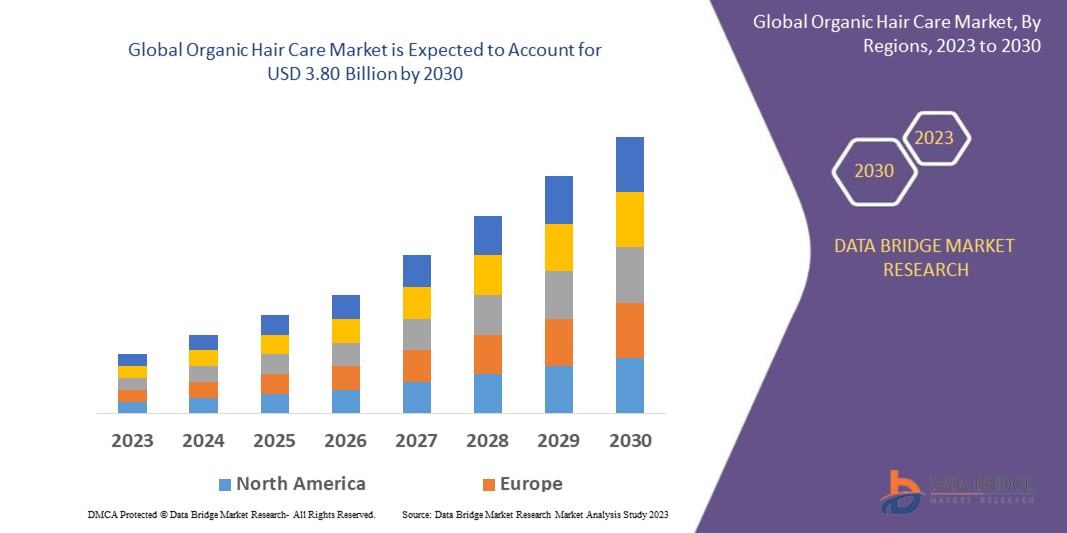
Data Bridge Market Research analyses that the global organic hair care market which was USD 2.37 billion in 2022, is expected to reach USD 3.80 billion by 2030, and is expected to undergo a CAGR of 6.10% during the forecast period of 2023 to 2030. “Shampoo” dominate the type segment of the global organic hair care market due to they are made from natural, chemical-free ingredients, which can be gentler on the scalp, reduce the risk of irritation or allergies, and promote healthier hair by avoiding harsh synthetic chemicals and preservatives. Additionally, organic shampoos are often environmentally friendly, as they minimize the use of harmful pesticides and support sustainable farming practices. In addition to the market insights such as market value, growth rate, market segments, geographical coverage, market players, and market scenario, the market report curated by the Data Bridge Market Research team includes in-depth expert analysis, import/export analysis, pricing analysis, production consumption analysis, and consumer behavior.
Organic Hair Care Market Scope and Segmentation
|
Report Metric |
Details |
|
Forecast Period |
2023 to 2030 |
|
Base Year |
2022 |
|
Historic Years |
2021 (Customizable to 2015-2020) |
|
Quantitative Units |
Revenue in USD Million, Volumes in Units, Pricing in USD |
|
Segments Covered |
Type, (Shampoo, Conditioner. Hair Loss Treatment Products, Hair Colorants, Hair Styling Products, Perms and Relaxants, Others), Distribution Channel (Hypermarket/Supermarket, Specialty Stores, Online Stores, Pharmacies/Drug Stores, Convenience Stores, Other Distribution Channels), Hair Type, (Normal, Dry, Oily) |
|
Countries Covered |
U.S., Canada, Mexico, Brazil, Argentina, Rest of South America, Germany, France, Italy, U.K., Belgium, Spain, Russia, Turkey, Netherlands, Switzerland, Rest of Europe, Japan, China, India, South Korea, Australia, Singapore, Malaysia, Thailand, Indonesia, Philippines, Rest of Asia-Pacific, U.A.E, Saudi Arabia, Egypt, South Africa, Israel, Rest of Middle East and Africa |
|
Market Players Covered |
Kao Corporation (Japan), Aveda Corporation (U.S.), The Colgate-Palmolive Company (U.S.), The Hain Celestial Group, Inc. (U.S.), Avalon Natural Products, Inc. (U.S.), Estée Lauder Companies Inc. (U.S.), Bentley Labs (GB) (U.S.), Nesta Hair Care (Spain), Bio Veda Action Research Pvt. Ltd. (India), LAKMÉ COSMETICS S.L. (Spain), Unilever (U.K.), and Giovanni Cosmetics, Inc. (U.S.) |
|
Market Opportunities |
|
Market Definition
Organic hair care refers to a category of hair care products and practices that prioritize the use of natural, non-synthetic ingredients derived from organic farming and sustainable sources. These products exclude synthetic chemicals, pesticides, and artificial fragrances, aiming to promote healthier hair and a reduced environmental footprint. Organic hair care typically relies on botanical extracts, essential oils, and plant-based ingredients known for their nourishing and therapeutic properties. This approach is gentler on the hair and scalp, reducing the risk of irritation and allergies. Organic hair care products may include shampoos, conditioners, hair oils, and styling aids, and they often adhere to strict organic certification standards. Consumers choose organic hair care for its potential to enhance hair health, reduce exposure to harmful chemicals, and support eco-friendly, sustainable practices in the beauty industry.
Global Organic Hair Care Market Dynamics
Drivers
- Increasing Awareness of the Potential Harm Caused by Synthetic Chemicals
Consumers are becoming increasingly aware of the potential health risks associated with synthetic chemicals commonly found in conventional hair care products. Ingredients like parabens, sulfates, and synthetic fragrances have raised concerns about skin irritation, allergies, and long-term health effects. In response to these concerns, consumers are actively seeking safer alternatives that prioritize their health and well-being. They are more inclined to choose organic hair care products that use natural ingredients known for their gentleness and minimal risk of adverse reactions.
Consumer health awareness is a potent driver in the global organic hair care market, motivating individuals to seek out products that align with their desire for safer, healthier, and more environmentally conscious choices in their hair care routines. This awareness has reshaped the beauty industry, prompting a shift toward natural and organic formulations.
- Consumers are Actively Seeking Hair Care Products Formulated with Organic and Natural Ingredients
Consumers are increasingly seeking hair care products that are formulated with natural, plant-based ingredients. They are moving away from synthetic chemicals, such as sulphates, parabens, and artificial fragrances, which are commonly found in conventional hair care items. Natural ingredients are often perceived as safer and purer compared to their synthetic counterparts. Consumers associate natural extracts, essential oils, and botanicals with a reduced risk of adverse reactions, skin irritations, and allergies.
The rising demand for natural ingredients reflects a broader shift in consumer preferences toward cleaner, more sustainable, and healthier hair care choices. As a result, the global organic hair care market continues to grow, driven by the appeal of natural and botanical solutions for maintaining beautiful and healthy hair.
Opportunity
- The Clean Beauty Movement Aligns with Organic Hair Care
Clean beauty is no longer a niche concept but a mainstream movement. Consumers are actively seeking products that align with clean beauty principles, which include avoiding potentially harmful chemicals and prioritizing natural and organic ingredients. Clean beauty products typically have transparent and straightforward labeling, making it easier for consumers to identify organic and natural hair care options. This trend promotes trust and fosters a stronger connection between consumers and brands.
Overall, the clean beauty trend creates a favorable environment for organic hair care brands to thrive. By aligning with clean beauty principles, emphasizing transparency, and continually innovating with natural and organic ingredients, companies can seize opportunities and gain a competitive edge in the market.
Restraint/Challenge
- Organic Products Typically have a Shorter Shelf Life due to the Absence of Synthetic Preservatives
Organic and natural hair care products often contain ingredients that are minimally processed and free from synthetic preservatives. While this aligns with clean beauty principles, it can lead to a shorter shelf life. Natural ingredients can be more vulnerable to microbial growth, oxidation, and degradation over time. Organic hair care formulations typically use fewer or no synthetic preservatives, which are commonly employed to extend the shelf life of conventional products. This reduced use of preservatives can limit the product's ability to remain stable and safe for an extended period.
To address the constraint of limited shelf life, organic hair care brands may explore innovative packaging solutions, invest in stability testing, and consider alternative natural preservatives that can extend the product's freshness while maintaining its clean beauty appeal. Additionally, clear labeling and consumer education can help manage expectations and reduce potential wastage due to product spoilage.
This global organic hair care market report provides details of new recent developments, trade regulations, import-export analysis, production analysis, value chain optimization, market share, the impact of domestic and localized market players, analyses opportunities in terms of emerging revenue pockets, changes in market regulations, strategic market growth analysis, market size, category market growths, application niches and dominance, product approvals, product launches, geographic expansions, technological innovations in the market. To gain more info on the global organic hair care market Contact Data Bridge Market Research for an Analyst Brief, our team will help you make an informed market decision to achieve market growth.
Recent Developments
- In January 2023, In hopes of expanding access to its product line, textured haircare brand Mielle Organics is being acquired by Procter & Gamble. As part of the deal, P&G and Mielle have both committed USD 10 million to the non-profit Mielle Cares, which is focused on providing resources and support to advance education and economic opportunities in Black and Brown communities.
- In August 2022, OrgaGlo, plant-based skin and hair care brand, has joined India's personal care and cosmetic industry with 18 different products under its umbrella. Categorized under baby care, hair care, face care and body care.
Global Organic Hair Care Market Scope
The global organic hair care market is segmented on the basis of type, distribution channel, and hair type. The growth amongst these segments will help you analyze meagre growth segments in the industries and provide the users with a valuable market overview and market insights to help them make strategic decisions for identifying core market applications.
Type
- Shampoo
- Conditioner
- Hair Loss Treatment Products
- Hair Colorants
- Hair Styling Products
- Perms and Relaxants
- Others
Distribution Channel
- Hypermarket/Supermarket
- Specialty Store
- Online Stores
- Pharmacies/Drug Stores
- Convenience Stores
- Other Distribution Channels
Hair Type
- Normal
- Dry
- Oily
Global Organic Hair Care Market Regional Analysis/Insights
The global organic hair care market is analyzed and market size insights and trends are provided by type, distribution channel, and hair type as referenced above.
The countries covered in the global organic hair care market report are U.S., Canada, Mexico, Germany, Poland, Ireland, Italy, U.K., France, Spain, Netherlands, Belgium, Switzerland, Turkey, Russia, Rest of Europe, Japan, China, India, South Korea, New Zealand, Vietnam, Australia, Singapore, Malaysia, Thailand, Indonesia, Philippines, Rest of Asia-Pacific, Brazil, Argentina, Chile, Rest of South America, UAE, Saudi Arabia, Egypt, Kuwait, South Africa, Rest of Middle East and Africa.
North America region dominates the global organic hair care market is segmented on the basis of type, distribution channel, and hair type. and will continue to excel in its trend of dominance during the forecast period 2023-2030 owing to the increased focus of the manufacturers on product innovations and increased expenditure for research and development proficiencies in regards to the incorporation of advanced technologies. Asia-Pacific will register the highest CAGR for the forecast period owing to the rising popularity of brands, growing personal disposable income, growth, and expansion of natural and organic personal care products in this region.
The country section of the report also provides individual market-impacting factors and changes in regulation in the market domestically that impact the current and future trends of the market. Data points like downstream and upstream value chain analysis, technical trends, and Porter's five forces analysis, case studies are some of the pointers used to forecast the market scenario for individual countries. Also, the presence and availability of global brands and their challenges faced due to large or scarce competition from local and domestic brands, the impact of domestic tariffs, and trade routes are considered while providing forecast analysis of the country data.
Competitive Landscape and Global Organic Hair Care Market Share Analysis
The global organic hair care market is segmented on the basis of type, distribution channel, and hair type. competitive landscape provides details by competitors. details included are company overview, company financials, revenue generated, market potential, investment in research and development, new market initiatives, global presence, production sites and facilities, production capacities, company strengths and weaknesses, product launch, product width, and breadth, application dominance. The above data points provided are only related to the companies' focus related to the global organic hair care market.
Some of the major players operating in the global organic hair care market are:
- Kao Corporation (Japan)
- Aveda Corporation (U.S.)
- The Colgate-Palmolive Company (U.S.)
- The Hain Celestial Group, Inc. (U.S.)
- Avalon Natural Products, Inc. (U.S.)
- Estée Lauder Companies Inc. (U.S.)
- Bentley Labs (GB) (U.S.)
- Nesta Hair Care (Spain)
- Bio Veda Action Research Pvt. Ltd. (India)
- LAKMÉ COSMETICS S.L. (Spain)
- Unilever (U.K.)
- Giovanni Cosmetics, Inc. (U.S.)

- Interactive Data Analysis Dashboard
- Company Analysis Dashboard for high growth potential opportunities
- Research Analyst Access for customization & queries
- Competitor Analysis with Interactive dashboard
- Latest News, Updates & Trend analysis
- Harness the Power of Benchmark Analysis for Comprehensive Competitor Tracking
Table of Content
1 INTRODUCTION
1.1 OBJECTIVES OF THE STUDY
1.2 MARKET DEFINITION
1.3 OVERVIEW OF GLOBAL ORGANIC HAIR CARE MARKET
1.4 CURRENCY AND PRICING
1.5 LIMITATION
1.6 MARKETS COVERED
2 MARKET SEGMENTATION
2.1 KEY TAKEAWAYS
2.2 ARRIVING AT THE GLOBAL ORGANIC HAIR CARE MARKET SIZE
2.3 VENDOR POSITIONING GRID
2.4 MARKETS COVERED
2.5 GEOGRAPHIC SCOPE
2.6 YEARS CONSIDERED FOR THE STUDY
2.7 RESEARCH METHODOLOGY
2.8 TECHNOLOGY LIFE LINE CURVE
2.9 MULTIVARIATE MODELLING
2.1 PRIMARY INTERVIEWS WITH KEY OPINION LEADERS
2.11 DBMR MARKET POSITION GRID
2.12 MARKET APPLICATION COVERAGE GRID
2.13 DBMR MARKET CHALLENGE MATRIX
2.14 SECONDARY SOURCES
2.15 GLOBAL ORGANIC HAIR CARE MARKET: RESEARCH SNAPSHOT
2.16 ASSUMPTIONS
3 MARKET OVERVIEW
3.1 DRIVERS
3.2 RESTRAINTS
3.3 OPPORTUNITIES
3.4 CHALLENGES
4 EXECUTIVE SUMMARY
5 PREMIUM INSIGHTS
5.1 CONSUMER BUYING BEHAVIOUR
5.2 FACTORS AFFECTING BUYING DECISION
5.3 PRODUCT ADOPTION SCENARIO
5.4 PORTER’S FIVE FORCES
5.5 REGULATION COVERAGE
5.6 RAW MATERIAL SOURCING ANALYSIS
5.7 IMPORT EXPORT SCENARIO
6 PRODUCTION CAPACITY OUTLOOK
7 PRICE INDEX
8 BRAND OUTLOOK
8.1 BRAND COMPARATIVE ANALYSIS
8.2 PRODUCT VS BRAND OVERVIEW
9 IMPACT OF ECONOMIC SLOWDOWN
9.1 IMPACT ON PRICES
9.2 IMPACT ON SUPPLY CHAIN
9.3 IMPACT ON SHIPMENT
9.4 IMPACT ON DEMAND
9.5 IMPACT ON STRATEGIC DECISIONS
10 SUPPLY CHAIN ANALYSIS
10.1 OVERVIEW
10.2 LOGISTIC COST SCENARIO
10.3 IMPORTANCE OF LOGISTICS SERVICE PROVIDERS
11 GLOBAL ORGANIC HAIR CARE MARKET , BY PRODUCT, (2022-2031) (USD MILLION)
11.1 OVERVIEW
11.2 SHAMPOO
11.3 CONDITIONER
11.4 HAIR LOSS TREATMENT PRODUCTS
11.5 HAIR COLOR
11.5.1 HAIR DYES AND COLORS
11.5.2 HAIR TINTS
11.5.3 HAIR BLEACHES
11.6 HAIR STYLING PRODUCTS
11.7 SERUMS
11.8 SPRAYS
11.9 GEL
11.1 OTHERS
12 GLOBAL ORGANIC HAIR CARE MARKET , BY FUNCTION , (2022-2031) (USD MILLION)
12.1 OVERVIEW
12.2 DANDRUFF
12.3 DRY HAIR
12.4 DAMAGED HAIR
12.5 FLAKY SCALP
12.6 HAIR FALL
12.7 OILY HAIR
12.8 NORMAL HAIR
12.9 MULTI FUNCTION
13 GLOBAL ORGANIC HAIR CARE MARKET, BY PACKAGING TYPE, (2022-2031) (USD MILLION)
13.1 OVERVIEW
13.2 BOTTLES AND JARS
13.3 TUBES
13.4 CONTAINERS
13.5 POUCHES
13.6 STICKS
13.7 DISPENSER
13.8 BLISTERS AND STRIP PACKS
13.9 OTHERS
14 GLOBAL ORGANIC HAIR CARE MARKET, BY END-USER, (2022-2031) (USD MILLION)
14.1 OVERVIEW
14.2 MEN
14.2.1 MEN, BY PRODUCT
14.2.1.1. SHAMPOO
14.2.1.2. CONDITIONER
14.2.1.3. HAIR LOSS TREATMENT PRODUCTS
14.2.1.4. HAIR COLOR
14.2.1.5. HAIR STYLING PRODUCTS
14.2.1.6. SERUMS
14.2.1.7. SPRAYS
14.2.1.8. GEL
14.2.1.9. OTHERS
14.3 WOMEN
14.3.1 WOMEN, BY PRODUCT
14.3.1.1. SHAMPOO
14.3.1.2. CONDITIONER
14.3.1.3. HAIR LOSS TREATMENT PRODUCTS
14.3.1.4. HAIR COLOR
14.3.1.5. HAIR STYLING PRODUCTS
14.3.1.6. SERUMS
14.3.1.7. SPRAYS
14.3.1.8. GEL
14.3.1.9. OTHERS
14.4 KIDS
14.4.1 KIDS, BY PRODUCT
14.4.1.1. SHAMPOO
14.4.1.2. CONDITIONER
14.4.1.3. HAIR LOSS TREATMENT PRODUCTS
14.4.1.4. HAIR COLOR
14.4.1.5. HAIR STYLING PRODUCTS
14.4.1.6. SERUMS
14.4.1.7. SPRAYS
14.4.1.8. GEL
14.4.1.9. OTHERS
15 GLOBAL ORGANIC HAIR CARE MARKET, BY DISTRIBUTION CHANNEL, (2022-2031) (USD MILLION)
15.1 OVERVIEW
15.2 OFFLINE
15.2.1 CONVENIENCE STORES
15.2.2 SPECIALIST RETAILERS
15.2.3 SUPERMARKETS AND HYPERMARKETS
15.2.4 DEPARTMENTAL STORES
15.2.5 OTHERS
15.3 ONLINE
15.3.1 E-COMMERCE
15.3.2 COMPANY OWN WEBSITE
16 GLOBAL ORGANIC HAIR CARE MARKET, BY GEOGRAPHY, 2022-2031 (USD MILLION)
GLOBAL ORGANIC HAIR CARE MARKET, (ALL SEGMENTATION PROVIDED ABOVE IS REPRESENTED IN THIS CHAPTER BY COUNTRY)
16.1 NORTH AMERICA
16.1.1 U.S.
16.1.2 CANADA
16.1.3 MEXICO
16.2 EUROPE
16.2.1 GERMANY
16.2.2 U.K.
16.2.3 ITALY
16.2.4 FRANCE
16.2.5 SPAIN
16.2.6 RUSSIA
16.2.7 SWITZERLAND
16.2.8 TURKEY
16.2.9 BELGIUM
16.2.10 NETHERLANDS
16.2.11 LUXEMBURG
16.2.12 NORWAY
16.2.13 SWEDEN
16.2.14 FINLAND
16.2.15 DENMARK
16.2.16 POLAND
16.2.17 REST OF EUROPE
16.3 ASIA-PACIFIC
16.3.1 JAPAN
16.3.2 CHINA
16.3.3 SOUTH KOREA
16.3.4 INDIA
16.3.5 SINGAPORE
16.3.6 THAILAND
16.3.7 INDONESIA
16.3.8 MALAYSIA
16.3.9 PHILIPPINES
16.3.10 AUSTRALIA
16.3.11 NEW ZEALAND
16.3.12 VIETNAM
16.3.13 TAIWAN
16.3.14 REST OF ASIA-PACIFIC
16.4 SOUTH AMERICA
16.4.1 BRAZIL
16.4.2 ARGENTINA
16.4.3 REST OF SOUTH AMERICA
16.5 MIDDLE EAST AND AFRICA
16.5.1 SOUTH AFRICA
16.5.2 EGYPT
16.5.3 SAUDI ARABIA
16.5.4 UNITED ARAB EMIRATES
16.5.5 ISRAEL
16.5.6 OMAN
16.5.7 QATAR
16.5.8 BAHRAIN
16.5.9 KUWAIT
16.5.10 REST OF MIDDLE EAST AND AFRICA
17 GLOBAL ORGANIC HAIR CARE MARKET, COMPANY LANDSCAPE
17.1 COMPANY SHARE ANALYSIS: GLOBAL
17.2 COMPANY SHARE ANALYSIS: NORTH AMERICA
17.3 COMPANY SHARE ANALYSIS: EUROPE
17.4 COMPANY SHARE ANALYSIS: ASIA-PACIFIC
17.5 MERGERS AND ACQUISITIONS
17.6 NEW PRODUCT DEVELOPMENT AND APPROVALS
17.7 EXPANSIONS
18 GLOBAL ORGANIC HAIR CARE MARKET - COMPANY PROFILES
18.1 PROCTER & GAMBLE
18.1.1 COMPANY SNAPSHOT
18.1.2 REVENUE ANALYSIS
18.1.3 PRODUCT PORTFOLIO
18.1.4 RECENT UPDATES
18.2 HONASA CONSUMER LTD
18.2.1 COMPANY SNAPSHOT
18.2.2 REVENUE ANALYSIS
18.2.3 PRODUCT PORTFOLIO
18.2.4 RECENT UPDATES
18.3 AMAZON BEAUTY INC.
18.3.1 COMPANY SNAPSHOT
18.3.2 REVENUE ANALYSIS
18.3.3 PRODUCT PORTFOLIO
18.3.4 RECENT UPDATES
18.4 PHYTO USA
18.4.1 COMPANY SNAPSHOT
18.4.2 REVENUE ANALYSIS
18.4.3 PRODUCT PORTFOLIO
18.4.4 RECENT UPDATES
18.5 LAKME USA
18.5.1 COMPANY SNAPSHOT
18.5.2 REVENUE ANALYSIS
18.5.3 PRODUCT PORTFOLIO
18.5.4 RECENT UPDATES
18.6 UNILEVER
18.6.1 COMPANY SNAPSHOT
18.6.2 REVENUE ANALYSIS
18.6.3 PRODUCT PORTFOLIO
18.6.4 RECENT UPDATES
18.7 ONESTA
18.7.1 COMPANY SNAPSHOT
18.7.2 REVENUE ANALYSIS
18.7.3 PRODUCT PORTFOLIO
18.7.4 RECENT UPDATES
18.8 JOHN MASTERS ORGANICS
18.8.1 COMPANY SNAPSHOT
18.8.2 REVENUE ANALYSIS
18.8.3 PRODUCT PORTFOLIO
18.8.4 RECENT UPDATES
18.9 ORGANIC HARVEST
18.9.1 COMPANY SNAPSHOT
18.9.2 REVENUE ANALYSIS
18.9.3 PRODUCT PORTFOLIO
18.9.4 RECENT UPDATES
18.1 SLICK ORGANICS PRIVATE LIMITED
18.10.1 COMPANY SNAPSHOT
18.10.2 REVENUE ANALYSIS
18.10.3 PRODUCT PORTFOLIO
18.10.4 RECENT UPDATES
18.11 DEYGA ORGANICS
18.11.1 COMPANY SNAPSHOT
18.11.2 REVENUE ANALYSIS
18.11.3 PRODUCT PORTFOLIO
18.11.4 RECENT UPDATES
18.12 KAO CORPORATION
18.12.1 COMPANY SNAPSHOT
18.12.2 REVENUE ANALYSIS
18.12.3 PRODUCT PORTFOLIO
18.12.4 RECENT UPDATES
18.13 AVEDA CORPORATION
18.13.1 COMPANY SNAPSHOT
18.13.2 REVENUE ANALYSIS
18.13.3 PRODUCT PORTFOLIO
18.13.4 RECENT UPDATES
18.14 THE HAIN CELESTIAL GROUP, INC
18.14.1 COMPANY SNAPSHOT
18.14.2 REVENUE ANALYSIS
18.14.3 PRODUCT PORTFOLIO
18.14.4 RECENT UPDATES
18.15 GREEN FEELS
18.15.1 COMPANY SNAPSHOT
18.15.2 REVENUE ANALYSIS
18.15.3 PRODUCT PORTFOLIO
18.15.4 RECENT UPDATES
18.16 LOTUS ORGANICS
18.16.1 COMPANY SNAPSHOT
18.16.2 REVENUE ANALYSIS
18.16.3 PRODUCT PORTFOLIO
18.16.4 RECENT UPDATES
18.17 BROWN LIVING
18.17.1 COMPANY SNAPSHOT
18.17.2 REVENUE ANALYSIS
18.17.3 PRODUCT PORTFOLIO
18.17.4 RECENT UPDATES
18.18 ORGANIC HAIR CARE
18.18.1 COMPANY SNAPSHOT
18.18.2 REVENUE ANALYSIS
18.18.3 PRODUCT PORTFOLIO
18.18.4 RECENT UPDATES
18.19 100% PURE
18.19.1 COMPANY SNAPSHOT
18.19.2 REVENUE ANALYSIS
18.19.3 PRODUCT PORTFOLIO
18.19.4 RECENT UPDATES
18.2 TRUE BOTANICALS
18.20.1 COMPANY SNAPSHOT
18.20.2 REVENUE ANALYSIS
18.20.3 PRODUCT PORTFOLIO
18.20.4 RECENT UPDATES
18.21 MIELLE.
18.21.1 COMPANY SNAPSHOT
18.21.2 REVENUE ANALYSIS
18.21.3 PRODUCT PORTFOLIO
18.21.4 RECENT UPDATES
18.22 MYVEG
18.22.1 COMPANY SNAPSHOT
18.22.2 REVENUE ANALYSIS
18.22.3 PRODUCT PORTFOLIO
18.22.4 RECENT UPDATES
18.23 INTELLIGENT NUTRIENTS
18.23.1 COMPANY SNAPSHOT
18.23.2 REVENUE ANALYSIS
18.23.3 PRODUCT PORTFOLIO
18.23.4 RECENT UPDATES
18.24 SIMPLY ORGANIC BEAUTY
18.24.1 COMPANY SNAPSHOT
18.24.2 REVENUE ANALYSIS
18.24.3 PRODUCT PORTFOLIO
18.24.4 RECENT UPDATES
NOTE: THE COMPANIES PROFILED IS NOT EXHAUSTIVE LIST AND IS AS PER OUR PREVIOUS CLIENT REQUIREMENT. WE PROFILE MORE THAN 100 COMPANIES IN OUR STUDY AND HENCE THE LIST OF COMPANIES CAN BE MODIFIED OR REPLACED ON REQUEST
19 RELATED REPORTS
20 QUESTIONNAIRE
21 CONCLUSION
22 ABOUT DATA BRIDGE MARKET RESEARCH

Data collection and base year analysis are done using data collection modules with large sample sizes. The stage includes obtaining market information or related data through various sources and strategies. It includes examining and planning all the data acquired from the past in advance. It likewise envelops the examination of information inconsistencies seen across different information sources. The market data is analysed and estimated using market statistical and coherent models. Also, market share analysis and key trend analysis are the major success factors in the market report. To know more, please request an analyst call or drop down your inquiry.
The key research methodology used by DBMR research team is data triangulation which involves data mining, analysis of the impact of data variables on the market and primary (industry expert) validation. Data models include Vendor Positioning Grid, Market Time Line Analysis, Market Overview and Guide, Company Positioning Grid, Patent Analysis, Pricing Analysis, Company Market Share Analysis, Standards of Measurement, Global versus Regional and Vendor Share Analysis. To know more about the research methodology, drop in an inquiry to speak to our industry experts.
Data Bridge Market Research is a leader in advanced formative research. We take pride in servicing our existing and new customers with data and analysis that match and suits their goal. The report can be customized to include price trend analysis of target brands understanding the market for additional countries (ask for the list of countries), clinical trial results data, literature review, refurbished market and product base analysis. Market analysis of target competitors can be analyzed from technology-based analysis to market portfolio strategies. We can add as many competitors that you require data about in the format and data style you are looking for. Our team of analysts can also provide you data in crude raw excel files pivot tables (Fact book) or can assist you in creating presentations from the data sets available in the report.