What is the Organic Quinoa Flour Market Size and Growth Rate?
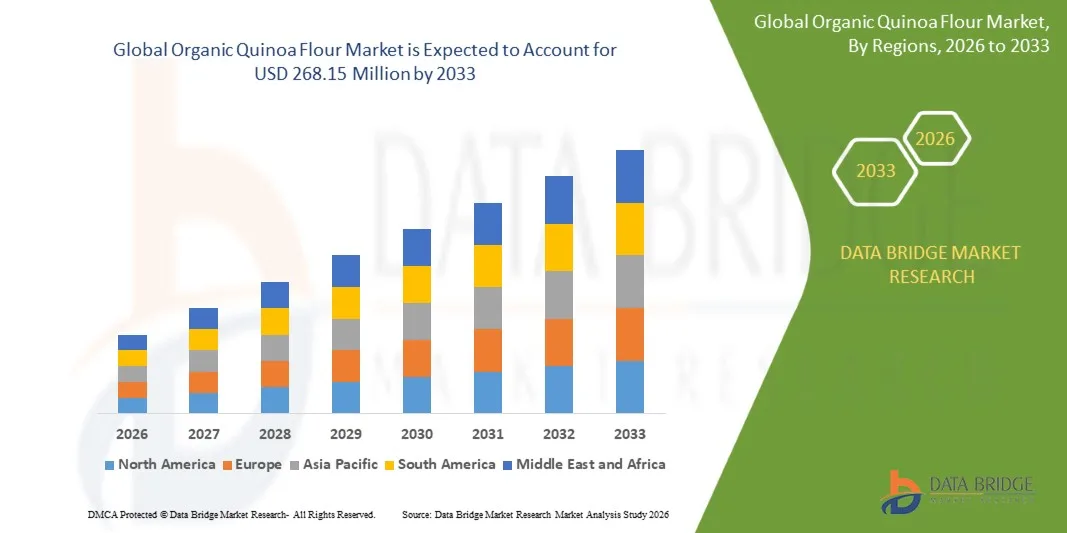
- As per Data Bridge Market Research analysis, the organic quinoa flour market was valued at USD 168.24 million in 2025 and is projected to reach USD 268.15 million by 2033, growing at a CAGR of 6.00% from 2026 to 2033.
- The market is experiencing steady growth driven by rising demand for gluten-free and high-protein ingredients, expanding clean-label product development, and wider use of ancient grains across bakery, snack, pasta, infant nutrition, and foodservice applications.
- The increasing shift toward plant-based diets, allergen-friendly formulations, and certified organic sourcing, combined with growing availability of specialty flours through retail and online channels, is supporting market adoption. Organic quinoa flour is being applied across gluten-free bakery and snack formulations, plant-based protein-enriched foods, and nutrition-focused products, offering manufacturers and home bakers a naturally gluten-free, nutrient-dense alternative to refined wheat flour.
Market Size & Forecast
- Global Market Value (2025): USD 168.24 Million
- Expected Market Value (2033): USD 268.15 Million
- Forecast CAGR (2026–2033): 6.00%
- Absolute Market Expansion (2025–2033): USD 99.91 Million
- Growth Multiple (2025–2033): 1.59x
- Leading Region in 2025: North America
- Fastest Growing Region: Asia Pacific
What are the Major Takeaways of the Organic Quinoa Flour Market?
- North America dominated the organic quinoa flour market with the largest revenue share of 37.40% in 2025, supported by strong demand for gluten-free foods, established organic retail networks, and high consumption of ancient-grain products.
- Asia-Pacific is expected to be the fastest-growing region at a CAGR of 7.90% from 2026 to 2033, fueled by rising health awareness, growing urban middle-class demand, and expanding availability of imported organic ingredients.
- The white quinoa flour segment led the type category with a 52.80% share in 2025, driven by its mild flavor, light color, and wide compatibility with baking and snack formulations.
- Red quinoa flour is the fastest-growing type, projected to register a CAGR of 7.40%, reflecting demand for higher-fiber, nuttier-tasting flours in premium and artisanal products.
- The business-to-business channel dominated the distribution category with a 61.50% revenue share in 2025, led by bulk purchasing by food manufacturers, bakeries, and private-label brands.
- Bakery & confectionery accounted for 43.20% of the market share in 2025, preferred by increasing use of quinoa flour in gluten-free breads, cookies, muffins, and flour blends.
- The snacks & cereals segment is the fastest-growing application category, with a CAGR of 7.20%, driven by rising demand for high-protein, clean-label crackers, bars, puffs, and breakfast cereals.
Report Scope and Organic Quinoa Flour Market Segmentation
|
Attributes |
Organic Quinoa Flour Key Market Insights |
|
Segments Covered |
|
|
Countries Covered |
North America
Europe
Asia-Pacific
Middle East and Africa
South America
|
|
Key Market Players |
|
|
Market Opportunities |
|
|
Value Added Data Infosets |
In addition to the insights on market scenarios such as market value, growth rate, segmentation, geographical coverage, and major players, the market reports curated by the Data Bridge Market Research also include in-depth expert analysis, pricing analysis, brand share analysis, consumer survey, demography analysis, supply chain analysis, value chain analysis, raw material/consumables overview, vendor selection criteria, PESTLE Analysis, Porter Analysis, and regulatory framework. |
What is the Key Trend in the Organic Quinoa Flour Market?
- Organic quinoa flour is evolving from a niche health-food ingredient into a functional baking and snacking input, as manufacturers combine whole-grain, sprouted, and fermented formats to improve nutrition, flavor, and shelf stability in gluten-free products.
- For instance, in 2019, according to Chemical Engineering Transactions, researchers reported that quinoa flour contains about 14.00% protein, 7.00% lipid, and 2.00% ash, that proteomic and immunoassay analyses detected no gluten, and that in-vitro digestion tests showed high digestibility, supporting its use as a nutritious wheat-free bread ingredient.
- Processing innovation, including germination, sprouting, and sourdough fermentation, is helping address the bitterness, texture, and functionality limits that have historically restricted the share of quinoa flour in commercial recipes.
- Supply-chain diversification is another visible shift, with North American vertically integrated quinoa milling emerging alongside traditional Andean sourcing to offer food manufacturers more reliable, traceable organic supply.
- For instance, in July 2021, according to Fermentation (MDPI), researchers replaced 20.00% of the rice flour in gluten-free bread with quinoa flour alternatives; quinoa sourdough raised bread protein to 9.82% versus 2.70% in control breads and extended shelf-life to up to six days, demonstrating the value of fermentation in quinoa-based formulations.
- As consumers continue to prioritize protein, clean labels, and allergen-friendly diets, organic quinoa flour is expected to expand beyond gluten-free bakery into snacks, pasta, infant nutrition, and plant-based ready meals.
What are the Key Drivers of the Organic Quinoa Flour Market?
- Growing prevalence of gluten-related disorders and the wider adoption of gluten-free and flexitarian diets are increasing demand for naturally gluten-free flours that deliver more protein and fiber than rice or corn flour.
- For instance, in 2016, according to the Journal of Cereal Science, researchers developing gluten-free bread from quinoa, buckwheat, rice flour, and potato starch found that a 25.00% quinoa flour formulation delivered higher sensory scores and a softer texture, without significant differences in bake loss, specific volume, or protein content.
- Food manufacturers are reformulating bakery, snack, and pasta products with ancient grains to meet clean-label expectations, differentiate premium ranges, and support protein-forward nutrition claims on pack.
- For instance, in December 2020, according to Food Business News, Ingredion launched HOMECRAFT Quinoa 112 flour in the U.S. and Canada, milled from a proprietary waxy variety of golden quinoa and grown, harvested, and milled in a vertically integrated Canadian operation, giving manufacturers a gluten-free alternative to rice and corn ingredients.
- With certified organic supply, expanding specialty retail, and rapid growth of online grocery channels, organic quinoa flour is becoming easier for both industrial buyers and household bakers to source across developed and emerging markets.
What Factors Are Challenging the Growth of the Organic Quinoa Flour Market?
- Quinoa flour has a distinct earthy flavor and lacks gluten, which can limit the proportion that manufacturers can use without compromising volume, crumb structure, and consumer acceptance in baked products.
- For instance, in July 2021, according to Fermentation (MDPI), gluten-free rice breads in which quinoa flour replaced 20.00% of rice flour reached a protein content of 9.61% but showed poor texture attributes and were the least preferred by consumers among the tested formulations.
- Organic certification, Andean sourcing concentration, and weather-dependent harvests can raise ingredient costs and create price volatility, making organic quinoa flour more expensive than wheat, rice, or corn flour.
- Saponin removal, milling quality, and rancidity risk from the flour's lipid content require careful processing and storage, adding technical and logistical requirements for producers and distributors.
- For instance, according to the Journal of Food and Dairy Sciences, a study replacing rice flour with quinoa flour in gluten-free pan bread found that bread volume and specific volume decreased as quinoa levels rose, and samples with 75.00% and 100.00% quinoa flour scored significantly lower on sensory properties.
- The combination of higher prices, formulation limits, and competition from other gluten-free flours such as rice, sorghum, buckwheat, and chickpea can constrain adoption among cost-sensitive manufacturers and consumers.
How is the Organic Quinoa Flour Market Segmented?
The organic quinoa flour market is segmented on the basis of type, distribution channel, application, and end user.
- By Type
On the basis of type, the organic quinoa flour market is segmented into white, red, and black. The white quinoa flour segment dominated the market with 52.80% share in 2025, supported by its mild taste, light color, and versatility across baking, snack, and pasta applications. White quinoa is the most widely cultivated variety, which supports stable supply and competitive pricing for industrial buyers. Its neutral flavor allows manufacturers to blend it into gluten-free flour mixes without strongly altering taste. Wide availability of certified organic white quinoa from Andean and North American growers further strengthens demand.
The red quinoa flour segment is projected to register the fastest growth at a CAGR of 7.40% from 2026 to 2033, driven by increasing demand for higher-fiber, antioxidant-rich, and visually distinctive flours. Red quinoa flour offers a nuttier flavor and deeper color that suit artisanal breads, crackers, and premium snack products. Brands are using red and black varieties to create differentiated, colorful ancient-grain ranges. Growing interest in tri-color blends and specialty flours is creating additional opportunities. Improvements in milling and de-bittering processes are also helping expand use of darker varieties.
- By Distribution Channel
On the basis of distribution channel, the organic quinoa flour market is segmented into business-to-business, supermarkets & hypermarkets, specialty & health food stores, and online. The business-to-business segment dominated the market with 61.50% share in 2025, supported by bulk procurement by food manufacturers, bakeries, and private-label brands. Industrial buyers value consistent specifications, organic certification, traceability, and long-term supply contracts. Direct sourcing relationships with milling companies and ingredient distributors help manufacturers manage price volatility and quality. Rising reformulation of gluten-free and high-protein products continues to support large-volume purchases through this channel.
The online segment is projected to register the fastest growth at a CAGR of 8.20% from 2026 to 2033, supported by increasing e-commerce penetration of health foods and specialty baking ingredients. Online platforms allow smaller brands and home bakers to access a wider range of organic and gluten-free flours than local stores. Subscription models, bulk packs, and direct-to-consumer offers are improving repeat purchases. Product information on certifications, nutrition, and recipes helps consumers evaluate unfamiliar flours. Expanding cross-border e-commerce is also improving availability in emerging markets.
- By Application
On the basis of application, the organic quinoa flour market is segmented into bakery & confectionery, snacks & cereals, pasta & noodles, infant & clinical nutrition, and others. The bakery & confectionery segment dominated the application category with 43.20% share in 2025, supported by increasing use of quinoa flour in gluten-free breads, muffins, cookies, and flour blends. Quinoa flour improves the protein, fiber, and mineral profile of baked goods compared with refined starches. Bakeries use it in blends to balance nutrition, flavor, and texture. Growth of gluten-free and wellness-focused bakery ranges in retail and cafés is further strengthening demand.
The snacks & cereals segment is projected to register the fastest growth at a CAGR of 7.20% from 2026 to 2033, driven by rising demand for high-protein, clean-label, and gluten-free convenience foods. Quinoa flour is increasingly used in extruded puffs, crackers, bars, chips, and breakfast cereals. It supports protein claims and ancient-grain positioning on pack. Manufacturers value its compatibility with extrusion and baking processes. Growing consumption of on-the-go snacks, particularly among younger and health-conscious consumers, is creating additional opportunities across retail and e-commerce.
- By End User
On the basis of end user, the organic quinoa flour market is segmented into food manufacturers, foodservice, and households. The food manufacturers segment dominated the end-user category with 57.60% share in 2025, supported by large-scale incorporation of quinoa flour into packaged bakery, snack, and pasta products. Manufacturers use it to meet gluten-free, plant-based, and protein-enriched claims. Long-term supply agreements with growers and millers help secure organic volumes. Rising investment in gluten-free product development and clean-label reformulation continues to strengthen demand from this segment.
The households segment is projected to register the fastest growth at a CAGR of 7.10% from 2026 to 2033, driven by increasing home baking, rising awareness of gluten intolerance, and wider availability of organic flours in retail and online stores. Consumers are using quinoa flour in pancakes, breads, and flour blends as a nutritious substitute for wheat flour. Recipe content on social media and food blogs is helping familiarize consumers with its use. Smaller pack sizes and premium organic labeling are also encouraging trial among health-conscious households.
Which Region Holds the Largest Share of the Organic Quinoa Flour Market?
- North America dominated the organic quinoa flour market with the largest revenue share of 37.40% in 2025, supported by strong demand for gluten-free foods, established organic retail networks, and high consumption of ancient-grain products.
- The region also benefits from the presence of leading ingredient companies, domestic quinoa cultivation and milling capacity, and rapid growth of gluten-free bakery and snack categories. Increasing use of quinoa flour by food manufacturers, specialty retailers, and online sellers continues to strengthen North America's position in the global market.
U.S. Organic Quinoa Flour Market Insight
The U.S. organic quinoa flour market is witnessing strong growth due to rising demand for gluten-free, high-protein, and clean-label foods across bakery, snack, and household applications. The country's mature organic retail ecosystem, along with the presence of leading flour brands and ingredient suppliers, is driving demand for certified organic quinoa flour. In addition, growing consumer interest in plant-based nutrition, celiac and gluten-sensitivity awareness, and online grocery shopping is accelerating adoption across retail and food manufacturing channels.
Asia-Pacific Organic Quinoa Flour Market Insight
The Asia-Pacific organic quinoa flour market is expected to witness rapid growth, driven by rising health awareness, growing urban incomes, and expanding availability of imported organic ingredients across countries such as China, Japan, and India. Increasing demand for gluten-free, high-protein, and superfood-based products is supporting regional market expansion. In addition, the rapid growth of e-commerce platforms and modern retail formats is improving consumer access to specialty flours.
Japan Organic Quinoa Flour Market Insight
The Japan organic quinoa flour market is witnessing consistent growth due to strong consumer focus on health, functional foods, and premium natural ingredients. Bakeries, specialty food brands, and health-conscious households are increasingly adopting quinoa flour in breads, confectionery, and nutrition products. Moreover, strict quality expectations, demand for traceable organic supply, and a growing market for gluten-free and allergen-friendly foods are further contributing to market growth in Japan.
China Organic Quinoa Flour Market Insight
The China organic quinoa flour market is growing rapidly, driven by rising middle-class spending on health foods, expanding cross-border e-commerce, and increasing interest in ancient grains and plant-based protein. Food manufacturers and online brands are introducing quinoa-based flours, cereals, and snacks aimed at urban consumers. In addition, growing awareness of dietary fiber and balanced nutrition is positioning China as a key growth market for organic quinoa flour across Asia-Pacific.
U.K. Organic Quinoa Flour Market Insight
The U.K. organic quinoa flour market is experiencing steady growth, supported by increasing adoption of gluten-free and plant-based diets, strong specialty and health-food retail, and growing home-baking culture. Retailers, independent bakeries, and online sellers are expanding ranges of ancient-grain flours, including quinoa. Furthermore, rising consumer interest in provenance, organic certification, and sustainable sourcing is supporting wider adoption of quinoa flour products in the U.K.
Germany Organic Quinoa Flour Market Insight
The Germany organic quinoa flour market is expanding steadily due to the country's well-developed organic food sector, strong health-food retail, and growing demand for gluten-free products. Organic food brands, bakeries, and baking-mix producers are increasingly using quinoa flour to broaden premium and specialty ranges. Continuous product innovation, high consumer awareness of organic labeling, and strong ingredient and baking technology expertise are further driving market growth in the country.
Which are the Top Companies in Organic Quinoa Flour Market?
The organic quinoa flour industry is primarily led by well-established companies, including:
- Bob's Red Mill Natural Foods (U.S.)
- Ancient Harvest (Quinoa Corporation) (U.S.)
- Ingredion Incorporated (U.S.)
- The Hain Celestial Group, Inc. (U.S.)
- Ardent Mills (U.S.)
- Lundberg Family Farms (U.S.)
- Pereg Gourmet (U.S.)
- Alter Eco (U.S.)
- Shiloh Farms (U.S.)
- Northern Quinoa Production Corporation (Canada)
- Nature's Path Foods (Canada)
- Doves Farm Foods Ltd (U.K.)
- Hodmedod's (U.K.)
- Dr. Schär AG/SPA (Italy)
- Rapunzel Naturkost GmbH (Germany)
- Bauckhof GmbH (Germany)
- DeutscheBack GmbH & Co. KG (Germany)
- Irupana Andean Organic Food (Bolivia)
- Inca's Food (Peru)
- Andean Naturals, Inc. (U.S.)
What are Latest Developments in Organic Quinoa Flour Market?
- In December 2020, Ingredion Incorporated launched HOMECRAFT Quinoa 112 flour in the U.S. and Canada, expanding its plant-based protein range. The flour is milled from a proprietary waxy variety of golden quinoa and is grown, harvested, and milled in a vertically integrated Canadian operation, supporting gluten-free baking, snacks, pasta, and pet food applications.
- In May 2020, Ingredion announced an exclusive commercial agreement with Northern Quinoa Production Corporation to distribute and market NorQuin's quinoa flours, strengthening the availability of North American-grown quinoa ingredients for food manufacturers.
- In 2013, DeutscheBack GmbH & Co. KG introduced three baking premixes, TopBake Quinoa Bread, TopSweet Quinoa Poundcake, and TopSweet Quinoa CupCake, enabling bakeries to use 10.00% quinoa flour with wheat flour without compromising volume or crumb texture, inspired by the United Nations naming 2013 the International Year of Quinoa.
- Lundberg Family Farms launched Organic Antique White Quinoa, backed by more than two million pounds of domestically grown organic quinoa sourced from growers across the Pacific Coast and Northwest regions, as reported by Nosh, supporting domestic organic quinoa supply.
- Pereg Gourmet extended its gluten-free flour range with six new varieties, including almond, banana, buckwheat, chickpea, coconut, and farro flours, and received the Whole Grains Council 100 Percent Whole Grain Stamp for its quinoa mixes, as reported by FSR Magazine, broadening ancient-grain and gluten-free flour choices.

- Interactive Data Analysis Dashboard
- Company Analysis Dashboard for high growth potential opportunities
- Research Analyst Access for customization & queries
- Competitor Analysis with Interactive dashboard
- Latest News, Updates & Trend analysis
- Harness the Power of Benchmark Analysis for Comprehensive Competitor Tracking
Global Organic Quinoa Flour Market, Supply Chain Analysis and Ecosystem Framework
To support market growth and help clients navigate the impact of geopolitical shifts, DBMR has integrated in-depth supply chain analysis into its Global Organic Quinoa Flour Market research reports. This addition empowers clients to respond effectively to global changes affecting their industries. The supply chain analysis section includes detailed insights such as Global Organic Quinoa Flour Market consumption and production by country, price trend analysis, the impact of tariffs and geopolitical developments, and import and export trends by country and HSN code. It also highlights major suppliers with data on production capacity and company profiles, as well as key importers and exporters. In addition to research, DBMR offers specialized supply chain consulting services backed by over a decade of experience, providing solutions like supplier discovery, supplier risk assessment, price trend analysis, impact evaluation of inflation and trade route changes, and comprehensive market trend analysis.
Data collection and base year analysis are done using data collection modules with large sample sizes. The stage includes obtaining market information or related data through various sources and strategies. It includes examining and planning all the data acquired from the past in advance. It likewise envelops the examination of information inconsistencies seen across different information sources. The market data is analysed and estimated using market statistical and coherent models. Also, market share analysis and key trend analysis are the major success factors in the market report. To know more, please request an analyst call or drop down your inquiry.
The key research methodology used by DBMR research team is data triangulation which involves data mining, analysis of the impact of data variables on the market and primary (industry expert) validation. Data models include Vendor Positioning Grid, Market Time Line Analysis, Market Overview and Guide, Company Positioning Grid, Patent Analysis, Pricing Analysis, Company Market Share Analysis, Standards of Measurement, Global versus Regional and Vendor Share Analysis. To know more about the research methodology, drop in an inquiry to speak to our industry experts.
Data Bridge Market Research is a leader in advanced formative research. We take pride in servicing our existing and new customers with data and analysis that match and suits their goal. The report can be customized to include price trend analysis of target brands understanding the market for additional countries (ask for the list of countries), clinical trial results data, literature review, refurbished market and product base analysis. Market analysis of target competitors can be analyzed from technology-based analysis to market portfolio strategies. We can add as many competitors that you require data about in the format and data style you are looking for. Our team of analysts can also provide you data in crude raw excel files pivot tables (Fact book) or can assist you in creating presentations from the data sets available in the report.