


Global Orthodontic Brackets Market
Market Size in USD Billion
CAGR :
% 
 USD
1.80 Billion
USD
3.58 Billion
2025
2033
USD
1.80 Billion
USD
3.58 Billion
2025
2033
 Forecast Period Forecast Period |
2026 –2033 |
 Market Size (Base Year) Market Size (Base Year) |
USD 1.80 Billion |
 Market Size (Forecast Year) Market Size (Forecast Year) |
USD 3.58 Billion |
 CAGR CAGR |
% |
| Major Markets Players |
|
Orthodontic Brackets Market Size
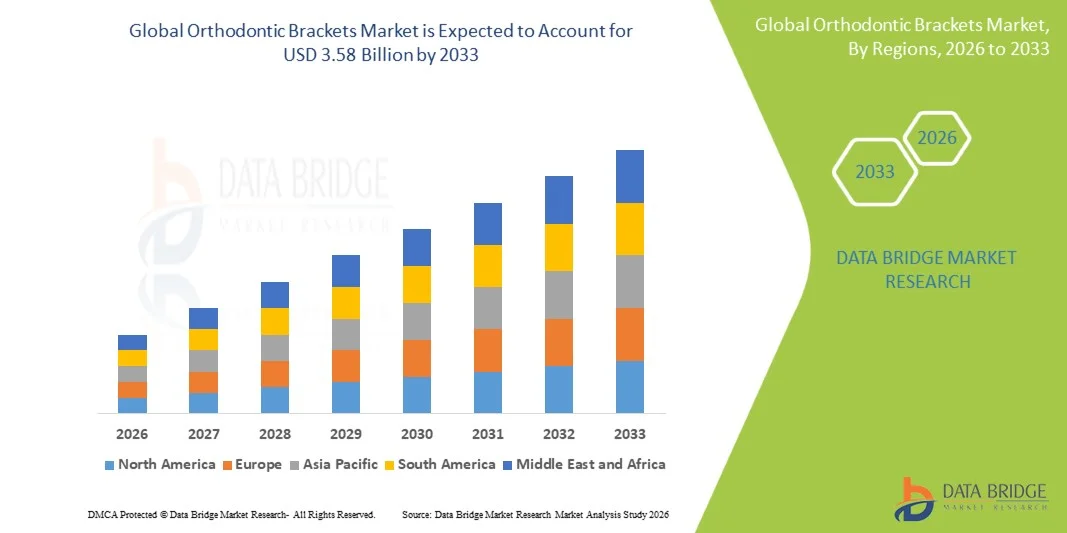
- The global orthodontic brackets market size was valued at USD 1.80 billion in 2025 and is expected to reach USD 3.58 billion by 2033, at a CAGR of 9.00% during the forecast period
- The market growth is largely fueled by the increasing prevalence of dental malocclusion and rising awareness regarding orthodontic treatments, leading to greater adoption of corrective dental procedures across both adolescents and adults
- Furthermore, growing demand for aesthetically appealing orthodontic solutions, such as ceramic and self-ligating brackets, along with advancements in dental technologies and materials, is establishing orthodontic brackets as a preferred treatment option. These converging factors are accelerating the uptake of orthodontic solutions, thereby significantly boosting the industry's growth
Orthodontic Brackets Market Analysis
- Orthodontic brackets, used as key components in fixed dental appliances for correcting teeth alignment and malocclusion, are increasingly essential in modern orthodontic treatments across both clinical and cosmetic dentistry due to their effectiveness, durability, and compatibility with advanced orthodontic techniques
- The escalating demand for orthodontic brackets is primarily fueled by the rising prevalence of dental disorders, increasing awareness of oral health, and a growing preference for aesthetic dental treatments among both adolescents and adults
- North America dominated the orthodontic brackets market with the largest revenue share of 40.2% in 2025, characterized by advanced dental healthcare infrastructure, high treatment affordability, and a strong presence of leading orthodontic product manufacturers, with the U.S. witnessing significant demand driven by cosmetic dentistry trends and technological advancements in bracket materials
- Asia-Pacific is expected to be the fastest growing region in the orthodontic brackets market during the forecast period due to increasing dental awareness, expanding healthcare access, and rising disposable incomes across emerging economies such as China and India
- Metallic Brackets segment dominated the orthodontic brackets market with a market share of 50.7% in 2025, driven by their cost-effectiveness, high strength, and widespread adoption in conventional orthodontic treatments
Report Scope and Orthodontic Brackets Market Segmentation
|
Attributes |
Orthodontic Brackets Key Market Insights |
|
Segments Covered |
|
|
Countries Covered |
North America
Europe
Asia-Pacific
Middle East and Africa
South America
|
|
Key Market Players |
|
|
Market Opportunities |
|
|
Value Added Data Infosets |
In addition to the insights on market scenarios such as market value, growth rate, segmentation, geographical coverage, and major players, the market reports curated by the Data Bridge Market Research also include in-depth expert analysis, patient epidemiology, pipeline analysis, pricing analysis, and regulatory framework |
Orthodontic Brackets Market Trends
“Rising Demand for Aesthetic and Advanced Orthodontic Solutions”
- A significant and accelerating trend in the global orthodontic brackets market is the increasing preference for aesthetic and technologically advanced orthodontic solutions such as ceramic, self-ligating, and lingual brackets. This shift is significantly enhancing patient comfort, treatment efficiency, and overall satisfaction
- For instance, ceramic brackets and self-ligating systems are widely adopted for their tooth-colored appearance and reduced friction, allowing more discreet and efficient orthodontic treatments. Similarly, lingual brackets are placed behind the teeth, offering an invisible treatment option for patients seeking aesthetic appeal
- Technological advancements in orthodontic brackets enable features such as improved material strength, reduced treatment time, and enhanced precision in tooth movement. For instance, self-ligating brackets eliminate the need for elastic ties, reducing friction and improving oral hygiene. Furthermore, advancements in bracket design offer patients greater comfort and fewer clinical visits
- The integration of orthodontic brackets with digital orthodontics and 3D imaging technologies facilitates precise treatment planning and customization. Through digital workflows, orthodontists can design and monitor treatment more effectively, creating a personalized and efficient orthodontic experience
- This trend towards more aesthetic, efficient, and patient-centric orthodontic solutions is fundamentally reshaping patient expectations for dental treatments. Consequently, companies such as 3M and Dentsply Sirona are developing advanced bracket systems with improved materials and treatment outcomes
- The demand for orthodontic brackets that offer aesthetic appeal and technological advancements is growing rapidly across both developed and emerging markets, as patients increasingly prioritize comfort, appearance, and treatment efficiency
- The growing influence of social media and rising awareness about dental aesthetics are encouraging more individuals to seek orthodontic treatments, thereby supporting market expansion
Orthodontic Brackets Market Dynamics
Driver
“Growing Demand Due to Rising Dental Disorders and Cosmetic Dentistry Adoption”
- The increasing prevalence of dental malocclusion and oral health disorders, coupled with the growing adoption of cosmetic dentistry, is a significant driver for the heightened demand for orthodontic brackets
- For instance, in March 2024, Align Technology announced advancements in digital orthodontic solutions, supporting integrated treatment planning alongside traditional bracket systems. Such strategies by key companies are expected to drive the orthodontic brackets industry growth in the forecast period
- As patients become more aware of dental aesthetics and oral health, orthodontic brackets offer effective solutions for correcting misaligned teeth, improving both functionality and appearance, making them a preferred treatment option
- Furthermore, the growing popularity of aesthetic dental treatments and increasing access to orthodontic care are making brackets an essential component of modern dentistry, offering compatibility with various treatment approaches
- The affordability of conventional metal brackets, availability of advanced variants, and increasing number of orthodontic clinics are key factors propelling the adoption of orthodontic brackets in both developed and developing regions. The trend towards early orthodontic intervention and rising dental tourism further contribute to market growth
- Government initiatives and healthcare programs aimed at improving oral health awareness are further supporting the adoption of orthodontic treatments globally
- The expanding base of trained orthodontic professionals and dental specialists is improving treatment accessibility, thereby driving market growth
Restraint/Challenge
“High Treatment Costs and Patient Discomfort Concerns”
- Concerns surrounding the high cost of orthodontic treatments and patient discomfort associated with brackets pose a significant challenge to broader market penetration. As orthodontic procedures often require long treatment durations, they can be financially and physically burdensome for patients
- For instance, reports of discomfort, oral irritation, and maintenance challenges during bracket-based treatments have made some patients hesitant to opt for traditional orthodontic solutions
- Addressing these concerns through improved bracket designs, enhanced patient comfort, and shorter treatment durations is crucial for increasing adoption. Companies such as 3M and Ormco emphasize advanced materials and ergonomic designs in their products to improve patient experience. In addition, the availability of alternative treatments such as clear aligners can act as a restraint for traditional bracket adoption, particularly among adult patients seeking less visible options
- While advancements are improving comfort and efficiency, the perceived inconvenience of fixed orthodontic appliances can still hinder widespread adoption, especially among working professionals and image-conscious individuals
- Overcoming these challenges through technological innovation, cost optimization, and increased awareness regarding long-term dental benefits will be vital for sustained market growth
- Limited insurance coverage for orthodontic procedures in several regions can restrict patient affordability and slow market penetration
- Stringent regulatory requirements and approval processes for dental devices may delay product launches and innovation in the market
Orthodontic Brackets Market Scope
The market is segmented on the basis of material, size type, ligation type, shape type, and end-user.
- By Material
On the basis of material, the orthodontic brackets market is segmented into metallic brackets, aesthetic brackets, and combination. The metallic brackets segment dominated the market with the largest market revenue share of 50.7% in 2025, driven by their high strength, cost-effectiveness, and widespread adoption in conventional orthodontic treatments. Metallic brackets are preferred for their durability and ability to withstand significant orthodontic forces, making them suitable for complex dental corrections. Their affordability compared to other materials makes them accessible to a larger patient population, particularly in developing regions. In addition, continuous advancements in stainless steel quality and reduced bracket size have improved patient comfort. The strong presence of metallic brackets in public healthcare and insurance-supported treatments further supports their dominance.
The aesthetic brackets segment is anticipated to witness the fastest growth rate from 2026 to 2033, fueled by increasing demand for visually appealing orthodontic solutions. Aesthetic brackets, including ceramic and clear brackets, offer a more discreet appearance, making them highly attractive among adult patients and working professionals. Growing awareness about dental aesthetics and rising disposable incomes are contributing to their adoption. Technological advancements have improved their strength and reduced brittleness, addressing earlier limitations. Furthermore, increasing influence of cosmetic dentistry trends and social media awareness is accelerating the demand for aesthetic orthodontic solutions globally.
- By Size Type
On the basis of size type, the orthodontic brackets market is segmented into large, mini, and ultramini. The mini segment dominated the market with the largest revenue share in 2025, driven by its optimal balance between strength and patient comfort. Mini brackets are widely preferred by orthodontists due to their smaller profile, which reduces irritation and enhances patient experience compared to larger brackets. Their compatibility with various orthodontic techniques and ease of placement further support their widespread use. In addition, mini brackets offer effective tooth control while maintaining treatment efficiency, making them suitable for a wide range of cases. The growing emphasis on patient comfort without compromising performance has strengthened their dominance in the market.
The ultramini segment is expected to witness the fastest growth rate from 2026 to 2033, driven by increasing demand for minimally visible and comfortable orthodontic solutions. Ultramini brackets provide enhanced aesthetics and reduced discomfort due to their compact size. They are particularly favored by adult patients seeking less noticeable treatment options. Advancements in manufacturing technologies have enabled the production of smaller yet highly durable brackets. Furthermore, orthodontists are increasingly adopting ultramini brackets to improve patient compliance and satisfaction, contributing to their rapid growth.
- By Ligation Type
On the basis of ligation type, the orthodontic brackets market is segmented into conventional ligation and self-ligating brackets. The conventional ligation segment dominated the market with the largest share in 2025, driven by its long-standing use, affordability, and widespread availability. Conventional brackets use elastic or metal ties to hold the archwire in place, making them a familiar and reliable option for orthodontists. Their lower cost compared to self-ligating systems makes them accessible to a broader patient base. In addition, they offer flexibility in treatment adjustments, which is beneficial in complex orthodontic cases. The extensive adoption of conventional systems in developing regions further contributes to their dominance.
The self-ligating brackets segment is anticipated to witness the fastest growth rate from 2026 to 2033, fueled by their ability to reduce friction and shorten treatment time. These brackets eliminate the need for elastic ties, improving oral hygiene and reducing the frequency of clinical visits. Increasing preference for efficient and low-maintenance orthodontic treatments is driving their adoption. Technological advancements have enhanced their performance and reliability. Furthermore, growing awareness among patients regarding advanced orthodontic options is supporting the rapid growth of this segment.
- By Shape Type
On the basis of shape type, the orthodontic brackets market is segmented into wide and round. The wide segment dominated the market with the largest revenue share in 2025, driven by its ability to provide better control over tooth movement and improved rotational stability. Wide brackets offer increased surface area for bonding, enhancing their adherence to teeth and reducing the risk of detachment. They are particularly useful in complex orthodontic cases requiring precise alignment. Orthodontists prefer wide brackets for their effectiveness in maintaining archwire positioning and delivering consistent treatment outcomes. Their reliability and efficiency in clinical practice contribute to their strong market presence.
The round segment is expected to witness the fastest growth rate from 2026 to 2033, driven by increasing demand for comfort-oriented orthodontic solutions. Round brackets are designed to reduce friction and improve patient comfort during treatment. Their smoother edges minimize irritation to oral tissues, making them suitable for long-term use. Advancements in bracket design have improved their functionality and treatment efficiency. In addition, rising patient preference for less intrusive orthodontic appliances is supporting the growth of this segment.
- By End-User
On the basis of end-user, the orthodontic brackets market is segmented into hospitals, dental clinics, and others. The dental clinics segment dominated the market with the largest revenue share in 2025, driven by the high volume of orthodontic procedures performed in specialized dental settings. Dental clinics offer dedicated orthodontic services, advanced equipment, and experienced professionals, making them the primary choice for patients. The increasing number of private dental clinics and orthodontic centers globally further supports this dominance. In addition, shorter waiting times and personalized care enhance patient preference for clinics over hospitals. The growing trend of outpatient dental procedures also contributes to this segment’s leadership.
The hospitals segment is anticipated to witness the fastest growth rate from 2026 to 2033, fueled by the expansion of dental departments within multi-specialty hospitals. Hospitals are increasingly offering comprehensive dental and orthodontic services, attracting patients seeking integrated healthcare solutions. Rising investments in healthcare infrastructure and the availability of advanced diagnostic technologies are supporting this growth. In addition, hospitals are preferred for complex cases requiring multidisciplinary care. The growing focus on improving oral healthcare services in hospital settings is further driving the expansion of this segment.
Orthodontic Brackets Market Regional Analysis
- North America dominated the orthodontic brackets market with the largest revenue share of 40.2% in 2025, characterized by advanced dental healthcare infrastructure, high treatment affordability, and a strong presence of leading orthodontic product manufacturers
- Consumers in the region highly value the effectiveness, improved treatment outcomes, and availability of advanced bracket options such as ceramic and self-ligating systems, along with access to specialized orthodontic care
- This widespread adoption is further supported by advanced dental healthcare infrastructure, high disposable incomes, and a strong presence of key market players, establishing orthodontic brackets as a preferred solution for both functional and cosmetic dental treatments
U.S. Orthodontic Brackets Market Insight
The U.S. orthodontic brackets market captured the largest revenue share within North America in 2025, fueled by the strong demand for advanced orthodontic treatments and the expanding trend of cosmetic dentistry. Patients are increasingly prioritizing the improvement of dental aesthetics and oral health through effective orthodontic solutions. The growing preference for technologically advanced brackets, combined with robust demand for aesthetic options such as ceramic and self-ligating systems, further propels the market. Moreover, the increasing integration of digital orthodontics and 3D imaging technologies is significantly contributing to the market's expansion.
Europe Orthodontic Brackets Market Insight
The Europe orthodontic brackets market is projected to expand at a substantial CAGR throughout the forecast period, primarily driven by increasing awareness of oral health and the escalating demand for aesthetic dental treatments. The rise in aging population, coupled with the need for corrective dental procedures, is fostering the adoption of orthodontic brackets. European patients are also drawn to the effectiveness and improved treatment outcomes these solutions offer. The region is experiencing significant growth across public and private dental care settings, with orthodontic treatments being incorporated into both routine and specialized dental services.
U.K. Orthodontic Brackets Market Insight
The U.K. orthodontic brackets market is anticipated to grow at a noteworthy CAGR during the forecast period, driven by the rising demand for cosmetic dentistry and a desire for improved dental appearance and oral health. In addition, increasing awareness regarding orthodontic care is encouraging both adolescents and adults to opt for corrective treatments. The UK’s well-established dental care system, alongside its growing focus on advanced orthodontic solutions, is expected to continue to stimulate market growth.
Germany Orthodontic Brackets Market Insight
The Germany orthodontic brackets market is expected to expand at a considerable CAGR during the forecast period, fueled by increasing awareness of dental health and the demand for technologically advanced and high-quality orthodontic solutions. Germany’s well-developed healthcare infrastructure, combined with its emphasis on innovation and precision in medical devices, promotes the adoption of orthodontic brackets, particularly in specialized dental clinics. The integration of advanced orthodontic techniques and materials is also becoming increasingly prevalent, aligning with patient expectations for effective and comfortable treatments.
Asia-Pacific Orthodontic Brackets Market Insight
The Asia-Pacific orthodontic brackets market is poised to grow at the fastest CAGR during the forecast period of 2026 to 2033, driven by increasing urbanization, rising disposable incomes, and improving access to dental care in countries such as China, Japan, and India. The region's growing awareness of oral health, supported by government initiatives promoting healthcare access, is driving the adoption of orthodontic treatments. Furthermore, as APAC emerges as a key region for dental service expansion, the affordability and accessibility of orthodontic brackets are expanding to a wider patient base.
Japan Orthodontic Brackets Market Insight
The Japan orthodontic brackets market is gaining momentum due to the country’s advanced healthcare system, rapid urbanization, and demand for high-quality dental care. The Japanese market places a significant emphasis on oral health and aesthetics, and the adoption of orthodontic brackets is driven by the increasing number of patients seeking corrective treatments. The integration of advanced dental technologies and precision-based orthodontic solutions is fueling growth. Moreover, Japan's aging population is likely to spur demand for orthodontic treatments focused on both functional and aesthetic improvements in dental structure.
India Orthodontic Brackets Market Insight
The India orthodontic brackets market accounted for a significant market share in Asia Pacific in 2025, attributed to the country's expanding middle class, rapid urbanization, and increasing awareness of dental health. India stands as one of the fastest-growing markets for dental care services, and orthodontic brackets are becoming increasingly popular in both urban and semi-urban areas. The push towards improved healthcare infrastructure and the availability of cost-effective orthodontic solutions, alongside a growing number of dental professionals, are key factors propelling the market in India.
Orthodontic Brackets Market Share
The Orthodontic Brackets industry is primarily led by well-established companies, including:
- 3M (U.S.)
- Ormco Corporation (U.S.)
- American Orthodontics Corporation (U.S.)
- Dentsply Sirona Inc. (U.S.)
- Henry Schein, Inc. (U.S.)
- Envista Holdings Corporation (U.S.)
- G&H Orthodontics (U.S.)
- Rocky Mountain Orthodontics, Inc. (U.S.)
- TP Orthodontics, Inc. (U.S.)
- Dentaurum GmbH & Co. KG (Germany)
- FORESTADENT Bernhard Förster GmbH (Germany)
- GC Corporation (Japan)
- Tomy Inc. (Japan)
- Shinye Orthodontic Products Co., Ltd. (China)
- Hangzhou Xingchen 3B Dental Instrument & Material Co., Ltd. (China)
- JJ Orthodontics Pvt. Ltd. (India)
- Leone S.p.A. (Italy)
- DB Orthodontics Limited (U.K.)
- Ortho Technology, Inc. (U.S.)
- Great Lakes Dental Technologies (U.S.)
What are the Recent Developments in Global Orthodontic Brackets Market?
- In November 2025, advancements in orthodontic technology introduced the use of 3D printing for fully customized orthodontic brackets, enabling improved precision, reduced treatment time, and enhanced patient comfort. These innovations also incorporate advanced nickel-titanium archwires, reflecting a shift toward highly personalized and efficient orthodontic treatments
- In April 2025, Ormco Corporation, a leading orthodontic solutions provider, announced the launch of its EtchFree Bonding system along with innovations such as Spark BiteSync and Spark Retainers at AAO 2025, aimed at improving bonding efficiency, enamel preservation, and overall orthodontic workflow. This development highlights Ormco’s focus on enhancing clinical outcomes and reducing treatment complexity through advanced orthodontic technologies
- In March 2025, leading orthodontic manufacturers such as Align Technology, Ormco, and 3M expanded their innovation pipelines with developments in AI-driven treatment planning, self-ligating bracket systems, and digitally integrated orthodontic solutions, improving treatment accuracy and patient outcomes. These advancements demonstrate the increasing role of digitalization in orthodontic bracket systems
- In August 2024, KLOwen Orthodontics, a U.S.-based orthodontic technology company, announced the launch of its custom metal self-ligating bracket system, designed to deliver precise tooth control and reduced treatment time through patient-specific customization. This innovation reflects the growing shift toward personalized orthodontic solutions and enhanced clinical efficiency in bracket-based treatments
- In May 2023, 3M, a global leader in healthcare and dental solutions, announced the development of a new biocompatible material for orthodontic brackets aimed at improving patient comfort and durability. This advancement highlights the industry’s focus on material innovation to enhance treatment outcomes and patient experience in fixed orthodontic systems
SKU-
Get online access to the report on the World's First Market Intelligence Cloud

- Interactive Data Analysis Dashboard
- Company Analysis Dashboard for high growth potential opportunities
- Research Analyst Access for customization & queries
- Competitor Analysis with Interactive dashboard
- Latest News, Updates & Trend analysis
- Harness the Power of Benchmark Analysis for Comprehensive Competitor Tracking
Research Methodology
Data collection and base year analysis are done using data collection modules with large sample sizes. The stage includes obtaining market information or related data through various sources and strategies. It includes examining and planning all the data acquired from the past in advance. It likewise envelops the examination of information inconsistencies seen across different information sources. The market data is analysed and estimated using market statistical and coherent models. Also, market share analysis and key trend analysis are the major success factors in the market report. To know more, please request an analyst call or drop down your inquiry.
The key research methodology used by DBMR research team is data triangulation which involves data mining, analysis of the impact of data variables on the market and primary (industry expert) validation. Data models include Vendor Positioning Grid, Market Time Line Analysis, Market Overview and Guide, Company Positioning Grid, Patent Analysis, Pricing Analysis, Company Market Share Analysis, Standards of Measurement, Global versus Regional and Vendor Share Analysis. To know more about the research methodology, drop in an inquiry to speak to our industry experts.
Customization Available
Data Bridge Market Research is a leader in advanced formative research. We take pride in servicing our existing and new customers with data and analysis that match and suits their goal. The report can be customized to include price trend analysis of target brands understanding the market for additional countries (ask for the list of countries), clinical trial results data, literature review, refurbished market and product base analysis. Market analysis of target competitors can be analyzed from technology-based analysis to market portfolio strategies. We can add as many competitors that you require data about in the format and data style you are looking for. Our team of analysts can also provide you data in crude raw excel files pivot tables (Fact book) or can assist you in creating presentations from the data sets available in the report.












