


What is the Malocclusion Market Size and Overview ?
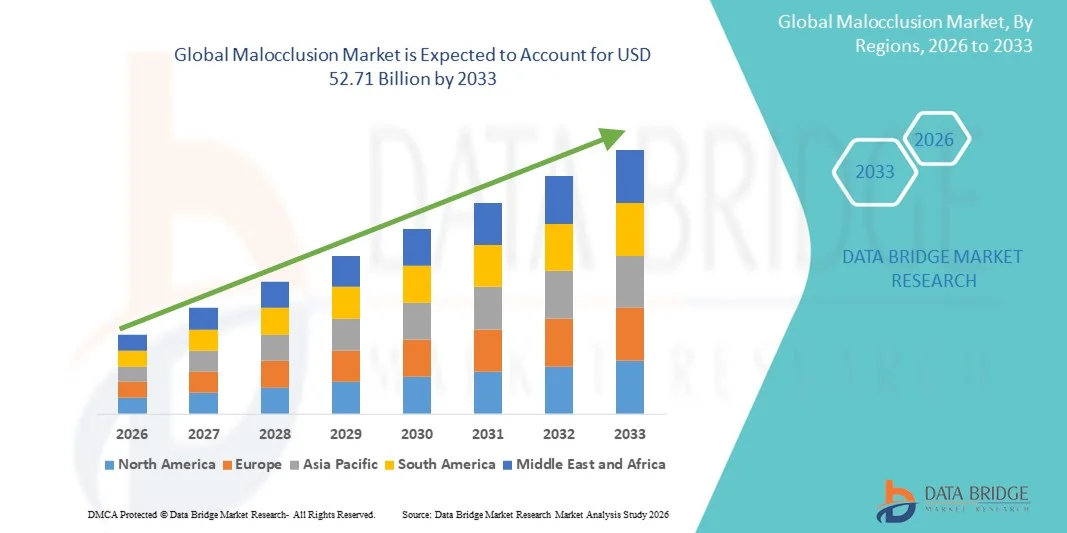
- As per Data Bridge Market Research Analysis the global malocclusion market size was valued at USD 30.52 billion in 2025 and is expected to reach USD 52.71 billion by 2033, at a CAGR of 7.07% during the forecast period
- The market growth is largely driven by increasing awareness of dental health, rising prevalence of malocclusion across all age groups, and growing demand for orthodontic treatments such as braces and aligners
- Furthermore, advancements in digital orthodontics, clear aligner technology, and minimally invasive corrective procedures are enhancing patient compliance and treatment outcomes. These factors are collectively driving the adoption of malocclusion correction solutions, thereby significantly boosting the industry’s growth
Market Size & Forecast
- Global Market Value (2025): USD 30.52 billion
- Expected Market Value (2033): USD 52.71 billion
- Forecast CAGR (2026–2033): 7.07%
What are the Major Takeaways of Malocclusion Market?
- The malocclusion market, covering the diagnosis, correction, and management of misaligned teeth and jaw irregularities, is increasingly essential in both pediatric and adult populations due to its impact on oral health, aesthetics, and overall quality of life
- The escalating demand in the malocclusion market is primarily fueled by rising prevalence of Class I, Class II, and Class III malocclusions, growing awareness of dental health, and increasing preference for orthodontic and surgical correction methods
- North America dominated the malocclusion market with the largest revenue share of 38.5% in 2025, characterized by advanced dental healthcare infrastructure, high awareness of oral health, and strong presence of key market players, with the U.S. witnessing substantial adoption of orthodontic braces and surgical interventions in hospitals and dental clinics
- Asia-Pacific is expected to be the fastest-growing region in the malocclusion market during the forecast period due to increasing dental care awareness, rising disposable incomes, and expanding access to dental clinics and hospitals offering corrective procedures
- Orthodontic braces segment dominated the malocclusion market with a market share of 46.2% in 2025, driven by their effectiveness in correcting various classes of malocclusion and wide availability across hospitals, dental clinics, and specialty centers
Report Scope and Malocclusion Market Segmentation
|
Attributes |
Malocclusion Key Market Insights |
|
Segments Covered |
|
|
Countries Covered |
North America
Europe
Asia-Pacific
Middle East and Africa
South America
|
|
Key Market Players |
|
|
Market Opportunities |
|
|
Value Added Data Infosets |
In addition to the insights on market scenarios such as market value, growth rate, segmentation, geographical coverage, and major players, the market reports curated by the Data Bridge Market Research also include in-depth expert analysis, patient epidemiology, pipeline analysis, pricing analysis, and regulatory framework |
What is the Key Trend in the Malocclusion Market ?
Digital Orthodontics and 3D Imaging Adoption
- A significant and accelerating trend in the global malocclusion market is the growing adoption of digital orthodontics and 3D imaging technologies, which enhance treatment precision and patient experience
- For instance, Invisalign’s ClinCheck software allows orthodontists to create 3D treatment simulations, enabling more accurate planning and customized aligner production
- Digital scanners and imaging systems improve diagnostic accuracy by providing detailed visualization of dental arches and occlusion patterns, reducing manual errors and treatment time
- Integration of AI in treatment planning enables predictive modeling of tooth movement, helping clinicians optimize treatment duration and outcomes
- The rise of tele-orthodontics allows remote monitoring of patient progress, reducing clinic visits and improving convenience for patients
- Increasing demand for minimally invasive and aesthetic solutions, such as clear aligners, is encouraging manufacturers to innovate with faster, more comfortable treatment options
- This trend towards digital, AI-assisted, and minimally invasive orthodontic solutions is reshaping patient expectations, encouraging manufacturers such as Ormco to develop advanced treatment planning tools and customized appliances
- The demand for precise, digitally driven malocclusion solutions is growing rapidly across both hospitals and dental clinics, as patients increasingly prioritize faster, more comfortable, and aesthetically appealing treatment options
Malocclusion Market Dynamics
Driver
Increasing Awareness and Rising Orthodontic Demand
- The growing awareness of oral health and rising prevalence of Class I, II, and III malocclusions are significant drivers of the malocclusion market
- For instance, in March 2025, Align Technology reported increased global adoption of clear aligners due to heightened patient awareness and demand for aesthetic correction
- Patients and caregivers increasingly recognize the functional and cosmetic benefits of early orthodontic interventions, fueling demand for corrective treatments
- The expansion of dental insurance coverage and affordability of orthodontic options are also encouraging adoption across age groups
- The convenience of customized braces, clear aligners, and advanced surgical interventions, combined with the availability of treatment in hospitals and dental clinics, is propelling market growth
- Rising investments by key orthodontic device manufacturers in R&D and digital treatment platforms are driving innovation and adoption across mature and emerging markets
- Increasing collaborations between dental clinics, hospitals, and tele-dentistry platforms are expanding access to malocclusion treatment, further boosting market demand
Restraint/Challenge
High Cost and Limited Access in Emerging Regions
- The relatively high cost of advanced orthodontic treatments, including clear aligners and digital orthodontics, poses a significant challenge to broader market penetration
- For instance, patients in developing regions often face financial barriers to accessing comprehensive malocclusion treatments
- Limited availability of skilled orthodontists and advanced dental facilities in certain regions restricts treatment adoption and market expansion
- Furthermore, long treatment durations and patient compliance requirements can deter some individuals from initiating corrective procedures
- Concerns over potential side effects, such as discomfort or minor oral injuries, may reduce patient willingness to undergo treatment
- Regulatory approvals for newer orthodontic devices and technologies can delay market entry in some regions, limiting product availability
- Overcoming these challenges through cost-effective treatment options, expansion of dental infrastructure, and patient education will be vital for sustained malocclusion market growth
How is the Malocclusion Market Segmented ?
The market is segmented on the basis of class, treatment, and end user.
- By Class
On the basis of class, the malocclusion market is segmented into Class I, Class II, and Class III. The Class I segment dominated the market with the largest revenue share in 2025, driven by its high prevalence among patients seeking orthodontic correction. Class I malocclusion often involves minor crowding or spacing, making it highly treatable with orthodontic braces or aligners, which encourages patient adoption. Dental clinics and hospitals prefer treating Class I cases due to predictable treatment outcomes and shorter duration, increasing the segment’s market share. The segment also benefits from high awareness among patients about cosmetic and functional benefits, leading to consistent demand. Preventive and early interventions in children and adolescents further support the dominance of Class I treatments. The availability of advanced tools for precise alignment also contributes to market leadership.
The Class II segment is anticipated to witness the fastest growth rate from 2026 to 2033, fueled by increasing awareness of complex bite issues and the rising adoption of surgical and non-surgical corrective options. Class II malocclusion often requires more comprehensive orthodontic planning, creating demand for innovative treatment solutions. Advancements in clear aligner technology and digital orthodontics facilitate effective Class II corrections, attracting both adult and pediatric patients. In addition, growing awareness of the functional issues associated with Class II cases, such as jaw pain and speech difficulties, is driving patient demand. Increasing investments by orthodontic device manufacturers to develop solutions tailored for Class II cases further support rapid growth. Expansion of dental infrastructure in emerging markets also contributes to the segment’s accelerated adoption.
- By Treatment
On the basis of treatment, the malocclusion market is segmented into orthodontic braces, surgery, and others. The Orthodontic Braces segment dominated the market in 2025 with a market share of 46.2% due to its widespread acceptance, affordability, and effectiveness in correcting a wide range of malocclusion cases. Braces are preferred by dental professionals for predictable outcomes across Class I, II, and III malocclusions, making them a staple treatment method. The segment benefits from technological innovations such as self-ligating braces and aesthetic options, increasing patient preference. High adoption in both dental clinics and hospitals contributes to consistent market share. Moreover, continuous awareness campaigns and insurance coverage for orthodontic braces enhance market penetration. Braces are also accessible to both adolescents and adults, supporting broad applicability.
The Surgery segment is expected to witness the fastest growth from 2026 to 2033, driven by the increasing prevalence of severe malocclusion cases requiring orthognathic or corrective jaw surgery. Surgical interventions are gaining traction due to technological advancements such as 3D imaging and CAD/CAM surgical guides, improving treatment precision. Rising patient awareness of the functional and aesthetic benefits of surgical correction is fueling adoption. Hospitals with specialized orthodontic and maxillofacial departments are expanding services, enabling higher surgical uptake. The growing trend of combining surgical procedures with orthodontic braces for complex cases also supports rapid growth. In addition, increased insurance coverage for surgical correction in developed markets is facilitating market expansion.
- By End User
On the basis of end user, the malocclusion market is segmented into hospitals & clinics, dental clinics, and others. The Dental Clinics segment dominated the market with the largest revenue share in 2025, driven by high accessibility, patient preference for specialized care, and strong presence of orthodontists. Dental clinics provide personalized treatment options including braces, clear aligners, and minor surgical corrections, making them a preferred choice. The segment benefits from shorter waiting times, convenient locations, and modern infrastructure, encouraging patient visits. Awareness campaigns and aesthetic considerations further boost demand. Dental clinics also cater to both pediatric and adult patients, enhancing overall market share. Continuous introduction of advanced orthodontic devices in dental clinics supports segment dominance.
The Hospitals & Clinics segment is anticipated to witness the fastest growth rate from 2026 to 2033, fueled by increasing complex malocclusion cases requiring multidisciplinary care. Hospitals provide integrated orthodontic, surgical, and diagnostic services, enabling treatment of severe Class II and III malocclusions. Expansion of hospital networks in emerging markets is improving access to advanced care. Technological advancements in hospitals, such as digital imaging and AI-assisted treatment planning, are driving adoption. Rising patient awareness about comprehensive treatment benefits and functional improvements contributes to rapid growth. Partnerships between hospitals and dental device manufacturers for training and equipment supply also enhance market expansion.
Which Region Holds the Largest Share of the Malocclusion Market?
- North America dominated the malocclusion market with the largest revenue share of 38.5% in 2025, characterized by advanced dental healthcare infrastructure, high awareness of oral health, and strong presence of key market players
- Patients and caregivers in the region highly value early diagnosis, effective treatment options, and the availability of technologically advanced solutions such as digital orthodontics and clear aligners
- This widespread adoption is further supported by high disposable incomes, strong presence of experienced orthodontists, and comprehensive dental insurance coverage, establishing orthodontic braces, surgical correction, and other malocclusion treatments as preferred solutions for both pediatric and adult populations
U.S. Malocclusion Market Insight
The U.S. malocclusion market captured the largest revenue share of 82% in 2025 within North America, fueled by rising awareness of oral health, high adoption of advanced orthodontic solutions, and strong dental healthcare infrastructure. Patients increasingly prioritize early diagnosis and treatment of Class I, II, and III malocclusions using orthodontic braces, clear aligners, and surgical interventions. The growing preference for digitally guided orthodontics, tele-orthodontic monitoring, and customized treatment plans further propels market growth. Moreover, insurance coverage for orthodontic treatments and the availability of specialized dental clinics enhance accessibility. The presence of major orthodontic device manufacturers and continuous innovation in treatment solutions significantly contribute to market expansion.
Europe Malocclusion Market Insight
The Europe malocclusion market is projected to expand at a substantial CAGR throughout the forecast period, primarily driven by increasing awareness of dental health and the rising prevalence of malocclusion among children and adults. Urbanization, coupled with growing investments in dental healthcare infrastructure, is fostering the adoption of advanced orthodontic treatments. European patients are also drawn to minimally invasive, aesthetic solutions such as clear aligners. The market is witnessing significant growth across hospitals, dental clinics, and specialty orthodontic centers, with treatments being incorporated into both preventive care and corrective procedures. Increasing focus on pediatric orthodontics and adult cosmetic dentistry supports market expansion.
U.K. Malocclusion Market Insight
The U.K. malocclusion market is anticipated to grow at a noteworthy CAGR during the forecast period, driven by rising demand for aesthetic and functional dental corrections. Growing concerns regarding misaligned teeth, bite issues, and related oral health complications are encouraging both adults and parents of children to seek orthodontic interventions. In addition, high adoption of digital orthodontic solutions, clear aligners, and advanced braces systems is expected to stimulate market growth. The U.K.’s well-established dental insurance and e-health platforms further facilitate access to treatments. Increased awareness campaigns and initiatives by dental associations are also promoting early diagnosis and intervention, boosting overall market demand.
Germany Malocclusion Market Insight
The Germany malocclusion market is expected to expand at a considerable CAGR during the forecast period, fueled by increasing awareness of oral health and preference for technologically advanced orthodontic solutions. Germany’s well-developed healthcare infrastructure, coupled with a high standard of dental care, supports the adoption of orthodontic braces, clear aligners, and surgical treatments. Growing interest in minimally invasive, precise, and aesthetic treatments is driving patient demand, particularly among adolescents and adults. Integration of digital orthodontics and AI-based treatment planning is becoming prevalent. Moreover, government-supported oral health initiatives and professional training programs enhance accessibility and adoption.
Asia-Pacific Malocclusion Market Insight
The Asia-Pacific malocclusion market is poised to grow at the fastest CAGR of 23% during the forecast period of 2026 to 2033, driven by increasing urbanization, rising disposable incomes, and growing awareness of dental health in countries such as China, Japan, and India. The region’s rising middle-class population and expansion of dental clinics and hospitals are supporting market growth. Furthermore, government initiatives promoting oral health, technological adoption in orthodontics, and availability of affordable treatment options are driving malocclusion treatment uptake. Increasing acceptance of clear aligners and digitally guided orthodontic solutions in both pediatric and adult populations is boosting market adoption.
Japan Malocclusion Market Insight
The Japan malocclusion market is gaining momentum due to the country’s high awareness of oral health, technologically advanced dental care facilities, and increasing demand for convenience and aesthetic correction. The Japanese market emphasizes preventive and corrective orthodontic care for both children and adults. Rising adoption of digital orthodontics, AI-assisted treatment planning, and clear aligners is driving growth. In addition, Japan’s aging population is boosting demand for minimally invasive and easy-to-use orthodontic solutions. Hospitals and specialized dental clinics are expanding services to meet the growing need for both functional and cosmetic malocclusion treatments.
India Malocclusion Market Insight
The India malocclusion market accounted for the largest market revenue share in Asia-Pacific in 2025, attributed to the country’s expanding middle class, rising disposable incomes, and increasing awareness of dental health. India is witnessing rapid growth in dental clinics and hospitals offering orthodontic services, including braces, clear aligners, and surgical correction. Government initiatives promoting oral health and the growth of private healthcare infrastructure are key factors driving market expansion. The affordability of treatment options, along with increasing adoption of digital orthodontics and tele-dentistry, is enhancing accessibility. Rising cosmetic dentistry awareness among adults and parents of children further supports market growth.
Which are the Top Companies in Malocclusion Market?
The Malocclusion industry is primarily led by well-established companies, including:
- 3M (U.S.)
- Dentsply Sirona Inc (U.S.)
- Rocky Mountain Orthodontics (U.S.)
- Align Technology, Inc. (U.S.)
- Ormco Corporation (U.S.)
- American Orthodontics (U.S.)
- Dentaurum (Germany)
- G&H Orthodontics (U.S.)
- TP Orthodontics, Inc. (U.S.)
- Envista Holdings Corporation (U.S.)
- Angelalign Technology Inc (China)
- Forestadent (Germany)
- Shanghai IMD (China)
- Zhejiang Protect Medical (China)
- Dental Morelli (Brazil)
- Hangzhou Xingchen 3B Dental (China)
- Hangzhou Shinye (China)
- K Line Europe GmbH (Germany)
- PlusDental (Germany)
- Henry Schein Orthodontics (U.S.)
What are the Recent Developments in Global Malocclusion Market ?
- In July 2025, Align Technology made its Invisalign Palatal Expander System available in India, offering a 3D‑printed device for skeletal and dental expansion as part of early‑interceptive malocclusion treatment, tailored to children and adolescents
- In July 2025, Align Technology expanded the launch of its Invisalign System with Mandibular Advancement featuring Occlusal Blocks across Asia‑Pacific markets (including Singapore, India, Australia, and Japan), enabling wider clinical use of this Class II malocclusion solution outside North America
- In April 2025, Align Technology announced the commercial availability in the U.S. and Canada of its new Invisalign® System with Mandibular Advancement featuring Occlusal Blocks, an innovative clear aligner designed to simultaneously advance the mandible and align teeth for Class II malocclusions at the American Association of Orthodontists (AAO) session
- In May 2024, OrthoFX announced nationwide availability of NiTime™ Clear Aligners, the first FDA‑cleared clear aligner system designed for reduced wear time (9–12 hours) while treating all classes of dental malocclusions, potentially improving patient compliance and predictability compared to traditional aligners
- In May 2024, OrthoFX showcased the NiTime™ / AirFlex™ clear aligner technology at the American Association of Orthodontists Annual Meeting, highlighting its advanced HyperElastic™ polymer and AirShell™ material, designed to enhance comfort, reduce refinements, and support efficient tooth movement in malocclusion treatment

- Interactive Data Analysis Dashboard
- Company Analysis Dashboard for high growth potential opportunities
- Research Analyst Access for customization & queries
- Competitor Analysis with Interactive dashboard
- Latest News, Updates & Trend analysis
- Harness the Power of Benchmark Analysis for Comprehensive Competitor Tracking
Data collection and base year analysis are done using data collection modules with large sample sizes. The stage includes obtaining market information or related data through various sources and strategies. It includes examining and planning all the data acquired from the past in advance. It likewise envelops the examination of information inconsistencies seen across different information sources. The market data is analysed and estimated using market statistical and coherent models. Also, market share analysis and key trend analysis are the major success factors in the market report. To know more, please request an analyst call or drop down your inquiry.
The key research methodology used by DBMR research team is data triangulation which involves data mining, analysis of the impact of data variables on the market and primary (industry expert) validation. Data models include Vendor Positioning Grid, Market Time Line Analysis, Market Overview and Guide, Company Positioning Grid, Patent Analysis, Pricing Analysis, Company Market Share Analysis, Standards of Measurement, Global versus Regional and Vendor Share Analysis. To know more about the research methodology, drop in an inquiry to speak to our industry experts.
Data Bridge Market Research is a leader in advanced formative research. We take pride in servicing our existing and new customers with data and analysis that match and suits their goal. The report can be customized to include price trend analysis of target brands understanding the market for additional countries (ask for the list of countries), clinical trial results data, literature review, refurbished market and product base analysis. Market analysis of target competitors can be analyzed from technology-based analysis to market portfolio strategies. We can add as many competitors that you require data about in the format and data style you are looking for. Our team of analysts can also provide you data in crude raw excel files pivot tables (Fact book) or can assist you in creating presentations from the data sets available in the report.













