


What is the Osteosarcoma Market Size and Growth Rate?
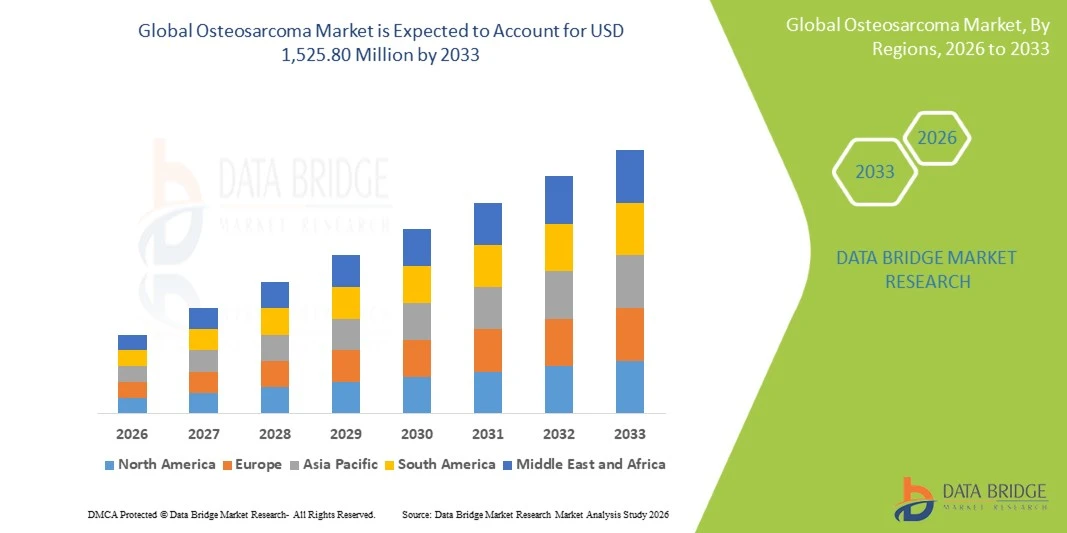
- As per Data Bridge Market Research analysis, the osteosarcoma market was valued at USD 804.47 million in 2025 and is projected to reach USD 1,525.80 million by 2033, growing at a CAGR of 8.33% from 2026 to 2033.
- The market is experiencing consistent growth driven by rising demand for advanced osteosarcoma treatment, increasing adoption of targeted and immunotherapies, and continued advancements in diagnostic, surgical, and therapeutic approaches for bone cancer.
- The increasing burden of osteosarcoma, particularly among younger populations, combined with growing investments in oncology research and development, is encouraging healthcare providers and pharmaceutical companies to advance innovative treatment options. Chemotherapy, targeted therapy, immunotherapy, and improved surgical interventions are supporting the development of more comprehensive treatment approaches and contributing to market growth.
Market Size & Forecast
- Global Market Value (2025): USD 804.47 Million
- Expected Market Value (2033): USD 1,525.80 Million
- Forecast CAGR (2026–2033): 8.33%
- Leading Region in 2025: North America
- Fastest Growing Region: Asia Pacific
What are the Major Takeaways of the Osteosarcoma Market?
- North America dominated the osteosarcoma market with the largest revenue share of 45% in 2025, supported by a robust healthcare framework, advanced oncology infrastructure, and significant investments in cancer research
- Asia-Pacific is expected to be the fastest-growing region at a CAGR of 5.0% from 2026 to 2033, fueled by improving healthcare infrastructure, increasing cancer awareness, and expanding access to advanced osteosarcoma diagnosis and treatment.
- The intramedullary osteosarcoma segment led the market with a 55% share in 2025, driven by its status as the most common form of osteosarcoma and its frequent occurrence within the medullary cavity of long bones.
- Juxtacortical osteosarcoma are the fastest-growing type, projected to register a CAGR of 5.0%, reflecting the surge in recognition of surface-based bone tumors and improvements in diagnostic imaging.
- The chemotherapy segment dominated the treatment category with a 42% revenue share in 2025, led by its established role in the standard multimodal treatment pathway for osteosarcoma
- Pediatric accounted for 59% of the market share in 2025, preferred by strong association of osteosarcoma with children and adolescents undergoing rapid skeletal growth.
- The geriatric segment is the fastest-growing age group category, with a CAGR of 5.5%, driven by the increasing diagnosis of osteosarcoma and other primary bone tumors among older adults
Report Scope and Osteosarcoma Market Segmentation
|
Attributes |
Osteosarcoma Key Market Insights |
|
Segments Covered |
|
|
Countries Covered |
North America
Europe
Asia-Pacific
Middle East and Africa
South America
|
|
Key Market Players |
|
|
Market Opportunities |
|
|
Value Added Data Infosets |
In addition to the insights on market scenarios such as market value, growth rate, segmentation, geographical coverage, and major players, the market reports curated by the Data Bridge Market Research also include in-depth expert analysis, patient epidemiology, pipeline analysis, pricing analysis, and regulatory framework. |
What is the Key Trend in the Osteosarcoma Market?
- Pharmaceutical companies and academic research centers are increasingly focusing on targeted therapies and immunotherapy approaches to address the limited treatment advances and persistent unmet needs associated with osteosarcoma.
- For instance, in September 2024, the U.S. FDA launched a comprehensive osteosarcoma surfaceome-target discovery project using mass spectrometry, genomic, and transcriptomic analyses to identify potential combinatorial targets for immunotherapy, reflecting the growing focus on targeted and immune-based treatment development.
- Emerging approaches including CAR T-cell therapy, targeted agents, antibody-based therapies, and combination regimens are expanding the clinical development pipeline for recurrent, metastatic, and treatment-resistant osteosarcoma.
- Researchers are also increasingly investigating molecularly targeted treatment combinations alongside established chemotherapy regimens to improve outcomes for newly diagnosed and high-risk osteosarcoma patients.
- For instance, in October 2025, the U.S. FDA and Osteosarcoma Institute held a workshop on advancing osteosarcoma drug development, with sessions covering promising therapeutic targets, preclinical research, clinical trials, and innovative approaches to treatment development.
- As targeted therapies, cellular immunotherapies, and biomarker-driven research continue to expand, osteosarcoma treatment development is increasingly shifting toward more precise and combination-based therapeutic strategies for patients with difficult-to-treat disease.
What are the Key Drivers of the Osteosarcoma Market?
- The persistent unmet medical need associated with recurrent and metastatic osteosarcoma is increasing demand for innovative therapies that can improve outcomes beyond conventional chemotherapy and surgery.
- For instance, in October 2025, the U.S. FDA and Osteosarcoma Institute brought together more than 370 researchers, biopharmaceutical representatives, regulators, and patient advocates to accelerate development of innovative osteosarcoma treatments and address persistent unmet medical needs.
- The concentration of osteosarcoma among children, adolescents, and young adults is encouraging pharmaceutical companies and research institutions to develop specialized pediatric oncology treatments and clinical trials targeting younger patient populations.
- For instance, in August 2025, the American Cancer Society reported that about 1,000 new osteosarcoma cases are diagnosed annually in the U.S., with approximately half occurring in children and adolescents, supporting continued demand for specialized pediatric oncology treatments and clinical research.
- With expanding clinical research into targeted agents, cellular therapies, and combination treatment strategies, the osteosarcoma market is being supported by continued efforts to address treatment-resistant and relapsed disease through innovative therapeutic development.
Which Factors are Challenging the Growth of the Osteosarcoma Market?
- Osteosarcoma is a rare cancer with a relatively small patient population, making patient recruitment, clinical-trial execution, and commercial investment more difficult compared with high-incidence cancer indications.
- For instance, in October 2025, the U.S. FDA and Osteosarcoma Institute identified clinical-trial design and implementation as major barriers to osteosarcoma drug development, highlighting difficulties associated with the disease’s rarity, molecular heterogeneity, and selection of suitable clinical endpoints.
- The complex biological characteristics and molecular heterogeneity of osteosarcoma make it difficult to identify consistently effective molecular targets and develop therapies that produce durable responses across diverse patient populations.
- The limited number of patients and difficulties in establishing appropriate clinical endpoints can increase research costs, prolong trial timelines, and restrict pharmaceutical investment, particularly for therapies targeting small osteosarcoma populations.
- For instance, in April 2025, an article published in Pharmaceuticals reported that chemotherapy resistance remains a significant barrier in osteosarcoma treatment, with resistance to methotrexate, doxorubicin, and cisplatin contributing to recurrence and limiting treatment effectiveness.
- These patient-population, biological, and clinical-development challenges continue to constrain the rapid introduction of novel osteosarcoma therapies, despite increasing research activity and the substantial unmet need for effective treatments.
How is the Osteosarcoma Market Segmented?
The osteosarcoma market is segmented on the basis of type, treatment, age group, and end-user
- By Type
On the basis of type, the osteosarcoma market is segmented into intramedullary osteosarcoma, juxtacortical osteosarcoma, and extraskeletal osteosarcoma. The intramedullary osteosarcoma segment dominated the market with a share of 55% in 2025, owing to its status as the most common form of osteosarcoma and its frequent occurrence within the medullary cavity of long bones. These tumors are particularly associated with adolescents and young adults and commonly affect the metaphyseal regions of the femur, tibia, and humerus. Diagnosis typically involves imaging followed by biopsy and histopathological examination. Treatment generally requires a combination of systemic chemotherapy and surgical resection, supporting sustained healthcare utilization. The availability of established diagnostic and treatment pathways further strengthens the segment's market position.
The juxtacortical osteosarcoma segment is projected to register the fastest growth at a CAGR of 5.0% from 2026 to 2033, supported by increasing recognition of surface-based bone tumors and improvements in diagnostic imaging. Juxtacortical osteosarcomas develop on the external surface of bones and include parosteal and periosteal forms. Advances in MRI, CT imaging, and pathological assessment are improving differentiation of these tumors from other bone lesions. Greater clinical awareness is also supporting earlier identification and referral to specialized orthopedic oncology centers. Research into tumor biology and individualized treatment approaches is further strengthening clinical interest in these relatively uncommon tumors. Increasing adoption of limb-sparing surgical techniques is also supporting treatment utilization.
- By Treatment
On the basis of treatment, the osteosarcoma market is segmented into chemotherapy, targeted therapy, immunotherapy, medications, and surgery. The chemotherapy segment dominated the market with a share of 42% in 2025, supported by its established role in the standard multimodal treatment pathway for osteosarcoma. Multi-agent chemotherapy is commonly administered before and after surgical tumor removal. Methotrexate, doxorubicin, and cisplatin remain important components of conventional treatment strategies. Chemotherapy is also used to reduce tumor burden before surgery and address microscopic disease after resection. Its established clinical use gives it a broader treatment base than newer therapeutic approaches.
The targeted therapy segment is projected to register the fastest growth at a CAGR of 9.8% from 2026 to 2033, driven by increasing research into therapies directed at specific molecular pathways involved in osteosarcoma progression. Tyrosine kinase inhibitors and other pathway-specific agents are being investigated for recurrent, metastatic, and treatment-resistant disease. Targeted therapies can provide treatment alternatives when conventional chemotherapy becomes less effective. Increasing molecular characterization of osteosarcoma is helping researchers identify potential therapeutic targets. Pharmaceutical and biotechnology companies are also expanding clinical-development programs focused on difficult-to-treat disease. Growing interest in precision oncology is further encouraging the development of biomarker-informed treatment strategies.
- By Age Group
On the basis of age group, the osteosarcoma market is segmented into adult, geriatric, and pediatric. The pediatric segment dominated the market with a share of 59% in 2025, reflecting the strong association of osteosarcoma with children and adolescents undergoing rapid skeletal growth. Osteosarcoma is particularly common during the adolescent growth period and frequently affects the long bones. Pediatric patients generally require coordinated treatment involving chemotherapy, surgery, imaging, pathology, and rehabilitation. Specialized pediatric oncology centers provide multidisciplinary services for diagnosis and treatment. Increasing investment in pediatric cancer research is also supporting development of more specialized therapeutic approaches.
The geriatric segment is projected to register the fastest growth at a CAGR of 5.5% from 2026 to 2033, supported by increasing diagnosis of osteosarcoma and other primary bone tumors among older adults. Osteosarcoma in older patients can present differently from conventional adolescent disease and may require individualized treatment planning. Advanced imaging and improved pathological assessment are helping physicians identify unusual bone tumors in elderly patients. Multidisciplinary oncology services are increasingly important because older patients may have additional clinical considerations affecting treatment selection. Research into molecularly targeted therapies is also providing additional treatment considerations for patients who may not tolerate intensive conventional chemotherapy. Greater clinical awareness of osteosarcoma in older populations is supporting diagnosis and specialized care.
- By End User
On the basis of end user, the osteosarcoma market is segmented into hospitals and clinics, diagnostic centers, and academic and research organizations. The hospitals and clinics segment dominated the market with a share of 60% in 2025, owing to the requirement for comprehensive diagnosis, chemotherapy, surgery, and follow-up care. Osteosarcoma treatment commonly requires multidisciplinary teams involving orthopedic surgeons, medical oncologists, radiologists, pathologists, and rehabilitation specialists. Hospitals provide the specialized infrastructure required for complex tumor resections and limb-salvage procedures. They also support administration and monitoring of intensive chemotherapy regimens. Increasing availability of specialized oncology centers is improving access to comprehensive osteosarcoma management.
The academic and research organizations segment is projected to register the fastest growth at a CAGR of 6.0% from 2026 to 2033, driven by increasing research into novel osteosarcoma treatments and disease biology. Universities and research institutions play an important role in identifying molecular targets and investigating mechanisms of treatment resistance. These organizations are increasingly involved in clinical trials evaluating targeted therapies, immunotherapies, and cellular treatment approaches. Collaboration between academic institutions, pharmaceutical companies, and specialized cancer centers is strengthening translational research. Growing attention toward rare cancers is also encouraging additional research funding and collaborative studies. Advances in molecular profiling and precision oncology are creating new areas for academic investigation.
Which Region Holds the Largest Share of the Osteosarcoma Market?
- North America dominated the osteosarcoma market with the largest revenue share of 45% in 2025, supported by a robust healthcare framework, advanced oncology infrastructure, and significant investments in cancer research.
- The region also benefits from established clinical-trial networks, greater access to specialized orthopedic oncology services, and increasing development of targeted, cellular, and immune-based therapies. Strong research activity and the availability of advanced diagnostic and treatment technologies continue to strengthen North America's leadership position in the global osteosarcoma market.
U.S. Osteosarcoma Market Insight
The U.S. osteosarcoma market is witnessing strong growth due to advanced cancer care infrastructure, specialized sarcoma centers, and increasing investment in osteosarcoma research and clinical trials. The country’s established oncology ecosystem, along with growing adoption of chemotherapy, surgical interventions, targeted therapies, and emerging immunotherapies, is supporting demand across specialized treatment settings. In addition, strong research activity and access to clinical trials are contributing to the development of new treatment approaches for osteosarcoma.
Asia-Pacific Osteosarcoma Market Insight
The Asia-Pacific osteosarcoma market is expected to witness rapid growth, driven by a large pediatric and young-adult patient population, improving cancer diagnosis, and expanding access to specialized oncology services across countries such as China, India, and Japan. Growing adoption of structured treatment protocols, increasing availability of quality-assured medicines, and development of shared-care oncology networks are supporting regional market expansion. In addition, increasing research activity and clinical-trial participation are strengthening the region’s role in osteosarcoma treatment and development.
Japan Osteosarcoma Market Insight
The Japan osteosarcoma market is witnessing consistent growth due to advanced oncology infrastructure, specialized medical expertise, and increasing focus on innovative cancer treatment and research. Healthcare institutions and research organizations are increasingly focusing on multidisciplinary approaches involving chemotherapy, surgery, diagnostic imaging, and emerging targeted treatment strategies. Moreover, continued investment in cancer research and access to sophisticated diagnostic and treatment technologies are supporting the development of osteosarcoma care in Japan.
China Osteosarcoma Market Insight
The China osteosarcoma market is growing rapidly, driven by a large patient population, improving cancer diagnosis, and expanding access to specialized oncology services. Growing adoption of structured treatment approaches, chemotherapy, surgical management, and emerging targeted therapies is supporting market demand across specialized hospitals and cancer centers. In addition, increasing availability of quality-assured medicines, development of oncology networks, and growing research activity are strengthening China’s position as an important market for osteosarcoma treatment.
U.K. Osteosarcoma Market Insight
The U.K. osteosarcoma market is experiencing steady growth, supported by specialist sarcoma centers, multidisciplinary treatment teams, and increasing research into advanced therapies and clinical management. Growing utilization of chemotherapy and surgery, along with research into targeted drugs and immunotherapy, is contributing to market development. Furthermore, ongoing clinical trials and genomic research are improving understanding of osteosarcoma biology and supporting the development of more personalized treatment approaches in the U.K.
Germany Osteosarcoma Market Insight
The Germany osteosarcoma market is expanding steadily due to its established healthcare infrastructure, specialized oncology capabilities, and growing emphasis on rare-cancer research. Hospitals and specialist centers are increasingly utilizing multidisciplinary treatment approaches combining chemotherapy, surgery, advanced imaging, and emerging targeted treatment options. Continuous research collaboration across European oncology networks and increasing focus on improving diagnosis and treatment strategies are further supporting osteosarcoma market development in Germany.
Which are the Top Companies in Osteosarcoma Market?
The osteosarcoma industry is primarily led by well-established companies, including:
- Merck & Co., Inc. (U.S.)
- Pfizer Inc. (U.S.)
- Bristol-Myers Squibb Company (U.S.)
- AstraZeneca (U.K.)
- Novartis AG (Switzerland)
- Amgen Inc. (U.S.)
- Eli Lilly and Company (U.S.)
- F. Hoffmann-La Roche Ltd (Switzerland)
- Takeda Pharmaceutical Company Limited (Japan)
- Johnson & Johnson Services, Inc. (U.S.)
- Sanofi (France)
- Bayer AG (Germany)
- GSK plc (U.K.)
- Regeneron Pharmaceuticals, Inc. (U.S.)
- Daiichi Sankyo Company, Limited (Japan)
- OS Therapies, Inc. (U.S.)
- Lisata Therapeutics, Inc. (U.S.)
- Rigel Pharmaceuticals, Inc. (U.S.)
- CRISPR Therapeutics (Switzerland)
- Agenus Inc. (U.S.)
What are Latest Developments in Osteosarcoma Market?
- In February 2025, OS Therapies announced that it had initiated commercial-ready manufacturing of OST-HER2, its Listeria-based immunotherapy candidate for osteosarcoma, to support a planned Biologics License Application (BLA) submission to the U.S. FDA. The company stated that its Phase 2b trial in recurrent, fully resected, lung-metastatic osteosarcoma had completed treatment and that positive results had been reported in the first quarter of 2025. This development represents continued advancement of OST-HER2 toward potential regulatory review for osteosarcoma treatment.
- In April 2024, Lisata Therapeutics announced that the U.S. FDA had granted Orphan Drug Designation to LSTA1, also known as certepetide, for the treatment of osteosarcoma. The investigational therapy is designed to activate a tumor-specific uptake pathway intended to improve penetration and accumulation of co-administered anticancer therapies within solid tumors. The designation followed the Rare Pediatric Disease Designation granted to LSTA1 for osteosarcoma in March 2024 and supported the company’s plans for further clinical development.
- In June 2023, St. Baldrick’s Foundation and its funding partners announced a new three-year, USD 1.5 million Fight Osteosarcoma Together Super Grant to support osteosarcoma research at Children’s Hospital of Philadelphia. The grant was awarded to Dr. Patrick Grohar with the goal of advancing a clinical trial for a new osteosarcoma treatment. The initiative highlighted continued investment in developing new therapeutic approaches for pediatric osteosarcoma, where treatment options have remained limited.
- In January 2022, OS Therapies announced nationwide enrollment for its Phase 2b AOST-2121 clinical trial of OST-HER2 in recurrent, resected osteosarcoma. The company reported that the Data Safety and Monitoring Committee had approved opening enrollment after the initial safety rollout of the first three patients. OST-HER2 is an off-the-shelf immunotherapy based on a Listeria monocytogenes vector and was being investigated for its potential to prevent metastasis, delay recurrence, and improve survival in osteosarcoma patients.
- In October 2021, OS Therapies announced dosing of the first patient in its Phase 2b clinical trial of OST-HER2 for recurrent, resected osteosarcoma. The potentially pivotal trial was designed to evaluate the Listeria-based immunotherapy in patients with osteosarcoma that had metastasized to the lungs and had subsequently been surgically resected. The development marked the transition of OST-HER2 into a clinical-stage evaluation specifically targeting recurrent osteosarcoma in children and young adults.

- Interactive Data Analysis Dashboard
- Company Analysis Dashboard for high growth potential opportunities
- Research Analyst Access for customization & queries
- Competitor Analysis with Interactive dashboard
- Latest News, Updates & Trend analysis
- Harness the Power of Benchmark Analysis for Comprehensive Competitor Tracking
Data collection and base year analysis are done using data collection modules with large sample sizes. The stage includes obtaining market information or related data through various sources and strategies. It includes examining and planning all the data acquired from the past in advance. It likewise envelops the examination of information inconsistencies seen across different information sources. The market data is analysed and estimated using market statistical and coherent models. Also, market share analysis and key trend analysis are the major success factors in the market report. To know more, please request an analyst call or drop down your inquiry.
The key research methodology used by DBMR research team is data triangulation which involves data mining, analysis of the impact of data variables on the market and primary (industry expert) validation. Data models include Vendor Positioning Grid, Market Time Line Analysis, Market Overview and Guide, Company Positioning Grid, Patent Analysis, Pricing Analysis, Company Market Share Analysis, Standards of Measurement, Global versus Regional and Vendor Share Analysis. To know more about the research methodology, drop in an inquiry to speak to our industry experts.
Data Bridge Market Research is a leader in advanced formative research. We take pride in servicing our existing and new customers with data and analysis that match and suits their goal. The report can be customized to include price trend analysis of target brands understanding the market for additional countries (ask for the list of countries), clinical trial results data, literature review, refurbished market and product base analysis. Market analysis of target competitors can be analyzed from technology-based analysis to market portfolio strategies. We can add as many competitors that you require data about in the format and data style you are looking for. Our team of analysts can also provide you data in crude raw excel files pivot tables (Fact book) or can assist you in creating presentations from the data sets available in the report.













