


Oxidative Stress Analysis Market Size
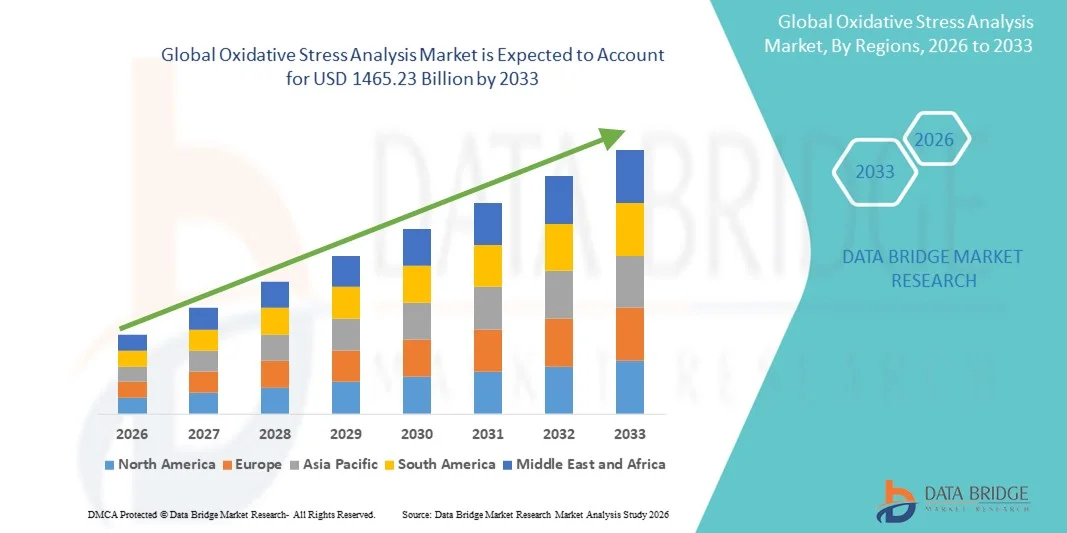
- The global oxidative stress analysis market size was valued at USD 743.5 billion in 2025 and is expected to reach USD 1465.23 billion by 2033, at a CAGR of 8.85% during the forecast period
- The market growth is largely fueled by the increasing prevalence of chronic diseases, lifestyle disorders, and aging populations, driving the need for accurate and timely oxidative stress analysis in clinical and research settings
- Furthermore, rising awareness among healthcare professionals and researchers about the role of oxidative stress in conditions such as cardiovascular diseases, diabetes, neurodegenerative disorders, and cancer is accelerating the adoption of Oxidative Stress Analysis solutions, thereby significantly boosting the industry's growth
Oxidative Stress Analysis Market Analysis
- Oxidative Stress Analysis, offering precise measurement and monitoring of reactive oxygen species and antioxidant levels in biological samples, is increasingly vital for both clinical diagnostics and research applications due to its role in understanding disease progression, aging, and therapeutic efficacy
- The escalating demand for Oxidative Stress Analysis is primarily fueled by the growing prevalence of chronic diseases, lifestyle disorders, and neurodegenerative conditions, as well as rising adoption in pharmaceutical research, clinical laboratories, and academic studies.
- North America dominated the oxidative stress analysis market with the largest revenue share of approximately 43% in 2025, supported by advanced healthcare infrastructure, high research activity, strong funding for clinical and translational studies, and the presence of key industry players. The U.S. accounted for the majority of regional demand due to widespread adoption in hospitals, diagnostic laboratories, and research centers
- Asia-Pacific is expected to be the fastest-growing region in the oxidative stress analysis market during the forecast period, registering a CAGR from 2026 to 2033, driven by improving healthcare infrastructure, increasing research initiatives, rising awareness about oxidative stress-related disorders, and expanding laboratory facilities in countries such as China, India, and Japan
- The consumables segment dominated the largest market revenue share of 45.6% in 2025, driven by its recurring usage in laboratories and clinical settings, high demand for assay kits, reagents, and calibration standards
Report Scope and Oxidative Stress Analysis Market Segmentation
|
Attributes |
Oxidative Stress Analysis Key Market Insights |
|
Segments Covered |
|
|
Countries Covered |
North America
Europe
Asia-Pacific
Middle East and Africa
South America
|
|
Key Market Players |
• Merck KGaA (Germany) |
|
Market Opportunities |
|
|
Value Added Data Infosets |
In addition to the insights on market scenarios such as market value, growth rate, segmentation, geographical coverage, and major players, the market reports curated by the Data Bridge Market Research also include in-depth expert analysis, patient epidemiology, pipeline analysis, pricing analysis, and regulatory framework. |
Oxidative Stress Analysis Market Trends
Rising Prevalence of Chronic Diseases and Lifestyle Disorders
- The increasing incidence of chronic diseases such as cardiovascular disorders, diabetes, and neurodegenerative conditions is driving the demand for oxidative stress analysis. Monitoring oxidative stress helps in early diagnosis, disease management, and preventive care
- For instance, in March 2024, Randox Laboratories launched its enhanced Oxidative Stress ELISA panel, aimed at providing clinicians with a comprehensive assessment of oxidative biomarkers in patients with chronic metabolic disorders. This product innovation is expected to boost market growth significantly
- Healthcare providers are increasingly adopting oxidative stress tests to monitor therapy effectiveness, improve patient outcomes, and guide personalized treatment plans
- Growing awareness among clinicians and researchers regarding the role of oxidative stress in aging and disease progression is fueling the adoption of advanced testing methods
- Advancements in point-of-care devices and laboratory-based assays are enhancing accuracy, sensitivity, and convenience, making oxidative stress testing more accessible in clinical and research settings
- Rising demand for preventive healthcare and wellness programs is also driving growth, as oxidative stress assessment is increasingly integrated into routine health check-ups
Oxidative Stress Analysis Market Dynamics
Driver
Integration into Clinical and Research Workflows
- A key trend is the integration of oxidative stress analysis into clinical diagnostics, research studies, and drug development pipelines
- For instance, in July 2023, Cayman Chemical introduced a new high-throughput assay kit for measuring oxidative stress markers in preclinical research, enabling faster and more reliable analysis of reactive oxygen species in experimental models
- The trend towards multiplex assays allows simultaneous measurement of multiple oxidative biomarkers, improving efficiency and data reliability
- Researchers are leveraging these assays to study disease mechanisms, evaluate therapeutic interventions, and identify new drug targets
- Increasing adoption of oxidative stress monitoring in personalized medicine and nutraceutical research is shaping product innovation
- Academic and clinical collaborations are supporting the development of more sophisticated analytical platforms, combining oxidative stress biomarkers with other diagnostic indicators
Restraint/Challenge
High Cost of Advanced Testing and Limited Standardization
- The relatively high cost of advanced oxidative stress analysis kits and equipment is a major restraint, especially for small laboratories and clinics in developing regions
- For instance, in May 2022, BioVision reported that its premium oxidative stress assay kits were primarily adopted by large research institutions, while smaller clinics preferred conventional biochemical markers due to affordability issues
- Limited standardization of oxidative stress biomarkers and lack of universal reference ranges pose challenges to consistent interpretation across laboratories
- Complexity in sample handling, storage, and assay calibration can hinder widespread adoption in routine clinical diagnostics
- To overcome these barriers, manufacturers are investing in simplified, cost-effective kits and robust quality control systems
- Education and training of healthcare professionals on the clinical relevance of oxidative stress testing are critical for market expansion
Oxidative Stress Analysis Market Scope
The market is segmented on the basis of product, technology, test type, disease, and end-user.
- By Product
On the basis of product, the Oxidative Stress Analysis market is segmented into consumables, instruments, and services. The consumables segment dominated the largest market revenue share of 45.6% in 2025, driven by its recurring usage in laboratories and clinical settings, high demand for assay kits, reagents, and calibration standards. Consumables are essential for routine testing and research workflows, providing reliable results with minimal setup. Laboratories prefer consumables due to their cost-effectiveness, ease of use, and compatibility with multiple platforms. Consumables support a wide range of applications across disease monitoring, pharmaceutical research, and academic studies. The availability of standardized kits from established manufacturers further propels their adoption. Additionally, frequent replacement cycles contribute to steady revenue growth, making consumables a key revenue-generating segment.
The instruments segment is expected to witness the fastest CAGR of 11.8% from 2026 to 2033, driven by growing investments in advanced laboratory equipment such as high-throughput analyzers, flow cytometers, and microscopy systems. Instruments enable precise, reproducible, and large-scale analysis of oxidative biomarkers. Rising R&D in academic and pharmaceutical research fuels demand for automation and high-content instrumentation. Technological advancements in sensitivity, accuracy, and multiplexing capabilities also support growth. Increasing adoption in emerging markets, where research infrastructure is expanding, further accelerates instrument deployment. Integration with digital platforms for data analysis and remote monitoring is creating additional opportunities. The growth is also supported by rising government grants and funding for oxidative stress research globally.
- By Technology
On the basis of technology, the market is segmented into ELISA, flow cytometry, chromatography, microscopy, high-content screening, and label-free detection. The ELISA segment held the largest market share of 38.9% in 2025, driven by its simplicity, cost-effectiveness, and widespread adoption in clinical and research laboratories. ELISA kits allow accurate quantification of oxidative stress biomarkers such as reactive oxygen species, antioxidants, and oxidative damage markers. Laboratories value ELISA for its reproducibility, standardized protocols, and compatibility with high-throughput testing. Pharmaceutical and biotechnology companies extensively use ELISA in drug development, biomarker validation, and toxicity studies. ELISA-based kits also support multiplexing, enabling simultaneous analysis of multiple targets, enhancing workflow efficiency. The global availability of commercial kits from established players ensures reliability and accessibility, sustaining dominance in the market.
The flow cytometry segment is projected to witness the fastest CAGR of 12.5% from 2026 to 2033, fueled by increasing demand for single-cell analysis and detailed oxidative stress profiling. Flow cytometry enables high-resolution, multiparameter analysis of cells, providing insights into oxidative damage and intracellular reactive oxygen species. Technological innovations, such as spectral flow cytometry and automated data analysis software, are improving performance and user adoption. Academic research, clinical trials, and pharmaceutical studies are key drivers. Rising applications in immunology, oncology, and cardiovascular research also support growth. Investment in laboratory automation and expanding research infrastructure in Asia-Pacific contribute to accelerated adoption.
- By Test Type
On the basis of test type, the market is segmented into indirect assays, antioxidant capacity assays, enzyme-based assays, and reactive oxygen species (ROS)-based assays. The indirect assays segment dominated the largest market share of 41.2% in 2025, driven by its ability to evaluate oxidative stress markers such as lipid peroxidation, protein oxidation, and DNA damage indirectly. Indirect assays are widely used in research and clinical diagnostics due to their reliability, reproducibility, and ease of standardization. Laboratories benefit from commercially available kits with well-established protocols, which reduce assay variability. The segment is versatile, supporting applications across disease monitoring, drug discovery, toxicology, and nutritional studies. Strong demand from pharmaceutical R&D and clinical laboratories further reinforces growth. Indirect assays are also cost-effective for large-scale studies, enhancing their adoption in emerging markets. The segment’s compatibility with multiple detection platforms, including spectrophotometry and microplate readers, strengthens its position. Availability from key manufacturers globally ensures accessibility. Routine quality control and regulatory compliance also drive steady revenue. Educational and research institutions favor indirect assays for training and academic studies.
The ROS-based assays segment is expected to witness the fastest CAGR of 13.1% from 2026 to 2033, owing to its ability to directly measure reactive oxygen species and enable real-time monitoring. These assays are increasingly adopted in cancer research, neurodegenerative disease studies, and cardiovascular investigations. Advances in fluorescent probes, high-throughput platforms, and imaging techniques improve sensitivity and precision. The growing importance of oxidative stress as a biomarker in personalized medicine and drug development drives adoption. Pharmaceutical companies leverage ROS-based assays for preclinical screening and toxicity evaluation. Academic and clinical researchers prefer them for mechanistic studies of oxidative damage. Rising awareness of oxidative stress pathways in disease progression further supports market expansion. Government grants and research funding increase availability of advanced platforms. Automation and integration with digital analysis tools enhance workflow efficiency. Emerging markets are adopting ROS-based assays due to increased research infrastructure. The segment also benefits from strong collaborations between assay developers and research institutions.
- By Disease
On the basis of disease, the market is segmented into cardiovascular disease, diabetes, chronic obstructive pulmonary disease (COPD), cancer, and asthma. The cardiovascular disease segment held the largest share of 36.7% in 2025, driven by the high prevalence of heart disease and the central role of oxidative stress in pathogenesis. Monitoring oxidative stress provides insights for early detection, prognosis, and personalized therapeutic interventions. Cardiovascular research programs and clinical applications dominate the demand for oxidative stress assays. Hospitals and clinical laboratories routinely use these tests to assess risk factors, evaluate treatment efficacy, and monitor disease progression. Pharmaceutical R&D targeting cardiovascular therapeutics also fuels adoption. The segment benefits from regulatory support for preventive healthcare programs. Rising awareness of oxidative damage in cardiovascular disorders contributes to consistent market growth. Developed regions such as North America and Europe account for substantial share due to well-established cardiac care infrastructure. Emerging markets are increasingly integrating oxidative stress testing into routine cardiovascular diagnostics. Availability of standardized assays ensures reproducibility and reliability. Collaborative research initiatives in cardiology reinforce adoption. Strong publication trends in cardiovascular oxidative stress research further validate the segment’s prominence.
The cancer segment is projected to witness the fastest CAGR of 12.9% from 2026 to 2033, fueled by increased focus on oxidative stress as a biomarker and therapeutic target in oncology. ROS and antioxidant imbalance play a key role in tumor initiation, progression, and drug resistance. Cancer research programs use oxidative stress assays to study tumor microenvironments, evaluate chemotherapeutic efficacy, and develop targeted therapies. Pharmaceutical companies are increasingly investing in oncology-focused biomarker research. Technological advancements in high-content screening, flow cytometry, and fluorescent probes facilitate accurate ROS detection in cancer cells. Clinical trials leverage these assays for patient stratification and therapy monitoring. The growing prevalence of cancer globally further expands demand. Funding from government and private organizations supports research in oxidative mechanisms. Collaboration between academic institutions and biotech firms accelerates adoption. Emerging markets are witnessing increased availability of oncology-specific assay kits. The segment benefits from rising awareness of early detection and personalized medicine approaches. Integration with multi-omics studies strengthens research output and relevance.
- By End-User
On the basis of end-user, the market is segmented into pharmaceutical and biotechnology companies, academic research institutes, clinical laboratories, and contract research organizations (CROs). The clinical laboratories segment dominated the largest market share of 42.5% in 2025, driven by routine patient testing, disease monitoring, and preventive healthcare programs. Laboratories benefit from standardized workflows, recurring testing demand, and regulatory compliance requirements. They extensively use oxidative stress assays for cardiovascular, diabetes, cancer, and neurodegenerative disease diagnostics. Clinical laboratories provide rapid results, support large-scale screening, and contribute to public health initiatives. Availability of prevalidated kits ensures accuracy and reproducibility. Advanced laboratory infrastructure in developed regions further strengthens adoption. Collaborations with pharmaceutical companies for biomarker studies enhance utilization. Demand is also supported by hospital-affiliated labs and independent diagnostic centers. Clinical laboratories offer a wide range of services from simple antioxidant capacity assays to complex enzyme-based and ROS measurements. Automation and integration with laboratory information systems improve efficiency.
The academic research institutes segment is expected to witness the fastest CAGR of 12.7% from 2026 to 2033, fueled by increasing research funding, expansion of life sciences programs, and rising publications on oxidative stress. Universities and research centers adopt advanced instruments, assays, and integrated platforms to explore oxidative stress mechanisms and disease associations. Collaboration with pharmaceutical and biotech companies facilitates translational research. Government grants and international research initiatives provide financial support for oxidative stress studies. Academic institutes also focus on method development, validation, and high-throughput screening. Expansion of research programs in emerging economies boosts demand. Increasing focus on molecular biology, oncology, neurodegeneration, and cardiovascular research drives adoption. Training and educational programs further strengthen utilization. Academic centers leverage automated and high-content platforms for large-scale studies. Publications and patent activities in oxidative stress reinforce the market’s growth potential.
Oxidative Stress Analysis Market Regional Analysis
- North America dominated the oxidative stress analysis market with the largest revenue share of approximately 43% in 2025, supported by advanced healthcare infrastructure, high research activity, strong funding for clinical and translational studies, and the presence of key industry players. The U.S. accounted for the majority of regional demand, driven by widespread adoption in hospitals, diagnostic laboratories, and research centers
- The region benefits from established cardiovascular, oncology, and metabolic disorder research programs that frequently utilize oxidative stress assays. High investment in R&D by pharmaceutical and biotechnology companies fosters continuous adoption of advanced instruments and reagents. Government-backed initiatives promoting biomarker discovery, early disease detection, and precision medicine further propel market growth
- Clinical laboratories extensively use these assays for patient monitoring, preventive health screenings, and chronic disease management. North American universities and academic research institutes also contribute significantly through basic and applied research. Standardized protocols, validated commercial kits, and strong regulatory frameworks enhance reliability and reproducibility of results. Strong collaborations between industry and
academic centers drive innovation
U.S. Oxidative Stress Analysis Market Insight
The U.S. oxidative stress analysis market accounted for the largest share of North American revenue in 2025, supported by advanced healthcare infrastructure, high research intensity, and strong funding for clinical and translational studies. The widespread adoption of oxidative stress analysis across hospitals, diagnostic laboratories, academic research institutes, and pharmaceutical & biotechnology companies significantly drives market growth. The high prevalence of chronic diseases such as cardiovascular disorders, cancer, diabetes, and neurodegenerative conditions increases the need for oxidative stress biomarkers in diagnosis, prognosis, and therapy monitoring.
Europe Oxidative Stress Analysis Market Insight
The Europe oxidative stress analysis market is projected to expand at a substantial CAGR throughout the forecast period, driven by high research activity, government funding for healthcare and biomedical projects, and increasing prevalence of chronic diseases. Countries such as Germany, France, and the U.K. are investing in translational research and clinical studies that incorporate oxidative stress analysis. The adoption of advanced instruments, high-content screening technologies, and standardized assays across hospitals, diagnostic labs, and research institutions contributes to market growth. Increasing collaborations between academia and pharmaceutical companies further fuel demand. Growth is also supported by a focus on personalized medicine, aging population, and rising prevalence of cardiovascular, metabolic, and neurodegenerative disorders. Multi-center research studies and clinical trials across Europe encourage the utilization of oxidative stress analysis platforms.
U.K. Oxidative Stress Analysis Market Insight
The U.K. oxidative stress analysis market is anticipated to grow at a noteworthy CAGR during the forecast period, driven by strong biomedical research programs, clinical trials, and government-supported research initiatives. Increasing awareness of oxidative stress-related disorders and the expansion of laboratory facilities in universities and hospitals contribute to adoption. Research on chronic diseases, cancer, and metabolic disorders stimulates demand for consumables and instruments. Growing collaboration between biotech firms and academic research institutes further accelerates market growth. The availability of advanced assay platforms, standardized protocols, and regulatory support strengthens reliability and reproducibility. Rising funding in life sciences research and public health initiatives also plays a key role.
Germany Oxidative Stress Analysis Market Insight
The Germany oxidative stress analysis market is expected to expand at a considerable CAGR during the forecast period, fueled by a robust healthcare and research infrastructure, high prevalence of chronic diseases, and emphasis on precision medicine. Germany’s focus on innovation, translational research, and adoption of advanced assay technologies promotes oxidative stress analysis adoption. Hospitals, clinical laboratories, and research centers are integrating high-content screening, ELISA, and ROS-based assays for diagnostics and research. Strong government and private funding for biomedical research further accelerates growth. Collaborative studies with international research institutes enhance technological adoption.
Asia-Pacific Oxidative Stress Analysis Market Insight
The Asia-Pacific oxidative stress analysis market is poised to grow at the fastest CAGR from 2026 to 2033, driven by improving healthcare infrastructure, increasing research initiatives, rising awareness about oxidative stress-related disorders, and expanding laboratory facilities in countries such as China, India, and Japan. Government-supported programs promoting biomedical research, preventive healthcare, and chronic disease monitoring are accelerating adoption. The expansion of diagnostic and research laboratories, along with rising investments by pharmaceutical and biotechnology companies, strengthens market growth. Increased focus on cardiovascular, oncology, metabolic, and neurodegenerative disease research fuels demand for advanced instruments, assays, and consumables. Collaboration between academic institutions and private research organizations further drives adoption. Rising publications, high research output, and growing laboratory automation also contribute to market expansion.
Japan Oxidative Stress Analysis Market Insight
The Japan oxidative stress analysis market is gaining momentum due to increasing research initiatives, advanced laboratory infrastructure, and a strong focus on preventive healthcare. Rising prevalence of oxidative stress-related diseases, coupled with government-backed research funding, supports the adoption of instruments, assays, and consumables. Universities, research centers, and clinical laboratories are increasingly integrating ROS-based, enzyme-based, and antioxidant capacity assays for diagnostic and research purposes. Aging population and rising healthcare awareness further drive demand for oxidative stress monitoring.
China Oxidative Stress Analysis Market Insight
The China oxidative stress analysis market accounted for the largest market revenue share in Asia-Pacific in 2025, attributed to expanding research programs, improving healthcare infrastructure, and increasing awareness of oxidative stress-associated diseases. Government initiatives to support biomedical research and chronic disease management are boosting demand for assays and instruments. The growing presence of research institutes, hospitals, and contract research organizations enhances accessibility. Rising pharmaceutical R&D, collaborations with international institutes, and an expanding academic research ecosystem further drive market growth.
Oxidative Stress Analysis Market Share
The Oxidative Stress Analysis industry is primarily led by well-established companies, including:
• Merck KGaA (Germany)
• Thermo Fisher Scientific (U.S.)
• Sigma-Aldrich (U.S.)
• Abcam (U.K.)
• PerkinElmer (U.S.)
• Agilent Technologies (U.S.)
• Bio-Rad Laboratories (U.S.)
• GE Healthcare (U.K.)
• Tecan Group (Switzerland)
• Danaher Corporation (U.S.)
• Cytiva (U.S.)
• Sartorius AG (Germany)
• Waters Corporation (U.S.)
• Promega Corporation (U.S.)
• BD Biosciences (U.S.)
• Hamilton Company (Switzerland)
• Eppendorf AG (Germany)
• ChemoMetec (Denmark)
• Abnova Corporation (Taiwan)
• Roche Diagnostics (Switzerland)
Latest Developments in Global Oxidative Stress Analysis Market
- In April 2025, AMSBIO announced an expansion of its oxidative-stress assay offerings: new kits covering biomarkers such as 8-oxo-dG (DNA oxidation), nitrotyrosine (protein oxidation), malondialdehyde (lipid peroxidation), and antioxidant enzymes — enabling researchers to quantify oxidative damage and antioxidant status with high sensitivity
- In May 2023, a major peer-reviewed article — “Recent progress in the development of fluorescent probes for imaging pathological oxidative stress” — was published by researchers from Beijing University of Chemical Technology (along with collaborators), summarizing innovations in fluorescent ROS/RNS/RSS probes for in-vitro and in-vivo imaging. This work highlights real-time oxidative stress detection — a key step for diagnostics and therapeutic research

- Interactive Data Analysis Dashboard
- Company Analysis Dashboard for high growth potential opportunities
- Research Analyst Access for customization & queries
- Competitor Analysis with Interactive dashboard
- Latest News, Updates & Trend analysis
- Harness the Power of Benchmark Analysis for Comprehensive Competitor Tracking
Data collection and base year analysis are done using data collection modules with large sample sizes. The stage includes obtaining market information or related data through various sources and strategies. It includes examining and planning all the data acquired from the past in advance. It likewise envelops the examination of information inconsistencies seen across different information sources. The market data is analysed and estimated using market statistical and coherent models. Also, market share analysis and key trend analysis are the major success factors in the market report. To know more, please request an analyst call or drop down your inquiry.
The key research methodology used by DBMR research team is data triangulation which involves data mining, analysis of the impact of data variables on the market and primary (industry expert) validation. Data models include Vendor Positioning Grid, Market Time Line Analysis, Market Overview and Guide, Company Positioning Grid, Patent Analysis, Pricing Analysis, Company Market Share Analysis, Standards of Measurement, Global versus Regional and Vendor Share Analysis. To know more about the research methodology, drop in an inquiry to speak to our industry experts.
Data Bridge Market Research is a leader in advanced formative research. We take pride in servicing our existing and new customers with data and analysis that match and suits their goal. The report can be customized to include price trend analysis of target brands understanding the market for additional countries (ask for the list of countries), clinical trial results data, literature review, refurbished market and product base analysis. Market analysis of target competitors can be analyzed from technology-based analysis to market portfolio strategies. We can add as many competitors that you require data about in the format and data style you are looking for. Our team of analysts can also provide you data in crude raw excel files pivot tables (Fact book) or can assist you in creating presentations from the data sets available in the report.













