


Oxidative Stress Assay Instruments Market Size
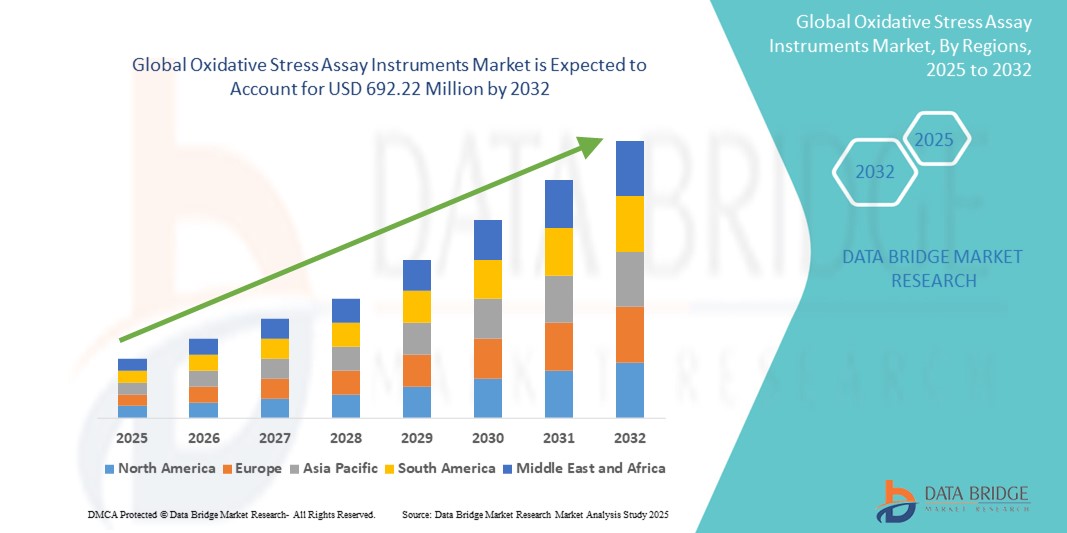
- The global oxidative stress assay instruments market size was valued at USD 344.86 Million in 2024 and is expected to reach USD 692.22 Million by 2032, at a CAGR of 9.10% during the forecast period
- The market growth is largely fueled by the rising demand for accurate, efficient, and real-time analytical tools in biomedical and pharmaceutical research, as well as increasing R&D investments in oxidative stress-related disease studies, such as cancer, neurodegenerative disorders, and cardiovascular diseases. This has led to a heightened adoption of advanced oxidative stress assay instruments in both academic and clinical research settings
- Furthermore, growing emphasis on early disease detection, biomarker discovery, and personalized medicine is establishing oxidative stress assay instruments as essential tools in modern diagnostics and drug development. These converging factors are accelerating the uptake of Oxidative Stress Assay Instruments solutions, thereby significantly boosting the industry's growth
Oxidative Stress Assay Instruments Market Analysis
- Oxidative stress assay instruments, essential for detecting reactive oxygen species (ROS) and evaluating oxidative stress in cells and tissues, are gaining importance across pharmaceutical, biotechnology, and academic research applications due to their role in understanding aging, cancer, neurodegenerative diseases, and metabolic disorders
- The rising incidence of chronic diseases, increased R&D investments in drug discovery, and growing demand for personalized medicine are driving the adoption of oxidative stress assay instruments across global laboratories and research centers
- North America dominated the oxidative stress assay instruments market with the largest revenue share of 38.4% in 2024, supported by well-established research infrastructure, high research funding, and a strong presence of key players in the U.S. and Canada. The U.S., in particular, experienced significant growth due to early technology adoption and strategic partnerships in life sciences
- Asia-Pacific is projected to be the fastest-growing region in the oxidative stress assay instruments market during the forecast period (2024–2031), driven by increasing biomedical research, expanding pharmaceutical industries, and rising healthcare investments in countries like China, India, South Korea, and Japan
- The cancer segment dominated oxidative stress assay instruments market with a revenue share of 33.8% in 2024, reflecting high research activity on oxidative stress’s role in tumorigenesis and therapy response
Report Scope and Oxidative Stress Assay Instruments Market Segmentation
|
Attributes |
Oxidative Stress Assay Instruments Key Market Insights |
|
Segments Covered |
|
|
Countries Covered |
North America
Europe
Asia-Pacific
Middle East and Africa
South America
|
|
Key Market Players |
|
|
Market Opportunities |
|
|
Value Added Data Infosets |
In addition to the insights on market scenarios such as market value, growth rate, segmentation, geographical coverage, and major players, the market reports curated by the Data Bridge Market Research also include in-depth expert analysis, pricing analysis, brand share analysis, consumer survey, demography analysis, supply chain analysis, value chain analysis, raw material/consumables overview, vendor selection criteria, PESTLE Analysis, Porter Analysis, and regulatory framework. |
Oxidative Stress Assay Instruments Market Trends
“Rising Demand for Intelligent and Automated Laboratory Solutions”
- A significant and accelerating trend in the global Oxidative Stress Assay Instruments market is the increasing integration of intelligent automation and smart data analytics into laboratory systems. These advancements are transforming how researchers conduct oxidative stress assays, enabling greater efficiency, accuracy, and user control
- For instance, next-generation oxidative stress assay platforms are being developed with intuitive software that allows seamless synchronization with laboratory management systems, enabling remote monitoring, automated calibration, and cloud-based data analysis
- Smart instrument interfaces are being designed to adapt to researcher behavior and workflows. These systems can optimize assay performance based on usage patterns and can deliver alerts for anomalies, reagent needs, or equipment malfunctions—greatly enhancing lab efficiency and reducing downtime
- Integration with centralized lab ecosystems allows users to control assay processes alongside other research tools such as spectrophotometers, PCR systems, and microplate readers, contributing to a more unified and automated research environment
- Companies such as Abcam, Thermo Fisher Scientific, and Enzo Life Sciences are developing oxidative stress assay kits and instruments that are compatible with automated liquid handling systems and high-throughput screening platforms, making them ideal for large-scale pharmaceutical and toxicological studies
- The demand for instruments that offer intelligent functionality and simplified operation is growing rapidly across academic, pharmaceutical, and biotechnology sectors, as research institutions seek to increase productivity, reproducibility, and scalability in oxidative stress analysis
Oxidative Stress Assay Instruments Market Dynamics
Driver
“Growing Need Due to Rising Health Concerns and Biomedical Research Expansion”
- The increasing burden of chronic diseases such as cancer, cardiovascular conditions, and neurodegenerative disorders, along with the growing interest in cellular health and aging research, is significantly driving demand for oxidative stress assay instruments globally
- For instance, in April 2024, Abcam plc launched a next-generation ROS detection assay kit that enables real-time monitoring of oxidative stress in live cells, enhancing research accuracy and throughput. Innovations like these are fueling the market growth and adoption of advanced oxidative stress instrumentation in academic and pharmaceutical labs
- As scientists seek better tools to evaluate cellular damage caused by reactive oxygen species (ROS), oxidative stress assay instruments offer precise and reproducible solutions for applications in toxicology, drug screening, and metabolic disorder studies
- Furthermore, the expansion of biotech start-ups and CROs (contract research organizations), especially in Asia-Pacific and Latin America, has led to increased procurement of microplate readers, fluorometric assays, and automated oxidative stress analyzers, boosting overall market expansion
- The convenience of high-throughput, real-time data collection, and multi-assay compatibility makes these instruments a core component in R&D pipelines, preclinical trials, and academic cell biology labs. The trend toward personalized and precision medicine further supports the demand for more sensitive and scalable oxidative stress detection systems
Restraint/Challenge
“Concerns Regarding High Costs and Technical Complexity”
- The high cost of advanced oxidative stress assay instruments, especially those offering automation, multiplexing, or imaging capabilities, remains a significant barrier for small labs, academic institutions in low-income regions, and price-sensitive research groups
- For instance, real-time imaging systems or integrated robotic assay platforms can exceed budget constraints, limiting adoption to large-scale pharmaceutical or academic centers with dedicated funding
- In addition, technical complexity and the need for specialized training in using fluorometric or chemiluminescent oxidative stress platforms can be a hurdle. Some instruments require sophisticated sample prep, calibration protocols, or specific reagents, which may deter broader usage in smaller facilities or among less experienced researchers
- To address these challenges, companies like Thermo Fisher Scientific and Enzo Life Sciences are investing in user-friendly assay kits, software automation, and training modules to simplify workflows and expand accessibility
- Reducing cost barriers through affordable single-use kits, cloud-based data management, and modular instrument options will be critical for ensuring broader market penetration and sustained long-term growth
Oxidative Stress Assay Instruments Market Scope
The market is segmented on the basis of test type, technology, diseases, and end user.
- By Test Type
On the basis of test type, the global oxidative stress assay instruments market is segmented into antioxidant capacity assays, ascorbic acid assays, glutathione assays, cell-based exogenous antioxidant assays, indirect assays, lipid-based assays, nucleic acid-based assays, protein-based assays, enzyme-based assays, and reactive oxygen species (ROS)-based assays. The reactive oxygen species-based assays segment dominated the market with the largest revenue share of 28.4% in 2024, driven by its widespread use in cellular stress and toxicity testing.
The glutathione assays segment is projected to register the fastest CAGR of 9.7% from 2025 to 2032, due to rising interest in redox biology and antioxidant research.
- By Technology
On the basis of technology, the global oxidative stress assay instruments market is segmented into enzyme-linked immunosorbent assay (ELISA), flow cytometry, high-content screening (HCS), label-free detection, microscopy, and chromatography. The enzyme-linked immunosorbent assay (ELISA) segment held the largest market share of 35.9% in 2024, as it remains a preferred method for routine oxidative stress biomarker quantification in clinical and research labs.
Flow cytometry is expected to witness the fastest CAGR of 10.3% from 2025 to 2032, owing to its high-throughput capabilities and ability to analyze multiple markers simultaneously in live cells.
- By Disease
On the basis of disease, the global oxidative stress assay instruments market is segmented into cardiovascular disease, diabetes, cancer, respiratory diseases, and other diseases. The cancer segment accounted for the largest revenue share of 33.8% in 2024, reflecting high research activity on oxidative stress’s role in tumorigenesis and therapy response.
The diabetes segment is anticipated to expand at the fastest CAGR of 9.9% from 2025 to 2032, supported by increasing prevalence and research into oxidative mechanisms in diabetic complications.
- By End User
On the basis of end user, the global oxidative stress assay instruments market is segmented into clinical laboratories, contract research organizations (CROs), pharmaceutical and biotechnology companies, academic research institutes, and cosmetic companies. The pharmaceutical and biotechnology companies segment led the market with a revenue share of 36.4% in 2024, due to increasing R&D and drug screening activities involving oxidative stress biomarkers.
The cosmetic companies segment is projected to witness the fastest CAGR of 10.8% from 2025 to 2032, owing to rising interest in oxidative stress testing in skin aging and anti-pollution product development.
Oxidative Stress Assay Instruments Market Regional Analysis
- In 2024, the North America oxidative stress assay instruments market dominated the global market, accounting for a dominant revenue share of 38.4%
- This leadership position can be attributed to the region’s robust biotechnology and pharmaceutical industries, extensive research funding, and advanced laboratory infrastructure
- The presence of major players such as Thermo Fisher Scientific, Bio-Rad Laboratories, and PerkinElmer further accelerates innovation and accessibility to cutting-edge oxidative stress testing technologies. Additionally, the increasing focus on chronic disease management and the adoption of biomarker-based diagnostic tools are fueling demand across clinical and research settings
U.S. Oxidative Stress Assay Instruments Market Insight
The U.S. oxidative stress assay instruments market accounted for a substantial 81% share of the North American market in 2024. This is largely due to the country’s strong emphasis on precision medicine, aging population, and a high burden of oxidative stress-related diseases such as cardiovascular disorders, diabetes, and cancer. The U.S. also benefits from significant investments in academic research and industry-sponsored clinical trials, particularly in oncology and neurodegenerative diseases. Moreover, the integration of advanced technologies like high-content screening, ELISA platforms, and multiplex assays is rapidly enhancing assay precision and throughput.
Europe Oxidative Stress Assay Instruments Market Insight
The Europe oxidative stress assay instruments market is poised for notable growth over the forecast period, with a projected compound annual growth rate (CAGR) of 8.7% from 2025 to 2032. This growth is driven by increased governmental and EU-backed funding for biomedical research, a rising number of collaborations between academia and pharmaceutical companies, and a growing emphasis on toxicology and environmental stress monitoring. European countries are witnessing a surge in demand for oxidative stress assays in clinical diagnostics and preclinical safety evaluations, reflecting the region's proactive approach to public health and therapeutic innovation.
U. K. Oxidative Stress Assay Instruments Market Insight
The U.K. oxidative stress assay instruments market is expected to grow at a CAGR of 8.9% through 2032, backed by the country’s leadership in genomic and translational medicine research. The U.K.'s National Health Service (NHS) and Genomics England initiatives are promoting early diagnosis and personalized medicine, where oxidative stress biomarkers play a key role. Moreover, the increasing integration of automated and AI-supported assay technologies is improving workflow efficiency and research outcomes across the country’s diagnostic and academic institutions.
Germany Oxidative Stress Assay Instruments Market Insight
The Germany oxidative stress assay instruments market continues to be a major contributor to the European landscape, with the Germany Oxidative Stress Assay Instruments Market projected to expand at a CAGR of 8.4% during the forecast period. The country’s highly developed infrastructure, commitment to sustainable medical research, and technological innovation contribute to a thriving diagnostic ecosystem. Demand for enzyme-based and reactive oxygen species (ROS)-based assays is growing, especially in research focused on inflammation, metabolic diseases, and aging. Germany’s emphasis on high-quality healthcare and life sciences R&D ensures consistent market demand.
Asia-Pacific Oxidative Stress Assay Instruments Market Insight
The Asia-Pacific oxidative stress assay instruments market is forecasted to exhibit the fastest growth globally from 2025 to 2032. This impressive expansion is fueled by rapid industrialization, increasing healthcare expenditure, and rising incidences of chronic diseases linked to oxidative stress in countries such as China, Japan, and India. In addition, government initiatives promoting biomedical innovation and digital health adoption are opening new avenues for advanced assay instrumentation. The growing local manufacturing of research-grade consumables and affordable test kits is also making oxidative stress assessment more accessible in the region.
Japan Oxidative Stress Assay Instruments Market Insight
The Japan oxidative stress assay instruments market is rapidly evolving due to the country’s commitment to high-tech healthcare solutions and early disease detection. Japan’s aging population and strong emphasis on health longevity are key drivers behind the increased application of oxidative stress assays in areas such as neurodegeneration and metabolic syndromes. Furthermore, integration with robotics and automation in lab workflows, coupled with academic excellence in cellular research, ensures Japan remains a key contributor to regional market growth.
China Oxidative Stress Assay Instruments Market Insight
China oxidative stress assay instruments market stands out in the region, holding the largest share in the Asia-Pacific Oxidative Stress Assay Instruments Market in 2024. The market’s momentum is supported by expanding research budgets, rapid urbanization, and the country’s status as a global manufacturing hub for diagnostics and assay instruments. China is heavily investing in AI-powered diagnostic tools, biotechnology parks, and cross-border collaborations in oxidative stress biomarker discovery. The emphasis on public health surveillance and chronic disease prevention has made oxidative stress testing a priority in clinical labs and hospitals nationwide.
Oxidative Stress Assay Instruments Market Share
The oxidative stress assay instruments industry is primarily led by well-established companies, including:
- Abcam plc (U.K.)
- Bio-Rad Laboratories, Inc. (U.S.)
- Cell Biolabs, Inc. (U.S.)
- Enzo Biochem, Inc. (U.S.)
- GenScript Biotech Corporation (China)
- Merck KGaA (Germany)
- Oxford Biomedical Research (U.S.)
- PerkinElmer (U.S.)
- Promega Corporation (U.S.)
- Qiagen N.V. (Netherlands)
- R&D Systems, Inc. (U.S.)
- F. Hoffmann-La Roche Ltd (Switzerland)
- Sigma-Aldrich Corporation (U.S.)
- Thermo Fisher Scientific, Inc. (U.S.)
- Trevigen, Inc. (U.S.)
- AMSBIO LLC (U.K.)
- Cayman Chemical Company (U.S.)
- EMD Millipore Corporation (U.S.)
- ImmunoChemistry Technologies, LLC (U.S.)
- RayBiotech, Inc. (U.S.)
Latest Developments in Global Oxidative Stress Assay Instruments Market
- In April 2024, Abcam plc launched its next-generation oxidative stress assay kits, designed to enhance accuracy and throughput in drug discovery and disease mechanism research. These new kits enable scientists to quantify oxidative damage in live cells with improved sensitivity and reproducibility, reinforcing Abcam’s role as a key player in redox biology solutions
- In January 2024, Cayman Chemical Company announced the expansion of its oxidative stress assay portfolio with new products for mitochondrial ROS detection and lipid peroxidation assays. These tools are aimed at helping researchers better understand oxidative damage mechanisms in metabolic and neurodegenerative diseases
- In October 2023, Thermo Fisher Scientific introduced automated high-throughput oxidative stress assays compatible with its Gibco CellInsight CX7 HCS platform, supporting multiparametric readouts for use in toxicology, pharmacology, and environmental studies. This development is intended to help pharma companies reduce assay variability and improve efficiency
- In June 2022, Dojindo, Japan launched the ROS Assay Kit for Photo-oxidation Resistant DCFH-DA. DCFH-DA is widely used for Reactive Oxygen Species detection
- In February 2022, Invitae introduced FusionPlex Dx and LiquidPlex Dx in Europe. FusionPlex Dx is intended to be used as a CDx to aid in identifying patients diagnosed with NSCLC with ROS proto-oncogene 1, receptor tyrosine kinase (ROS1) fusions, and others for whom treatment with targeted therapy may be beneficial

- Interactive Data Analysis Dashboard
- Company Analysis Dashboard for high growth potential opportunities
- Research Analyst Access for customization & queries
- Competitor Analysis with Interactive dashboard
- Latest News, Updates & Trend analysis
- Harness the Power of Benchmark Analysis for Comprehensive Competitor Tracking
Data collection and base year analysis are done using data collection modules with large sample sizes. The stage includes obtaining market information or related data through various sources and strategies. It includes examining and planning all the data acquired from the past in advance. It likewise envelops the examination of information inconsistencies seen across different information sources. The market data is analysed and estimated using market statistical and coherent models. Also, market share analysis and key trend analysis are the major success factors in the market report. To know more, please request an analyst call or drop down your inquiry.
The key research methodology used by DBMR research team is data triangulation which involves data mining, analysis of the impact of data variables on the market and primary (industry expert) validation. Data models include Vendor Positioning Grid, Market Time Line Analysis, Market Overview and Guide, Company Positioning Grid, Patent Analysis, Pricing Analysis, Company Market Share Analysis, Standards of Measurement, Global versus Regional and Vendor Share Analysis. To know more about the research methodology, drop in an inquiry to speak to our industry experts.
Data Bridge Market Research is a leader in advanced formative research. We take pride in servicing our existing and new customers with data and analysis that match and suits their goal. The report can be customized to include price trend analysis of target brands understanding the market for additional countries (ask for the list of countries), clinical trial results data, literature review, refurbished market and product base analysis. Market analysis of target competitors can be analyzed from technology-based analysis to market portfolio strategies. We can add as many competitors that you require data about in the format and data style you are looking for. Our team of analysts can also provide you data in crude raw excel files pivot tables (Fact book) or can assist you in creating presentations from the data sets available in the report.













