What is the Para Aramid Fibers Market Size and Growth Rate?
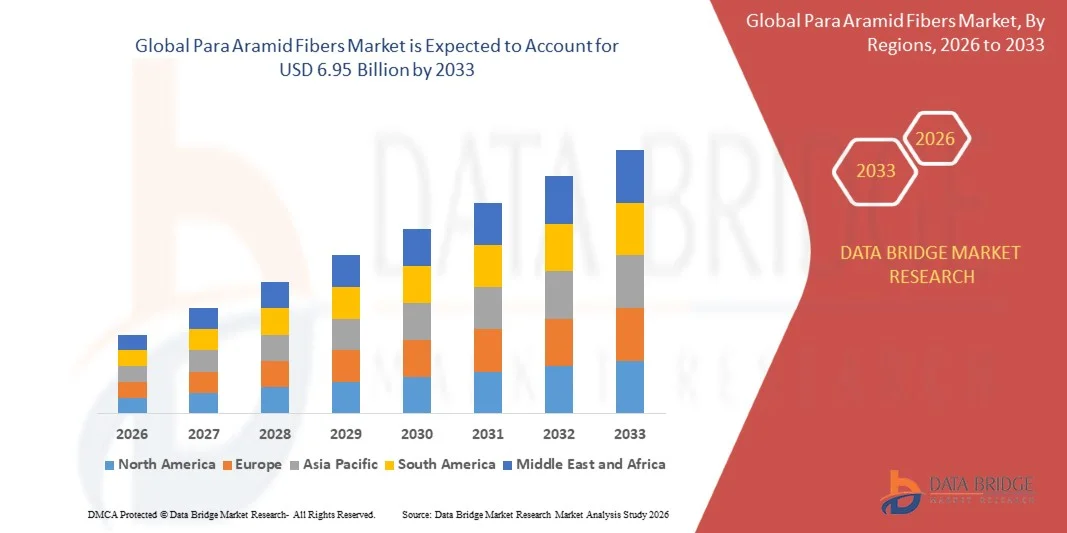
- As per Data Bridge Market Research analysis, the para aramid fibers market was valued at USD 4.02 billion in 2025 and is projected to reach USD 6.95 billion by 2033, growing at a CAGR of 7.10% from 2026 to 2033.
- The market is experiencing consistent growth driven by rising demand for high-strength and lightweight materials, increasing adoption in security and protective applications, and expanding use across aerospace, automotive, telecommunications, and industrial sectors.
- The increasing emphasis on personnel safety, ballistic protection, lightweight vehicle components, and high-performance reinforcement materials is encouraging manufacturers to adopt para aramid fibers. Their high tensile strength, heat resistance, low weight, and durability are supporting replacement of conventional materials in applications such as protective clothing, optical fiber reinforcement, tires, friction materials, and industrial composites.
Market Size & Forecast
- Global Market Value (2025): USD 4.02 Billion
- Expected Market Value (2033): USD 6.95 Billion
- Forecast CAGR (2026–2033): 7.10%
- Leading Region in 2025: North America
- Fastest Growing Region: Asia Pacific
What are the Major Takeaways of the Para Aramid Fibers Market?
- North America dominated the para aramid fibers market with the largest revenue share of 30% in 2025, supported by robust defense spending, aerospace innovation, industrial safety regulations, and established demand for ballistic protection and reinforced composites.
- Asia-Pacific is expected to be the fastest-growing region at a CAGR of 8.9% from 2026 to 2033, fueled by rapid industrialization, expanding telecommunications infrastructure, rising security and protection requirements, and growing demand from China and India.
- The filament yarn segment led the market with a 59% share in 2025, driven by its extensive use in protective textiles, tire reinforcement, optical fiber cables, and other high-strength applications.
- Short fibers are the fastest-growing product form type, projected to register a CAGR of 7.0%, reflecting the surge in utilization in frictional materials, composites, and engineered reinforcement applications.
- The protection segment dominated the application category with a 37.8% revenue share in 2025, led by extensive utilization of para-aramid fibers in ballistic protection, protective clothing, helmets, gloves, and other safety products.
- Ballistic protection accounted for 35% of the market share in 2025, preferred by the extensive use of para-aramid fibers in body armor, helmets, ballistic panels, protective shields, and military equipment
- The cut protection segment is the fastest-growing protection level category, with a CAGR of 8.5%, driven by increasing demand for cut-resistant gloves, sleeves, and protective garments.
Report Scope and Para Aramid Fibers Market Segmentation
|
Attributes |
Para Aramid Fibers Key Market Insights |
|
Segments Covered |
|
|
Countries Covered |
North America
Europe
Asia-Pacific
Middle East and Africa
South America
|
|
Key Market Players |
|
|
Market Opportunities |
|
|
Value Added Data Infosets |
In addition to the insights on market scenarios such as market value, growth rate, segmentation, geographical coverage, and major players, the market reports curated by the Data Bridge Market Research also include import export analysis, production capacity overview, production consumption analysis, price trend analysis, climate change scenario, supply chain analysis, value chain analysis, raw material/consumables overview, vendor selection criteria, PESTLE Analysis, Porter Analysis, and regulatory framework. |
What is the Key Trend in the Para Aramid Fibers Market?
- Para-aramid fibers are increasingly being incorporated into lightweight, high-performance composite materials for automotive, aerospace, defense, and industrial applications, replacing heavier reinforcement materials while maintaining strength and durability.
- For instance, in April 2025, an Alexandria Engineering Journal review highlighted the growing role of fiber-reinforced composites, including aramid fibers, in automotive engineering as manufacturers pursue vehicle lightweighting, improved efficiency, and enhanced structural performance.
- Manufacturers are increasingly developing advanced para-aramid fibers with enhanced tensile strength, thermal stability, chemical resistance, and interfacial performance to meet demanding aerospace, defense, telecommunications, and industrial requirements.
- Sustainable and circular para-aramid solutions are gaining attention as manufacturers seek to reduce material waste, carbon emissions, and dependence on virgin raw materials while retaining the performance characteristics required in demanding applications.
- For instance, in November 2025, Teijin Aramid introduced Twaron Next, a para-aramid fiber incorporating circular and bio-based raw materials, with its circular-content variant reported to reduce carbon emissions by up to 7% compared with virgin Twaron.
- As industries increasingly prioritize lightweight construction, high mechanical performance, and lower environmental impact, para-aramid fibers are expected to gain further adoption in advanced composites, protective systems, reinforcement products, and next-generation infrastructure.
What are the Key Drivers of the Para Aramid Fibers Market?
- The increasing demand for lightweight ballistic protection and high-performance protective equipment is significantly increasing the use of para-aramid fibers in military, law enforcement, and security applications.
- For instance, in February 2024, the U.S. Army fielded its Next-Generation Integrated Head Protection System to approximately 2,000 Soldiers, highlighting continued modernization of lightweight protective equipment.
- Growing defense modernization, industrial safety requirements, and demand for high-strength materials are encouraging manufacturers to use para-aramid fibers in body armor, helmets, protective clothing, aerospace components, and reinforced structures.
- For instance, in January 2025, Teijin Aramid highlighted its collaboration with SAFECO Industries to develop advanced ballistic vehicle armor using Twaron para-aramid, emphasizing lightweight protection for high-risk environments.
- With defense modernization, lightweight vehicle development, telecommunications expansion, and demand for durable reinforcement materials continuing to increase, para-aramid fibers will remain important for high-performance protection and structural applications.
Which Factors are Challenging the Growth of the Para Aramid Fibers Market?
- Para-aramid fibers involve high production and processing costs because manufacturing requires specialized polymer chemistry, sophisticated spinning technology, controlled processing conditions, and substantial investment in production infrastructure.
- For instance, in October 2024, ChemAnalyst reported that Asian aramid fiber prices increased amid higher production costs, with para-phenylenediamine (PPD) prices rising 2.6% in China, highlighting the impact of feedstock-cost increases on para-aramid fiber production expenses.
- These higher material costs can limit adoption in price-sensitive automotive, construction, consumer, and industrial applications, where manufacturers may favor lower-cost glass fibers or other conventional reinforcement materials.
- For instance, in June 2024, European Rubber Journal reported that Teijin’s aramid fiber business was affected by inventory adjustments in the supply chain, while the company continued to face challenges in stabilizing production, highlighting supply-chain and production-stability constraints for para-aramid fibers.
- The high production cost, specialized processing requirements, and competition from lower-cost reinforcement materials continue to restrict broader para-aramid adoption, particularly in mass-market applications, despite the material's superior strength-to-weight ratio and thermal performance.
How is the Para Aramid Fibers Market Segmented?
The para aramid fibers market is segmented on the basis of product form, application, protection level, and end user.
- By Product Form
On the basis of product form, the para-aramid fibers market is segmented into filament yarn, short fibers, pulp, and others. The filament yarn segment dominated the market with 59% share in 2025, owing to its extensive use in protective textiles, tire reinforcement, optical fiber cables, and other high-strength applications. Filament yarn provides continuous reinforcement and consistent tensile performance, making it suitable for applications requiring high strength and dimensional stability. Its lightweight characteristics also support its use in products where weight reduction is important without compromising mechanical performance. The material offers excellent resistance to heat, abrasion, and chemicals, which increases its suitability for demanding industrial environments. Growing demand for ballistic protection and high-performance reinforcement materials is supporting the consumption of filament yarn.
The short fibers segment is projected to register the fastest growth at CAGR of 7.0% from 2026 to 2033, driven by increasing utilization in frictional materials, composites, and engineered reinforcement applications. Short fibers can be incorporated into different material formulations to improve strength, wear resistance, and thermal performance. Their ability to disperse within friction and composite systems makes them suitable for specialized industrial applications. Increasing demand for lightweight materials is encouraging manufacturers to replace conventional reinforcement materials with high-performance fibers. Automotive braking components and industrial friction products are important application areas for short para-aramid fibers. Continued development of application-specific fiber lengths and grades is supporting greater adoption.
- By Application
On the basis of application, the para-aramid fibers market is segmented into frictional materials, protection, electrical insulation, safety garment, rubber reinforcement, tire reinforcement, industrial filtration, optical fibers, and others. The protection segment dominated the market with an 37.8% share in 2025, supported by extensive utilization of para-aramid fibers in ballistic protection, protective clothing, helmets, gloves, and other safety products. Para-aramid fibers provide high tensile strength while maintaining relatively low weight, making them suitable for personnel-protection applications. Their heat, flame, and abrasion resistance further enhance their performance in demanding environments. Defense, law enforcement, and industrial safety applications represent important sources of demand for protective para-aramid materials. Increasing emphasis on personnel safety and protective equipment is supporting continued adoption.
The optical fibers segment is projected to register the fastest growth at CAGR of 8.8% from 2025 to 2033, driven by increasing deployment of fiber-optic telecommunications infrastructure. Para-aramid fibers are used as strength members in optical fiber cables because they provide high tensile strength without adding substantial weight. Expansion of broadband connectivity and high-speed communication networks is increasing demand for reinforced optical cables. The continued rollout of advanced telecommunications infrastructure is creating additional opportunities for para-aramid fiber suppliers. Their flexibility and resistance to mechanical stress help protect optical fibers during installation and operation. Increasing data transmission requirements are encouraging wider deployment of fiber-optic networks.
- By Protection Level
On the basis of protection level, the para-aramid fibers market is segmented into ballistic protection, cut protection, heat protection, flame protection, abrasion protection, impact protection, and electrical protection. The ballistic protection segment dominated the market with 35% share in 2025, owing to the extensive use of para-aramid fibers in body armor, helmets, ballistic panels, protective shields, and military equipment. The high strength-to-weight ratio of para-aramid fibers enables manufacturers to develop lightweight protective systems. Their ability to absorb and dissipate energy makes them suitable for ballistic applications requiring high-performance materials. Defense and law-enforcement procurement remains an important source of demand for ballistic-grade para-aramid products. Increasing modernization of protective equipment is encouraging the use of advanced fiber-based materials.
The cut protection segment is projected to register the fastest growth at a CAGR of 8.5% from 2026 to 2033, supported by increasing demand for cut-resistant gloves, sleeves, and protective garments. Para-aramid fibers provide high resistance to cutting and abrasion while maintaining flexibility and relatively low weight. These characteristics make them suitable for workers exposed to sharp metal, glass, machinery, and other hazardous materials. Increasing workplace safety requirements are encouraging industries to adopt higher-performance protective equipment. Automotive, manufacturing, construction, metal processing, and logistics applications are contributing to demand for cut-resistant materials. Manufacturers are also focusing on lighter and more comfortable protective products to improve usability.
- By End User
On the basis of end user, the para-aramid fibers market is segmented into automotive, aerospace and defence, electronics and telecommunication, electrical, and others. The automotive segment dominated the market with 30% share in 2025, supported by extensive use of para-aramid fibers in tire reinforcement, friction materials, belts, hoses, and other automotive components. The high strength-to-weight ratio of para-aramid fibers enables manufacturers to improve component performance while controlling weight. Their resistance to heat, abrasion, and mechanical stress is particularly valuable in demanding automotive applications. Tire reinforcement and friction materials represent important consumption areas within the automotive sector. Increasing vehicle lightweighting requirements are further supporting the adoption of high-performance reinforcement fibers. The expansion of electric mobility is also creating additional applications for lightweight and durable fiber-reinforced components.
The electronics and telecommunication segment is projected to register the fastest growth CAGR of 7.1% from 2026 to 2033, driven by increasing deployment of optical fiber networks and advanced telecommunications infrastructure. Para-aramid fibers provide high tensile strength and flexibility, making them suitable for reinforcement in optical communication cables. Expansion of high-speed connectivity is increasing demand for durable fiber-optic cable systems. Growing deployment of 5G and broadband infrastructure is creating additional opportunities for para-aramid-based cable reinforcement. Data-center expansion is also supporting demand for reliable and high-performance optical connectivity. The material helps cables withstand installation stresses while protecting the optical fibers within the cable structure.
Which Region Holds the Largest Share of the Para Aramid Fibers Market?
- North America dominated the para aramid fibers market with the largest revenue share of 30% in 2025, supported by robust defense spending, aerospace innovation, industrial safety regulations, and established demand for ballistic protection and reinforced composites.
- The region also benefits from substantial defense spending, established aerospace and automotive manufacturing capabilities, stringent occupational safety requirements, and increasing adoption of lightweight, high-strength materials. Growing demand for ballistic protection, advanced protective clothing, tire reinforcement, and fiber-optic infrastructure further strengthens North America’s position in the global para-aramid fibers market.
U.S. Para Aramid Fibers Market Insight
The U.S. para-aramid fibers market is witnessing strong growth due to rising demand for high-performance materials across aerospace and defense, automotive, protective equipment, and telecommunications applications. The country’s advanced aerospace and defense ecosystem, along with increasing adoption of lightweight and high-strength materials, is driving demand across ballistic protection, tire reinforcement, and industrial applications. In addition, growing investments in advanced protective systems, fiber-optic infrastructure, and vehicle lightweighting are accelerating the adoption of para-aramid fibers across diverse industries.
Asia-Pacific Para-Aramid Fibers Market Insight
The Asia-Pacific para-aramid fibers market is expected to witness rapid growth, driven by expanding automotive production, telecommunications infrastructure, and industrial manufacturing across countries such as China, India, and Japan. Growing demand for lightweight reinforcement materials, protective equipment, and high-performance fibers is supporting regional market expansion. Additionally, increasing investments in aerospace and defense capabilities, fiber-optic networks, and advanced automotive components are accelerating para-aramid fiber adoption across industrial and commercial sectors.
Japan Para-Aramid Fibers Market Insight
The Japan para-aramid fibers market is witnessing consistent growth due to rising demand for advanced materials across automotive, electronics, telecommunications, and industrial applications. Automotive manufacturers and industrial companies are increasingly utilizing para-aramid fibers for tire reinforcement, friction materials, rubber reinforcement, and lightweight components. Moreover, increasing demand for high-performance protective materials and optical fiber cables, together with Japan’s focus on advanced manufacturing technologies, is further contributing to market growth.
China Para-Aramid Fibers Market Insight
The China para-aramid fibers market is growing rapidly, driven by expanding automotive manufacturing, telecommunications infrastructure, and demand for advanced protective materials. Growing utilization of para-aramid fibers in tire reinforcement, optical fiber cables, protective equipment, and industrial applications is significantly boosting market demand. In addition, rising investments in aerospace and defense capabilities, expansion of high-speed communication networks, and increasing focus on lightweight and high-strength materials are positioning China as a major growth market for para-aramid fibers globally.
U.K. Para-Aramid Fibers Market Insight
The U.K. para-aramid fibers market is experiencing steady growth, supported by rising demand for advanced protective materials, aerospace and defense applications, automotive components, and telecommunications infrastructure. Increasing utilization of para-aramid fibers in ballistic protection, safety garments, optical fiber cables, and high-performance reinforcement applications is contributing to market growth. Furthermore, continued development of lightweight materials and increasing demand for high-strength solutions across industrial and defense applications are supporting the adoption of para-aramid fibers in the U.K.
Germany Para-Aramid Fibers Market Insight
The Germany para-aramid fibers market is expanding steadily due to the country’s strong automotive manufacturing base, advanced industrial capabilities, and increasing demand for high-performance reinforcement materials. Automotive companies and industrial manufacturers are increasingly utilizing para-aramid fibers in tire reinforcement, friction materials, rubber components, and lightweight applications. Continuous advancements in automotive technologies, increasing demand for protective equipment, and growing deployment of optical fiber infrastructure, along with Germany’s focus on advanced manufacturing, are further driving market growth.
Which are the Top Companies in Para Aramid Fibers Market?
The para aramid fibers industry is primarily led by well-established companies, including:
- TEIJIN LIMITED (Japan)
- DuPont (U.S.)
- Yantai Tayho Advanced Materials Co., Ltd. (China)
- Kolon Industries, Inc. (South Korea)
- HYOSUNG ADVANCED MATERIALS (South Korea)
- TAEKWANG Industrial Co., Ltd. (South Korea)
- HUVIS (South Korea)
- Kermel S.A. (France)
- China National Bluestar (Group) Co., Ltd. (China)
- SuZhou Hayxan Protection Technology Co.,Ltd. (China)
- Jiangsu Yabang Dyestuff Co., Ltd. (China)
- Guangzhou Green New Materials Co., Ltd. (China)
- Davy Textiles Ltd. (U.K.)
- Artec (China)
- AFCHINA (China)
- Toray Industries, Inc. (Japan)
- China National Petroleum Corporation (China)
- Sinopec Yizheng Chemical Fibre Company Limited (China)
- Jiangsu Zhongxing Chemical Fiber Co., Ltd. (China)
- Shandong Vicome Import & Export Co., Ltd. (China)
What are Latest Developments in Para Aramid Fibers Market?
- In August 2025, DuPont announced an agreement with Arclin to divest its Aramids business, which includes the Kevlar and Nomex brands. The transaction is intended to transfer the high-performance aramid fiber business to Arclin, enabling the business to expand its global reach and application-development capabilities while allowing DuPont to further streamline its portfolio. The development represents a significant structural change involving one of the leading global suppliers of aramid fibers
- In January 2024, DuPont and Point Blank Enterprises announced an exclusive partnership to offer body armor made with Kevlar EXO aramid fiber to North American state and local law-enforcement departments. The collaboration combines DuPont’s next-generation aramid fiber technology with Point Blank’s body-armor manufacturing capabilities to develop lightweight and flexible protective solutions. The partnership also targeted the requirements of the updated National Institute of Justice (NIJ) ballistic protection standards.
- In April 2023, DuPont launched Kevlar EXO, a next-generation aramid fiber developed for demanding protection applications. The new fiber was designed to provide a combination of ballistic protection, lightweight performance, flexibility, and thermal resistance, with military and law-enforcement personnel identified as initial users through soft-body-armor applications. The development represented a major expansion of DuPont’s Kevlar technology platform and was produced at the company’s new manufacturing facility in Virginia.
- In April 2023, Teijin Aramid achieved its first industrial-scale production run using its physical fiber-to-fiber recycling technology for aramid fibers. The initiative focused on recycling end-of-life aramid products into new fiber materials and represented an important development toward a circular production process for Twaron aramid fibers. Teijin subsequently continued advancing the technology, including another industrial-scale production run in April 2024 and development of chemical recycling technologies.
- In December 2021, DuPont announced the winner of its North America Kevlar Innovation Award, recognizing Ansell’s HyFlex 11-290 sleeve incorporating Kevlar Comfort Engineered Yarn. The protective sleeve combined Kevlar fiber with an ergonomic design to provide cut and thermal protection while improving wearer comfort and mobility. The development highlighted continued innovation in para-aramid fiber applications for industrial personal protective equipment and demonstrated the expansion of Kevlar® into specialized protection products.

- Interactive Data Analysis Dashboard
- Company Analysis Dashboard for high growth potential opportunities
- Research Analyst Access for customization & queries
- Competitor Analysis with Interactive dashboard
- Latest News, Updates & Trend analysis
- Harness the Power of Benchmark Analysis for Comprehensive Competitor Tracking
Global Para Aramid Fibers Market, Supply Chain Analysis and Ecosystem Framework
To support market growth and help clients navigate the impact of geopolitical shifts, DBMR has integrated in-depth supply chain analysis into its Global Para Aramid Fibers Market research reports. This addition empowers clients to respond effectively to global changes affecting their industries. The supply chain analysis section includes detailed insights such as Global Para Aramid Fibers Market consumption and production by country, price trend analysis, the impact of tariffs and geopolitical developments, and import and export trends by country and HSN code. It also highlights major suppliers with data on production capacity and company profiles, as well as key importers and exporters. In addition to research, DBMR offers specialized supply chain consulting services backed by over a decade of experience, providing solutions like supplier discovery, supplier risk assessment, price trend analysis, impact evaluation of inflation and trade route changes, and comprehensive market trend analysis.
Data collection and base year analysis are done using data collection modules with large sample sizes. The stage includes obtaining market information or related data through various sources and strategies. It includes examining and planning all the data acquired from the past in advance. It likewise envelops the examination of information inconsistencies seen across different information sources. The market data is analysed and estimated using market statistical and coherent models. Also, market share analysis and key trend analysis are the major success factors in the market report. To know more, please request an analyst call or drop down your inquiry.
The key research methodology used by DBMR research team is data triangulation which involves data mining, analysis of the impact of data variables on the market and primary (industry expert) validation. Data models include Vendor Positioning Grid, Market Time Line Analysis, Market Overview and Guide, Company Positioning Grid, Patent Analysis, Pricing Analysis, Company Market Share Analysis, Standards of Measurement, Global versus Regional and Vendor Share Analysis. To know more about the research methodology, drop in an inquiry to speak to our industry experts.
Data Bridge Market Research is a leader in advanced formative research. We take pride in servicing our existing and new customers with data and analysis that match and suits their goal. The report can be customized to include price trend analysis of target brands understanding the market for additional countries (ask for the list of countries), clinical trial results data, literature review, refurbished market and product base analysis. Market analysis of target competitors can be analyzed from technology-based analysis to market portfolio strategies. We can add as many competitors that you require data about in the format and data style you are looking for. Our team of analysts can also provide you data in crude raw excel files pivot tables (Fact book) or can assist you in creating presentations from the data sets available in the report.