


What is the Parkinson’s Disease Market Size and Growth Rate?
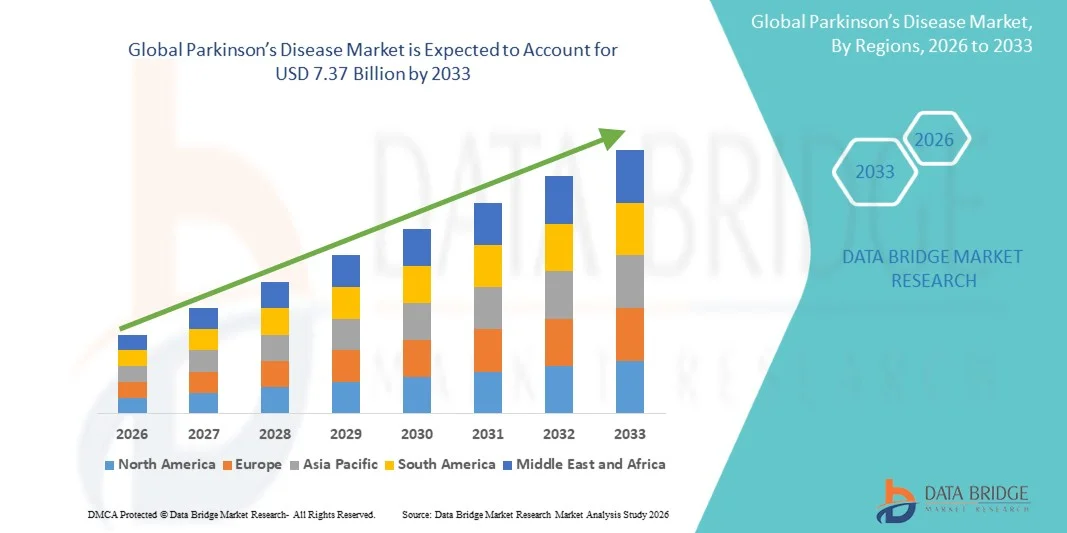
- As per Data Bridge Market Research analysis, the Parkinson’s Disease market was valued at USD 3.65 billion in 2025 and is projected to reach USD 7.37 billion by 2033, growing at a CAGR of 9.20% from 2026 to 2033.
- The market is expanding due to the rising prevalence of parkinson’s disease, growing geriatric population, increasing disease awareness and diagnosis, rising demand for effective symptomatic treatments, and advancements in parkinson’s disease therapeutics. Increasing investments in neurological drug research and development, the introduction of novel drug-delivery approaches, and the development of therapies targeting motor fluctuations are further supporting market growth.
- Parkinson’s disease therapies are pharmaceutical and therapeutic products designed to manage motor and non-motor symptoms associated with parkinson’s disease and improve patients’ quality of life. These therapies include levodopa/carbidopa, dopamine agonists, monoamine oxidase b inhibitors, catechol-o-methyltransferase inhibitors, anticholinergics, and other antiparkinsonian treatments, administered through oral, transdermal, injectable, and infusion-based routes.
Market Size & Forecast
- Global Market Value (2025): USD 3.65 billion
- Expected Market Value (2033): USD 7.37 billion
- Forecast CAGR (2026–2033): 9.20%
- Leading Region in 2025: North America
- Fastest Growing Region: Asia-Pacific
What are the Major Takeaways of the Parkinson’s Disease Market?
- North America dominated the global parkinson’s disease market with a 38.10% revenue share in 2025, supported by advanced healthcare infrastructure, high healthcare expenditure, strong pharmaceutical research and development, and greater adoption of advanced parkinson’s disease therapies.
- Asia-pacific is expected to be the fastest-growing regional market, registering a CAGR of 12.74% from 2026 to 2033, driven by increasing healthcare expenditure, improving diagnosis rates, expanding healthcare infrastructure, and rising awareness of neurological disorders.
- Carbidopa-levodopa dominated the global parkinson’s disease treatment market with a 39.46% revenue share in 2025, supported by its established role in managing parkinson’s disease motor symptoms and its widespread clinical use.
- Oral administration represented the leading route of administration segment, accounting for a 60.31% revenue share in the parkinson’s disease drugs market, supported by ease of administration, patient convenience, established prescribing practices, and the broad availability of oral parkinson’s medicines.
- Parenteral administration are expected to register a CAGR of 9.5% to 10.0% from 2026 to 2033, supported by increasing clinical adoption, combination therapy, improved symptom management, and continued product development.
Report Scope and Parkinson’s Disease Market Segmentation
|
Attributes |
Parkinson’s Disease Key Market Insights |
|
Segments Covered |
|
|
Countries Covered |
North America
Europe
Asia-Pacific
Middle East and Africa
South America
|
|
Key Market Players |
|
|
Market Opportunities |
|
|
Value Added Data Infosets |
In addition to the insights on market scenarios such as market value, growth rate, segmentation, geographical coverage, and major players, the market reports curated by the Data Bridge Market Research also include in-depth expert analysis, patient epidemiology, pipeline analysis, pricing analysis, and regulatory framework. |
What is the Key Trend in the Parkinson’s Disease Market?
- The parkinson’s disease market is increasingly shifting toward advanced drug-delivery systems and longer-acting formulations, as pharmaceutical companies seek to reduce motor fluctuations and improve treatment convenience. Continuous subcutaneous and intestinal delivery systems are gaining attention because they can provide steadier dopaminergic exposure than intermittent oral dosing.
- For instance, in February 2025, Supernus pharmaceuticals received FDA approval for ONAPGA (apomorphine hydrochloride) for advanced parkinson’s disease, providing a continuous subcutaneous infusion option. The development highlights the movement toward infusion-based treatment approaches for patients who experience motor fluctuations despite conventional oral therapy.
- The market is also moving toward extended-release and once-daily oral formulations designed to improve the duration of symptom control and reduce dosing frequency. For instance, in June 2026, zambon and amneal announced a positive CHMP opinion for HOPLDEO (ipx203), an extended-release levodopa/carbidopa formulation. The phase 3 rise-pd study showed increased “good on” time with fewer daily doses compared with immediate-release levodopa/carbidopa.
- The market is additionally shifting toward disease-modifying and precision-treatment approaches targeting biological mechanisms associated with parkinson’s disease, including alpha-synuclein, lrrk2, GBA, and other pathways.
- Overall, the parkinson’s disease market is increasingly shaped by continuous drug delivery, extended-release formulations, once-daily therapies, disease-modifying candidates, biomarker-driven treatment strategies, and precision medicine. Recent developments involving Supernus, Amneal, Zambon, Roche, And Biogen demonstrate that manufacturers are focusing not only on conventional symptomatic treatment but also on improving dosing convenience, reducing motor fluctuations, extending therapeutic duration, and targeting the underlying biological mechanisms of parkinson’s disease.
What are the Key Drivers of the Parkinson’s Disease Market?
- The increasing development of disease-modifying therapies is a major driver of the parkinson’s disease market, as pharmaceutical and biotechnology companies are increasingly targeting the underlying biological mechanisms associated with disease progression rather than focusing only on symptomatic treatment.
- Research is expanding toward targets such as alpha-synuclein, LRRK2, GBA1, and other pathways associated with neurodegeneration. This is supporting continued investment in innovative Parkinson’s drug pipelines and clinical trials.
- For instance, in June 2025, Roche announced that it would advance prasinezumab into Phase III development for early-stage parkinson’s disease. Prasinezumab is an investigational anti-alpha-synuclein antibody designed to target a biological mechanism associated with Parkinson’s disease progression. Roche's decision followed Phase IIb PADOVA and longer-term follow-up data.
- Investment in targeted drug-delivery technologies and therapies capable of addressing the blood-brain barrier is another emerging driver. Denali also advanced programs targeting GCase and alpha-synuclein using its TransportVehicle platforms. These approaches demonstrate increasing industry interest in delivering therapies to relevant neurological targets and developing treatments based on disease biology.
- Overall, the parkinson’s disease market is increasingly shaped by disease-modifying drug development, alpha-synuclein targeting, genetically targeted therapies, oral treatment options, advanced drug-delivery platforms, and precision medicine approaches.
What Factors Are Challenging the Growth of the Accelerometer-Based Digital Pen Market?
- The parkinson’s disease market continues to face challenges in developing disease-modifying therapies, as many investigational treatments have struggled to demonstrate statistically significant effects on disease progression.
- Clinical trial design, long study durations, and difficulty measuring disease progression remain major challenges for parkinson’s drug development. The FDA has highlighted incomplete understanding of disease progression, variability between patients, limitations in traditional trial designs, and inadequate trial size and duration as barriers to developing transformative neurological therapies.
- For instance, in February 2025, a continuous subcutaneous apomorphine infusion treatment for motor fluctuations in parkinson’s disease. The approval followed earlier regulatory rejections related to product quality and the delivery device, highlighting the regulatory and device-development challenges associated with advanced parkinson’s treatments.
- Disease heterogeneity and the need for personalized treatment approaches continue to complicate therapeutic development. Parkinson’s disease can involve substantial differences in motor and non-motor symptoms, disease progression, and treatment response, making it difficult to identify uniform endpoints and therapies applicable across patient populations. The ongoing development of combination approaches reflects the recognition that a single mechanism may not adequately address the complexity of disease progression.
- Overall, the parkinson’s disease market is challenged by the complexity of disease modification, lengthy clinical development timelines, difficulty establishing reliable progression endpoints, treatment-related safety considerations, and the need to demonstrate durable benefits across heterogeneous patient populations. Recent developments in prasinezumab, risvodetinib, adaptive deep-brain stimulation, and other emerging approaches illustrate the industry's continued effort to overcome these barriers.
How is the parkinson’s disease market segmented?
The Parkinson’s Disease market is segmented on the basis of drug class, medical devices, route of administration, and distribution channel.
- By Drug Class
On the basis of drug class, the global parkinson’s disease market is segmented into levodopa/carbidopa, dopamine receptor agonists, MAO-inhibitors, COMT-inhibitors, anticholinergics, and other drugs. The levodopa/carbidopa segment dominated the market with a 35.02% revenue share in 2025, supported by its established position as a primary symptomatic treatment, widespread clinical adoption, and effectiveness in improving motor symptoms.
The levodopa/carbidopa segment is expected to register a CAGR of 4.10% from 2026 to 2033, supported by continued demand for established levodopa-based treatment and the development of advanced formulations and delivery systems.
- By Medical Devices
On the basis of medical devices, the global parkinson’s disease market is segmented into deep brain stimulation (DBS) devices and carbidopa/levodopa enteral suspension (DUOPA) delivery devices. The deep brain stimulation (DBS) devices segment dominated the medical devices segment with a 59.30% revenue share in 2025, supported by the increasing adoption of DBS therapy among patients with advanced parkinson’s disease, technological advancements in neuromodulation systems, and growing demand for minimally invasive treatment options.
The deep brain stimulation devices segment is projected to register a CAGR of 10.00% from 2026 to 2033, driven by the rising prevalence of parkinson’s disease, increasing adoption of advanced DBS systems, and continued product innovation.
- By Route of Administration
On the basis of route of administration, the global parkinson’s disease market is segmented into oral, transdermal, subcutaneous, intestinal infusion, and others. The oral segment dominated the market with a 75.05% revenue share in 2025, supported by the widespread use of oral levodopa/carbidopa, dopamine agonists, mao-b inhibitors, COMT inhibitors, and other established parkinson’s medicines.
The infusion segment is projected to register a CAGR of 4.21% from 2026 to 2031, supported by increasing adoption of continuous drug-delivery systems for patients experiencing motor fluctuation.
- By Distribution Channel
On the basis of distribution channel, the global parkinson’s disease market is segmented into hospital pharmacies, clinics, retail pharmacies, and online pharmacies. The hospital pharmacy segment accounted for a 59.78% revenue share in 2025, supported by the specialist management of parkinson’s disease, hospital-based initiation of advanced therapies, and the need for medical supervision for complex treatment regimens.
The online pharmacy segment is expected to register a CAGR of 4.93% from 2026 to 2031, driven by increasing digital healthcare adoption, prescription fulfillment, home delivery, and growing acceptance of online pharmaceutical services.
Which Region Holds the Largest Share of the Parkinson’s Disease Market?
- North America dominated the global parkinson’s disease market with a 38.10% revenue share in 2025, supported by advanced healthcare infrastructure, high healthcare expenditure, strong pharmaceutical research and development, and greater adoption of advanced parkinson’s disease therapies.
- Asia-pacific is expected to be the fastest-growing regional market, registering a CAGR of 12.74% from 2026 to 2033, driven by increasing healthcare expenditure, improving diagnosis rates, expanding healthcare infrastructure, and rising awareness of neurological disorder.
U.S. Parkinson’s Disease Market Insight
The U.S. Parkinson’s disease market is expanding steadily, supported by the rising prevalence of parkinson’s disease, an aging population, advanced healthcare infrastructure, and strong pharmaceutical research and development capabilities. Increasing adoption of levodopa-based therapies, dopamine agonists, deep brain stimulation, and continuous drug-delivery technologies is supporting market growth. Growing investments in disease-modifying therapies, biomarker research, and precision medicine are further strengthening the treatment landscape. In addition, improved disease awareness, early diagnosis, specialist neurological care, and favorable access to innovative therapies are contributing to increased demand for advanced parkinson’s disease management solutions across the U.S.
Canada Parkinson’s Disease Market Insight
The Canada parkinson’s disease market is supported by an aging population, increasing prevalence of parkinson’s disease, established healthcare infrastructure, and growing access to advanced neurological treatments. Rising disease awareness and improvements in diagnosis are contributing to greater demand for effective symptom-management therapies. The market is also benefiting from the adoption of advanced drug-delivery systems, deep brain stimulation, and continuous infusion technologies for patients with advanced disease. Increasing healthcare expenditure, pharmaceutical research, and clinical development activities are further supporting market expansion. Growing emphasis on personalized treatment and innovative disease-management approaches is expected to create additional opportunities across Canada.
Germany Parkinson’s Disease Market Insight
Germany’s parkinson’s disease market is supported by a well-developed healthcare system, increasing prevalence of parkinson’s disease among the aging population, and strong access to specialized neurological care. Growing adoption of advanced treatment options, including levodopa-based therapies, deep brain stimulation, and continuous drug-delivery systems, is contributing to market development. Increasing healthcare expenditure and improvements in disease diagnosis are further supporting treatment uptake. In addition, Germany’s established pharmaceutical and medical device industries encourage research and innovation in neurological therapies. The growing focus on personalized treatment and improved disease management is expected to create further opportunities for market expansion.
U.K. Parkinson’s Disease Market Insight
The U.K. Parkinson’s disease market is expanding due to the growing prevalence of parkinson’s disease, an aging population, increasing disease awareness, and improvements in diagnosis and treatment. The national health service (NHS) provides broad access to established therapies, including levodopa-based medicines, dopamine agonists, and advanced treatment options for patients with complex symptoms. Increasing adoption of deep brain stimulation, continuous drug-delivery systems, and digital health technologies is supporting treatment innovation. In addition, ongoing clinical research and investment in disease-modifying therapies are creating opportunities for pharmaceutical companies and medical-device manufacturers in the U.K.
Asia-Pacific Parkinson’s Disease Market Insight
The Asia-pacific parkinson’s disease market is experiencing strong growth, supported by the rising prevalence of neurological disorders, aging populations, expanding healthcare infrastructure, and increasing healthcare expenditure. Growing awareness of parkinson’s disease and improvements in diagnosis are contributing to earlier treatment and greater demand for advanced therapies. China, Japan, India, South Korea, And Australia represent important markets across the region, supported by expanding pharmaceutical research and development activities and improving access to specialized neurological care. Increasing adoption of innovative drug-delivery systems, digital health technologies, and advanced treatment approaches is further supporting regional market expansion.
China Parkinson’s Disease Market Insight
The China parkinson’s disease market is expanding as the country experiences a growing aging population and increasing prevalence of neurodegenerative disorders. Improvements in neurological diagnosis, specialist healthcare services, and access to advanced treatment options are supporting market development. Growing healthcare expenditure and government initiatives to strengthen medical infrastructure are also improving access to parkinson’s disease management. Pharmaceutical companies are increasing research and development activities, while hospitals are adopting advanced drug-delivery systems and neuromodulation technologies. Increasing disease awareness, earlier diagnosis, and expanding availability of innovative therapies.
Japan Parkinson’s Disease Market Insight
The Japan parkinson’s disease market is expanding due to the country’s rapidly aging population, increasing prevalence of parkinson’s disease, and well-established healthcare infrastructure. Rising demand for effective symptom management, advanced drug therapies, and innovative medical devices is supporting market development. Japan’s strong pharmaceutical and biotechnology ecosystem is also encouraging research into disease-modifying treatments, digital health solutions, and neuromodulation technologies. Growing awareness, improved diagnosis, and greater adoption of advanced treatment options are further contributing to market growth. The increasing focus on personalized care and innovative therapies is expected to create additional opportunities for market participants.
Which are the Top Companies in Parkinson’s Disease Market?
The Parkinson’s Disease industry is primarily led by well-established companies, including:
- GlaxoSmithKline plc (U.S.)
- Teva Pharmaceutical Industries Ltd. (U.S.)
- Boehringer Ingelheim International GmbH (Germany)
- AbbVie Inc. (U.S.)
- Bausch Health (U.S.)
- Lundbeck (U.S.)
- Sun Pharmaceutical Industries Ltd. (India)
- ACADIA Pharmaceuticals Inc. (U.S.)
- Merck & Co. Inc. (U.S.)
- Novartis AG (U.S.)
- UCB S.A. (U.S.)
- Dr. Reddy’s Laboratories Ltd.(India)
- WOCKHARDT (U.S.)
- F. Hoffmann-La Roche Ltd (U.S.)
- STADA Arzneimittel AG (India)
- Orion Corporation (U.S.)
- Mylan N.V (U.S.)
- Cipla Inc. (U.S.)
- Par Pharmaceutical (India)
- DAIICHI SANKYO COMPANY LIMITED (Japan)
- Apotex Inc. (U.S.)
What are Latest Developments in Parkinson’s Disease Market?
- In September 2025, Bayer/BlueRock advanced bemdaneprocel into Phase III development, making it the first Parkinson’s cell therapy to reach Phase III. The therapy is designed to replace dopamine-producing neurons lost during Parkinson’s disease and represents continued development of cell-replacement approaches for potentially disease-modifying treatment.
- In May 2026, Biogen and Denali discontinued BIIB122 development after the Phase 2b LUMA study failed to meet its primary and secondary endpoints in early-stage Parkinson’s disease. The companies said Denali would continue independently investigating the drug in people carrying pathogenic LRRK2 variants.
- In June 2026, Amneal reported Phase 4 ELEVATE-PD results for CREXONT Interim results from 214 participants showed increased daily “Good On” time, reduced “Off” time, and improved motor-function measures after switching to CREXONT. The FDA also approved a labeling update allowing certain patients with swallowing difficulties to open the capsules and sprinkle the contents on applesauce.
- In July 2026, The STEM-PD stem-cell trial reported positive early results. One year after treatment, brain scans showed that the transplanted cells had implanted in all seven assessed participants, while six reported reducing their dopamine medication. Parkinson’s UK noted that the trial remains small and requires longer-term follow-up.
- In July 2026, Syntara reported initial clinical findings for SNT-4728, with early results indicating reduced inflammation in a brain region associated with movement and motivation in people with isolated REM sleep behavior disorder, a condition associated with elevated Parkinson’s risk. The trial also reported no major safety concerns at this stage.

- Interactive Data Analysis Dashboard
- Company Analysis Dashboard for high growth potential opportunities
- Research Analyst Access for customization & queries
- Competitor Analysis with Interactive dashboard
- Latest News, Updates & Trend analysis
- Harness the Power of Benchmark Analysis for Comprehensive Competitor Tracking
Data collection and base year analysis are done using data collection modules with large sample sizes. The stage includes obtaining market information or related data through various sources and strategies. It includes examining and planning all the data acquired from the past in advance. It likewise envelops the examination of information inconsistencies seen across different information sources. The market data is analysed and estimated using market statistical and coherent models. Also, market share analysis and key trend analysis are the major success factors in the market report. To know more, please request an analyst call or drop down your inquiry.
The key research methodology used by DBMR research team is data triangulation which involves data mining, analysis of the impact of data variables on the market and primary (industry expert) validation. Data models include Vendor Positioning Grid, Market Time Line Analysis, Market Overview and Guide, Company Positioning Grid, Patent Analysis, Pricing Analysis, Company Market Share Analysis, Standards of Measurement, Global versus Regional and Vendor Share Analysis. To know more about the research methodology, drop in an inquiry to speak to our industry experts.
Data Bridge Market Research is a leader in advanced formative research. We take pride in servicing our existing and new customers with data and analysis that match and suits their goal. The report can be customized to include price trend analysis of target brands understanding the market for additional countries (ask for the list of countries), clinical trial results data, literature review, refurbished market and product base analysis. Market analysis of target competitors can be analyzed from technology-based analysis to market portfolio strategies. We can add as many competitors that you require data about in the format and data style you are looking for. Our team of analysts can also provide you data in crude raw excel files pivot tables (Fact book) or can assist you in creating presentations from the data sets available in the report.













