


What is the Patent Ductus Arteriosus Treatment Market Size and Growth Rate?
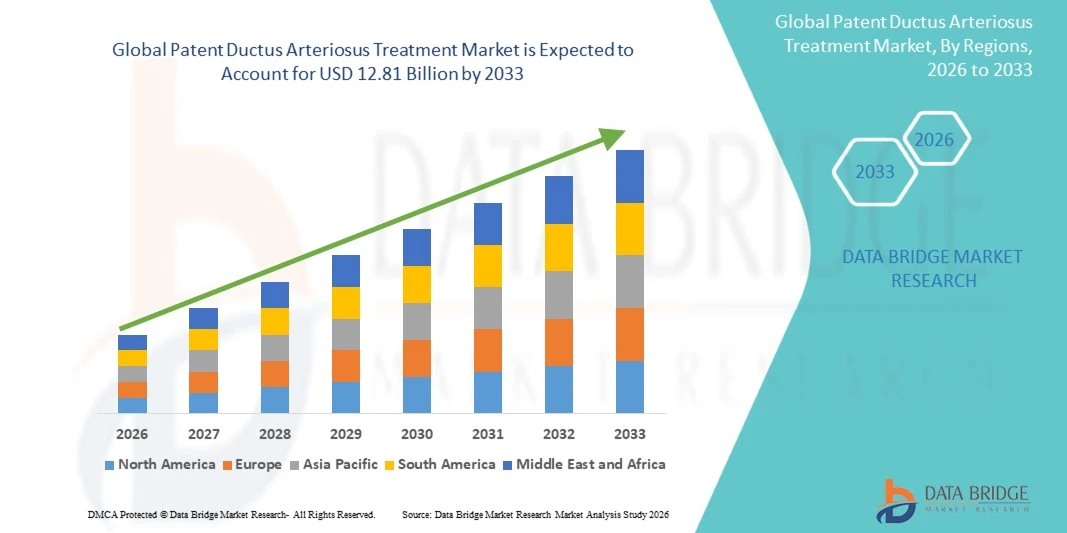
- As per Data Bridge Market Research analysis, the patent ductus arteriosus treatment market was valued at USD 4.19 billion in 2025 and is projected to reach USD 12.81 billion by 2033, growing at a CAGR of 15.00% from 2026 to 2033.
- The market is experiencing consistent growth driven by rising demand for diagnostic tests, increasing research and development activities, and the introduction of diversified treatment methods for patent ductus arteriosus, particularly across neonatal and pediatric care.
- The increasing incidence of patent ductus arteriosus among newborns, particularly very low birth weight infants, combined with growing adoption of advanced diagnostic and treatment approaches, is supporting market expansion. Echocardiography, medicines, catheter-based procedures, and surgical interventions are increasingly being integrated into clinical management, while improvements in conservative treatment approaches are contributing to better neonatal outcomes.
Market Size & Forecast
- Global Market Value (2025): USD 4.19 Billion
- Expected Market Value (2033): USD 12.81 Billion
- Forecast CAGR (2026–2033): 15.00%
- Leading Region in 2025: North America
- Fastest Growing Region: Asia Pacific
What are the Major Takeaways of the Patent Ductus Arteriosus Treatment Market?
- North America dominated the patent ductus arteriosus treatment market with the largest revenue share of 45% in 2025, supported by advanced neonatal and cardiac care infrastructure, high adoption of specialized treatment technologies, and significant investments in medical research and development.
- Asia-Pacific is expected to be the fastest-growing region at a CAGR of 7.4% from 2026 to 2033, fueled by increasing research and development activities and improving access to advanced PDA treatment.
- The echocardiogram segment led the market with a 45% share in 2025, driven by its ability to directly visualize the ductus arteriosus and assess abnormal blood flow
- Electrocardiogram are the fastest-growing diagnosis type, projected to register a CAGR of 6.8%, reflecting the surge in continued use as a complementary cardiac assessment tool in patients suspected of having PDA.
- The medicines segment dominated the treatment category with a 50% revenue share in 2025, led by the established role of pharmacological treatment in managing PDA, particularly among premature infants.
- Hospitals accounted for 55% of the market share in 2025, preferred by the need for specialized diagnostic and treatment infrastructure for PDA management.
- The catheter-based procedures segment is the fastest-growing treatment category, with a CAGR of 8.0%, driven by increasing preference for minimally invasive PDA closure among anatomically suitable patients.
Report Scope and Patent Ductus Arteriosus Treatment Market Segmentation
|
Attributes |
Patent Ductus Arteriosus Treatment Key Market Insights |
|
Segments Covered |
|
|
Countries Covered |
North America
Europe
Asia-Pacific
Middle East and Africa
South America
|
|
Key Market Players |
|
|
Market Opportunities |
|
|
Value Added Data Infosets |
In addition to the insights on market scenarios such as market value, growth rate, segmentation, geographical coverage, and major players, the market reports curated by the Data Bridge Market Research also include in-depth expert analysis, patient epidemiology, pipeline analysis, pricing analysis, and regulatory framework. |
What is the Key Trend in the Patent Ductus Arteriosus Treatment Market?
- Treatment strategies for patent ductus arteriosus are increasingly shifting toward individualized management, with greater emphasis on echocardiographic assessment, selective intervention, and minimally invasive closure in high-risk preterm infants.
- For instance, in April 2025, the American Academy of Pediatrics recommended against routine prophylactic or early medical closure, highlighting the growing preference for treatment based on hemodynamic significance and clinical condition.
- Advanced echocardiography enables clinicians to evaluate ductal size, flow patterns, cardiac effects, and pulmonary blood flow to determine whether intervention is clinically appropriate.
- Transcatheter PDA closure is increasingly being considered for extremely low-birth-weight infants when pharmacological treatment is unsuccessful or unsuitable, reducing reliance on surgical ligation.
- For instance, in August 2025, researchers at AIIMS New Delhi reported successful percutaneous PDA closure in nine of ten preterm neonates, with no procedure-related deaths, supporting wider use of catheter-based treatment.
- As neonatal cardiac teams continue adopting evidence-based selection criteria and less invasive interventions, individualized PDA management is expected to remain a central trend in treatment practice, particularly for vulnerable premature infants requiring specialized cardiovascular care and long-term monitoring after intervention and discharge from hospital settings globally.
What are the Key Drivers of the Patent Ductus Arteriosus Treatment Market?
- The high prevalence of patent ductus arteriosus among extremely preterm and very low-birth-weight infants is increasing demand for neonatal cardiac diagnosis, monitoring, and treatment services across specialized healthcare facilities.
- For instance, in April 2025, the American Academy of Pediatrics reported that delayed PDA closure is common in preterm infants, particularly those born at greater levels of immaturity, reinforcing the need for effective clinical management.
- Growing availability of neonatal intensive care units and pediatric cardiac services is improving access to echocardiography, pharmacological therapy, catheter-based closure, and surgical intervention.
- For instance, in August 2025, an AIIMS New Delhi study demonstrated the feasibility of transcatheter PDA closure in preterm neonates weighing a median 1,270 grams, expanding treatment possibilities for vulnerable infants.
- With advances in neonatal diagnostics, specialized cardiac teams, and minimally invasive technologies, increasing clinical capacity for PDA management is expected to support continued market growth across specialized neonatal and pediatric cardiac care settings, particularly in developing countries.
Which Factors are Challenging the Growth of the Patent Ductus Arteriosus Treatment Market?
- Uncertainty regarding the clinical significance and optimal treatment timing of patent ductus arteriosus continues to complicate treatment decisions, particularly among extremely preterm infants.
- These uncertainties can delay intervention and create variation in clinical practice because physicians must balance potential benefits of closure against spontaneous closure and treatment-related risks.
- For instance, in April 2025, the American Academy of Pediatrics highlighted persistent uncertainty and substantial variability in PDA assessment and management despite extensive clinical research.
- Pharmacological treatments can also involve safety concerns and variable effectiveness, limiting treatment adoption when clinicians weigh potential benefits against adverse outcomes in fragile neonates.
- For instance, in January 2024, the Baby-OSCAR randomized trial evaluated ibuprofen in 653 extremely preterm infants and found no significant reduction in death or moderate-to-severe bronchopulmonary dysplasia outcomes at 36 weeks.
- Limited access to specialized neonatal cardiac expertise and procedural facilities can restrict the adoption of advanced PDA closure procedures, particularly in healthcare systems where trained neonatal echocardiography and pediatric cardiac teams remain insufficient.
How is the Patent Ductus Arteriosus Treatment Market Segmented?
The patent ductus arteriosus treatment market is segmented on the basis of diagnosis, treatment, end-users, and distribution channel.
- By Diagnosis
On the basis of diagnosis, the patent ductus arteriosus treatment market is segmented into echocardiogram, chest X-ray, electrocardiogram, and others. The echocardiogram segment dominated the market with 45% share in 2025, owing to its ability to directly visualize the ductus arteriosus and assess abnormal blood flow. Echocardiography is widely used to determine the size and anatomical characteristics of PDA and evaluate its hemodynamic significance. It enables healthcare professionals to assess ductal diameter, shunt direction, flow pattern, and cardiac effects associated with PDA. The non-invasive nature of the procedure makes it particularly suitable for premature infants and pediatric patients who require repeated assessments. Increasing availability of echocardiography equipment in neonatal intensive care units is further supporting adoption.
The electrocardiogram segment is projected to register the fastest growth at 6.8% CAGR from 2026 to 2033, supported by its continued use as a complementary cardiac assessment tool in patients suspected of having PDA. Electrocardiography can help identify cardiac electrical changes associated with significant left-to-right shunting. It provides a relatively accessible and non-invasive method for evaluating cardiac activity alongside imaging-based diagnosis. Increasing availability of ECG equipment across hospitals and specialty cardiac facilities is supporting its utilization. Improvements in portable and digital ECG technologies are also making cardiac assessment more convenient. The growing emphasis on comprehensive cardiovascular evaluation is supporting the use of ECG alongside echocardiography
- By Treatment
On the basis of treatment, the patent ductus arteriosus treatment market is segmented into medicines, catheter-based procedures, and surgery. The medicines segment dominated the market with 50% share in 2025, owing to the established role of pharmacological treatment in managing PDA, particularly among premature infants. Medicines are commonly used to encourage closure of the ductus arteriosus in clinically appropriate patients. Pharmacological management provides a non-invasive treatment option before consideration of procedural intervention. The approach is particularly relevant in neonatal intensive care settings where premature infants require carefully monitored treatment. Increasing use of paracetamol and other pharmacological therapies is supporting the continued relevance of this segment.
The catheter-based procedures segment is projected to register the fastest growth at 8.0% CAGR from 2026 to 2033, driven by increasing preference for minimally invasive PDA closure among anatomically suitable patients. Catheter-based procedures allow closure of the PDA through vascular access without requiring conventional open surgery. Advances in PDA closure devices are expanding the applicability of these procedures to smaller and more complex patient populations. Improvements in imaging and catheterization technologies are also supporting procedural accuracy. Increasing availability of specialized pediatric cardiac catheterization facilities is further encouraging adoption. The growing focus on reducing procedural invasiveness and recovery requirements is supporting demand for transcatheter closure.
- By End-Users
On the basis of end-users, the patent ductus arteriosus treatment market is segmented into hospitals, homecare, specialty centres, and others. The hospitals segment dominated the market with 55% share in 2025, owing to the need for specialized diagnostic and treatment infrastructure for PDA management. Hospitals provide access to neonatal intensive care units, pediatric cardiologists, cardiac surgeons, and advanced diagnostic imaging equipment. Premature infants with clinically significant PDA frequently require close monitoring and multidisciplinary care within hospital environments. Hospitals can provide pharmacological treatment as well as catheter-based procedures and surgical intervention when clinically required. The availability of echocardiography and continuous patient monitoring further strengthens the role of hospitals.
The specialty centres segment is projected to register the fastest growth at 7.8% CAGR from 2026 to 2033, driven by increasing demand for specialized pediatric and congenital cardiac services. Specialty centres provide dedicated expertise in echocardiography, pediatric cardiology, interventional procedures, and congenital heart disease management. Increasing referrals of complex PDA cases to specialized facilities are supporting the expansion of this segment. These centres can provide catheter-based closure using specialized cardiac teams and advanced imaging systems. Growing availability of minimally invasive treatment options is further increasing the importance of specialty cardiac facilities. Increasing clinical focus on specialized management of congenital cardiovascular conditions is also supporting demand.
- By Distribution Channel
On the basis of distribution channel, the patent ductus arteriosus treatment market is segmented into hospital pharmacy, online pharmacy, and retail pharmacy. The hospital pharmacy segment dominated the market with 60% share in 2025, owing to the predominantly hospital-based diagnosis and treatment of PDA. Medicines used for PDA management, particularly in premature infants, are generally administered under clinical supervision. Hospital pharmacies provide immediate access to medications required for neonatal and pediatric cardiac care. The need for monitoring during pharmacological treatment further supports medicine distribution through hospital pharmacies. Hospitals also manage patients undergoing catheter-based or surgical PDA closure, creating a strong connection between treatment facilities and pharmacy services.
The online pharmacy segment is projected to register the fastest growth at 9.0% CAGR from 2026 to 2033, driven by increasing digitalization of pharmaceutical distribution and growing adoption of online healthcare services. Online pharmacies provide convenient access to prescribed medicines for patients requiring continued treatment following hospital care. Expansion of digital prescription systems is supporting the integration of online pharmaceutical purchasing into broader healthcare services. Home delivery can also improve convenience for families managing ongoing pediatric healthcare requirements. Increasing internet penetration and consumer familiarity with digital pharmacy platforms are supporting adoption. However, online channels are expected to play a greater role in follow-up medication requirements than in acute PDA treatment, which generally requires specialized clinical supervision.
Which Region Holds the Largest Share of the Patent Ductus Arteriosus Treatment Market?
- North America dominated the patent ductus arteriosus treatment market with the largest revenue share of 45% in 2025, supported by advanced neonatal and cardiac care infrastructure, high adoption of specialized treatment technologies, and significant investments in medical research and development.
- The region also benefits from well-developed neonatal intensive care facilities, widespread access to echocardiography, specialized pediatric cardiology centres, and increasing adoption of minimally invasive PDA closure procedures. Strong clinical expertise and established healthcare systems further support the diagnosis and management of PDA.
U.S. Patent Ductus Arteriosus Treatment Market Insight
The U.S. patent ductus arteriosus treatment market is witnessing strong growth due to advanced neonatal and pediatric cardiac care infrastructure, increasing diagnosis of congenital heart conditions, and widespread availability of specialized treatment facilities. The country’s established healthcare system, along with increasing adoption of echocardiography, pharmacological therapies, and minimally invasive PDA closure procedures, is driving demand across hospitals and specialty cardiac centres. In addition, growing investments in neonatal intensive care and pediatric cardiology services are supporting improved diagnosis and treatment of PDA.
Asia-Pacific Patent Ductus Arteriosus Treatment Market Insight
The Asia-Pacific patent ductus arteriosus treatment market is expected to witness rapid growth, driven by expanding healthcare infrastructure, increasing access to pediatric cardiac services, and rising awareness of congenital heart conditions across countries such as China, India, and Japan. Growing availability of neonatal intensive care facilities, advanced cardiac diagnostics, and minimally invasive treatment options is supporting regional market expansion. In addition, increasing investments in specialized cardiac centres and improvements in early diagnosis are accelerating the adoption of PDA treatment across the region.
Japan Patent Ductus Arteriosus Treatment Market Insight
The Japan patent ductus arteriosus treatment market is witnessing consistent growth due to advanced neonatal care infrastructure, established pediatric cardiology services, and increasing adoption of sophisticated cardiac diagnostic technologies. Hospitals and specialty cardiac centres are increasingly utilizing echocardiography and minimally invasive procedures for diagnosis and treatment of PDA. Moreover, Japan’s strong healthcare infrastructure, emphasis on early diagnosis, and continued development of pediatric cardiovascular care are further contributing to market growth.
China Patent Ductus Arteriosus Treatment Market Insight
The China patent ductus arteriosus treatment market is growing rapidly, driven by expanding healthcare infrastructure, increasing availability of pediatric cardiac services, and rising awareness regarding congenital heart conditions. Growing adoption of echocardiography, pharmacological treatment, and catheter-based PDA closure procedures across hospitals and specialty centres is significantly supporting market demand. In addition, increasing investments in neonatal intensive care, improvements in early cardiovascular diagnosis, and expanding access to specialized cardiac treatment are supporting the development of the PDA treatment market in China.
U.K. Patent Ductus Arteriosus Treatment Market Insight
The U.K. patent ductus arteriosus treatment market is experiencing steady growth, supported by established neonatal care services, specialized pediatric cardiology facilities, and increasing adoption of advanced diagnostic and treatment approaches. Healthcare providers are increasingly utilizing echocardiography for PDA assessment and minimally invasive techniques for suitable patients. Furthermore, strong clinical infrastructure, growing emphasis on early diagnosis, and continued development of specialized congenital heart disease services are contributing to market growth in the U.K.
Germany Patent Ductus Arteriosus Treatment Market Insight
The Germany patent ductus arteriosus treatment market is expanding steadily due to the country’s advanced healthcare infrastructure, specialized pediatric cardiac services, and increasing use of modern diagnostic and interventional technologies. Hospitals and specialty centres are increasingly adopting echocardiography, pharmacological management, and catheter-based procedures for PDA diagnosis and treatment. Continuous advancements in pediatric cardiovascular care, strong clinical expertise, and increasing emphasis on early detection and specialized treatment are further driving market growth in Germany.
Which are the Top Companies in Patent Ductus Arteriosus Treatment Market?
The patent ductus arteriosus treatment industry is primarily led by well-established companies, including:
- Abbott (U.S.)
- Boston Scientific Corporation (U.S.)
- Medtronic (Ireland)
- Edwards Lifesciences Corporation (U.S.)
- Terumo Corporation (Japan)
- B. Braun SE (Germany)
- W. L. Gore & Associates, Inc. (U.S.)
- Cook Medical (U.S.)
- LifeTech Scientific Corporation (China)
- Occlutech Holding AG (Switzerland)
- MicroPort Scientific Corporation (China)
- Lepu Medical Technology (Beijing) Co., Ltd. (China)
- BIOTRONIK SE & Co. KG (Germany)
- Artivion, Inc. (U.S.)
- Pfizer Inc. (U.S.)
- Recordati (Italy)
- Merck & Co., Inc. (U.S.)
- GSK plc (U.K.)
- Johnson & Johnson Services, Inc. (U.S.)
What are Latest Developments in Patent Ductus Arteriosus Treatment Market?
- In December 2025, Abbott announced that its Amplatzer Piccolo Delivery System received U.S. FDA clearance and CE Mark, introducing a delivery system specifically designed to enable more precise placement of the Amplatzer Piccolo Occluder in premature infants with patent ductus arteriosus. The development is intended to improve procedural control when treating very small infants and further supports the use of minimally invasive transcatheter PDA closure.
- In July 2024, researchers published a clinical practice guideline in the Journal of Perinatology providing recommendations for procedural closure of PDA in preterm infants. The guideline stated that procedural closure may be considered for selected extremely preterm infants with a large hemodynamically significant PDA and noted that transcatheter closure may be preferred over surgical ligation when appropriate expertise and patient characteristics are available. The publication provides a structured clinical framework for the increasing use of catheter-based PDA treatment.
- In October 2022, Abbott presented three-year data for the Amplatzer Piccolo Occluder demonstrating its use for minimally invasive closure of PDA in premature infants, including babies weighing approximately 1 kilogram. The data reported high implantation success and sustained PDA closure, supporting the use of transcatheter treatment as an alternative to surgical intervention in appropriately selected premature infants. The findings were presented at a pediatric and congenital interventional cardiovascular symposium in the U.S.
- In March 2022, a survey published in the European Journal of Pediatrics highlighted substantial variation in the diagnosis and treatment of PDA among premature infants, reflecting the lack of consensus surrounding PDA management. The research examined clinical practices among physicians and found considerable differences in screening and treatment approaches. The findings emphasized the need for stronger evidence and more consistent clinical guidance for determining when pharmacological or procedural PDA treatment should be used.
- In December 2021, research published in the Journal of the American Heart Association examined trends and outcomes associated with surgical versus transcatheter PDA closure in neonates and infants at U.S. children's hospitals. The study evaluated the changing use of PDA closure approaches and provided evidence on outcomes associated with surgical and catheter-based interventions. This research contributed to the growing clinical evidence base surrounding transcatheter PDA closure and the transition toward less invasive treatment approaches for appropriately selected patients.

- Interactive Data Analysis Dashboard
- Company Analysis Dashboard for high growth potential opportunities
- Research Analyst Access for customization & queries
- Competitor Analysis with Interactive dashboard
- Latest News, Updates & Trend analysis
- Harness the Power of Benchmark Analysis for Comprehensive Competitor Tracking
Data collection and base year analysis are done using data collection modules with large sample sizes. The stage includes obtaining market information or related data through various sources and strategies. It includes examining and planning all the data acquired from the past in advance. It likewise envelops the examination of information inconsistencies seen across different information sources. The market data is analysed and estimated using market statistical and coherent models. Also, market share analysis and key trend analysis are the major success factors in the market report. To know more, please request an analyst call or drop down your inquiry.
The key research methodology used by DBMR research team is data triangulation which involves data mining, analysis of the impact of data variables on the market and primary (industry expert) validation. Data models include Vendor Positioning Grid, Market Time Line Analysis, Market Overview and Guide, Company Positioning Grid, Patent Analysis, Pricing Analysis, Company Market Share Analysis, Standards of Measurement, Global versus Regional and Vendor Share Analysis. To know more about the research methodology, drop in an inquiry to speak to our industry experts.
Data Bridge Market Research is a leader in advanced formative research. We take pride in servicing our existing and new customers with data and analysis that match and suits their goal. The report can be customized to include price trend analysis of target brands understanding the market for additional countries (ask for the list of countries), clinical trial results data, literature review, refurbished market and product base analysis. Market analysis of target competitors can be analyzed from technology-based analysis to market portfolio strategies. We can add as many competitors that you require data about in the format and data style you are looking for. Our team of analysts can also provide you data in crude raw excel files pivot tables (Fact book) or can assist you in creating presentations from the data sets available in the report.












