


What is the Pathogen Specific Kits Market Size and Growth Rate?
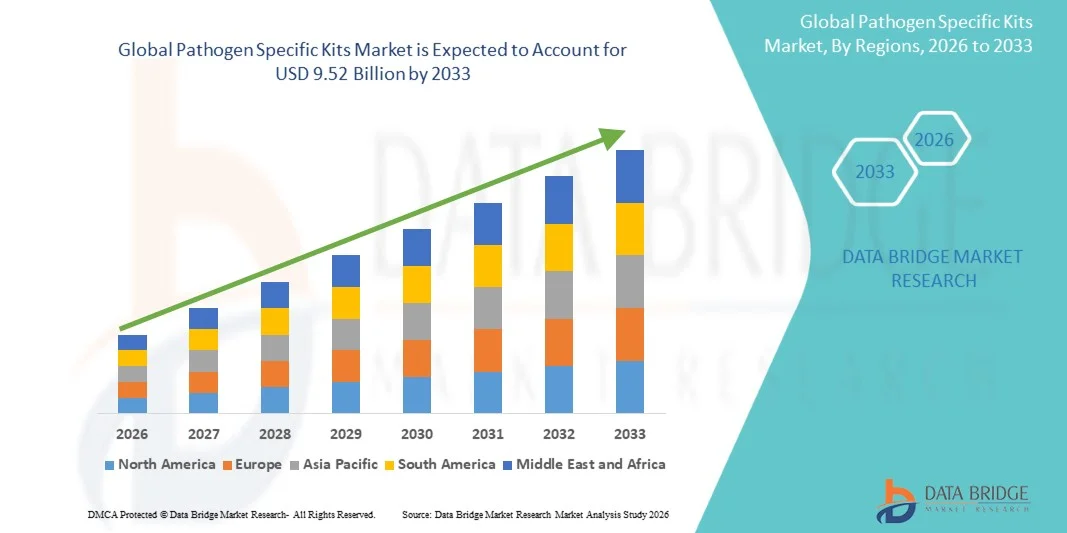
- As per Data Bridge Market Research analysis, the pathogen specific kits market was valued at USD 6.30 billion in 2025 and is projected to reach USD 9.52 billion by 2033, growing at a CAGR of 5.30% from 2026 to 2033.
- The market is expanding steadily on the back of recurring infectious disease outbreaks, rising demand for rapid and accurate pathogen identification, growing antimicrobial resistance concerns, and the broad adoption of molecular and multiplex testing across hospitals, public health laboratories, and food safety programmes.
- Pathogen specific kits are diagnostic and detection products designed to identify particular viruses, bacteria, fungi, or parasites in clinical, food, environmental, or veterinary samples, using technologies such as real-time PCR, immunoassay, isothermal amplification, and sequencing. Demand is being reshaped by the shift from single-target tests toward multiplex and syndromic panels that identify several possible causes of infection at once, by the spread of testing into point-of-care and wastewater surveillance settings, and by the continued need for rapid outbreak response tools.
Market Size & Forecast
- Global Market Value (2025): USD 6.30 Billion
- Expected Market Value (2033): USD 9.52 Billion
- Forecast CAGR (2026–2033): 5.30%
- Leading Region in 2025: North America
- Fastest Growing Region: Asia-Pacific
What are the Major Takeaways of the Pathogen Specific Kits Market?
- North America dominated the global pathogen specific kits market with the largest revenue share of 39.47% in 2025, supported by a well-developed clinical laboratory infrastructure, high adoption of molecular diagnostics, an active regulatory pathway for new tests, and strong public health surveillance programmes.
- Asia-Pacific is expected to be the fastest-growing region at a CAGR of 7.4% from 2026 to 2033, driven by expanding healthcare access, growing investment in laboratory and diagnostic capacity in China and India, rising infectious disease burden, and the presence of fast-growing regional kit manufacturers.
- The PCR/real-time PCR segment led the technology category with a 46.28% share in 2025, owing to its high sensitivity and specificity, its suitability for multiplexing, and its established position as the reference method for detecting viral, bacterial, and parasitic pathogens.
- Isothermal amplification is the fastest-growing technology, projected to register a CAGR of 7.9%, reflecting demand for rapid, instrument-light tests that can be used at the point of care and in resource-limited settings.
- The nucleic acid detection kits segment dominated the kit type category with a 52.64% revenue share in 2025, favoured for its accuracy in identifying specific pathogens at low concentrations, while antigen detection kits are the fastest-growing kit type at a CAGR of 6.4%.
- Viruses accounted for 44.37% of the market by pathogen type in 2025, reflecting recurring respiratory and other viral outbreaks, but fungi represent the fastest-growing pathogen segment at a CAGR of 7.4%, as awareness of invasive and drug-resistant fungal infections rises.
- Hospitals and clinical laboratories represented the leading end-user segment with a 46.15% share in 2025, while point-of-care and home-based testing is the fastest-growing end user at a CAGR of 8.3%.
Report Scope and Pathogen Specific Kits Market Segmentation
|
Attributes |
Pathogen Specific Kits Key Market Insights |
|
Segments Covered |
|
|
Countries Covered |
North America
Europe
Asia-Pacific
Middle East and Africa
South America
|
|
Key Market Players |
|
|
Market Opportunities |
|
|
Value Added Data Infosets |
In addition to the insights on market scenarios such as market value, growth rate, segmentation, geographical coverage, and major players, the market reports curated by the Data Bridge Market Research also include in-depth expert analysis, patient epidemiology, pipeline analysis, pricing analysis, and regulatory framework. |
What is the Key Trend in the Pathogen Specific Kits Market?
- Manufacturers are increasingly moving from single-target tests toward multiplex and syndromic panels that detect and differentiate several pathogens, and resistance markers, from a single sample, reflecting clinicians’ need to resolve overlapping symptoms quickly and with fewer separate orders.
- This shift is being reinforced by regulators clearing or authorizing panels for new specimen types and clinical scenarios, widening the menu of tests available to hospital and reference laboratories.
- For instance, in August 2026, QIAGEN received U.S. FDA clearance for its QIAstat-Dx BCID GPF Plus AMR Panel, which detects 20 pathogens and 10 antimicrobial resistance markers directly from positive blood cultures in about one hour, and in August 2026, Seegene USA received FDA Emergency Use Authorization for its Allplex HSV-1&2/VZV/MPXV Assay, described as the first multiplex PCR test designed to differentiate HSV-1, HSV-2, varicella-zoster virus, and mpox virus in ulcerative skin lesions in a single run.
- Established diagnostics leaders are simultaneously broadening their respiratory panels to cover the viruses most often responsible for seasonal illness, giving hospital laboratories a single test for overlapping presentations.
- For instance, in February 2025, Thermo Fisher Scientific announced FDA 510(k) clearance for its Applied Biosystems TaqPath COVID-19, Flu A, Flu B, RSV Select Panel, a real-time PCR multiplex test that detects and differentiates SARS-CoV-2, influenza A, influenza B, and respiratory syncytial virus, and can identify co-infections, with results in as little as three hours.
- As multiplex and syndromic formats continue to displace single-target testing across bloodstream, respiratory, and dermatological indications, panel breadth and speed to result are expected to remain the primary axes of competition in the pathogen specific kits market through the forecast period.
What are the Key Drivers of the Pathogen Specific Kits Market?
- The recurrence of large infectious disease outbreaks, including foodborne, respiratory, and emerging pathogens, keeps public health agencies and laboratories dependent on fast, specific detection kits for diagnosis, case confirmation, and outbreak investigation.
- Diagnostics companies are responding quickly to outbreaks by launching pathogen-specific assays, allowing laboratories to expand testing capacity within days or weeks of a public health signal rather than waiting for lengthy development cycles.
- For instance, on August 6, 2026, Roche, together with its subsidiary TIB MOLBIOL, launched two new real-time PCR tests for Cyclospora cayetanensis, the LightMix Modular Cyclospora assay and the multiplex LightMix OneTube Gastro Para 2 assay, as a cyclospora outbreak linked to iceberg lettuce spread across the United States, with health officials reporting 6,358 illnesses, at least 278 hospitalizations, and two deaths across 15 states as of August 5, 2026.
- Laboratories are also seeking to raise throughput and reduce hands-on time, driving demand for kits that integrate with automated extraction and detection platforms.
- For instance, in May 2026, Applied BioCode announced FDA clearance for its BioCode Respiratory Pathogen Panel, which detects 17 prevalent respiratory pathogens, for use with nucleic acid extraction on Thermo Fisher Scientific’s KingFisher Flex platform, adding an automated high-volume workflow option for clinical laboratories.
- With outbreaks recurring, manufacturers able to respond within weeks, and laboratories pursuing automated, high-throughput workflows, demand for pathogen specific kits is expected to remain resilient throughout the forecast period.
What Factors are Challenging the Growth of the Pathogen Specific Kits Market?
- Regulatory pathways for diagnostic kits are demanding, and many newly launched outbreak-response tests initially reach the market under research-use-only or emergency authorization status rather than full clearance, which limits how and where they can be used clinically.
- For instance in August 2026, the Roche launched two cyclospora PCR assays that are designated for research use only and are not intended for diagnostic use, while Seegene’s HSV/VZV/mpox multiplex assay was granted Emergency Use Authorization rather than full marketing clearance, illustrating the gap between rapid market entry and routine diagnostic adoption.
- Testing demand is also cyclical and outbreak-dependent, and laboratories face reimbursement pressure and budget constraints that can slow the adoption of more expensive multiplex and syndromic panels relative to lower-cost single-target tests.
- Single-pathogen testing, by its nature, requires separate orders and samples for each suspected pathogen, creating diagnostic gaps and added cost when the causative agent is not among those targeted, while broad panels raise questions of cost-effectiveness and clinical interpretation.
- The combination of demanding regulatory pathways, reimbursement and budget pressure on high-cost panels, and demand that rises and falls with outbreaks continues to temper growth, keeping expansion steady rather than rapid despite strong underlying clinical need.
How is the Pathogen Specific Kits Market Segmented?
The pathogen specific kits market is segmented on the basis of technology, kit type, pathogen type, sample type, application, end user and regulatory status.
- By Technology
On the basis of technology, the global pathogen specific kits market is segmented into PCR/real-time PCR, immunoassay, isothermal amplification, next-generation sequencing-based, and microarray & others. The PCR/real-time PCR segment dominated the market with a 46.28% share in 2025, owing to its high sensitivity and specificity, its suitability for multiplexing several targets in one reaction, and its established position as the reference method for detecting viral, bacterial, and parasitic pathogens.
The isothermal amplification segment is projected to register the fastest growth at a CAGR of 7.9% from 2026 to 2033, driven by demand for rapid, instrument-light tests that can be run at the point of care and in resource-limited settings without the thermal cycling required by conventional PCR.
- By Kit Type
On the basis of kit type, the global pathogen specific kits market is segmented into nucleic acid detection kits, antigen detection kits, antibody detection kits, culture & identification kits, and sample preparation & extraction kits. The nucleic acid detection kits segment dominated the market with a share of 52.64% in 2025, favoured for its accuracy in identifying specific pathogens at low concentrations and its role in confirming infection during outbreaks.
The antigen detection kits segment is expected to witness the fastest CAGR of 6.4% from 2026 to 2033, driven by growing use of rapid antigen tests in decentralized settings such as primary care, retail pharmacy, and home testing, where speed and ease of use outweigh the higher sensitivity of molecular methods.
- By Pathogen Type
On the basis of pathogen type, the global pathogen specific kits market is segmented into viruses, bacteria, fungi, and parasites. The viruses segment dominated the market with a share of 44.37% in 2025, reflecting recurring respiratory, herpes-family, and other viral outbreaks and the large testing volumes they generate across hospitals and laboratories.
The fungi segment is expected to witness the fastest CAGR of 7.4% from 2026 to 2033, driven by rising recognition of invasive fungal infections and emerging drug-resistant fungal pathogens, and by the increasing inclusion of fungal targets in bloodstream and other syndromic panels.
- By Sample Type
On the basis of sample type, the global pathogen specific kits market is segmented into respiratory samples, blood samples, stool samples, urine samples, and other samples. The respiratory samples segment dominated the market with a share of 38.92% in 2025, reflecting the high volume of testing for influenza, SARS-CoV-2, respiratory syncytial virus, and other respiratory pathogens, particularly during seasonal peaks.
The blood samples segment is expected to witness the fastest CAGR of 6.8% from 2026 to 2033, driven by growing use of bloodstream infection panels that identify pathogens and antimicrobial resistance markers directly from positive blood cultures, supporting faster and more targeted treatment of sepsis.
- By Application
On the basis of application, the global pathogen specific kits market is segmented into clinical diagnostics, food safety testing, environmental & wastewater surveillance, veterinary diagnostics, and research. The clinical diagnostics segment dominated the market with a share of 68.41% in 2025, reflecting the central role of pathogen detection in patient diagnosis, treatment selection, and infection control across hospitals and laboratories.
The environmental & wastewater surveillance segment is expected to witness the fastest CAGR of 8.7% from 2026 to 2033, driven by public health agencies expanding community-level monitoring of respiratory and other pathogens through digital PCR kits validated on multiple platforms, offering early warning of outbreaks ahead of clinical case counts.
- By End User
On the basis of end user, the global pathogen specific kits market is segmented into hospitals & clinical laboratories, reference & diagnostic laboratories, public health & government agencies, food & beverage manufacturers, academic & research institutes, and point-of-care & home-based testing. The hospitals & clinical laboratories segment dominated the market with a share of 46.15% in 2025, reflecting the concentration of diagnostic testing volume in hospital-based and affiliated laboratories.
The point-of-care & home-based testing segment is expected to witness the fastest CAGR of 8.3% from 2026 to 2033, driven by the development of rapid, handheld, and waived-complexity tests that deliver results in minutes outside central laboratories, and by patient preference for convenient, decentralized testing.
- By Regulatory Status
On the basis of regulatory status, the global pathogen specific kits market is segmented into IVD cleared/approved, emergency use authorized, and research use only. The IVD cleared/approved segment dominated the market with a share of 63.58% in 2025, as clinical laboratories and hospitals generally require fully cleared or approved kits for routine patient diagnosis and reimbursement.
The research use only segment is expected to witness the fastest CAGR of 6.3% from 2026 to 2033, driven by manufacturers releasing outbreak-response assays quickly as research tools, allowing public health and research laboratories to expand investigation capacity before diagnostic clearance is obtained.
Which Region Holds the Largest Share of the Pathogen Specific Kits Market?
- North America dominated the pathogen specific kits market and accounted for the largest revenue share of 39.47% in 2025, supported by a well-developed clinical laboratory infrastructure, high adoption of molecular and multiplex diagnostics, and the concentration of leading kit manufacturers and platform developers in the region.
- The region also benefits from an active regulatory pathway for new tests, established public health surveillance networks, and rapid commercial response to domestic outbreaks. Continued clearance of new multiplex panels and automated workflows is expected to reinforce North America’s leadership through the forecast period.
U.S. Pathogen Specific Kits Market Insight
The U.S. pathogen specific kits market holds the leading position within North America, underpinned by the scale of its hospital and reference laboratory network, high uptake of syndromic and multiplex testing, and frequent public health responses to foodborne and respiratory outbreaks. U.S. laboratories are early adopters of newly cleared bloodstream, respiratory, and gastrointestinal panels, and manufacturers routinely launch outbreak-specific assays here first. The country’s regulatory system, including emergency use pathways, allows new pathogen tests to reach laboratories quickly when public health needs arise.
Canada Pathogen Specific Kits Market Insight
Canada’s pathogen-specific kits market is expanding due to rising infectious-disease surveillance, demand for rapid diagnostics, and increased adoption of molecular testing. Hospitals, diagnostic laboratories, and research institutions are driving demand for accurate, targeted detection of bacteria, viruses, and other pathogens. Technological advances, including PCR and multiplex assays, are improving testing speed and sensitivity. Government preparedness initiatives and investments in healthcare infrastructure are further supporting market development, while regulatory requirements influence product adoption.
Asia-Pacific Pathogen Specific Kits Market Insight
The Asia-Pacific pathogen specific kits market is expected to witness the fastest growth globally, driven by expanding healthcare access, growing laboratory and diagnostic capacity, rising infectious disease burden, and a large base of regional kit manufacturers. Governments across the region are investing in public health laboratory networks and surveillance, while domestic and international companies expand local production and distribution of PCR, rapid antigen, and multiplex kits.
China Pathogen Specific Kits Market Insight
The China pathogen specific kits market is expanding rapidly, supported by a large domestic in vitro diagnostics industry, substantial laboratory infrastructure built out in recent years, and government emphasis on disease surveillance and pathogen detection capability. Chinese manufacturers offer a broad range of real-time PCR and sequencing-based kits for viral and bacterial pathogens, and continue to expand exports of molecular diagnostic kits into emerging markets.
India Pathogen Specific Kits Market Insight
The India pathogen specific kits market is growing quickly, driven by a high burden of infectious diseases, expanding private diagnostic laboratory chains, and increasing government investment in public health testing. Demand is rising for affordable rapid and molecular tests for diseases such as tuberculosis, dengue, and respiratory infections, and domestic manufacturers are scaling production alongside multinational suppliers to serve both urban and semi-urban healthcare facilities.
Which are the Top Companies in Pathogen Specific Kits Market?
The pathogen specific kits industry is primarily led by well-established companies, including:
- F. Hoffmann-La Roche Ltd (Switzerland)
- Thermo Fisher Scientific Inc. (U.S.)
- QIAGEN N.V. (Netherlands)
- bioMérieux SA (France)
- Abbott Laboratories (U.S.)
- Hologic, Inc. (U.S.)
- Becton, Dickinson and Company (U.S.)
- Cepheid (Danaher Corporation) (U.S.)
- Bio-Rad Laboratories, Inc. (U.S.)
- Seegene Inc. (South Korea)
- QuidelOrtho Corporation (U.S.)
- Siemens Healthineers AG (Germany)
- DiaSorin S.p.A. (Italy)
- Meridian Bioscience, Inc. (U.S.)
- Applied BioCode, Inc. (U.S.)
- Visby Medical, Inc. (U.S.)
- Agilent Technologies, Inc. (U.S.)
- Revvity, Inc. (U.S.)
- Illumina, Inc. (U.S.)
- Takara Bio Inc. (Japan)
- Promega Corporation (U.S.)
- Sysmex Corporation (Japan)
- Bruker Corporation (U.S.)
- Sansure Biotech Inc. (China)
- BGI Genomics Co., Ltd. (China)
- GT Molecular, Inc. (U.S.)
- Norgen Biotek Corp. (Canada)
- Randox Laboratories Ltd (U.K.)
What are Latest Developments in Pathogen Specific Kits Market?
- In August 2026, Seegene USA received U.S. FDA Emergency Use Authorization for its Allplex HSV-1&2/VZV/MPXV Assay, described as the first multiplex PCR test designed to simultaneously detect and differentiate herpes simplex virus types 1 and 2, varicella-zoster virus, and mpox virus from ulcerative skin lesions in a single run, addressing the diagnostic gap created by overlapping clinical presentations.
- In August 2026, QIAGEN received U.S. FDA clearance for its QIAstat-Dx BCID GPF Plus AMR Panel, enabling detection of 20 pathogens and 10 antimicrobial resistance markers directly from positive blood cultures in about one hour, expanding the company’s syndromic testing menu for bloodstream infections.
- On August 6, 2026, Roche, in collaboration with its subsidiary TIB MOLBIOL, launched two new research-use-only real-time PCR assays for Cyclospora cayetanensis, the LightMix Modular Cyclospora assay and the multiplex LightMix OneTube Gastro Para 2 assay covering six gastrointestinal parasites, for use on the LightCycler 480 and LightCycler PRO instruments, in response to a multistate U.S. cyclospora outbreak.
- In May 2026, Applied BioCode announced FDA clearance for its BioCode Respiratory Pathogen Panel, which detects 17 prevalent respiratory pathogens, when paired with nucleic acid extraction on Thermo Fisher Scientific’s KingFisher Flex platform, extending the panel’s automated, high-throughput workflow options for clinical laboratories and building on the earlier authorization of the company’s gastrointestinal panel on the same extraction system.
- In February 2025, Thermo Fisher Scientific announced FDA 510(k) clearance for its Applied Biosystems TaqPath COVID-19, Flu A, Flu B, RSV Select Panel, a real-time PCR multiplex test that identifies and differentiates SARS-CoV-2, influenza A, influenza B, and respiratory syncytial virus, and can detect co-infections, delivering results in as little as three hours.

- Interactive Data Analysis Dashboard
- Company Analysis Dashboard for high growth potential opportunities
- Research Analyst Access for customization & queries
- Competitor Analysis with Interactive dashboard
- Latest News, Updates & Trend analysis
- Harness the Power of Benchmark Analysis for Comprehensive Competitor Tracking
Data collection and base year analysis are done using data collection modules with large sample sizes. The stage includes obtaining market information or related data through various sources and strategies. It includes examining and planning all the data acquired from the past in advance. It likewise envelops the examination of information inconsistencies seen across different information sources. The market data is analysed and estimated using market statistical and coherent models. Also, market share analysis and key trend analysis are the major success factors in the market report. To know more, please request an analyst call or drop down your inquiry.
The key research methodology used by DBMR research team is data triangulation which involves data mining, analysis of the impact of data variables on the market and primary (industry expert) validation. Data models include Vendor Positioning Grid, Market Time Line Analysis, Market Overview and Guide, Company Positioning Grid, Patent Analysis, Pricing Analysis, Company Market Share Analysis, Standards of Measurement, Global versus Regional and Vendor Share Analysis. To know more about the research methodology, drop in an inquiry to speak to our industry experts.
Data Bridge Market Research is a leader in advanced formative research. We take pride in servicing our existing and new customers with data and analysis that match and suits their goal. The report can be customized to include price trend analysis of target brands understanding the market for additional countries (ask for the list of countries), clinical trial results data, literature review, refurbished market and product base analysis. Market analysis of target competitors can be analyzed from technology-based analysis to market portfolio strategies. We can add as many competitors that you require data about in the format and data style you are looking for. Our team of analysts can also provide you data in crude raw excel files pivot tables (Fact book) or can assist you in creating presentations from the data sets available in the report.













