


What is the Patient Centric Healthcare App Market Size and Growth Rate?
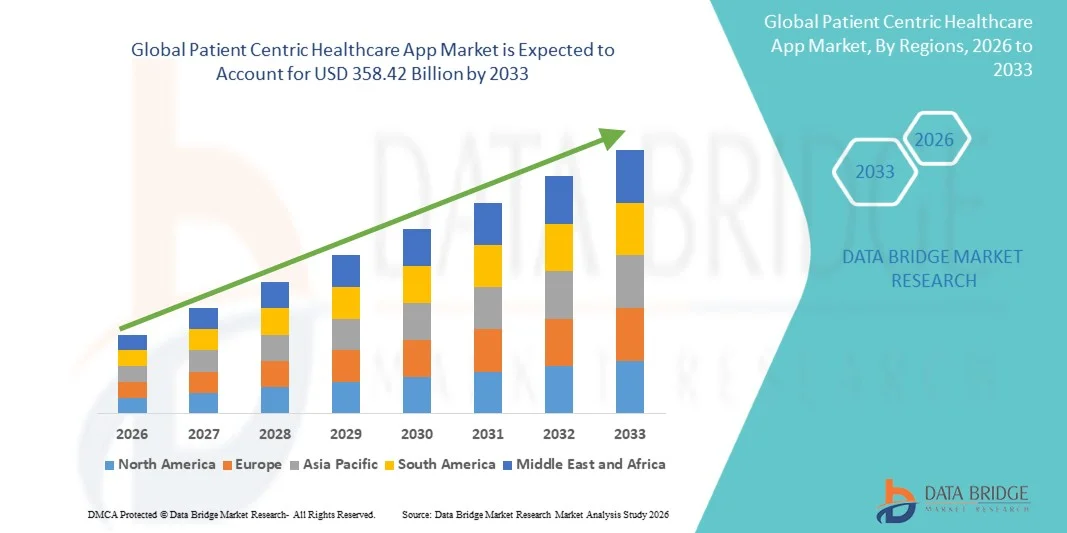
- As per Data Bridge Market Research analysis, the patient centric healthcare app market was valued at USD 25.27 billion in 2025 and is projected to reach USD 358.42 billion by 2033, growing at a CAGR of 39.31% from 2026 to 2033.
- The market is experiencing consistent growth driven by increasing demand for personalized healthcare services, rising adoption of digital health technologies, growing patient engagement, and the need for convenient access to healthcare information, appointment management, medication reminders, remote monitoring, and disease management through mobile applications.
- The increasing focus on patient-centered care, combined with the growing adoption of smartphones, connected health devices, telehealth services, and digital healthcare platforms, is compelling healthcare providers and technology companies to adopt patient centric healthcare apps to improve patient engagement, enhance communication, and support continuous care management. AI-enabled features, remote patient monitoring, personalized health recommendations, and integrated healthcare services are gaining traction by providing more accessible, connected, and individualized digital healthcare experiences.
Market Size & Forecast
- Global Market Value (2025): USD 25.27 Billion
- Expected Market Value (2033): USD 358.42 Billion
- Forecast CAGR (2026–2033): 39.31%
- Leading Region in 2025: North America
- Fastest Growing Region: Asia Pacific
What are the Major Takeaways of the Patient Centric Healthcare App Market?
- North America dominated the patient centric healthcare app market with the largest revenue share of 36% in 2025, supported by advanced digital healthcare infrastructure, high smartphone and connected-device penetration, strong adoption of telehealth and remote patient monitoring solutions, and increasing demand for personalized and patient-centered healthcare services.
- Asia-Pacific is expected to be the fastest-growing region at a CAGR of 42.5% from 2026 to 2033, fueled by increasing healthcare digitization, rising smartphone adoption, growing investments in digital health infrastructure, expanding telehealth services, and increasing demand for convenient and personalized healthcare solutions across countries such as India, China, and Japan.
- The solution segment led the market with a 68% share in 2025, driven by increasing demand for patient-centric applications that support appointment scheduling, medication management, health monitoring, disease management, communication, and personalized healthcare services.
- Services are the fastest-growing component type, projected to register a CAGR of 41.0%, reflecting the growing demand for implementation, integration, consulting, maintenance, technical support, and other services required to deploy and manage patient centric healthcare applications.
- The cloud segment dominated the deployment mode category with a 58% revenue share in 2025, led by increasing demand for scalable, flexible, remotely accessible, and easily integrated digital healthcare platforms that enable patients and healthcare providers to access health information and services across multiple devices.
- Large enterprises accounted for 62% of the market share in 2025, supported by their greater investment capacity, extensive healthcare technology infrastructure, larger patient bases, and increasing adoption of integrated digital platforms to improve patient engagement and healthcare delivery.
- The healthcare segment is the fastest-growing industry vertical category, with a CAGR of 40.8%, driven by increasing adoption of digital patient engagement solutions, remote monitoring, telehealth, electronic health information access, personalized care management, and growing emphasis on improving patient experience and continuity of care.
Report Scope and Patient Centric Healthcare App Market Segmentation
|
Attributes |
Patient Centric Healthcare App Key Market Insights |
|
Segments Covered |
|
|
Countries Covered |
North America
Europe
Asia-Pacific
Middle East and Africa
South America
|
|
Key Market Players |
|
|
Market Opportunities |
|
|
Value Added Data Infosets |
In addition to the insights on market scenarios such as market value, growth rate, segmentation, geographical coverage, and major players, the market reports curated by the Data Bridge Market Research also include in-depth expert analysis, patient epidemiology, pipeline analysis, pricing analysis, and regulatory framework. |
What is the Key Trend in the Patient Centric Healthcare App Market?
- Patient centric healthcare apps are increasingly evolving toward interoperable platforms that connect electronic health records, patient portals, healthcare providers, and third-party applications, enabling patients to access, manage, and share health information through a single digital interface. The growing emphasis on interoperability and standards-based APIs is supporting more connected and patient-centered digital healthcare experiences.
- For instance, in July 2025, the U.S. Office of the National Coordinator for Health Information Technology (ONC) reported that app-based access to online medical records increased from 38% in 2020 to 57% in 2024, highlighting the continued shift toward smartphone-based access to patient health information.
- Remote patient monitoring and real-time health tracking are increasingly being incorporated into patient centric healthcare apps, allowing patients to collect health information through connected devices and transmit data to healthcare providers for ongoing monitoring and treatment management.
- Healthcare providers are also expanding the use of connected applications for chronic disease management, medication tracking, appointment management, health-record access, and communication with care teams, strengthening patient participation in healthcare decisions.
- For instance, in 2025, the ONC's Leading Edge Acceleration Projects program included a patient-centered decision-support project using FHIR subscriptions to automatically identify patients for enrollment in a hypertension monitoring program and provide real-time responses when elevated blood-pressure readings are reported.
- As patients increasingly use smartphones, connected devices, and digital health platforms to manage healthcare information, patient centric healthcare apps are evolving toward integrated and personalized platforms that combine health records, monitoring, communication, care coordination, and digital health services.
What are the Key Drivers of the Patient Centric Healthcare App Market?
- The increasing demand for convenient access to health information and greater patient participation in healthcare decisions is driving adoption of patient centric healthcare apps, particularly for accessing medical records, viewing test results, communicating with providers, managing appointments, and supporting chronic disease management.
- For instance, in July 2025, the ONC reported that 65% of individuals nationally had been offered and accessed their online medical records or patient portal in 2024, while 69% of individuals managing a chronic condition accessed their records at least once during the year.
- The growing adoption of smartphones, connected medical devices, telehealth, and remote patient monitoring is also increasing demand for applications that enable continuous collection and exchange of health information between patients and healthcare providers. CMS describes remote patient monitoring as the collection of patient health data through connected devices and its transmission to healthcare providers for treatment or condition management.
- For instance, in July 2025, the Centers for Medicare & Medicaid Services (CMS) announced commitments from healthcare and technology companies to support a patient-centric healthcare ecosystem, including applications for diabetes and obesity management, conversational AI for symptom checking and care navigation, appointment scheduling, and digital check-in.
- With healthcare organizations seeking to improve patient engagement and provide more coordinated care, patient centric healthcare apps are becoming increasingly important for connecting patients with health records, providers, caregivers, and digital healthcare services while supporting more accessible and continuous healthcare delivery..
Which Factors are Challenging the Growth of the Patient Centric Healthcare App Market?
- The implementation and expansion of patient centric healthcare apps can be challenging because healthcare organizations must address interoperability, privacy, cybersecurity, data governance, and integration requirements while connecting applications with existing electronic health record and healthcare information systems.
- For instance, in 2025, the ONC reported that although most U.S. hospitals had adopted foundational patient engagement capabilities, fewer than half had all advanced capabilities for record import and patient-generated data submission, while lower-resourced hospitals lagged in adopting app-based and FHIR-enabled patient engagement capabilities.
- Data fragmentation can also restrict the effectiveness of patient centric healthcare apps, as individuals may maintain multiple patient portals and health records across different providers, insurers, laboratories, pharmacies, and hospitals. In 2024, 59% of individuals in the U.S. reported having multiple online medical records or patient portals.
- Privacy and security requirements represent additional challenges because patient centric healthcare apps handle sensitive health information and must provide appropriate safeguards for accessing, storing, and sharing medical records. ONC guidance highlights the importance of privacy, security, interoperability, and secure APIs when developing health applications.
- For instance, in July 2025, the ONC reported that only 7% of individuals used a portal-organizing app to combine medical information from different portals or online medical records in 2024, indicating that interoperability and consolidation of information across multiple healthcare sources remain areas for further development.
- These interoperability, data fragmentation, privacy, security, and infrastructure constraints can increase implementation complexity and slow adoption, particularly among healthcare organizations with limited digital capabilities or insufficient resources to integrate advanced patient engagement technologies.
How is the Patient Centric Healthcare App Market Segmented?
The patient centric healthcare app market is segmented on the basis of technology, operating system, application, and end user.
- By Technology
On the basis of technology, the patient centric healthcare app market is segmented into Phone-Based Apps, Web-Based Apps, and Wearable Patient Centric Apps. The Phone-Based Apps segment dominated the market with 52% share in 2025, owing to increasing smartphone penetration, growing use of mobile health applications, and rising demand for convenient access to personal health information and healthcare services. Phone-based applications enable patients to access medical records, manage appointments, communicate with healthcare providers, receive medication reminders, and monitor health information through mobile devices.
The Wearable Patient Centric Apps segment is projected to register the fastest growth at a CAGR of 43.8% from 2026 to 2033, driven by increasing adoption of wearable devices, connected health technologies, and continuous health monitoring solutions. Wearable applications enable patients to monitor health and wellness indicators and share relevant information with healthcare providers. Remote patient monitoring is further supporting demand for connected applications, as healthcare providers increasingly use data transmitted from connected medical devices to support disease and treatment management. The increasing adoption of smartwatches, fitness trackers, and connected medical devices is strengthening the integration of wearable applications with patient-centric healthcare platforms.
- By Operating System
On the basis of operating system, the patient centric healthcare app market is segmented into iOS, Android, Windows, and Others. The Android segment dominated the market with 54% share in 2025, supported by the broad availability of Android smartphones, increasing smartphone adoption, and the extensive availability of healthcare applications across different device categories and price ranges. Android-based healthcare applications provide patients with access to health records, wellness management tools, appointment services, medication reminders, telehealth functions, and remote health monitoring. The wide device ecosystem and accessibility of Android smartphones are supporting the adoption of patient-centric healthcare applications across developed and emerging markets.
The iOS segment is projected to register the fastest growth at a CAGR of 40.7% from 2026 to 2033, driven by increasing adoption of premium smartphones, connected health ecosystems, and healthcare applications integrated with wearable devices. iOS applications support health information management, wellness tracking, communication with healthcare providers, and integration with connected health technologies. Increasing demand for personalized digital healthcare experiences and greater integration between smartphones, wearable devices, and healthcare applications is further supporting the growth of iOS-based patient-centric applications.
- By Application
On the basis of application, the patient centric healthcare app market is segmented into Wellness Management, Disease and Treatment Management, and Others. The Disease and Treatment Management segment dominated the market with 57% share in 2025, owing to increasing prevalence of chronic diseases, growing demand for continuous health monitoring, and rising adoption of digital tools for treatment management. Patient-centric applications support patients in monitoring health conditions, accessing medical information, communicating with healthcare providers, managing medications, and tracking treatment-related information. According to ONC, in 2024, 81% of individuals with a chronic condition were offered online access to their medical records and 69% accessed their records, demonstrating the increasing use of digital health technologies among individuals managing chronic conditions.
The Wellness Management segment is projected to register the fastest growth at a CAGR of 41.9% from 2026 to 2033, driven by increasing awareness of preventive healthcare, healthy lifestyles, fitness monitoring, nutrition management, and personalized wellness services. Wellness applications allow users to monitor physical activity, health indicators, nutrition, medication schedules, and other aspects of personal health. Increasing consumer interest in preventive health management and the integration of smartphone applications with wearable devices are further supporting the adoption of wellness management applications.
- By End User
On the basis of end user, the patient centric healthcare app market is segmented into Hospitals, Clinics, and Home Use. The Hospitals segment dominated the market with 48% share in 2025, supported by increasing adoption of patient engagement technologies, electronic health records, patient portals, and mobile healthcare applications. Hospitals increasingly use digital platforms to enable patients to access medical records, view clinical information, communicate with healthcare providers, manage appointments, and participate more actively in their care. According to ONC, in 2024, eight in ten hospitals had all foundational patient engagement capabilities, while two in three hospitals had all emerging capabilities that included access through applications and viewing of clinical notes. The increasing integration of patient-centric applications with hospital information systems is further strengthening adoption.
The Home Use segment is projected to register the fastest growth at a CAGR of 42.6% from 2026 to 2033, driven by increasing adoption of remote patient monitoring, telehealth, connected medical devices, and self-management applications. Home-based healthcare applications enable patients to monitor health conditions outside traditional healthcare facilities and share relevant information with healthcare providers. CMS states that remote patient monitoring allows patients to collect information such as blood pressure, weight, and glucose levels through connected medical devices, with the information automatically transmitted to healthcare providers for condition management. Increasing demand for convenient healthcare access, chronic disease management, and continuous monitoring is further supporting the adoption of patient-centric healthcare applications for home use.
Which Region Holds the Largest Share of the Patient Centric Healthcare App Market?
- North America dominated the patient centric healthcare app market with the largest revenue share of 36% in 2025, supported by high smartphone penetration, advanced digital health infrastructure, widespread adoption of electronic health records, and increasing use of patient portals and mobile healthcare applications.
- The region also benefits from increasing investments in digital healthcare infrastructure, interoperability standards, remote patient monitoring, and patient engagement technologies. Rising demand for convenient access to medical records, digital communication with healthcare providers, personalized health management, and connected healthcare services continues to strengthen North America’s leadership position in the global market.
U.S. Patient Centric Healthcare App Market Insight
The U.S. patient centric healthcare app market is witnessing strong growth due to increasing adoption of electronic health records, patient portals, smartphone health applications, remote patient monitoring, and digital patient engagement solutions. The country's mature healthcare infrastructure, widespread use of connected healthcare technologies, and increasing emphasis on patient access to health information are driving demand for patient-centric applications. In addition, according to the U.S. Office of the National Coordinator for Health Information Technology (ONC), app-based access to online medical records increased from 38% in 2020 to 57% in 2024, demonstrating the increasing use of mobile applications for patient access to healthcare information.
Asia-Pacific Patient Centric Healthcare App Market Insight
The Asia-Pacific patient centric healthcare app market is expected to witness rapid growth, driven by increasing smartphone penetration, expanding digital healthcare infrastructure, rising telehealth adoption, and growing investments in connected healthcare technologies across countries such as China, India, and Japan. Growing awareness regarding digital health services, increasing use of mobile healthcare applications, and rising demand for convenient access to healthcare information are supporting regional market expansion. Additionally, increasing adoption of remote patient monitoring, wearable devices, and AI-enabled healthcare applications is accelerating patient centric healthcare app adoption across the region.
Japan Patient Centric Healthcare App Market Insight
The Japan patient centric healthcare app market is witnessing consistent growth due to rising investments in digital healthcare, an aging population, increasing demand for remote healthcare services, and growing adoption of connected health technologies. Healthcare providers are increasingly utilizing digital applications to support patient communication, health monitoring, appointment management, and access to healthcare information. Moreover, increasing integration of smartphones, wearable devices, remote monitoring technologies, and digital health platforms, along with the country's focus on improving healthcare accessibility and efficiency, is further contributing to market growth.
China Patient Centric Healthcare App Market Insight
The China patient centric healthcare app market is growing rapidly, driven by increasing healthcare digitalization, expanding smartphone adoption, growing telehealth services, and rising investments in digital healthcare infrastructure. Increasing adoption of mobile healthcare applications across hospitals, clinics, and home-based healthcare is significantly boosting market demand. In addition, rising use of online healthcare services, remote patient monitoring, electronic health information, and AI-enabled digital health solutions is supporting the expansion of patient centric healthcare applications across the country.
U.K. Patient Centric Healthcare App Market Insight
The U.K. patient centric healthcare app market is experiencing steady growth, supported by increasing adoption of digital health services, electronic health records, patient-facing applications, and remote healthcare technologies. Healthcare organizations are increasingly implementing digital applications to improve patient access to health information, communication with healthcare providers, appointment management, and ongoing health monitoring. Furthermore, integration of interoperable digital health technologies, remote monitoring, and personalized healthcare services is enhancing patient engagement and supporting continued market development in the U.K.
Germany Patient Centric Healthcare App Market Insight
The Germany patient centric healthcare app market is expanding steadily due to increasing digitalization of healthcare services, rising adoption of electronic health records, and growing emphasis on interoperable digital health systems. Hospitals, clinics, and patients are increasingly utilizing digital applications for healthcare information access, communication, appointment management, treatment support, and health monitoring. Continuous advancements in mobile healthcare technologies, connected medical devices, remote patient monitoring, and digital health infrastructure, along with growing emphasis on patient-centered care and interoperability, are further driving market growth in Germany.
Which are the Top Companies in Patient Centric Healthcare App Market?
The Patient Centric Healthcare App industry is primarily led by well-established companies, including:
- Optum, Inc. (U.S.)
- Teladoc Health, Inc. (U.S.)
- Epic Systems Corporation (U.S.)
- Oracle Corporation (U.S.)
- Koninklijke Philips N.V. (Netherlands)
- Siemens Healthineers AG (Germany)
- GE HealthCare Technologies Inc. (U.S.)
- Veradigm Inc. (U.S.)
- Doctolib (France)
- Ada Health GmbH (Germany)
- Allscripts Healthcare Solutions, Inc. (U.S.)
- athenahealth, Inc. (U.S.)
- Cerner Corporation (U.S.)
- Doximity, Inc. (U.S.)
- Amwell (U.S.)
- Health Catalyst, Inc. (U.S.)
- Practo Technologies Pvt. Ltd. (India)
- MediBuddy (India)
- 1mg (India)
- Hinge Health (U.S.)
What are Latest Developments in Patient Centric Healthcare App Market?
- In July 2025, the U.S. Centers for Medicare & Medicaid Services (CMS) announced commitments from major technology and healthcare organizations to support the development of a more patient-centric healthcare ecosystem. The initiative included digital tools for diabetes and obesity management, conversational AI for symptom checking and care navigation, appointment scheduling, digital check-in, secure digital identity, and health record retrieval. The development highlights the increasing integration of mobile applications, artificial intelligence, and digital healthcare services to provide more connected and patient-centered experiences.
- In July 2025, the U.S. Office of the National Coordinator for Health Information Technology (ONC) reported that app-based access to online medical records increased from 38% in 2020 to 57% in 2024. The report also indicated that 65% of individuals were offered and accessed online medical records or patient portals in 2024. The continued shift toward application-based health information access highlights growing demand for patient-centric healthcare applications that enable individuals to access, manage, and share their health information.
- In August 2025, the U.S. Office of the National Coordinator for Health Information Technology (ONC) reported continued growth in health IT-enabled patient engagement capabilities across U.S. hospitals. The report found that two in three hospitals had emerging patient engagement capabilities enabling patients to view clinical notes and access health information through applications. In 2024, 81% of hospitals enabled patient access through applications configured to meet API specifications, while 70% enabled access through applications configured to meet HL7 FHIR specifications. The development reflects increasing integration of patient-facing applications with hospital information systems and electronic health records..
- In July 2025, the World Health Organization (WHO) continued to emphasize the importance of interoperable digital health technologies and standards for supporting connected and patient-centered healthcare systems. WHO's digital health initiatives focus on strengthening interoperability, data exchange, and the scaling of digital health solutions. These developments support the continued integration of healthcare applications with digital health infrastructure and connected healthcare services.

- Interactive Data Analysis Dashboard
- Company Analysis Dashboard for high growth potential opportunities
- Research Analyst Access for customization & queries
- Competitor Analysis with Interactive dashboard
- Latest News, Updates & Trend analysis
- Harness the Power of Benchmark Analysis for Comprehensive Competitor Tracking
Data collection and base year analysis are done using data collection modules with large sample sizes. The stage includes obtaining market information or related data through various sources and strategies. It includes examining and planning all the data acquired from the past in advance. It likewise envelops the examination of information inconsistencies seen across different information sources. The market data is analysed and estimated using market statistical and coherent models. Also, market share analysis and key trend analysis are the major success factors in the market report. To know more, please request an analyst call or drop down your inquiry.
The key research methodology used by DBMR research team is data triangulation which involves data mining, analysis of the impact of data variables on the market and primary (industry expert) validation. Data models include Vendor Positioning Grid, Market Time Line Analysis, Market Overview and Guide, Company Positioning Grid, Patent Analysis, Pricing Analysis, Company Market Share Analysis, Standards of Measurement, Global versus Regional and Vendor Share Analysis. To know more about the research methodology, drop in an inquiry to speak to our industry experts.
Data Bridge Market Research is a leader in advanced formative research. We take pride in servicing our existing and new customers with data and analysis that match and suits their goal. The report can be customized to include price trend analysis of target brands understanding the market for additional countries (ask for the list of countries), clinical trial results data, literature review, refurbished market and product base analysis. Market analysis of target competitors can be analyzed from technology-based analysis to market portfolio strategies. We can add as many competitors that you require data about in the format and data style you are looking for. Our team of analysts can also provide you data in crude raw excel files pivot tables (Fact book) or can assist you in creating presentations from the data sets available in the report.













