


Pelvic Congestion Syndrome Market Size
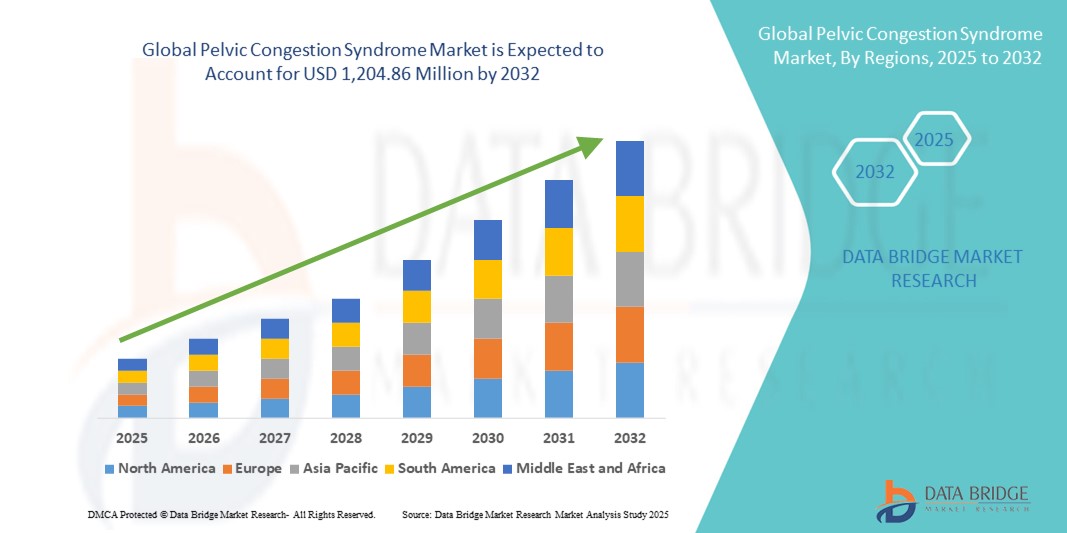
- The global pelvic congestion syndrome market size was valued at USD 724.74 million in 2024 and is expected to reach USD 1,204.86 million by 2032, at a CAGR of 6.56% during the forecast period
- The market growth is largely fueled by the increasing awareness and improved diagnostic capabilities for chronic pelvic pain in women, which is leading to a surge in the diagnosis of pelvic congestion syndrome (PCS), particularly in reproductive-age females
- Furthermore, rising consumer demand for minimally invasive and effective treatment solutions, such as embolization procedures and hormone therapy, is establishing PCS therapies as the preferred approach to managing chronic pelvic pain. These converging factors are accelerating the uptake of pelvic congestion syndrome solutions, thereby significantly boosting the industry's growth
Pelvic Congestion Syndrome Market Analysis
- Pelvic Congestion Syndrome (PCS), a chronic condition caused by varicose veins in the pelvic region, is increasingly recognized in both clinical and outpatient settings due to enhanced diagnostic awareness and the growing use of imaging technologies such as ultrasound and MRI
- The rising demand for minimally invasive treatments, including embolization therapy and laparoscopic interventions, is fueling market growth. Women of reproductive age, particularly those experiencing chronic pelvic pain, are increasingly seeking specialized care for PCS, creating a substantial patient pool
- North America dominated the pelvic congestion syndrome market with the largest revenue share of 41.8% in 2024, attributed to advanced healthcare infrastructure, early disease awareness, and high adoption of minimally invasive procedures. The U.S. is at the forefront, with significant investments in interventional radiology and gynecology supporting market expansion
- Asia-Pacific is expected to be the fastest growing region in the pelvic congestion syndrome market, projected to grow at a CAGR of 10.7% during the forecast period (2025–2032), driven by increasing healthcare access, improving diagnostic capabilities, and growing awareness of chronic pelvic pain conditions among women in countries such as China, India, and South Korea
- The NSAIDs (Nonsteroidal Anti-Inflammatory Drugs) segment dominated the pelvic congestion syndrome market with a market revenue share of 68.3% in 2024, attributed to their widespread use in managing chronic pelvic pain, their availability over-the-counter and by prescription, and established effectiveness in reducing inflammation and discomfort. NSAIDs are often the first line of treatment, especially for patients presenting with mild to moderate symptoms
Report Scope and Pelvic Congestion Syndrome Market Segmentation
|
Attributes |
Pelvic Congestion Syndrome Key Market Insights |
|
Segments Covered |
|
|
Countries Covered |
North America
Europe
Asia-Pacific
Middle East and Africa
South America
|
|
Key Market Players |
|
|
Market Opportunities |
|
|
Value Added Data Infosets |
In addition to the insights on market scenarios such as market value, growth rate, segmentation, geographical coverage, and major players, the market reports curated by the Data Bridge Market Research also include in-depth expert analysis, pricing analysis, brand share analysis, consumer survey, demography analysis, supply chain analysis, value chain analysis, raw material/consumables overview, vendor selection criteria, PESTLE Analysis, Porter Analysis, and regulatory framework. |
Pelvic Congestion Syndrome Market Trends
“Growing Demand for Technologically Advanced and User-Friendly Solutions”
- A significant and accelerating trend in the global pelvic congestion syndrome market is the continuous advancement in diagnostic and therapeutic technologies, offering healthcare providers and patients more accurate, less invasive, and user-friendly treatment solutions
- For instance, the increasing use of duplex ultrasound and magnetic resonance imaging (MRI) allows for more precise detection of pelvic venous insufficiency, enabling targeted interventions such as embolization therapies and sclerotherapy. These innovations provide safer alternatives to open surgery and improve patient recovery times
- Personalized medicine approaches are also being integrated into treatment protocols, where hormone therapies and pain management strategies are tailored to the specific symptoms and hormonal profiles of patients
- Moreover, the emergence of telehealth platforms and digital patient monitoring tools is enhancing access to diagnosis and ongoing care, especially in remote or underserved areas. These platforms facilitate real-time consultations and follow-ups, improving treatment adherence and outcomes
- Biopharmaceutical companies are increasingly investing in R&D for long-acting formulations of nonsteroidal anti-inflammatory drugs (NSAIDs) and hormonal agents to reduce dosing frequency and improve patient compliance in chronic pelvic pain management
- The demand for these advanced, patient-centric therapeutic solutions is expected to grow significantly across both developed and developing markets, as awareness about chronic pelvic pain and pelvic congestion syndrome rises globally
Pelvic Congestion Syndrome Market Dynamics
Driver
“Growing Need Due to Rising Disease Awareness and Minimally Invasive Treatment Options”
- The increasing awareness among women regarding chronic pelvic pain and the rising diagnostic accuracy for underdiagnosed conditions like Pelvic Congestion Syndrome (PCS) are significant drivers for the heightened demand for PCS diagnosis and treatment
- For instance, in April 2024, Merit Medical Systems, Inc. announced the expansion of its minimally invasive vascular embolization product portfolio, aiming to offer more targeted and effective solutions for conditions such as PCS. Such initiatives by key players are expected to drive the Pelvic Congestion Syndrome industry growth during the forecast period
- As more patients and physicians become aware of the symptoms and vascular causes of PCS, there is a growing shift toward early diagnosis and non-surgical treatment approaches. Techniques such as pelvic vein embolization offer advanced benefits like outpatient care, minimal downtime, and long-term symptom relief—making them a compelling alternative to traditional surgery
- Furthermore, the rising adoption of interventional radiology and the expansion of women’s health clinics are making minimally invasive procedures more accessible. Healthcare providers are integrating PCS diagnostic protocols alongside imaging services such as Doppler ultrasound, CT, and MRI, facilitating timely and accurate treatment
- The demand for PCS treatment is further boosted by patient preference for less invasive, cost-effective, and fertility-preserving options. The availability of embolization procedures in outpatient settings and the support of public and private health insurers in developed markets contribute significantly to market growth
Restraint/Challenge
“Lack of Disease Awareness and Misdiagnosis”
- The limited awareness of pelvic congestion syndrome among both patients and general practitioners remains a major barrier to market growth. PCS is frequently misdiagnosed as endometriosis, irritable bowel syndrome, or psychosomatic pain, delaying proper treatment and limiting patient access to effective therapies.
- For instance, studies have shown that over 30% of women with chronic pelvic pain remain undiagnosed or are misdiagnosed for years, primarily due to a lack of standardized diagnostic criteria and training among healthcare professionals
- Bridging this gap requires investment in physician education, awareness campaigns, and inclusion of PCS screening in gynecological assessments
- Another challenge is the limited availability of trained interventional radiologists, particularly in developing and rural regions, which restricts access to embolization treatment. Additionally, the high cost of imaging procedures such as MRI and CT scans can be a deterrent for early-stage diagnosis
- Overcoming these challenges through physician training, public awareness initiatives, and healthcare policy adjustments will be critical for improving diagnosis rates and ensuring sustained growth of the Pelvic Congestion Syndrome treatment market
Pelvic Congestion Syndrome Market Scope
The market is segmented on the basis of type and application.
• By Type
On the basis of type, the pelvic congestion syndrome market is segmented into NSAIDs (Nonsteroidal Anti-Inflammatory Drugs) and dihydroergotamine.
The NSAIDs (Nonsteroidal Anti-Inflammatory Drugs) segment dominated the largest market revenue share of 68.3% in 2024, attributed to their widespread use in managing chronic pelvic pain, their availability over-the-counter and by prescription, and established effectiveness in reducing inflammation and discomfort. NSAIDs are often the first line of treatment, especially for patients presenting with mild to moderate symptoms.
The Dihydroergotamine segment is expected to witness the fastest CAGR of 19.6% from 2025 to 2032, owing to its increasing application in refractory cases of pelvic congestion syndrome. This segment’s growth is also supported by clinical research exploring the efficacy of ergot derivatives in vascular tone modulation and chronic venous disorders. Its use is gaining traction especially in cases where hormonal or NSAID therapies have shown limited success.
• By Application
On the basis of application, the pelvic congestion syndrome market is segmented into primary pelvic congestion syndrome and secondary pelvic congestion syndrome. The primary pelvic congestion syndrome segment accounted for the largest market revenue share of 74.1% in 2024, due to the higher prevalence among premenopausal women, hormonal influences, and chronic pelvic pain cases linked to venous insufficiency without underlying structural abnormalities. Increased diagnostic awareness and non-invasive treatment advancements are also driving growth in this segment.
The secondary pelvic congestion syndrome segment is projected to register the fastest CAGR of 17.2% during the forecast period, primarily driven by rising cases associated with anatomical abnormalities, post-pregnancy complications, and other gynecological conditions. This includes patients requiring specialized interventions such as embolization or surgical correction, which are gaining adoption in tertiary care settings globally.
Pelvic Congestion Syndrome Market Regional Analysis
- North America dominated the pelvic congestion syndrome market with the largest revenue share of 41.8% in 2024, driven by increased awareness of women’s health issues, advancements in diagnostic imaging technologies, and a strong presence of interventional radiology centers
- The region benefits from favorable healthcare reimbursement policies and growing patient preference for minimally invasive treatment options such as pelvic vein embolization
- Consumers in the region are increasingly prioritizing timely diagnosis and effective management of chronic pelvic pain. The presence of specialized women’s health clinics and access to technologically advanced treatment solutions support regional market dominance
U.S. Pelvic Congestion Syndrome Market Insight
The U.S. pelvic congestion syndrome market captured the largest revenue share of 61% in 2024 within North America, fueled by rising disease awareness campaigns, increased diagnosis rates, and patient demand for non-surgical treatment alternatives. The growth is also supported by robust access to advanced imaging modalities such as Doppler ultrasound, CT, and MRI, which facilitate accurate and early diagnosis. Further,the country has witnessed an uptick in outpatient interventional radiology procedures, such as ovarian vein embolization, which are preferred for their minimal recovery time and high success rates. The presence of organizations like the Society of Interventional Radiology promoting awareness of PCS has also played a critical role in market expansion.
Europe Pelvic Congestion Syndrome Market Insight
The Europe pelvic congestion syndrome market is projected to grow at a CAGR of 9.6% during the forecast period, driven by increasing demand for effective chronic pelvic pain management and the integration of interventional treatments in public healthcare systems. Countries like Germany, France, and the U.K. are adopting embolization procedures in both public and private healthcare settings. In addition, increasing investments in women-centric health programs, along with physician education on differential diagnosis of pelvic pain, are fostering market growth.
U.K. Pelvic Congestion Syndrome Market Insight
The U.K. pelvic congestion syndrome market is expected to grow at a CAGR of 10.1% from 2025 to 2032, due to rising patient awareness, strong diagnostic infrastructure, and growing acceptance of interventional radiology. Public health initiatives emphasizing early screening for chronic pelvic pain are also helping identify more PCS cases.
Germany Pelvic Congestion Syndrome Market Insight
The Germany pelvic congestion syndrome market is anticipated to register a CAGR of 9.9% during the forecast period, supported by a well-established healthcare infrastructure, emphasis on minimally invasive therapies, and government support for radiology advancements. High diagnosis accuracy and availability of pelvic venous imaging systems are enhancing treatment rates.
Asia-Pacific Pelvic Congestion Syndrome Market Insight
The Asia-Pacific pelvic congestion syndrome market is poised to grow at the fastest CAGR of 10.7% from 2025 to 2032, fueled by rising healthcare investments, increasing prevalence of PCS among women, and growing demand for outpatient gynecological care in countries like China, India, and Japan. Government initiatives promoting maternal and women’s health awareness are contributing to early diagnosis and treatment uptake. Moreover, increased access to embolization procedures in urban healthcare centers is accelerating regional market growth.
Japan Pelvic Congestion Syndrome Market Insight
The Japan pelvic congestion syndrome market is gaining traction, owing to its technologically advanced healthcare system, aging female population, and increased investment in interventional procedures. Diagnostic accuracy is high due to widespread use of pelvic MRIs, and hospitals are increasingly incorporating embolization services as standard practice for PCS management.
China Pelvic Congestion Syndrome Market Insight
The China pelvic congestion syndrome market accounted for the largest revenue share in Asia-Pacific in 2024, supported by rapid urbanization, a growing middle-class population, and expansion of interventional radiology services across tertiary hospitals. National healthcare reforms that promote early screening for gynecological conditions and partnerships with global medical device firms are also driving treatment adoption, especially in tier-1 and tier-2 cities.
Pelvic Congestion Syndrome Market Share
The pelvic congestion syndrome industry is primarily led by well-established companies, including:
- Novartis AG (Switzerland)
- Sanofi (France)
- Tolmar Pharmaceuticals, Inc. (U.S.)
- Actiza Pharmaceutical Private Limited (India)
- Pfizer, Inc. (U.S.)
- AbbVie Inc. (U.S.)
- GlaxoSmithKline plc (U.K.)
- Boehringer Ingelheim International GmbH (Germany)
- Bayer AG (Germany)
- AstraZeneca (U.K.)
- Indivior PLC (U.K.)
- Takeda Pharmaceutical Company Limited (Japan)
- Fresenius Kabi USA (U.S.)

- Interactive Data Analysis Dashboard
- Company Analysis Dashboard for high growth potential opportunities
- Research Analyst Access for customization & queries
- Competitor Analysis with Interactive dashboard
- Latest News, Updates & Trend analysis
- Harness the Power of Benchmark Analysis for Comprehensive Competitor Tracking
Data collection and base year analysis are done using data collection modules with large sample sizes. The stage includes obtaining market information or related data through various sources and strategies. It includes examining and planning all the data acquired from the past in advance. It likewise envelops the examination of information inconsistencies seen across different information sources. The market data is analysed and estimated using market statistical and coherent models. Also, market share analysis and key trend analysis are the major success factors in the market report. To know more, please request an analyst call or drop down your inquiry.
The key research methodology used by DBMR research team is data triangulation which involves data mining, analysis of the impact of data variables on the market and primary (industry expert) validation. Data models include Vendor Positioning Grid, Market Time Line Analysis, Market Overview and Guide, Company Positioning Grid, Patent Analysis, Pricing Analysis, Company Market Share Analysis, Standards of Measurement, Global versus Regional and Vendor Share Analysis. To know more about the research methodology, drop in an inquiry to speak to our industry experts.
Data Bridge Market Research is a leader in advanced formative research. We take pride in servicing our existing and new customers with data and analysis that match and suits their goal. The report can be customized to include price trend analysis of target brands understanding the market for additional countries (ask for the list of countries), clinical trial results data, literature review, refurbished market and product base analysis. Market analysis of target competitors can be analyzed from technology-based analysis to market portfolio strategies. We can add as many competitors that you require data about in the format and data style you are looking for. Our team of analysts can also provide you data in crude raw excel files pivot tables (Fact book) or can assist you in creating presentations from the data sets available in the report.












