


What is the Pembrolizumab Market Size and Overview?
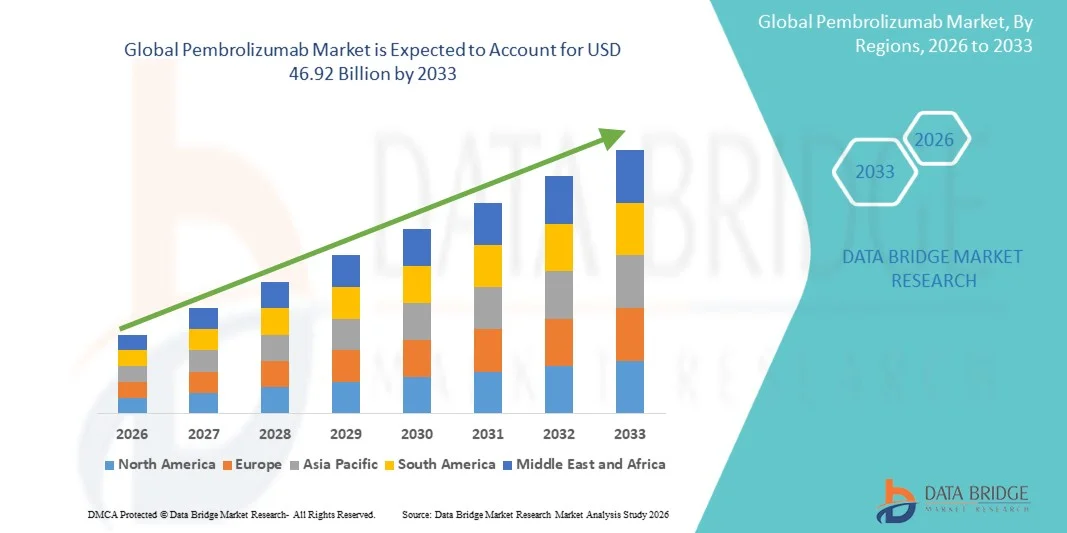
As per Data Bridge Market Research analysis, the global pembrolizumab market was valued at USD 34.29 billion in 2025 and is projected to reach USD 46.92 billion by 2033, growing at a CAGR of 4.00% from 2026 to 2033. Growth continues to be driven by pembrolizumab's broad and expanding label of FDA- and EMA-approved oncology indications, rising global cancer incidence, and sustained clinical adoption of PD-1 checkpoint inhibition as a standard-of-care therapy across both early-stage and advanced/metastatic solid tumors.
Merck & Co.'s Keytruda (pembrolizumab) remains the dominant branded immune checkpoint inhibitor globally, supported by an extensive clinical trial network, over 30 approved oncology indications, and the recent commercial launch of a subcutaneous formulation, KEYTRUDA QLEX, that is expected to extend product convenience and support continued market leadership. In addition, the approaching expiry of Keytruda's core patents is accelerating biosimilar pipeline activity, with multiple developers advancing pembrolizumab biosimilars through late-stage clinical trials and early regulatory approvals in select markets ahead of anticipated large-market launches later in the decade.
Market Size & Forecast
- Global Market Value (2025): USD 34.29 Billion
- Expected Market Value (2033): USD 46.92 Billion
- Forecast CAGR (2026–2033): 4.00%
- Leading Region in 2025: North America
- Fastest Growing Region: Asia-Pacific
Key Market Trends & Insights
- North America dominated the global pembrolizumab market with the largest revenue share of 38.10% in 2025, supported by high cancer prevalence, favorable reimbursement policies, and extensive oncology clinical infrastructure.
- The branded segment led the market with a share of over 98% in 2025, as Keytruda remains the sole commercially marketed pembrolizumab product across major regulated markets, with no biosimilars yet launched in the U.S., EU, or Japan.
- The biosimilar pipeline segment is projected to be the fastest-growing category, registering a CAGR of 45.90%, reflecting accelerating late-stage clinical development and early regulatory approvals ahead of anticipated launches in major markets around 2028–2029.
- Asia-Pacific is expected to be the fastest-growing region at a CAGR of 6.40% from 2026 to 2033, fueled by rising cancer incidence, expanding oncology treatment infrastructure, and increasing regulatory approvals across China, Japan, and India.
- The advanced/metastatic therapy setting segment dominates with a 61.28% share in 2025, reflecting pembrolizumab's original and most extensively studied use in late-stage oncology, though early-stage/perioperative use continues to expand.
- The Intravenous (IV) formulation accounted for the majority of 2025 revenue, while the Subcutaneous (SC) formulation is expected to be the fastest-growing route following the September 2025 FDA approval of KEYTRUDA QLEX across most solid tumor indications.
Report Scope and Pembrolizumab Market Segmentation
|
Attributes |
Pembrolizumab Key Market Insights |
|
Segments Covered |
|
|
Countries Covered |
North America
Europe
Asia-Pacific
Middle East and Africa
South America
|
|
Key Market Players |
|
|
Market Opportunities |
|
|
Value Added Data Infosets |
|
Pembrolizumab Market Dynamics
Key Market Driver: Expanding Oncology Label and Rising Global Cancer Incidence
Pembrolizumab's continually expanding portfolio of U.S. FDA- and European Medicines Agency (EMA)-approved indications across non-small cell lung cancer (NSCLC), melanoma, urothelial carcinoma, head and neck squamous cell carcinoma (HNSCC), gastric cancer, cervical cancer, renal cell carcinoma, triple-negative breast cancer, endometrial cancer, and several other malignancies remains a major driver of market growth.
Rising global cancer incidence, increasing adoption of immune checkpoint inhibitors as first-line, adjuvant, and neoadjuvant therapies, and expanding clinical evidence supporting pembrolizumab-based combination regimens with chemotherapy, targeted therapies, and antibody-drug conjugates continue to broaden the addressable patient population.
For instance, Merck continues to expand the Keytruda label through multiple FDA approvals across early-stage and metastatic cancers, strengthening its position as one of the most widely indicated oncology immunotherapies. In addition, ongoing Phase III clinical trials evaluating pembrolizumab across new tumor types and biomarker-driven populations are expected to further support long-term market expansion and reinforce its role as a cornerstone of modern cancer immunotherapy.
Key Restraint/Challenge: Impending Patent Expiry and Rising Biosimilar Competition
A significant restraint facing the pembrolizumab market is the approaching expiry of Keytruda's core patents across major global markets toward the end of the decade, accelerating biosimilar development by companies including Samsung Bioepis, Celltrion, Amgen, Sandoz, Bio-Thera Solutions, Henlius, and Organon. Increasing competition from biosimilar manufacturers is expected to exert downward pressure on pricing while gradually reducing the market exclusivity currently enjoyed by the originator product. Furthermore, healthcare cost-containment initiatives such as the U.S. Inflation Reduction Act, evolving health technology assessment (HTA) frameworks across Europe, and national reference-pricing systems are intensifying pricing negotiations for premium oncology therapies.
These reimbursement pressures, coupled with expanding biosimilar pipelines and increasing payer preference for lower-cost alternatives, are expected to challenge revenue growth despite continued expansion in patient volumes. Manufacturers must therefore continue investing in lifecycle management strategies, new indications, and differentiated formulations to sustain long-term commercial competitiveness.
Key Market Opportunity: Subcutaneous formulation extending product lifecycle and improving patient convenience
The approval of KEYTRUDA QLEX, the subcutaneous formulation of pembrolizumab co-formulated with berahyaluronidase alfa, represents a significant commercial opportunity by reducing treatment administration time, improving patient convenience, and increasing operational efficiency within oncology infusion centers. Compared with conventional intravenous administration, subcutaneous delivery substantially reduces infusion-chair occupancy while simplifying treatment workflows for healthcare providers.
The new formulation is expected to improve patient satisfaction, expand treatment capacity in high-volume cancer centers, and reduce overall healthcare resource utilization. Moreover, successful transition of eligible patients from intravenous to subcutaneous administration may strengthen Merck's lifecycle management strategy and help preserve market share following future biosimilar entry. Growing physician preference for shorter administration times and increasing demand for patient-centered oncology care are expected to accelerate adoption of this differentiated formulation across multiple approved indications.
Pembrolizumab Market Scope
The pembrolizumab market is segmented on the basis of type, formulation, therapy setting, indication, distribution channel, and end user.
- By Type
On the basis of type, the global pembrolizumab market is segmented into branded and biosimilars.
The branded segment dominated the market with over 98.0% share in 2025, as Merck's originator brand Keytruda continues to hold exclusive commercial marketing rights across major markets, including the U.S., Europe, and Japan. The segment benefits from extensive clinical evidence demonstrating efficacy across multiple cancer indications, broad regulatory approvals, strong physician confidence, and inclusion in major oncology treatment guidelines such as the NCCN and ESMO guidelines. Continuous expansion of approved indications, increasing adoption of combination immunotherapy regimens, and ongoing investment in lifecycle management strategies, including the development of subcutaneous formulations, continue to reinforce the dominance of the branded segment.
The biosimilars segment, although not yet commercially established in most regulated markets, is projected to register the fastest growth at a CAGR of 4.5% from 2026 to 2033, driven by advancing late-stage clinical development programs and increasing regulatory submissions by several global manufacturers. Growing healthcare cost-containment initiatives, rising demand for affordable immunotherapies, and anticipated patent expirations are expected to accelerate biosimilar adoption across developed and emerging markets following commercial launch.
- By Formulation
On the basis of formulation, the global pembrolizumab market is segmented into intravenous (IV) and subcutaneous (SC).
The intravenous (IV) segment dominated the market in 2025, reflecting its position as the original and most widely utilized route of administration across all approved pembrolizumab indications worldwide. Intravenous administration has been extensively adopted in hospitals and oncology centers due to its well-established clinical protocols, broad physician familiarity, and compatibility with combination chemotherapy and targeted treatment regimens. The availability of comprehensive long-term clinical evidence and standardized infusion infrastructure continues to support the segment's leading market position.
The subcutaneous (SC) segment is expected to witness the fastest growth during the forecast period, driven by the FDA approval of KEYTRUDA QLEX and increasing preference for shorter administration times, improved patient convenience, and optimized healthcare resource utilization. Subcutaneous delivery significantly reduces infusion-chair occupancy, improves workflow efficiency in oncology clinics, and enhances the overall patient treatment experience, supporting rapid adoption across multiple cancer indications.
- By Therapy Setting
On the basis of therapy setting, the global pembrolizumab market is segmented into early-stage/perioperative, advanced/metastatic, and others.
The advanced/metastatic segment dominated the market with a 61.28% share in 2025, as pembrolizumab initially established its commercial success in the treatment of advanced cancers where immune checkpoint inhibitors rapidly became standard-of-care therapies. Extensive approvals across metastatic NSCLC, melanoma, urothelial carcinoma, HNSCC, renal cell carcinoma, and several other solid tumors continue to generate substantial treatment volumes. The growing use of pembrolizumab in combination with chemotherapy, targeted therapies, and antibody-drug conjugates further strengthens demand within advanced-stage oncology treatment.
The early-stage/perioperative segment is anticipated to witness the fastest CAGR from 2026 to 2033, supported by increasing clinical evidence demonstrating improved event-free survival and overall survival when pembrolizumab is administered as neoadjuvant or adjuvant therapy. Expanding regulatory approvals across resectable NSCLC, triple-negative breast cancer, melanoma, and other early-stage malignancies are significantly increasing the eligible patient population and creating new long-term growth opportunities.
- By Indication
On the basis of indication, the global pembrolizumab market is segmented into non-small cell lung cancer (NSCLC), melanoma, urothelial carcinoma, HNSCC, gastric/gastroesophageal cancer, cervical cancer, renal cell carcinoma, triple-negative breast cancer, endometrial cancer, and other indications.
The non-small cell lung cancer (NSCLC) segment dominated the market with a 28.45% share in 2025, reflecting the high global incidence of lung cancer and pembrolizumab's well-established role as first-line, adjuvant, and metastatic therapy. Strong clinical outcomes, broad biomarker-driven approvals, and extensive use both as monotherapy and in combination with platinum-based chemotherapy continue to support the segment's leadership. Continuous expansion of treatment indications and increasing physician preference for immunotherapy further reinforce market dominance.
The endometrial cancer segment is expected to witness the fastest CAGR from 2026 to 2033, supported by relatively recent regulatory approvals and expanding use of pembrolizumab in combination with lenvatinib for advanced endometrial carcinoma. Increasing awareness of biomarker-directed therapies, rising diagnosis rates, and expanding utilization of immunotherapy across gynecological cancers are expected to accelerate growth throughout the forecast period.
- By Distribution Channel
On the basis of distribution channel, the global pembrolizumab market is segmented into hospital pharmacies, specialty pharmacies, and online/mail-order pharmacies.
The hospital pharmacies segment dominated the market in 2025, owing to the fact that pembrolizumab is predominantly administered within hospitals, comprehensive cancer centers, and academic medical institutions under the supervision of oncology specialists. Hospital pharmacies manage procurement, storage, preparation, and dispensing of high-value biologic therapies while ensuring compliance with complex treatment protocols, reimbursement requirements, and pharmacovigilance standards.
The online/mail-order pharmacies segment is expected to witness the fastest CAGR from 2026 to 2033, driven by increasing digitalization of specialty pharmaceutical distribution, expanding home-based supportive oncology services, and growing adoption of decentralized healthcare models. Improvements in specialty drug logistics, electronic prescribing systems, and remote patient management are expected to support gradual expansion of this distribution channel.
- By End User
On the basis of end user, the global pembrolizumab market is segmented into hospitals & cancer centers, specialty oncology clinics, ambulatory infusion centers, and academic & research institutes.
The hospitals & cancer centers segment dominated the market in 2025, owing to the concentration of advanced oncology infrastructure, multidisciplinary cancer care teams, specialized infusion facilities, and comprehensive diagnostic capabilities required for immunotherapy administration. These institutions remain the primary treatment settings for complex oncology cases and large clinical trial programs, supporting widespread utilization of pembrolizumab across approved indications.
The ambulatory infusion centers segment is expected to witness the fastest CAGR from 2026 to 2033, driven by the growing transition of routine immunotherapy administration from inpatient hospitals to lower-cost outpatient infusion facilities. Increasing emphasis on patient convenience, shorter treatment durations, reduced healthcare costs, and the introduction of subcutaneous pembrolizumab formulations are expected to further accelerate the adoption of ambulatory infusion centers during the forecast period.
Pembrolizumab Market Regional Analysis
North America dominated the pembrolizumab market and accounted for the largest revenue share of 38.10% in 2025, supported by a high cancer burden, widespread adoption of immune checkpoint inhibitors, strong healthcare expenditure, and favorable reimbursement policies. The region benefits from early regulatory approvals by the U.S. Food and Drug Administration (FDA), extensive participation in global oncology clinical trials, and the presence of Merck's well-established commercial and research infrastructure. Increasing utilization of pembrolizumab across lung cancer, melanoma, renal cell carcinoma, urothelial carcinoma, and triple-negative breast cancer continues to drive treatment volumes. Furthermore, expanding biomarker testing, precision oncology programs, and multidisciplinary cancer care models are improving patient identification and accelerating immunotherapy adoption. Continuous label expansion and increasing integration of pembrolizumab into earlier stages of cancer treatment are expected to further strengthen the region's leadership throughout the forecast period.
U.S. Pembrolizumab Market Insight
The U.S. pembrolizumab market remains the largest single-country market globally, underpinned by broad payer coverage, extensive NCCN guideline inclusion, and Merck's concentrated commercial and clinical infrastructure. Continued expansion into earlier treatment settings and the rollout of the subcutaneous formulation are expected to support demand, even as pricing pressure under the Inflation Reduction Act and looming biosimilar competition weigh on the long-term outlook.
Europe Pembrolizumab Market Insight
The Europe pembrolizumab market remains a significant contributor to global revenue, supported by broad regulatory approvals, established oncology infrastructure, and growing use of combination immunotherapy regimens. Health technology assessment reforms and national reference-pricing mechanisms across major European markets are increasingly shaping net pricing and reimbursement dynamics for the region.
Asia-Pacific Pembrolizumab Market Insight
The Asia-Pacific pembrolizumab market is expected to witness the fastest growth, driven by rising cancer incidence, expanding oncology treatment infrastructure, and growing regulatory approvals across China, Japan, India, and South Korea. The region is also a key hub for pembrolizumab biosimilar development, with several South Korean and Chinese companies advancing late-stage clinical programs ahead of anticipated global launches.
Which are the Top Companies in Pembrolizumab Market?
The pembrolizumab industry is primarily led by well-established companies, including:
- Merck & Co., Inc. (U.S.)
- Bristol-Myers Squibb Company (U.S.)
- F. Hoffmann-La Roche Ltd (Switzerland)
- Samsung Bioepis Co., Ltd. (South Korea)
- Celltrion, Inc. (South Korea)
- Amgen Inc. (U.S.)
- Sandoz Group AG (Switzerland)
- Biocon Biologics Limited (India)
- Alvotech (Iceland)
- Formycon AG (Germany)
- Zydus Lifesciences Limited (India)
- Dr. Reddy's Laboratories Ltd. (India)
- Bio-Thera Solutions, Ltd. (China)
- Shanghai Henlius Biotech, Inc. (China)
- mAbxience (Spain)
- BioNTech SE (Germany)
- Qilu Pharmaceutical Co., Ltd. (China)
- Enzene Biosciences Ltd. (India)
- BIOCAD (Russia)
Latest Developments in Pembrolizumab Market
- In September 2025, the FDA approved KEYTRUDA QLEX, a subcutaneous co-formulation of pembrolizumab with berahyaluronidase alfa, for use across most of Keytruda's approved solid tumor indications, marking a major lifecycle-extension milestone for Merck.
- In February 2026, Merck's fourth-quarter and full-year 2025 financial results reported combined KEYTRUDA/KEYTRUDA QLEX global sales of USD 31.7 billion for 2025, reaffirming pembrolizumab's position as one of the world's best-selling pharmaceutical products.
- In 2026, Samsung Bioepis announced positive preliminary Phase 1 and Phase 3 results for SB27, its proposed pembrolizumab biosimilar, meeting primary endpoints and positioning the company among the leading biosimilar developers ahead of Keytruda's patent expiry.
- In August 2025, Bioéticos launched Pembrolizumab Bioéticos in Paraguay, becoming the first pembrolizumab biosimilar to reach a commercial market globally.
- In November 2025, Biocad's pembrolizumab biosimilar, Pembroria, was approved in Vietnam, followed by approval of a further biosimilar in Jordan by Sana Pharma in February 2026, reflecting accelerating biosimilar market entry in select emerging markets ahead of major-market launches.

- Interactive Data Analysis Dashboard
- Company Analysis Dashboard for high growth potential opportunities
- Research Analyst Access for customization & queries
- Competitor Analysis with Interactive dashboard
- Latest News, Updates & Trend analysis
- Harness the Power of Benchmark Analysis for Comprehensive Competitor Tracking
Data collection and base year analysis are done using data collection modules with large sample sizes. The stage includes obtaining market information or related data through various sources and strategies. It includes examining and planning all the data acquired from the past in advance. It likewise envelops the examination of information inconsistencies seen across different information sources. The market data is analysed and estimated using market statistical and coherent models. Also, market share analysis and key trend analysis are the major success factors in the market report. To know more, please request an analyst call or drop down your inquiry.
The key research methodology used by DBMR research team is data triangulation which involves data mining, analysis of the impact of data variables on the market and primary (industry expert) validation. Data models include Vendor Positioning Grid, Market Time Line Analysis, Market Overview and Guide, Company Positioning Grid, Patent Analysis, Pricing Analysis, Company Market Share Analysis, Standards of Measurement, Global versus Regional and Vendor Share Analysis. To know more about the research methodology, drop in an inquiry to speak to our industry experts.
Data Bridge Market Research is a leader in advanced formative research. We take pride in servicing our existing and new customers with data and analysis that match and suits their goal. The report can be customized to include price trend analysis of target brands understanding the market for additional countries (ask for the list of countries), clinical trial results data, literature review, refurbished market and product base analysis. Market analysis of target competitors can be analyzed from technology-based analysis to market portfolio strategies. We can add as many competitors that you require data about in the format and data style you are looking for. Our team of analysts can also provide you data in crude raw excel files pivot tables (Fact book) or can assist you in creating presentations from the data sets available in the report.












