


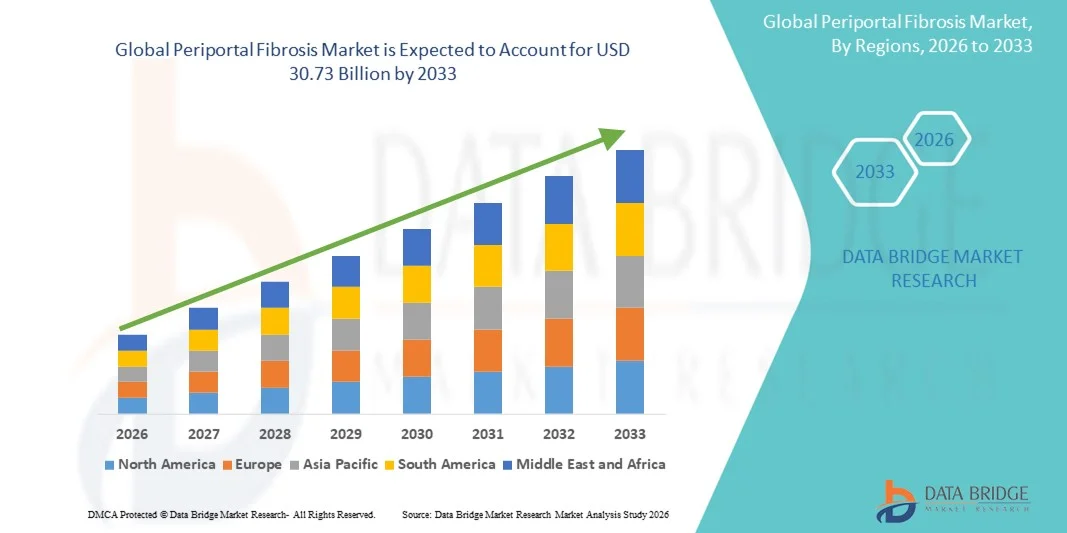
Periportal Fibrosis Market Size
- The global periportal fibrosis market size was valued at USD 20.85 billion in 2025 and is expected to reach USD 30.73 billion by 2033, at a CAGR of 4.97% during the forecast period
- The market growth is largely fueled by the rising prevalence of liver diseases, including chronic hepatitis B and C infections, schistosomiasis, and other parasitic infections, which are key drivers of periportal fibrosis. Early detection and increased awareness about liver fibrosis among healthcare providers and patients are significantly contributing to the market expansion
- Furthermore, the growing demand for effective diagnostic tools, imaging techniques, and therapeutic interventions to manage liver fibrosis is driving the adoption of Periportal Fibrosis solutions. These converging factors are accelerating the uptake of advanced imaging, biomarker testing, and pharmacological treatments, thereby significantly boosting the industry’s growth
Periportal Fibrosis Market Analysis
- Periportal Fibrosis, characterized by progressive liver tissue scarring around the portal vein, is increasingly recognized as a critical health concern due to its association with schistosomiasis, viral hepatitis, and other chronic liver disorders. The rising prevalence of liver-related conditions and advancements in diagnostic and therapeutic solutions are driving heightened focus on effective management strategies
- The escalating demand for periportal fibrosis treatments is primarily fueled by growing awareness about liver health, increasing adoption of advanced imaging and biomarker testing, and the rising preference for early intervention and non-invasive therapies
- North America dominated the periportal fibrosis market with the largest revenue share of 41.6% in 2025, driven by the presence of advanced healthcare infrastructure, high diagnosis rates for liver and parasitic diseases, and strong research initiatives on liver fibrosis. The U.S. remains the key contributor to the regional market, supported by widespread access to hepatology specialists, government-funded liver health programs, and the availability of advanced diagnostic and therapeutic options
- Asia-Pacific is expected to be the fastest-growing region in the periportal fibrosis market during the forecast period, projected to expand at a CAGR of 22.8% from 2026 to 2033, due to the high prevalence of schistosomiasis and viral hepatitis, increasing healthcare expenditure, rising awareness about liver health, and government initiatives promoting early diagnosis and treatment. Countries such as China, India, and Japan are witnessing significant adoption of imaging technologies, biomarker testing, and anti-fibrotic therapies
- The oral segment accounted for the largest market revenue share of 56.8% in 2025, attributed to convenience, long-term patient compliance, and affordability in chronic fibrosis management
Report Scope and Periportal Fibrosis Market Segmentation
|
Attributes |
Periportal Fibrosis Key Market Insights |
|
Segments Covered |
|
|
Countries Covered |
North America
Europe
Asia-Pacific
Middle East and Africa
South America
|
|
Key Market Players |
|
|
Market Opportunities |
|
|
Value Added Data Infosets |
In addition to the insights on market scenarios such as market value, growth rate, segmentation, geographical coverage, and major players, the market reports curated by the Data Bridge Market Research also include in-depth expert analysis, patient epidemiology, pipeline analysis, pricing analysis, and regulatory framework. |
Periportal Fibrosis Market Trends
Advancements in Diagnosis and Targeted Therapeutics
- A significant and accelerating trend in the global periportal fibrosis market is the growing focus on early diagnosis and personalized treatment approaches. Innovations in imaging modalities such as elastography, MRI, and advanced ultrasound techniques are enabling more precise assessment of liver fibrosis progression and severity, facilitating timely intervention
- For instance, in February 2024, a multicenter clinical study demonstrated that combining transient elastography with serum biomarkers significantly improved the non-invasive diagnosis of periportal fibrosis, allowing clinicians to stratify patients more accurately and plan appropriate treatment regimens. Similarly, ongoing research in antifibrotic pharmacotherapy is exploring agents targeting key fibrogenic pathways, offering tailored treatment for patients at different disease stages
- The trend toward integrated diagnostic and therapeutic approaches is also supported by the adoption of machine-learning models for risk prediction and disease monitoring, enabling clinicians to personalize therapy and monitor response more efficiently. These approaches are driving clinical research initiatives and encouraging the development of novel therapeutics aimed at slowing or reversing fibrosis progression
- Furthermore, growing emphasis on patient stratification based on etiology (e.g., schistosomiasis, viral hepatitis, or metabolic liver disease) is shaping targeted intervention strategies, improving outcomes and reducing complications associated with late-stage periportal fibrosis
- This trend toward precision diagnostics and targeted therapeutics is fundamentally transforming the management of periportal fibrosis, emphasizing early intervention, patient-centered care, and the development of disease-modifying agents
Periportal Fibrosis Market Dynamics
Driver
Rising Prevalence of Liver Diseases and Enhanced Clinical Awareness
- The increasing global incidence of liver diseases such as viral hepatitis, non-alcoholic fatty liver disease (NAFLD), and schistosomiasis is a significant driver of the periportal fibrosis market, as these conditions frequently lead to fibrotic remodeling of the liver
- For instance, in March 2023, the World Health Organization reported a rising burden of chronic hepatitis infections in endemic regions, highlighting the urgent need for effective fibrosis monitoring and management. Such epidemiological trends are expected to fuel market growth through increased demand for diagnostic services and therapeutic interventions
- As clinicians become more aware of the risks of progression from mild fibrosis to cirrhosis and portal hypertension, the adoption of routine screening and early-stage therapeutic strategies is rising. Early intervention improves prognosis and reduces healthcare costs associated with late-stage liver disease
- Furthermore, the growth of specialized hepatology centers and liver clinics is expanding access to advanced imaging and pharmacological treatment options, supporting market expansion
- Increasing healthcare spending, especially in emerging economies, along with initiatives to improve liver disease awareness, are further propelling the demand for periportal fibrosis diagnostics and therapeutics across both public and private healthcare settings
Restraint/Challenge
Limited Access to Advanced Diagnostics and High Treatment Costs
- Despite market growth, limited access to advanced diagnostic tools such as elastography and MRI in resource-constrained regions poses a significant challenge to timely detection and management of periportal fibrosis. Many patients remain undiagnosed until advanced disease stages due to lack of infrastructure and trained personnel
- For instance, reports from rural healthcare networks indicate delays in fibrosis diagnosis due to the unavailability of specialized imaging, contributing to increased morbidity and the need for more intensive interventions later
- The high cost of antifibrotic therapies and continuous monitoring can also restrict adoption, particularly in low-income countries or for patients without comprehensive health coverage. While generic treatments and supportive care options are available, newer targeted agents often carry a premium price
- In addition, variability in clinical guidelines and limited consensus on standardized management protocols across regions may hinder uniform treatment practices, affecting market growth
- Overcoming these challenges through investment in healthcare infrastructure, training of medical personnel, patient education, and the development of cost-effective diagnostic and therapeutic solutions will be vital for sustaining growth in the periportal fibrosis market
Periportal Fibrosis Market Scope
The market is segmented on the basis of drug class, mode of administration, distribution channel, and end user.
- By Drug Class
On the basis of drug class, the Periportal Fibrosis market is segmented into Interferon (IFN) therapy, nucleoside analogs, maloti lipid, and other drug classes. The nucleoside analog segment dominated the largest market revenue share of 52.6% in 2025, driven by its well-established antiviral efficacy, ability to suppress viral replication, and proven impact on slowing fibrosis progression. Clinicians favor nucleoside analogs such as entecavir and tenofovir for their tolerability, safety profile, and availability in generic forms. The segment’s dominance is reinforced by inclusion in global clinical guidelines, high adoption in hospital and outpatient settings, and widespread patient acceptance. Strong real-world outcomes and ongoing clinical validation continue to support its leading position in the market.
The maloti lipid segment is expected to witness the fastest CAGR of 19.3% from 2026 to 2033, driven by emerging lipid-based antifibrotic therapies targeting key pathways in liver fibrogenesis. Increased clinical trials, innovative formulations, and research-backed efficacy have encouraged adoption in specialist centers. Growing awareness among clinicians and patients about alternative therapies for fibrosis management is further fueling demand. The development of combination regimens with nucleoside analogs also contributes to accelerated growth. Expansion into emerging markets with rising prevalence of hepatic fibrosis supports rapid uptake. Regulatory approvals of newer lipid-based agents are enhancing market confidence. Patient preference for safer, steroid-sparing, or non-traditional antifibrotics adds to segment momentum. Overall, strong R&D investment and clinical validation are sustaining high growth potential.
- By Mode of Administration
On the basis of mode of administration, the market is segmented into injectable, oral, and others. The oral segment accounted for the largest market revenue share of 56.8% in 2025, attributed to convenience, long-term patient compliance, and affordability in chronic fibrosis management. Oral nucleoside analogs and antifibrotics allow outpatient treatment, reducing hospital visits while maintaining consistent viral suppression and fibrosis control. The segment benefits from widespread availability in both generic and branded formulations, established clinical protocols, and strong patient adherence. Growing adoption of oral therapies in emerging economies and increased physician preference for non-invasive administration further reinforce dominance. Integration into standard treatment regimens and positive real-world outcomes also enhance its market leadership.
The injectable segment is projected to witness the fastest CAGR of 21.1% from 2026 to 2033, driven by parenteral interferon therapy and emerging injectable antifibrotic agents for severe or advanced cases. Injectable administration ensures precise dosing, rapid therapeutic effect, and suitability for hospital-based or specialist clinic interventions. Clinical adoption is increasing due to higher efficacy in acute or treatment-resistant fibrosis cases. Development of long-acting injectable formulations reduces dosing frequency, improving patient convenience. Growing awareness of injectable options in combination therapy regimens supports market expansion. Expansion of hospital infusion centers and specialty clinics also facilitates adoption. Rising investment in injectable R&D and regulatory approvals further propel growth. Increasing patient preference for rapid-acting treatments ensures continued momentum.
- By Distribution Channel
On the basis of distribution channel, the market is segmented into hospital pharmacies, retail pharmacies, and online pharmacies. The hospital pharmacies segment dominated the largest revenue share of 50.3% in 2025, driven by the high volume of prescriptions for injectable therapies and specialized nucleoside analog treatments administered under medical supervision. Hospitals provide centralized dispensing, ensure treatment compliance, and offer access to complex therapy regimens. The presence of trained clinical staff, advanced pharmacy infrastructure, and integration with hospital-based treatment plans reinforces the segment’s market leadership. Hospitals also serve as primary sites for patient education, monitoring, and adherence programs, supporting sustained demand. High patient turnover and concentrated treatment delivery make hospitals the central point for periportal fibrosis therapy distribution.
The online pharmacies segment is expected to witness the fastest CAGR of 22.5% from 2026 to 2033, fueled by increasing digital adoption, ease of access to medications, and growing patient preference for home delivery of oral therapies. E-pharmacy platforms provide convenience, competitive pricing, and remote access to chronic care medications. Awareness campaigns, telemedicine integration, and increasing internet penetration are driving adoption globally. Online pharmacies also reduce logistical barriers in rural or underserved regions. Growing regulatory support for digital healthcare platforms further accelerates market uptake. Patient preference for home-based therapy refills and convenience reinforces segment growth.
- By End User
On the basis of end user, the market is segmented into hospitals, homecare, specialty clinics, and others. The hospitals segment accounted for the largest market revenue share of 54.7% in 2025, owing to the high concentration of patients requiring diagnostic evaluation, parenteral therapy, and intensive monitoring. Hospitals provide multidisciplinary care, access to advanced imaging, and structured treatment protocols, making them the primary treatment hub for periportal fibrosis. The segment benefits from centralized therapy management, high patient volumes, and adoption of combination treatment regimens. Hospital-based clinical trials, patient monitoring, and early intervention strategies reinforce its market dominance.
The homecare segment is projected to register the fastest CAGR of 20.4% from 2026 to 2033, driven by the growing adoption of oral therapies, telemedicine-based monitoring, and patient preference for home-based management. The shift toward outpatient care, availability of self-administered oral drugs, and rising geriatric population support segment growth. Patient education programs and increasing access to homecare services contribute to higher adoption. Cost-effectiveness of home-based care, reduced hospital visits, and convenience are major growth factors. Expansion in developed and emerging markets and favorable healthcare policies further accelerate growth. Telehealth integration and remote monitoring technologies reinforce the momentum of this segment.
Periportal Fibrosis Market Regional Analysis
- The North America periportal fibrosis market dominated with the largest revenue share of 41.6% in 2025, driven by advanced healthcare infrastructure, high diagnosis rates for liver and parasitic diseases, and strong research initiatives focused on liver fibrosis
- The market leads the regional market, supported by widespread access to hepatology specialists, government-funded liver health programs, and the availability of advanced diagnostic and therapeutic options
- Rising investment in clinical research, increasing use of non-invasive imaging, and broader adoption of anti-fibrotic therapies further contribute to market growth
U.S. Periportal Fibrosis Market Insight
The U.S. periportal fibrosis market captured the largest share within North America in 2025, fueled by a high prevalence of viral hepatitis, autoimmune liver disorders, and rising awareness about liver health. The market is driven by well-established healthcare infrastructure, availability of hepatology specialists, and government initiatives supporting early diagnosis and treatment. Growing adoption of imaging technologies, biomarker testing, and advanced therapeutic options for liver fibrosis is significantly boosting the U.S. market.
Europe Periportal Fibrosis Market Insight
The Europe periportal fibrosis market is projected to expand at a substantial CAGR during the forecast period, driven by increasing prevalence of hepatitis, growing focus on early diagnosis, and rising healthcare expenditure. Countries such as Germany, France, and the U.K. are witnessing higher adoption of imaging technologies, biomarker testing, and anti-fibrotic therapies. The region is experiencing growth across hospitals, specialty clinics, and research centers, supported by government initiatives and private investments promoting liver health awareness.
U.K. Periportal Fibrosis Market Insight
The U.K. periportal fibrosis market is expected to grow at a noteworthy CAGR during the forecast period due to increasing cases of schistosomiasis and viral hepatitis, rising awareness about liver diseases, and expanding access to diagnostic facilities. The integration of non-invasive liver fibrosis testing and targeted therapies in clinical practice is driving adoption. Additionally, public health campaigns and research collaborations are boosting market development.
Germany Periportal Fibrosis Market Insight
Germany’s periportal fibrosis market is anticipated to expand at a significant CAGR, fueled by rising prevalence of chronic liver diseases, government initiatives supporting liver health, and technological advancements in diagnostics and therapeutics. The well-established healthcare infrastructure, along with strong clinical research networks, enhances the availability of effective treatment options and encourages early detection and management of periportal fibrosis.
Asia-Pacific Periportal Fibrosis Market Insight
The Asia-Pacific periportal fibrosis market is poised to grow at the fastest CAGR of 22.8% during the forecast period of 2026 to 2033. Growth is driven by high prevalence of schistosomiasis and viral hepatitis, rising healthcare expenditure, increasing awareness about liver health, and expanding access to advanced diagnostic and therapeutic options. Countries such as China, India, and Japan are witnessing greater adoption of imaging technologies, biomarker testing, and anti-fibrotic therapies, supported by government programs and private sector investment in liver disease management.
Japan Periportal Fibrosis Market Insight
The Japan periportal fibrosis market is gaining traction due to the country’s focus on healthcare innovation, high prevalence of liver disorders in aging populations, and rising adoption of advanced diagnostic techniques. Non-invasive imaging technologies and personalized anti-fibrotic treatment approaches are being increasingly utilized in hospitals and specialty clinics, driving market growth.
China Periportal Fibrosis Market Insight
The China periportal fibrosis market accounted for the largest market revenue share in Asia-Pacific in 2025, owing to the high burden of viral hepatitis, expanding middle-class population, and increasing healthcare expenditure. Government initiatives promoting early diagnosis, widespread availability of imaging technologies, and growing adoption of anti-fibrotic therapies are key factors contributing to the market’s expansion.
Periportal Fibrosis Market Share
The Periportal Fibrosis industry is primarily led by well-established companies, including:
• Gilead Sciences (U.S.)
• Roche Holding AG (Switzerland)
• Merck & Co., Inc. (U.S.)
• Novartis AG (Switzerland)
• Bristol-Myers Squibb (U.S.)
• Pfizer Inc. (U.S.)
• AbbVie Inc. (U.S.)
• GlaxoSmithKline plc (U.K.)
• Sanofi S.A. (France)
• Takeda Pharmaceutical Company (Japan)
• Mylan N.V. (U.S.)
• Amgen Inc. (U.S.)
• Celgene Corporation (U.S.)
• Bayer AG (Germany)
Latest Developments in Global Periportal Fibrosis Market
- In March 2024, the drug Resmetirom showed promising results in a Phase III trial for improving liver fibrosis and reducing disease progression in patients with metabolic dysfunction‑associated steatotic liver disease (MASLD)
- In March 2024, the company 89bio announced the initiation of its global Phase III “ENLIGHTEN‑Fibrosis” trial of Pegozafermin in patients with biopsy‑confirmed fibrosis, underscoring the advancement of novel treatments targeting liver fibrosis
- In November 2024, the company Sagimet Biosciences reported that its investigational agent Denifanstat demonstrated improved fibrosis outcomes in a subset of a Phase 2 trial for metabolic‑associated steatohepatitis (MASH), highlighting progress in therapeutic development for fibrotic liver disease
- In March 2025, an industry update reported that ongoing clinical trials in anti‑liver fibrosis therapies are increasingly incorporating non‑invasive imaging and biomarker endpoints, reflecting a shift in how periportal and other hepatic fibrosis stages are managed and assessed in research settings

- Interactive Data Analysis Dashboard
- Company Analysis Dashboard for high growth potential opportunities
- Research Analyst Access for customization & queries
- Competitor Analysis with Interactive dashboard
- Latest News, Updates & Trend analysis
- Harness the Power of Benchmark Analysis for Comprehensive Competitor Tracking
Data collection and base year analysis are done using data collection modules with large sample sizes. The stage includes obtaining market information or related data through various sources and strategies. It includes examining and planning all the data acquired from the past in advance. It likewise envelops the examination of information inconsistencies seen across different information sources. The market data is analysed and estimated using market statistical and coherent models. Also, market share analysis and key trend analysis are the major success factors in the market report. To know more, please request an analyst call or drop down your inquiry.
The key research methodology used by DBMR research team is data triangulation which involves data mining, analysis of the impact of data variables on the market and primary (industry expert) validation. Data models include Vendor Positioning Grid, Market Time Line Analysis, Market Overview and Guide, Company Positioning Grid, Patent Analysis, Pricing Analysis, Company Market Share Analysis, Standards of Measurement, Global versus Regional and Vendor Share Analysis. To know more about the research methodology, drop in an inquiry to speak to our industry experts.
Data Bridge Market Research is a leader in advanced formative research. We take pride in servicing our existing and new customers with data and analysis that match and suits their goal. The report can be customized to include price trend analysis of target brands understanding the market for additional countries (ask for the list of countries), clinical trial results data, literature review, refurbished market and product base analysis. Market analysis of target competitors can be analyzed from technology-based analysis to market portfolio strategies. We can add as many competitors that you require data about in the format and data style you are looking for. Our team of analysts can also provide you data in crude raw excel files pivot tables (Fact book) or can assist you in creating presentations from the data sets available in the report.












