


What is the Peritoneal Dialysis Market Size and Growth Rate?
- As per Data Bridge Market Research analysis, the peritoneal dialysis market was valued at USD 9.47 billion in 2025 and is projected to reach USD 14.77 billion by 2033, growing at a CAGR of 5.72% from 2026 to 2033.
- The market is experiencing steady growth driven by the rising prevalence of end-stage renal disease (ESRD) and chronic kidney disease (CKD), increasing preference for home-based dialysis therapies, and continuous advancements in automated peritoneal dialysis systems, biocompatible dialysis solutions, and remote patient monitoring technologies.
- The growing burden of diabetes and hypertension, coupled with supportive government initiatives promoting home dialysis and increasing awareness of patient-centric renal replacement therapies, is encouraging healthcare providers and patients to adopt peritoneal dialysis. Automated peritoneal dialysis and continuous ambulatory peritoneal dialysis are increasingly being utilized as cost-effective and flexible alternatives to in-center hemodialysis, particularly for home-care management and long-term treatment of kidney failure.
Market Size & Forecast
- Global Market Value (2025): USD 9.47 Billion
- Expected Market Value (2033): USD 14.77 Billion
- Forecast CAGR (2026–2033): 5.72%
- Leading Region in 2025: North America
- Fastest Growing Region: Asia Pacific
What are the Major Takeaways of the Peritoneal Dialysis Market?
- North America dominated the peritoneal dialysis market with a 34.83% revenue share in 2025, supported by favorable reimbursement policies, high adoption of home dialysis, and advanced healthcare infrastructure.
- Asia-Pacific is expected to be the fastest-growing region at a CAGR of 12.95% from 2026 to 2033, fueled by the rising prevalence of chronic kidney disease, expanding healthcare infrastructure, and increasing adoption of home-based dialysis
- The peritoneal dialysis products segment led the market with a 72.5% share in 2025, driven by the continuous demand for dialysis solutions, cyclers, catheters, transfer sets, and other consumables required throughout the treatment cycle.
- Peritoneal dialysis services are the fastest-growing offering type, projected to register a CAGR of 6.4%, reflecting the surge in demand for home dialysis training, remote patient monitoring, telehealth support, and long-term disease management services
- The continuous ambulatory peritoneal dialysis (CAPD) segment dominated the modality category with a 64.6% revenue share in 2025, led by its simplicity, affordability, and widespread use in home-based renal replacement therapy.
- Solution bags accounted for 36.8% of the market share in 2025, preferred by their indispensable role in every peritoneal dialysis procedure and the recurring nature of replacement therapy.
- The acute kidney injury (AKI) segment is the fastest-growing disease indication category, with a CAGR of 6.8%, driven by increasing incidence of critical illnesses, sepsis, cardiac surgery, and infectious diseases associated with acute renal impairment.
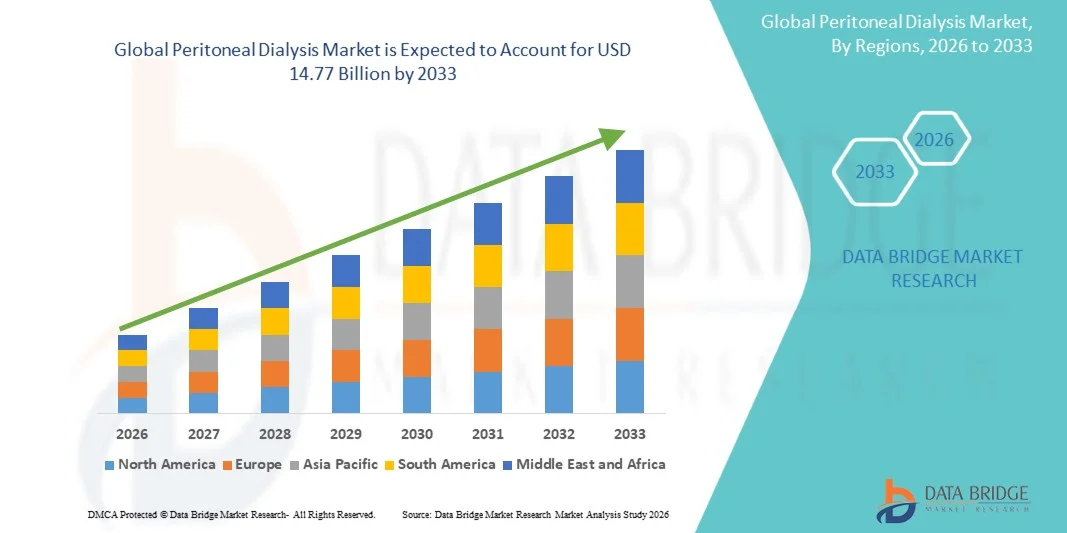
Report Scope and Peritoneal Dialysis Market Segmentation
|
Attributes |
Peritoneal Dialysis Key Market Insights |
|
Segments Covered |
|
|
Countries Covered |
North America
Europe
Asia-Pacific
Middle East and Africa
South America
|
|
Key Market Players |
|
|
Market Opportunities |
|
|
Value Added Data Infosets |
In addition to the insights on market scenarios such as market value, growth rate, segmentation, geographical coverage, and major players, the market reports curated by the Data Bridge Market Research also include in-depth expert analysis, patient epidemiology, pipeline analysis, pricing analysis, and regulatory framework. |
What is the Key Trend in the Peritoneal Dialysis Market?
- Home-based kidney care is increasingly becoming the preferred treatment approach, with healthcare systems expanding the adoption of automated peritoneal dialysis (APD) supported by digital connectivity and remote patient monitoring to improve patient outcomes and reduce hospital dependence.
- For instance, in January 2024, a study published in the Journal of Clinical Medicine demonstrated that remote monitoring for peritoneal dialysis patients improves treatment oversight by enabling proactive intervention, supporting wider adoption of connected home dialysis programs.
- Remote patient monitoring enables clinicians to track treatment adherence, prescription compliance, and therapy performance while allowing early intervention for potential complications.
- Healthcare providers are increasingly integrating connected cyclers and telehealth platforms to deliver personalized home dialysis management and improve long-term treatment continuity.
- For instance, in June 2024, an article published in the Clinical Kidney Journal highlighted that two-way communication automated peritoneal dialysis cyclers and eHealth technologies are accelerating the adoption of remote patient monitoring, enabling clinicians to supervise home dialysis treatments, optimize prescriptions, and intervene earlier when complications arise.
- As healthcare systems continue prioritizing home-based renal replacement therapy and digital health integration, adoption of automated peritoneal dialysis is expected to accelerate, reinforcing connected home dialysis as a key component of chronic kidney disease management.
What are the Key Drivers of the Peritoneal Dialysis Market?
- The rising global prevalence of chronic kidney disease (CKD), end-stage renal disease (ESRD), diabetes, and hypertension has significantly increased demand for home-based renal replacement therapies that improve accessibility and reduce healthcare costs.
- For instance, in June 2024, an article published in the Clinical Kidney Journal emphasized that integrated home dialysis models, including peritoneal dialysis, improve patient autonomy, quality of life, and healthcare efficiency, supporting broader adoption of home-based renal replacement therapy worldwide.
- Governments, healthcare providers, and nephrology organizations are increasingly encouraging peritoneal dialysis because it offers greater patient independence, lower infrastructure requirements, and reduced dependence on in-center hemodialysis facilities.
- For instance, in May 2024, the International Society for Peritoneal Dialysis (ISPD) published its Assisted Peritoneal Dialysis Position Paper, recommending expansion of assisted home peritoneal dialysis programs to improve access for older adults and patients unable to perform self-care, supporting broader adoption of home-based renal replacement therapy worldwide.
- With healthcare systems increasingly focusing on value-based care, improved patient quality of life, and expansion of home dialysis programs, peritoneal dialysis is expected to remain a key modality for long-term renal replacement therapy.
Which Factors are Challenging the Growth of the Peritoneal Dialysis Market?
- Peritoneal dialysis requires comprehensive patient training, strict infection-control practices, and long-term adherence to treatment protocols, creating operational challenges for healthcare providers and patients.
- For instance, in July 2024, a study published in the Clinical Kidney Journal identified peritoneal dialysis-related peritonitis as a major complication that contributes to hospitalization, technique failure, and discontinuation of peritoneal dialysis, highlighting the persistent clinical challenge limiting broader adoption.
- These clinical and educational requirements limit adoption among elderly patients, individuals with inadequate caregiver support, and healthcare systems with limited home dialysis infrastructure.
- Infection-related complications, catheter dysfunction, and technique failure continue to increase healthcare utilization and frequently result in patients transitioning from peritoneal dialysis to in-center hemodialysis.
- For instance, in May 2024, a study published in BMC Nephrology reported that peritoneal dialysis-related peritonitis resulted in hospitalization in 64.4% of episodes, catheter removal in 18.7%, and transfer to hemodialysis in 18.3% of cases, demonstrating how infectious complications continue to restrain long-term utilization of peritoneal dialysis.
- The continued risk of peritonitis and the need for sustained patient education, regular monitoring, and specialized clinical support remain significant barriers to broader adoption, particularly across low-resource and developing healthcare systems.
How is the Peritoneal Dialysis Market Segmented?
The peritoneal dialysis market is segmented on the basis of offering, modality, product, disease indication, and end user.
- By Offering
On the basis of offering, the peritoneal dialysis market is segmented into peritoneal dialysis products and peritoneal dialysis services. The peritoneal dialysis products segment dominated the market with an estimated share of 72.5% in 2025, driven by the continuous demand for dialysis solutions, cyclers, catheters, transfer sets, and other consumables required throughout the treatment cycle. These products are essential for both Continuous Ambulatory Peritoneal Dialysis (CAPD) and Automated Peritoneal Dialysis (APD), generating recurring revenue due to regular replacement requirements. Rising prevalence of chronic kidney disease (CKD) and end-stage renal disease (ESRD) continues to increase product consumption globally. Manufacturers are also focusing on biocompatible solutions and advanced cyclers to improve treatment outcomes. The expansion of home-based dialysis further supports long-term demand for PD products.
The peritoneal dialysis services segment is projected to register the fastest growth at an estimated CAGR of 6.4% from 2026 to 2033, driven by increasing demand for home dialysis training, remote patient monitoring, telehealth support, and long-term disease management services. Healthcare providers are expanding integrated home dialysis programs to improve patient adherence and reduce hospitalization rates. Digital health technologies are enabling clinicians to optimize therapy remotely. Rising adoption of value-based care and personalized renal care is expected to further accelerate service demand.
- By Modality
On the basis of modality, the peritoneal dialysis market is segmented into continuous ambulatory peritoneal dialysis (CAPD) and automated peritoneal dialysis (APD). The continuous ambulatory peritoneal dialysis (CAPD) segment dominated the market with 64.6% revenue share in 2025, owing to its simplicity, affordability, and widespread use in home-based renal replacement therapy. CAPD does not require automated equipment, making it particularly suitable for developing countries and resource-limited healthcare settings. It offers patients greater flexibility while reducing dependence on hospital infrastructure. Increasing awareness of home dialysis and supportive reimbursement policies continue to drive adoption. The therapy remains the preferred option for long-term cost-effective renal care.
The automated peritoneal dialysis (APD) segment is expected to witness the fastest growth at an estimated CAGR of 9.8% from 2026 to 2033, driven by increasing utilization of cycler-based therapy, technological advancements, and remote patient monitoring capabilities. APD improves treatment convenience by performing dialysis overnight, enhancing patient quality of life and treatment adherence. Growing digital connectivity and physician monitoring capabilities are supporting wider adoption. Continuous innovation in automated cyclers is expected to sustain strong market growth.
- By Product
On the basis of product, the peritoneal dialysis market is segmented into solution bags, machines, catheters, transfer sets, and others. The solution bags segment accounted for 36.8% of the market in 2025, owing to their indispensable role in every peritoneal dialysis procedure and the recurring nature of replacement therapy. Patients require multiple dialysis solution exchanges each day, creating continuous product demand. Increasing incidence of ESRD and growing home dialysis adoption continue to support market expansion. Manufacturers are developing more biocompatible dialysis fluids to improve long-term outcomes and reduce complications. The recurring utilization of solution bags ensures sustained revenue generation.
The machines segment is projected to register the fastest CAGR of 8.9% during the forecast period, supported by increasing adoption of automated peritoneal dialysis systems and advancements in connected cyclers. Rising demand for remote patient monitoring and digital healthcare integration is encouraging healthcare providers to adopt advanced APD equipment. Compact and user-friendly systems are improving treatment convenience and patient compliance. Continued investments in home dialysis infrastructure are expected to accelerate growth.
- By Disease Indication
On the basis of disease indication, the peritoneal dialysis market is segmented into end-stage renal disease (ESRD), acute kidney injury (AKI), and other kidney diseases. The End-stage renal disease (ESRD) segment dominated the market with an estimated share of 78.0% in 2025, due to the large patient population requiring lifelong renal replacement therapy. Peritoneal dialysis remains one of the primary treatment modalities for ESRD patients seeking home-based care and improved lifestyle flexibility. The increasing prevalence of diabetes, hypertension, and aging populations continues to expand the ESRD burden globally. Favorable reimbursement policies and technological improvements further support market growth. Clinical guidelines increasingly recommend home dialysis whenever appropriate.
The acute kidney injury (AKI) segment is expected to witness the fastest growth at an estimated CAGR of 6.8% from 2026 to 2033, driven by increasing incidence of critical illnesses, sepsis, cardiac surgery, and infectious diseases associated with acute renal impairment. Growing awareness regarding early renal replacement therapy and expanding healthcare infrastructure in emerging economies are supporting adoption. Ongoing clinical research is also broadening the use of peritoneal dialysis for AKI management.
- By End User
On the basis of end user, the peritoneal dialysis market is segmented into home care settings, hospitals, and others. The home care settings segment dominated the market with an estimated share of 67.0% in 2025, owing to increasing preference for home-based dialysis, greater patient independence, and reduced hospital visits. Home peritoneal dialysis lowers treatment costs while improving patient quality of life. Government initiatives and favorable reimbursement policies continue to encourage home dialysis adoption. Remote patient monitoring technologies are improving treatment safety and physician oversight. The convenience and flexibility of home therapy continue to strengthen this segment's leadership.
The hospitals segment is expected to register the fastest growth at an estimated CAGR of 6.6% from 2026 to 2033, driven by increasing diagnosis of chronic kidney disease, expanding nephrology services, and greater adoption of automated peritoneal dialysis technologies. Hospitals remain essential for patient evaluation, catheter placement, treatment initiation, and complication management. Rising investments in specialized renal care infrastructure and stronger hospital-home care integration are expected to sustain long-term growth.
Which Region Holds the Largest Share of the Peritoneal Dialysis Market?
- North America dominated the peritoneal dialysis market with a 34.83% revenue share in 2025, supported by favorable reimbursement policies, high adoption of home dialysis, and advanced healthcare infrastructure.
- The region also benefits from well-established renal care infrastructure, increasing utilization of automated peritoneal dialysis systems, widespread availability of remote patient monitoring technologies, and the presence of leading market participants including Baxter International and Fresenius Medical Care. Growing government initiatives promoting home dialysis and continuous technological advancements in connected peritoneal dialysis systems continue to strengthen North America's leadership position in the global market.
U.S. Peritoneal Dialysis Market Insight
The U.S. peritoneal dialysis market is witnessing strong growth due to the rising prevalence of chronic kidney disease (CKD) and end-stage renal disease (ESRD), increasing adoption of home dialysis therapies, and supportive reimbursement policies promoting home-based renal replacement therapy. The country's advanced healthcare infrastructure, growing utilization of automated peritoneal dialysis (APD) systems, and expanding use of remote patient monitoring technologies are driving market demand across hospitals and home care settings. The presence of major industry players such as Baxter International and Fresenius Medical Care, coupled with continuous innovation in connected dialysis systems, further supports market expansion. In addition, the CMS End-Stage Renal Disease Treatment Choices (ETC) Model continues to encourage healthcare providers to increase home dialysis utilization, improving patient access while reducing dependence on in-center hemodialysis.
Asia-Pacific Peritoneal Dialysis Market Insight
The Asia-Pacific peritoneal dialysis market is expected to witness rapid growth, driven by the increasing burden of chronic kidney disease, diabetes, and hypertension, along with expanding healthcare infrastructure across China, India, Japan, and Southeast Asia. Rising healthcare expenditure, improving access to renal replacement therapy, and favorable government initiatives supporting home-based dialysis are contributing significantly to regional market expansion. Healthcare providers are increasingly adopting automated peritoneal dialysis systems and remote patient monitoring technologies to improve treatment accessibility and patient outcomes. In addition, the International Society of Nephrology (ISN) reports that Asia accounts for one of the world's largest chronic kidney disease patient populations, creating substantial long-term demand for affordable home dialysis solutions.
Japan Peritoneal Dialysis Market Insight
The Japan peritoneal dialysis market is witnessing consistent growth due to the country's rapidly aging population, increasing prevalence of end-stage renal disease, and growing preference for home-based renal replacement therapies. Healthcare providers are increasingly adopting automated peritoneal dialysis technologies integrated with digital health platforms and remote patient monitoring systems to improve treatment efficiency and patient adherence. Government support for home healthcare and continuous advancements in dialysis technologies are further strengthening market growth. Moreover, the Japanese Society for Dialysis Therapy (JSDT) continues reporting expansion of home dialysis initiatives aimed at improving quality of life while reducing long-term healthcare expenditure associated with facility-based dialysis.
China Peritoneal Dialysis Market Insight
The China peritoneal dialysis market is growing rapidly, driven by the increasing prevalence of chronic kidney disease, expanding healthcare coverage, and strong government initiatives promoting home dialysis services. Continuous investments in nephrology infrastructure, improved reimbursement mechanisms, and increasing availability of automated peritoneal dialysis systems are significantly boosting market demand. Growing awareness regarding home-based dialysis and increasing adoption of digital healthcare technologies are further supporting regional growth. In addition, China has implemented "Peritoneal Dialysis First" programs in several provinces to improve dialysis accessibility, reduce treatment costs, and expand renal care services for patients requiring long-term dialysis
U.K. Peritoneal Dialysis Market Insight
The U.K. peritoneal dialysis market is experiencing steady growth, supported by increasing adoption of home dialysis therapies, National Health Service (NHS) initiatives promoting patient-centered kidney care, and expanding utilization of telehealth services. Healthcare providers are increasingly recommending home-based dialysis for eligible patients to improve treatment flexibility, reduce hospital dependency, and enhance quality of life. Growing adoption of automated peritoneal dialysis systems and digital patient monitoring platforms is further strengthening the market. Furthermore, the UK Kidney Association recommends increasing home dialysis utilization wherever clinically appropriate, supporting wider adoption of peritoneal dialysis across the country.
Germany Peritoneal Dialysis Market Insight
The Germany peritoneal dialysis market is expanding steadily due to increasing prevalence of chronic kidney disease, advanced nephrology care infrastructure, and growing adoption of home dialysis technologies. Hospitals and renal care providers are increasingly utilizing automated peritoneal dialysis systems integrated with remote monitoring solutions to improve patient outcomes, treatment adherence, and clinical efficiency. Strong healthcare reimbursement policies, continuous technological innovation, and increasing focus on patient-centered renal care continue to support market growth. In addition, Fresenius Medical Care has expanded digital home dialysis solutions across Germany and Europe, including kinexus PD Remote Therapy Management for automated and continuous ambulatory peritoneal dialysis, strengthening adoption of connected home dialysis technologies.
Which are the Top Companies in Peritoneal Dialysis Market?
The peritoneal dialysis industry is primarily led by well-established companies, including:
- Fresenius Medical Care AG (Germany)
- Baxter (U.S.)
- DaVita Inc. (U.S.)
- NIPRO CORPORATION (Japan)
- B. Braun SE (Germany)
- Terumo Corporation (Japan)
- Cook (U.S.)
- Medtronic plc (Ireland)
- BD (U.S.)
- Teleflex Incorporated (U.S.)
- AngioDynamics, Inc. (U.S.)
- Kimal PLC (U.K.)
- JMS Co., Ltd. (Japan)
- Asahi Kasei Corporation (Japan)
- Toray Industries, Inc. (Japan)
- Quanta Dialysis Technologies Ltd. (U.K.)
- AWAK Technologies Pte. Ltd. (Singapore)
- Renax Biomedical Technology Co., Ltd. (China)
- Polymed (India)
What are Latest Developments in Peritoneal Dialysis Market?
- In October 2024, Baxter International announced measures to restore production and supply of peritoneal dialysis solutions after Hurricane Helene caused flooding at its North Cove manufacturing facility in North Carolina. The company worked with regulatory authorities, including the U.S. FDA, to authorize temporary imports from international facilities to maintain availability of critical dialysis solutions for patients. The event highlighted the importance of resilient manufacturing and global supply networks for ensuring continuity of peritoneal dialysis care.
- In November 2023, Baxter International presented new clinical data at the American Society of Nephrology (ASN) Kidney Week demonstrating that its Sharesource Remote Patient Management platform, when used with automated peritoneal dialysis systems, was associated with a 77% lower risk of home dialysis technique failure. The findings highlighted the role of digital monitoring technologies in improving treatment management, reducing therapy interruptions, and supporting the continued expansion of home-based peritoneal dialysis programs
- In April 2022, Fresenius Medical Care announced that the U.S. Food and Drug Administration (FDA) granted 510(k) clearance for the Versi™PD Cycler System, a next-generation automated peritoneal dialysis (APD) platform designed to simplify home dialysis through an intuitive user interface, wireless connectivity, and enhanced patient usability. The clearance expanded the company's home dialysis portfolio and supported the growing adoption of automated peritoneal dialysis.
- In June 2021, Baxter International launched Sharesource Analytics 1.0, a next-generation digital health module integrated into its Sharesource Remote Patient Management platform for home peritoneal dialysis. The solution provides clinicians with advanced analytics and treatment insights to identify potential therapy complications earlier and improve management of patients receiving automated peritoneal dialysis at home
- In May 2021, Fresenius Medical Care North America introduced the Kinexus Therapy Management Platform, a cloud-based connected health platform for patients receiving peritoneal dialysis using the Liberty® Select cycler. The platform enables remote therapy management, simplifies clinical workflows, and improves monitoring of home dialysis patients, supporting broader adoption of digital kidney care.

- Interactive Data Analysis Dashboard
- Company Analysis Dashboard for high growth potential opportunities
- Research Analyst Access for customization & queries
- Competitor Analysis with Interactive dashboard
- Latest News, Updates & Trend analysis
- Harness the Power of Benchmark Analysis for Comprehensive Competitor Tracking
Data collection and base year analysis are done using data collection modules with large sample sizes. The stage includes obtaining market information or related data through various sources and strategies. It includes examining and planning all the data acquired from the past in advance. It likewise envelops the examination of information inconsistencies seen across different information sources. The market data is analysed and estimated using market statistical and coherent models. Also, market share analysis and key trend analysis are the major success factors in the market report. To know more, please request an analyst call or drop down your inquiry.
The key research methodology used by DBMR research team is data triangulation which involves data mining, analysis of the impact of data variables on the market and primary (industry expert) validation. Data models include Vendor Positioning Grid, Market Time Line Analysis, Market Overview and Guide, Company Positioning Grid, Patent Analysis, Pricing Analysis, Company Market Share Analysis, Standards of Measurement, Global versus Regional and Vendor Share Analysis. To know more about the research methodology, drop in an inquiry to speak to our industry experts.
Data Bridge Market Research is a leader in advanced formative research. We take pride in servicing our existing and new customers with data and analysis that match and suits their goal. The report can be customized to include price trend analysis of target brands understanding the market for additional countries (ask for the list of countries), clinical trial results data, literature review, refurbished market and product base analysis. Market analysis of target competitors can be analyzed from technology-based analysis to market portfolio strategies. We can add as many competitors that you require data about in the format and data style you are looking for. Our team of analysts can also provide you data in crude raw excel files pivot tables (Fact book) or can assist you in creating presentations from the data sets available in the report.













