


Persistent Corneal Epithelial Defects Treatment Market Size
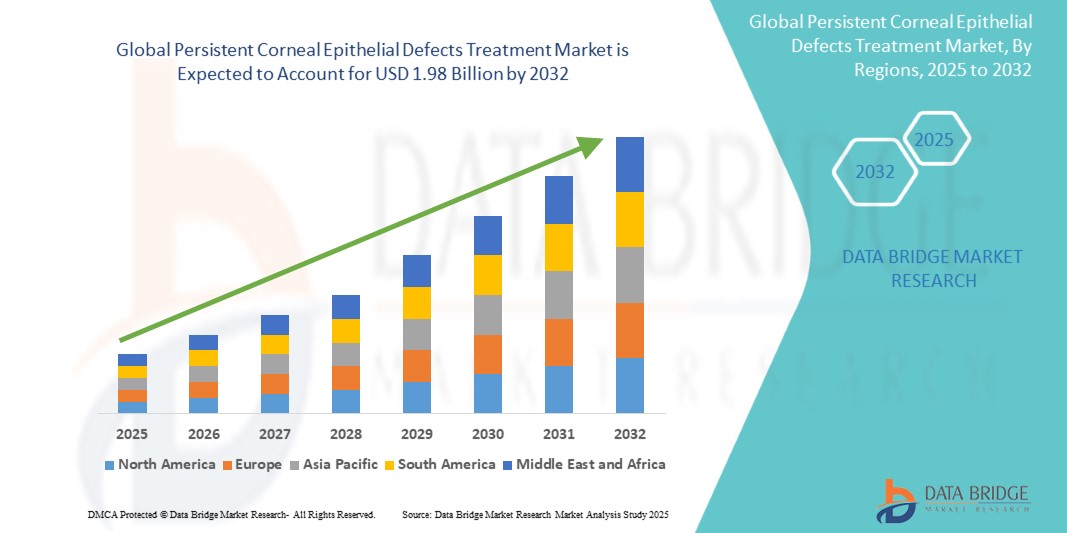
- The global Persistent Corneal Epithelial Defects Treatment market was valued at USD 1.44 billion in 2024 and is expected to reach USD 1.98 billion by 2032 at a CAGR of 4.05%, during forecast period
- This growth is driven by factors due to its advanced eye care infrastructure, high adoption of innovative biologics and therapeutic drugs, and strong presence of key pharmaceutical and biotech companies
Persistent Corneal Epithelial Defects Treatment Market Analysis
- Persistent Corneal Epithelial Defects (PCED) treatments are essential tools in modern ophthalmology, enabling effective healing of chronic corneal wounds and preventing further ocular complications such as infection, scarring, or vision loss. These treatments are widely used in conditions such as neurotrophic keratitis, dry eye syndrome, and chemical injuries
- The demand for treatments in the Global Persistent Corneal Epithelial Defects (PCED) Treatment Market is significantly driven by the growing prevalence of ocular surface disorders, increased awareness through ophthalmic screening programs, and technological advancements in regenerative and biologic therapies such as growth factors and amniotic membrane products
- North America is expected to dominate the Global Persistent Corneal Epithelial Defects (PCED) Treatment Market with a share of 36.4%, due to its advanced eye care infrastructure, high adoption of innovative biologics and therapeutic drugs, and strong presence of key pharmaceutical and biotech companies
- For instance, the U.S. has seen increasing clinical trials for amniotic membrane products and growth factor-based eye drops, highlighting its leadership in innovation and access
- Asia-Pacific is expected to be the fastest growing region in the Global Persistent Corneal Epithelial Defects (PCED) Treatment Market during the forecast period due to rapid improvements in healthcare access, increasing awareness about eye diseases, and rising demand for advanced ocular therapies
- The antibiotics segment is expected to dominate the Global Persistent Corneal Epithelial Defects (PCED) Treatment Market with a market share of 34.5% due to its widespread clinical use, cost-effectiveness, and essential role in preventing or managing secondary bacterial infections in patients with PCED. Despite the emergence of advanced treatments such as growth factors and amniotic membrane products, antibiotics remain a mainstay in therapy owing to their accessibility, established safety profile, and routine integration into PCED treatment protocols. Their continued role in supportive care reinforces their leading position in the market
Report Scope and Persistent Corneal Epithelial Defects Treatment Market Segmentation
|
Attributes |
Persistent Corneal Epithelial Defects Treatment Key Market Insights |
|
Segments Covered |
|
|
Countries Covered |
North America
Europe
Asia-Pacific
Middle East and Africa
South America
|
|
Key Market Players |
|
|
Market Opportunities |
|
|
Value Added Data Infosets |
In addition to the insights on market scenarios such as market value, growth rate, segmentation, geographical coverage, and major players, the market reports curated by the Data Bridge Market Research also include depth expert analysis, patient epidemiology, pipeline analysis, pricing analysis, and regulatory framework. |
Persistent Corneal Epithelial Defects Treatment Market Trends
“Biologic Therapies Transforming the Treatment Landscape ”
- One prominent trend in the Persistent Corneal Epithelial Defects treatment market is the is the increasing adoption of biologic therapies such as recombinant growth factors, blood-derived eye drops, and amniotic membrane products for PCED management
- These novel therapies offer targeted healing by modulating epithelial regeneration, reducing inflammation, and enhancing tissue repair
For instance,
- For instance, growth factor-based formulations have shown faster re-epithelialization in clinical settings, improving visual outcomes in patients with neurotrophic keratitis
This trend is transforming the landscape of Persistent Corneal Epithelial Defects treatments, as the incorporation of regenerative medicine is reshaping ocular surface disease care and encouraging pipeline development of next-gen biologics
Persistent Corneal Epithelial Defects Treatment Market Dynamics
Driver
“Rising Burden of Corneal Surface Diseases”
- The increasing prevalence of conditions such as diabetes, herpes zoster ophthalmicus, and chronic dry eye disease contributes significantly to the incidence of PCED
- Elderly populations and post-operative patients (e.g., after LASIK or corneal transplants) are particularly vulnerable to epithelial healing disorder
- The growing clinical emphasis on early intervention to prevent corneal scarring or ulceration further supports demand for advanced therapies
For instance,
- In July 2022, according to the study published by the American Academy of Ophthalmology, diabetic patients were found to be at a 4x higher risk of PCED, underlining the condition’s association with systemic disease
- As awareness around the health risks of UV exposure spreads globally, the demand for Persistent Corneal Epithelial Defects treatment products is expected to rise significantly
Opportunity
“increasing Penetration of E-Commerce Platforms”
- The increasing penetration of e-commerce platforms and the rise of direct-to-consumer (DTC) brands present a significant opportunity for Persistent Corneal Epithelial Defects treatment manufacturers to reach a broader and more targeted consumer base
- Additionally, digital marketing strategies, including influencer partnerships are helping brands build consumer trust and increase product visibility. These therapies offer personalized treatment strategies aimed at restoring normal epithelial cell turnover and reducing disease recurrence
For instance,
- in January 2025, a report in Ocular Surface Journal highlighted the successful use of cultivated oral mucosal epithelial transplantation (COMET) in treating severe PCED cases in Japan, demonstrating the potential of cell-based approaches
- The digital transformation of the retail landscape allows both established players and startups to scale rapidly, offer personalized product recommendations, and improve consumer engagement
Restraint/Challenge
“High Treatment Costs and Limited Accessibility ”
- Biologic and regenerative therapies, while effective, come at a high cost, limiting accessibility in low-resource healthcare systems
- One of the major restraints in the Persistent Corneal Epithelial Defects treatment market is the limited accessibility and affordability of high-quality dermatological care products in rural and economically disadvantaged areas
- cost-intensive treatments such as amniotic membrane grafts or autologous serum drops are often not covered by insurance, restricting widespread adoption
For instance,
- In November 2024, according to a report Health Economics Review noted that advanced ocular surface therapies are 3–5 times more expensive than standard treatments, posing a burden on both patients and providers
- This disparity in access restricts market penetration and limits growth potential, particularly in emerging markets where Persistent Corneal Epithelial Defects incidence is often high but awareness and distribution remain low
Persistent Corneal Epithelial Defects Treatment Market Scope
The market is segmented on the basis of mechanism of action, drugs, route of administration, end user, and distribution channel.
|
Segmentation |
Sub-Segmentation |
|
By Drugs |
|
|
By Route of Administration |
|
|
By End User |
|
|
By Distribution Channel
|
|
In 2025, the antibiotics segment is projected to dominate the market with the largest share in the drug type segment
The antibiotics segment is expected to dominate the Persistent Corneal Epithelial Defects (PCED) treatment market with the largest share of 34.5% in 2025 due to its widespread clinical use, cost-effectiveness, and essential role in preventing secondary infections during treatment. Despite the introduction of newer therapeutic agents such as growth factors and amniotic membrane products, antibiotics remain a fundamental component in PCED management owing to their broad-spectrum antimicrobial activity, ease of accessibility, and established clinical protocols. Their continued use in both acute and long-term care settings reinforces their dominant market position.
The growth factors segment is expected to account for the largest share during the forecast period in the drug segment
In 2025, the growth factors segment is expected to dominate the market due to their targeted mechanism of action, enhanced healing properties, and rising adoption as advanced treatment options for PCED. Unlike traditional drugs such as antibiotics or corticosteroids, growth factors directly stimulate epithelial cell proliferation and migration, promoting faster and more effective corneal healing. The increasing demand for regenerative and personalized therapies, coupled with ongoing research advancements and regulatory support, is further driving the expansion of this segment
Persistent Corneal Epithelial Defects Treatment Market Regional Analysis
“North America is the Dominant Region in the Persistent Corneal Epithelial Defects Treatment Market”
- North America dominates the Persistent Corneal Epithelial Defects (PCED) treatment market, driven by a strong ophthalmic care infrastructure, early adoption of regenerative eye therapies, and the presence of key pharmaceutical and biotech firms specializing in ocular diseases
- The U.S. holds a significant share due to a high prevalence of ocular surface diseases such as neurotrophic keratitis and limbal stem cell deficiency, coupled with growing use of innovative therapies such as recombinant growth factors and amniotic membrane product
- Favorable reimbursement policies for rare eye conditions, as well as robust research and clinical trials for biologic and regenerative treatments, further fuel market growth in the region
- Additionally, increasing awareness campaigns, access to advanced diagnostic technologies, and integrated ophthalmology networks contribute to increased diagnosis and treatment rates across the region
“Asia-Pacific is Projected to Register the Highest Growth Rate”
- The Asia-Pacific region is expected to witness the highest growth rate in the Persistent Corneal Epithelial Defects treatment market, driven by rising awareness of ocular surface disorders and expanding access to specialized eye care services
- Countries such as China, India, and Japan are emerging as key growth centers due to rising geriatric populations, increasing prevalence of diabetes and dry eye disease, and growing government investments in ophthalmic infrastructure
- Japan, known for its advanced healthcare systems and strong ophthalmic research, is playing a pivotal role in clinical trials for PCED treatment options, including regenerative therapies
- China and India are experiencing improved access to biologics and amniotic membrane-based products, driven by collaborations between local and global players, boosting the regional market outlook
Persistent Corneal Epithelial Defects Treatment Market Share
The market competitive landscape provides details by competitor. Details included are company overview, company financials, revenue generated, market potential, investment in research and development, new market initiatives, global presence, production sites and facilities, production capacities, company strengths and weaknesses, product launch, product width and breadth, application dominance. The above data points provided are only related to the companies' focus related to market.
The Major Market Leaders Operating in the Market Are:
- Johnson & Johnson (U.S.
- GlaxoSmithKline plc (U.K.
- Bayer AG (Germany)
- Sanofi (France)
- BD (U.S.)
- Sun Pharmaceutical Industries Ltd. (India)
- Cipla Inc. (India)
- Medtronic (U.S.)
Latest Developments in Global Persistent Corneal Epithelial Defects Treatment Market
- In February 2025, RegeneraSight Biologics announced the initiation of Phase III trials for its next-generation recombinant human nerve growth factor (rhNGF) eye drop, optimized for faster epithelial healing in neurotrophic keratitis patients across North America and Europe
- In October 2024, BioTissue Inc. reported positive Phase II trial outcomes for its cryopreserved amniotic membrane therapy, demonstrating enhanced corneal healing in patients with persistent epithelial defects in both U.S. and European cohorts

- Interactive Data Analysis Dashboard
- Company Analysis Dashboard for high growth potential opportunities
- Research Analyst Access for customization & queries
- Competitor Analysis with Interactive dashboard
- Latest News, Updates & Trend analysis
- Harness the Power of Benchmark Analysis for Comprehensive Competitor Tracking
Data collection and base year analysis are done using data collection modules with large sample sizes. The stage includes obtaining market information or related data through various sources and strategies. It includes examining and planning all the data acquired from the past in advance. It likewise envelops the examination of information inconsistencies seen across different information sources. The market data is analysed and estimated using market statistical and coherent models. Also, market share analysis and key trend analysis are the major success factors in the market report. To know more, please request an analyst call or drop down your inquiry.
The key research methodology used by DBMR research team is data triangulation which involves data mining, analysis of the impact of data variables on the market and primary (industry expert) validation. Data models include Vendor Positioning Grid, Market Time Line Analysis, Market Overview and Guide, Company Positioning Grid, Patent Analysis, Pricing Analysis, Company Market Share Analysis, Standards of Measurement, Global versus Regional and Vendor Share Analysis. To know more about the research methodology, drop in an inquiry to speak to our industry experts.
Data Bridge Market Research is a leader in advanced formative research. We take pride in servicing our existing and new customers with data and analysis that match and suits their goal. The report can be customized to include price trend analysis of target brands understanding the market for additional countries (ask for the list of countries), clinical trial results data, literature review, refurbished market and product base analysis. Market analysis of target competitors can be analyzed from technology-based analysis to market portfolio strategies. We can add as many competitors that you require data about in the format and data style you are looking for. Our team of analysts can also provide you data in crude raw excel files pivot tables (Fact book) or can assist you in creating presentations from the data sets available in the report.












