


What is the Personal Mobility Vehicle Market Size and Growth Rate?
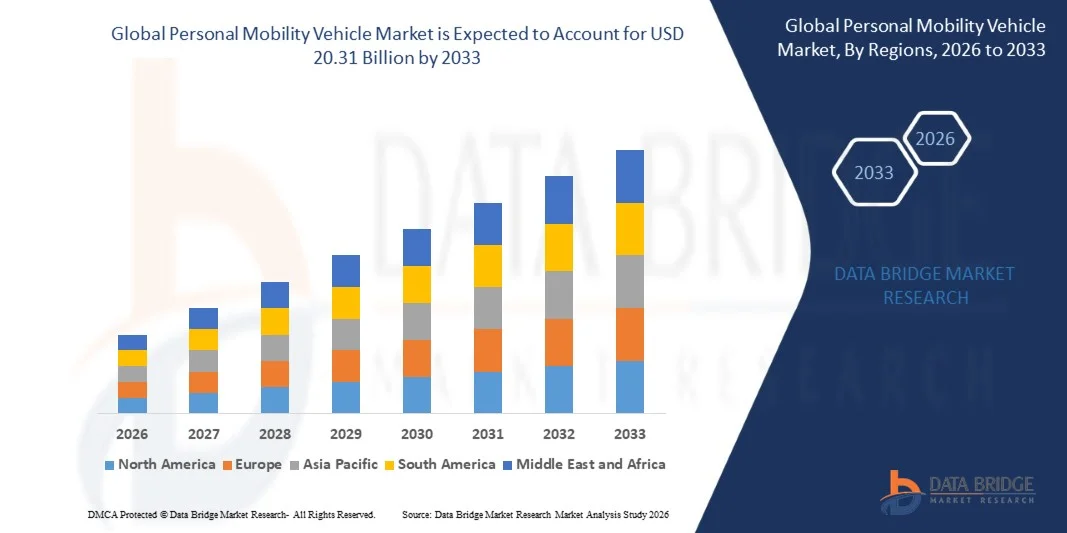
- As per Data Bridge Market Research analysis, the Personal Mobility Vehicle Market is estimated at USD 8.50 billion in 2025 and is projected to reach USD 20.31 billion by 2033, growing at a CAGR of 11.50% from 2026 to 2033.
- The market is experiencing strong growth driven by rising urban demand for affordable, sustainable last-mile transportation, continued advancement in battery and stability-control technology, and growing entry of established automotive and motorcycle manufacturers into the personal mobility vehicle category.
- Growing consumer preference for eco-friendly urban commuting alternatives, combined with expanding shared mobility fleet deployment and rising integration of AI-based stability and connectivity features, is compelling leading manufacturers to continuously innovate their product portfolios. Continued government support for micro-mobility infrastructure is expected to further accelerate category adoption across major markets.
Market Size & Forecast
- Global Market Value (2025): USD 8.50 Billion
- Expected Market Value (2033): USD 20.31 Billion
- Forecast CAGR (2026–2033): 11.50%
- Leading Region in 2025: Asia-Pacific
- Fastest Growing Region: North America
What are the Major Takeaways of the Personal Mobility Vehicle Market?
- Asia-Pacific dominated the Personal Mobility Vehicle Market with the largest revenue share of 42.6% in 2025, supported by high population density, extensive two-wheeler manufacturing infrastructure, and strong consumer adoption of micro-mobility solutions across China, Japan, and India.
- North America is expected to be the fastest-growing region from 2026 to 2033, registering a CAGR of 13.2%, fueled by expanding state zero-emission vehicle policies, growing charging infrastructure availability, and rising commercial adoption by e-commerce and food delivery operators.
- The electric kick scooters segment led the product type category with a 38.4% revenue share in 2025, driven by widespread adoption for short-distance urban commuting and favorable pricing.
- The self-balancing scooters/hoverboards segment is the fastest-growing product type, with a CAGR of 12.8% from 2026 to 2033, reflecting rising integration of AI-based stability systems and entry of established automotive manufacturers.
- The lithium-ion segment dominated the battery type category with a 76.5% revenue share in 2025, owing to its superior energy density and lighter weight relative to lead-acid alternatives.
- The last-mile delivery application segment is the fastest-growing category, with a CAGR of 13.5% from 2026 to 2033, driven by rising adoption by e-commerce and food delivery operators seeking to reduce costs and emissions.
- The 15–25 km/h speed range segment led the market with a 46.8% revenue share in 2025, reflecting the range most commonly regulated and permitted for personal mobility vehicles across major urban markets.
Report Scope and Personal Mobility Vehicle Market Segmentation
|
Attributes |
Personal Mobility Vehicle Key Market Insights |
|
Segments Covered |
|
|
Countries Covered |
North America
Europe
Asia-Pacific
Middle East and Africa
South America
|
|
Key Market Players |
|
|
Market Opportunities |
|
|
Value Added Data Infosets |
In addition to the market insights such as market value, growth rate, market segments, geographical coverage, market players, and market scenario, the market report curated by the Data Bridge Market Research team includes in-depth expert analysis, import/export analysis, pricing analysis, production consumption analysis, and pestle analysis. |
What is the Key Trend in the Personal Mobility Vehicle Market?
- Established motorcycle and automotive manufacturers continue to enter the personal mobility vehicle category, bringing automotive-grade stability-control expertise to micro-mobility products.
- In November 2025, Yamaha Motor launched two electric personal mobility models in partnership with River Mobility, utilizing gyroscopic sensors derived from the company's automotive stability-control research and development.
- Leading personal mobility vehicle brands continue to pursue dual-brand strategies that separate mass-market safety-focused products from high-performance exploration-grade offerings.
- In January 2026, Segway debuted a dual-brand global strategy, with its Ninebot brand focusing on mass-market safety and affordability while Segway itself pivots toward high-performance, exploration-grade mobility products.
- Manufacturers continue to introduce higher-performance personal mobility vehicles featuring faster acceleration and more durable components.
- In spring 2025, Segway launched its GT3 Pro and GT3 SuperScooters, featuring 0–30 mph acceleration in 3.9 seconds and 11-inch self-healing tires, reflecting the industry's continued push toward higher-performance personal mobility products.
As established automotive manufacturers continue to enter the category and leading brands continue to differentiate mass-market and high-performance product lines, the Personal Mobility Vehicle Market is expected to sustain strong growth across both developed and emerging urban mobility markets.
What are the Key Drivers of the Personal Mobility Vehicle Market?
- Rising urban demand for affordable, sustainable last-mile transportation continues to drive strong consumer and commercial adoption of personal mobility vehicles across major cities globally.
- In November 2025, Yamaha Motor's entry into the personal mobility vehicle category through its partnership with River Mobility reflected growing automotive industry confidence in the long-term growth trajectory of the personal mobility vehicle market.
- Continued advancement in battery technology and AI-based stability-control systems continues to improve personal mobility vehicle performance, safety, and consumer appeal.
- In April 2025, Segway's launch of its GT3 Pro and GT3 SuperScooters, featuring rapid acceleration and self-healing tire technology, illustrated the industry's continued investment in performance and durability improvements.
- Growing partnerships between personal mobility vehicle manufacturers and battery-swapping infrastructure providers continue to expand vehicle range and reduce downtime for both personal and commercial users.
- Expanding e-commerce and food delivery industry adoption of personal mobility vehicles for last-mile logistics continues to create substantial incremental commercial demand.
With urban micro-mobility adoption continuing to accelerate and established automotive manufacturers continuing to enter the category, the Personal Mobility Vehicle Market is expected to remain a high-growth category within the broader urban transportation landscape.
Which Factors are Challenging the Growth of the Personal Mobility Vehicle Market?
- Inconsistent regulatory frameworks governing speed limits, sidewalk and road usage, and safety requirements across different cities and countries continue to create market fragmentation and compliance complexity for manufacturers.
- Battery fire safety concerns associated with lithium-ion personal mobility vehicles continue to prompt stricter safety certification requirements in several major markets, adding compliance costs for manufacturers.
- In February 2024, The U.K. Department for Transport reported that fire and rescue services had identified a rising number of incidents involving lithium-ion batteries used in e-scooters and e-bikes. Government guidance highlighted risks associated with damaged batteries, improper charging, and unauthorized modifications, increasing the importance of battery safety controls, compliant components, and safe charging practices for personal mobility vehicle manufacturers.
- Intensifying competition among established brands, well-funded startups, and low-cost regional manufacturers continues to pressure pricing and margins across the personal mobility vehicle industry.
- Limited dedicated micro-mobility infrastructure, including protected bike lanes and secure parking, in many cities continues to constrain broader adoption despite growing consumer interest.
- In April 2026, The European Commission stated that e-scooters and certain other personal mobility devices are covered by product-safety provisions, but that these provisions do not specifically regulate their on-road use, contributing to different approaches among Member States. A separate European Parliament question noted differences in requirements relating to braking, lighting, speed limitation, and anti-tampering, illustrating the regulatory complexity faced by manufacturers operating across multiple markets.
- The combination of regulatory fragmentation across markets, battery safety compliance requirements, and intensifying competitive pricing pressure continues to create headwinds for the personal mobility vehicle market, even as strong urban demand and automotive industry entry support long-term category growth.
How is the Personal Mobility Vehicle Market Segmented?
The Personal Mobility Vehicle Market is segmented on the basis of product type, battery type, speed range, application, component, distribution channel, and end user.
- By Product Type
On the basis of product type, the Personal Mobility Vehicle Market is segmented into electric kick scooters, self-balancing scooters/hoverboards, electric unicycles, and electric skateboards. The electric kick scooters segment dominated the market with a 38.4% share in 2025, driven by their widespread adoption for short-distance urban commuting, favorable pricing relative to other personal mobility formats, and expanding shared mobility fleet deployment.
The self-balancing scooters/hoverboards segment is projected to register the fastest growth at a CAGR of 12.8% from 2026 to 2033, driven by rising integration of AI-based autonomous stability systems and growing entry of established automotive manufacturers into the category.
- By Battery Type
On the basis of battery type, the Personal Mobility Vehicle Market is segmented into lithium-ion, lead-acid, and others. The lithium-ion segment dominated the market with a 76.5% share in 2025, owing to its superior energy density, longer lifecycle, and lighter weight relative to lead-acid alternatives, making it the preferred choice across premium and mid-range personal mobility vehicles.
The lithium-ion segment is also expected to witness the fastest CAGR of 12.1% from 2026 to 2033, driven by continued battery technology improvements and declining production costs.
- By Speed Range
On the basis of speed range, the Personal Mobility Vehicle Market is segmented into below 15 km/h, 15–25 km/h, and above 25 km/h. The 15–25 km/h segment dominated the market with a 46.8% share in 2025, reflecting the speed range most commonly regulated and permitted for personal mobility vehicles across major urban markets.
The above 25 km/h segment is expected to witness the fastest CAGR of 12.6% from 2026 to 2033, driven by rising consumer demand for higher-performance personal mobility vehicles, including exploration-grade and off-road-capable models.
- By Application
On the basis of application, the Personal Mobility Vehicle Market is segmented into personal/recreational use, commercial/shared mobility, and last-mile delivery. The personal/recreational use segment dominated the market with a 58.7% share in 2025, reflecting the fundamentally consumer-driven nature of the personal mobility vehicle category across commuting and leisure applications.
The last-mile delivery segment is projected to witness the fastest CAGR of 13.5% from 2026 to 2033, driven by rising adoption of personal mobility vehicles by e-commerce and food delivery operators seeking to reduce delivery costs and emissions.
- By Component
On the basis of component, the Personal Mobility Vehicle Market is segmented into battery & charging system, motor & drivetrain, frame & body, and sensors & electronics. The battery & charging system segment dominated the market with a 41.6% share in 2025, reflecting its position as the single largest cost component within personal mobility vehicles.
The sensors & electronics segment is expected to witness the fastest CAGR of 13.1% from 2026 to 2033, driven by growing integration of gyroscopic stability sensors, GPS tracking, and app-based connectivity features.
- By Distribution Channel
On the basis of distribution channel, the Personal Mobility Vehicle Market is segmented into specialty retailers, online/e-commerce, and direct/OEM. The online/e-commerce segment dominated the market with a 44.3% share in 2025, reflecting strong consumer preference for direct-to-consumer digital purchasing of personal mobility vehicles.
The direct/OEM segment is projected to witness the fastest CAGR of 11.9% from 2026 to 2033, supported by growing manufacturer investment in branded retail experiences and direct enterprise sales to shared mobility operators.
- By End User
On the basis of end user, the Personal Mobility Vehicle Market is segmented into individual consumers, shared mobility operators, and corporate/institutional buyers. The individual consumers segment dominated the market with a 69.2% share in 2025, reflecting the fundamentally consumer-driven nature of personal mobility vehicle purchasing.
The shared mobility operators segment is expected to witness the fastest CAGR of 13.7% from 2026 to 2033, driven by continued expansion of urban micro-mobility sharing programs and fleet-based commercial deployment.
Which Region Holds the Largest Share of the Personal Mobility Vehicle Market?
- Asia-Pacific dominated the Personal Mobility Vehicle Market and accounted for the largest revenue share of 42.6% in 2025, supported by high urban population density, extensive two-wheeler and micro-mobility manufacturing infrastructure, and strong consumer adoption across China, Japan, and India.
- The region also benefits from competitive domestic manufacturing costs and strong government support for electric micro-mobility adoption. Continued expansion of regional manufacturing capacity is expected to further reinforce Asia-Pacific's leadership position in the global market.
China Personal Mobility Vehicle Market Insight
The China personal mobility vehicle market remains anchored by the country's extensive electric two-wheeler and micro-mobility manufacturing base, with established brands including Ninebot/Segway, Xiaomi, and NIU Technologies supporting product availability and technological development. Strong domestic consumer adoption of electric scooters and other compact mobility solutions for urban commuting is further supported by China's large urban population, established component supply chains, and extensive manufacturing capabilities, creating a strong foundation for continued market development.
India Personal Mobility Vehicle Market Insight
The India personal mobility vehicle market continues to grow, supported by strong domestic two-wheeler manufacturing expertise from companies including Hero MotoCorp, Bajaj Auto, TVS Motor, and Ather Energy, alongside rising urban demand for affordable electric mobility solutions. Increasing consumer interest in low-cost commuting options, expanding electric vehicle infrastructure, and growing awareness of operating-cost advantages are supporting adoption. The country's large urban population and established two-wheeler ecosystem also provide opportunities for further development of electric personal mobility solutions.
U.S. Personal Mobility Vehicle Market Insight
The U.S. personal mobility vehicle market is expected to witness strong growth, driven by expanding state zero-emission vehicle policies, growing charging infrastructure availability, and rising commercial adoption by e-commerce and food delivery operators. Demand is particularly concentrated across major metropolitan areas, including California, New York, and Texas, where urban congestion and demand for convenient short-distance transportation support micro-mobility adoption. Continued investment in electric mobility infrastructure and fleet-based applications is further creating opportunities for personal mobility vehicle manufacturers.
Japan Personal Mobility Vehicle Market Insight
The Japan personal mobility vehicle market benefits from the strong domestic presence of leading manufacturers including Yamaha Motor and Honda Motor, alongside the country's established automotive engineering capabilities. Continued development of stability-control systems, compact electric drivetrains, batteries, and safety technologies is supporting innovation in personal mobility products. Japan's aging population, compact urban environments, and demand for convenient short-distance transportation are also creating opportunities for lightweight and technologically advanced mobility solutions designed for urban and recreational applications.
Europe Personal Mobility Vehicle Market Insight
The Europe personal mobility vehicle market continues to benefit from strong government support for sustainable urban transport policies and growing consumer preference for eco-friendly commuting alternatives across major cities. Expanding cycling and micro-mobility infrastructure, restrictions on conventional vehicles in selected urban areas, and increasing emphasis on reducing urban emissions are supporting demand for electric personal mobility solutions. The growing availability of shared micro-mobility services and continued investment in sustainable urban transportation networks are further contributing to market development across the region.
Which are the Top Companies in the Personal Mobility Vehicle Market?
The global personal mobility vehicle industry is primarily led by well-established micro-mobility and automotive companies, including:
- Segway Inc. (Ninebot) (China)
- Xiaomi Corporation (China)
- Razor USA LLC (U.S.)
- Yamaha Motor Co., Ltd. (Japan)
- Gogoro Inc. (Taiwan)
- Hero MotoCorp Ltd. (India)
- Swagtron (Swagway, LLC) (U.S.)
- Hangzhou Chic Intelligent Technology Co., Ltd. (China)
- Bajaj Auto Ltd. (India)
- TVS Motor Company Ltd. (India)
- Ather Energy Pvt. Ltd. (India)
- NIU Technologies (China)
- KYMCO (Kwang Yang Motor Co., Ltd.) (Taiwan)
- Honda Motor Co., Ltd. (Japan)
- InMotion Technologies (China)
- Airwheel (China)
- Jetson Electric Bikes LLC (U.S.)
- Bird Global, Inc. (U.S.)
- Lime (Neutron Holdings, Inc.) (U.S.)
- Tomoloo Technology Co., Ltd. (China)
What are the Latest Developments in the Personal Mobility Vehicle Market?
- In January 2026, Segway debuted a dual-brand global strategy, with its Ninebot brand focusing on mass-market safety and affordability while Segway itself pivots toward high-performance, exploration-grade mobility products.
- In November 2025, Yamaha Motor launched two electric personal mobility models in partnership with River Mobility, utilizing gyroscopic sensors derived from automotive stability-control research and development.
- In April 2025, Segway launched its GT3 Pro and GT3 SuperScooters, featuring 0–30 mph acceleration in 3.9 seconds and 11-inch self-healing tires.
- In March 2025, Gogoro and Hero MotoCorp partnered to co-develop battery-swapping infrastructure and launched the CrossOver GX250 in India, expanding shared battery infrastructure for personal mobility vehicles.
- In January 2024, Segway, a subsidiary of Ninebot, announced the launch of its new Ninebot S2 Self-Balancing Scooter at CES 2024, reflecting continued product innovation within the personal mobility vehicle category.

- Interactive Data Analysis Dashboard
- Company Analysis Dashboard for high growth potential opportunities
- Research Analyst Access for customization & queries
- Competitor Analysis with Interactive dashboard
- Latest News, Updates & Trend analysis
- Harness the Power of Benchmark Analysis for Comprehensive Competitor Tracking
Data collection and base year analysis are done using data collection modules with large sample sizes. The stage includes obtaining market information or related data through various sources and strategies. It includes examining and planning all the data acquired from the past in advance. It likewise envelops the examination of information inconsistencies seen across different information sources. The market data is analysed and estimated using market statistical and coherent models. Also, market share analysis and key trend analysis are the major success factors in the market report. To know more, please request an analyst call or drop down your inquiry.
The key research methodology used by DBMR research team is data triangulation which involves data mining, analysis of the impact of data variables on the market and primary (industry expert) validation. Data models include Vendor Positioning Grid, Market Time Line Analysis, Market Overview and Guide, Company Positioning Grid, Patent Analysis, Pricing Analysis, Company Market Share Analysis, Standards of Measurement, Global versus Regional and Vendor Share Analysis. To know more about the research methodology, drop in an inquiry to speak to our industry experts.
Data Bridge Market Research is a leader in advanced formative research. We take pride in servicing our existing and new customers with data and analysis that match and suits their goal. The report can be customized to include price trend analysis of target brands understanding the market for additional countries (ask for the list of countries), clinical trial results data, literature review, refurbished market and product base analysis. Market analysis of target competitors can be analyzed from technology-based analysis to market portfolio strategies. We can add as many competitors that you require data about in the format and data style you are looking for. Our team of analysts can also provide you data in crude raw excel files pivot tables (Fact book) or can assist you in creating presentations from the data sets available in the report.













