


What is the Personal Protective Gloves Market Size and Growth Rate?
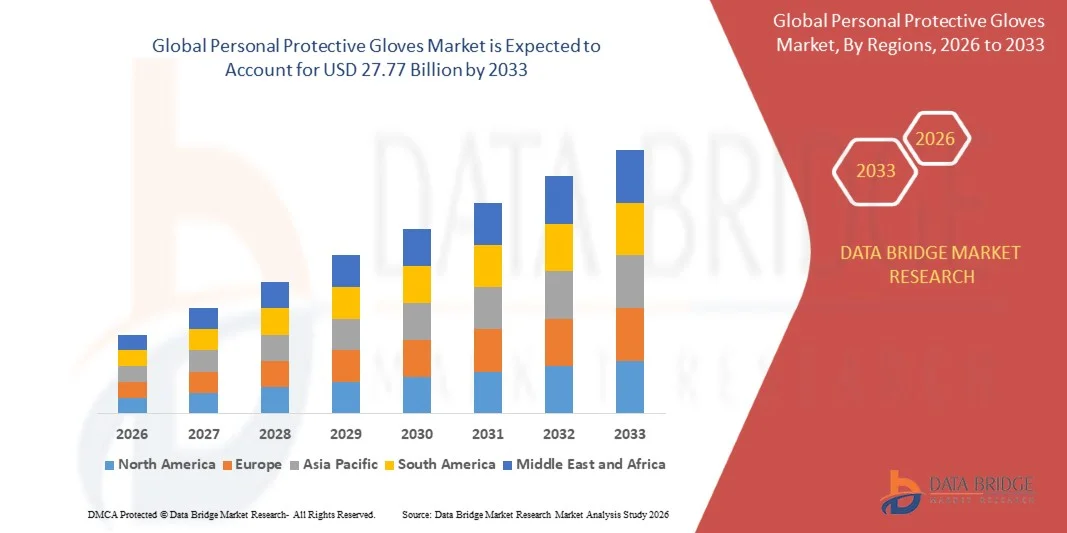
- As per Data Bridge Market Research analysis, the personal protective gloves market was valued at USD 16.78 billion in 2025 and is projected to reach USD 27.77 billion by 2033, growing at a CAGR of 6.50% from 2026 to 2033.
- The market is experiencing steady growth driven by rising global demand for hand protection across healthcare, food processing, and industrial manufacturing sectors, growing regulatory emphasis on workplace safety compliance, and increasing consumer and institutional awareness of infection control following heightened post-pandemic hygiene standards.
- The growing complexity of workplace safety regulations, combined with expanding industrial and healthcare infrastructure across emerging economies, is compelling employers and healthcare institutions to standardize glove procurement across chemical-resistant, cut-resistant, and biological-protection categories. Rising demand for nitrile gloves as a latex-free alternative continues to reshape material preferences across both medical and industrial end-use segments.
- Continued expansion of e-commerce and food-service hygiene requirements is broadening glove usage beyond traditional healthcare and industrial applications into food handling, cleaning services, and personal care settings, supporting sustained volume growth across the disposable glove category.
- Growing corporate emphasis on employee safety programs and liability-risk reduction is prompting manufacturers and distributors across chemical, automotive, and construction sectors to formalize glove-selection protocols matched to specific hazard profiles, further diversifying demand across the protection-type spectrum.
Market Size & Forecast
- Global Market Value (2025): USD 16.78 Billion
- Expected Market Value (2033): USD 27.77 Billion
- Forecast CAGR (2026–2033): 6.50%
- Leading Region in 2025: Asia-Pacific
- Fastest Growing Region: North America
What are the Major Takeaways of the Personal Protective Gloves Market?
- Asia-Pacific dominated the global personal protective gloves market with the largest revenue share of 47.83% in 2025, supported by concentrated glove manufacturing capacity across Malaysia, Thailand, and China.
- North America is expected to be the fastest-growing region at a CAGR of 7.8% from 2026 to 2033, fueled by stringent occupational safety regulations and rising healthcare and food-processing sector demand.
- The nitrile material type segment led the market with a 43.62% share in 2025, driven by its superior chemical resistance, puncture resistance, and its role as a latex-free alternative for allergy-sensitive users.
- The disposable gloves product type segment is the fastest-growing product category, projected to register a CAGR of 8.1%, reflecting rising single-use hygiene requirements across healthcare, food service, and cleaning applications.
- The healthcare & medical end-use industry segment dominated the end-use category with a 38.47% revenue share in 2025, led by sustained demand for examination and surgical gloves across hospitals, clinics, and diagnostic laboratories.
- The powder-free form segment accounted for 71.36% of the market share in 2025, preferred for its reduced allergy risk and compliance with regulatory restrictions on powdered glove use in medical settings.
- The online retail distribution channel is the fastest-growing distribution segment, with a CAGR of 8.9%, driven by rising institutional and individual procurement of protective gloves through e-commerce platforms.
Report Scope and Personal Protective Gloves Market Segmentation
|
Attributes |
Personal Protective Gloves Key Market Insights |
|
Segments Covered |
|
|
Countries Covered |
North America
Europe
Asia-Pacific
Middle East and Africa
South America
|
|
Key Market Players |
|
|
Market Opportunities |
|
|
Value Added Data Infosets |
In addition to the insights on market scenarios such as market value, growth rate, segmentation, geographical coverage, and major players, the market reports curated by the Data Bridge Market Research also include in-depth expert analysis, geographically represented company-wise production and capacity, network layouts of distributors and partners, detailed and updated price trend analysis and deficit analysis of supply chain and demand. |
What is the Key Trend in the Personal Protective Gloves Market?
- Glove manufacturers are increasingly expanding nitrile production capacity to meet rising demand for latex-free, chemical-resistant hand protection across healthcare and industrial applications.
- For instance, in April 2025, Top Glove Corporation announced an expansion of its nitrile glove manufacturing capacity in Malaysia to meet growing demand from healthcare and food-processing customers seeking latex-free alternatives.
- Rising adoption of powder-free glove formulations is enabling healthcare institutions and food-processing facilities to comply with tightening regulatory restrictions on powdered glove use while reducing allergy-related risks.
- Manufacturers are increasingly investing in enhanced tactile-sensitivity and dexterity-focused glove designs to improve usability in precision-demanding applications such as surgical procedures and electronics assembly.
- For instance, in January 2025, Ansell introduced an expanded line of high-dexterity nitrile examination gloves designed for improved tactile sensitivity in surgical and diagnostic applications.
- As healthcare institutions, industrial employers, and food-service providers continue to prioritize hygiene, safety compliance, and worker protection, the adoption of advanced protective glove materials and formulations is expected to accelerate, reinforcing their role as an essential procurement category across global end-use industries.
What are the Key Drivers of the Personal Protective Gloves Market?
- Rising global emphasis on workplace safety compliance, combined with expanding healthcare and food-processing infrastructure, has significantly increased demand for protective gloves across chemical-resistant, cut-resistant, and biological-protection categories.
- For instance, in March 2025, Hartalega Holdings expanded its glove manufacturing capacity in Malaysia to meet rising demand from healthcare providers and industrial employers across North America and Europe.
- Healthcare institutions, food-processing facilities, and industrial employers are increasingly standardizing glove procurement protocols to reduce infection risk, ensure regulatory compliance, and improve worker safety outcomes.
- For instance, in October 2024, Honeywell International announced an investment in additional cut-resistant glove manufacturing capacity to support rising orders from industrial and manufacturing customers.
- With healthcare systems, food-processing operations, and industrial employers increasingly relying on protective gloves as a foundational safety and hygiene measure, personal protective gloves will remain indispensable across medical, food-service, and manufacturing environments worldwide.
- For instance, in June 2024, Kossan Rubber Industries expanded its nitrile glove production capacity to support growing demand from healthcare distributors and industrial safety-equipment suppliers globally.
- Overall, rising workplace safety requirements, healthcare demand, and expanding food-processing and industrial activities are driving protective glove adoption. Increasing procurement standardization and manufacturing capacity expansion are further supporting market growth. Protective gloves are expected to remain essential across healthcare, food processing, manufacturing, and other industrial applications.
Which Factors are Challenging the Growth of the Personal Protective Gloves Market?
- Raw material price volatility, particularly for nitrile butadiene rubber and natural rubber latex, creates significant cost pressure for glove manufacturers, affecting production margins and end-market pricing stability.
- These raw-material cost fluctuations limit pricing predictability among manufacturers and constrain profitability for smaller producers operating with limited pricing power in competitive commodity glove segments.
- For instance, in September 2024, Top Glove Corporation Bhd reported that higher raw-material and operating costs continued to affect its cost structure, while the company highlighted competitive pricing conditions in the glove industry.
- The raw-material price volatility and intense price-based competition associated with commodity-grade disposable gloves continue to pressure manufacturer margins, particularly among smaller producers in price-sensitive markets. This cost volatility slows capacity-expansion investment in certain regions, limiting the pace of production-capacity growth despite steady underlying demand.
How is the Personal Protective Gloves Market Segmented?
The personal protective gloves market is segmented on the basis of material type, product type, form, protection type, end-use industry, length, sterility, coating technology, distribution channel and glove size.
- By Material Type
On the basis of material type, the global personal protective gloves market is segmented into nitrile, natural rubber latex, neoprene, vinyl/PVC, polyethylene, leather, and others. The nitrile segment dominated the market with a 43.62% share in 2025, owing to its superior chemical resistance, puncture resistance, and role as a latex-free alternative for allergy-sensitive healthcare workers and consumers. These gloves deliver reliable barrier protection and durability, making them the preferred choice across both medical and industrial applications.
The leather segment is projected to register the fastest growth at a CAGR of 7.4% from 2026 to 2033, driven by rising demand for durable, heat-resistant, and cut-resistant hand protection in welding, construction, and heavy-industrial applications. Advances in leather treatment and reinforcement technologies, combined with growing industrial safety compliance, are accelerating segment expansion.
- By Product Type
On the basis of product type, the global personal protective gloves market is segmented into disposable gloves and reusable/durable gloves. The disposable gloves segment led the market with a 64.28% share in 2025, supported by its widespread use across healthcare, food service, and cleaning applications requiring single-use hygiene protocols.
The disposable gloves segment is also expected to experience the fastest growth at a CAGR of 8.1% from 2026 to 2033, driven by increasing single-use hygiene requirements and expanding applications across food handling, personal care, and cleaning services.
- By Form
On the basis of form, the global personal protective gloves market is segmented into powdered and powder-free. The powder-free segment dominated the market with a share of 71.36% in 2025 due to its widespread adoption across healthcare and food-processing settings complying with regulatory restrictions on powdered glove use, increasing demand for reduced allergy risk, and growing integration with sterile packaging protocols. Additionally, rising focus on infection control and worker health further supports the strong adoption of powder-free glove formulations.
The powder-free segment is anticipated to continue as the dominant and fastest-consolidating form category, with powdered gloves representing a shrinking share as global regulatory bodies continue tightening restrictions on cornstarch-powdered glove use in medical and food-handling settings due to associated health and contamination risks.
- By Protection Type
On the basis of protection type, the global personal protective gloves market is segmented into chemical & liquid protection, cut & puncture resistance, thermal/heat resistance, mechanical protection, and biological/infection protection. The biological/infection protection segment dominated the market with a share of 36.84% in 2025 due to its widespread use across healthcare examination, surgical, and laboratory applications requiring reliable barrier protection against pathogens and bodily fluids. The widespread adoption of nitrile and latex biological-protection gloves across hospitals and diagnostic facilities is driving strong demand for this protection-type category.
The cut & puncture resistance segment is expected to witness the fastest CAGR of 8.3% from 2026 to 2033, driven by the rising need for hand protection in manufacturing, metal fabrication, and glass-handling applications where injury risk from sharp materials is significant. Manufacturers are increasingly integrating high-performance fiber blends into cut-resistant glove designs. Additionally, the growing emphasis on workplace injury reduction in industrial settings is further accelerating adoption of this protection-type category.
- By End-Use Industry
On the basis of end-use industry, the global personal protective gloves market is segmented into healthcare & medical, food processing, industrial & manufacturing, chemical & petrochemical, automotive, construction, and others. The healthcare & medical segment dominated the market with a share of 38.47% in 2025 due to its critical role in infection control across hospitals, clinics, and diagnostic laboratories requiring high-volume examination and surgical glove procurement. High adoption is driven by the increasing need for sterile and non-sterile barrier protection, integration with hospital procurement protocols, and enhanced regulatory compliance requirements. Additionally, growing investment by healthcare systems and group purchasing organizations to standardize glove procurement is reinforcing the leading position of this segment in the market.
The food processing segment is expected to witness the fastest CAGR of 8.4% from 2026 to 2033, driven by increasing food-safety regulatory requirements and rising demand for hygienic hand protection across food-handling, packaging, and processing operations. Growing adoption of disposable gloves across quick-service restaurants and food-manufacturing facilities is further accelerating market expansion in this segment.
- By Length
On the basis of length, the global personal protective gloves market is segmented into wrist length, elbow length, and gauntlet. The wrist length segment dominated the market with a share of 68.72% in 2025 due to its widespread adoption as the standard glove format across healthcare examination, food handling, and general industrial applications requiring basic hand coverage. Rising adoption of wrist-length disposable gloves across high-volume healthcare and food-service settings is driving strong demand for this length category.
The elbow length segment is expected to witness the fastest CAGR of 7.6% from 2026 to 2033, driven by the rising need for extended forearm protection in surgical, veterinary, and chemical-handling applications requiring coverage beyond the wrist. Manufacturers are increasingly integrating extended-length designs into specialized protective glove product lines. Additionally, the growing emphasis on comprehensive contamination protection in laboratory and industrial settings is further accelerating adoption of this length category.
- By Sterility
On the basis of sterility, the global personal protective gloves market is segmented into sterile and non-sterile. The non-sterile segment dominated the market with a share of 79.36% in 2025 due to its widespread adoption across general examination, food handling, and industrial applications that do not require sterile barrier protection. High adoption is supported by healthcare facilities, food-processing operations, and industrial employers that rely on cost-effective non-sterile gloves for routine, non-surgical tasks. Additionally, increasing integration with high-volume procurement contracts enhances cost efficiency and reinforces the dominance of the non-sterile segment.
The sterile segment is expected to witness the fastest CAGR of 7.9% from 2026 to 2033, driven by the increasing demand for surgical and invasive-procedure protection in hospitals and ambulatory surgical centers. By offering validated sterility assurance, this segment enhances patient safety, regulatory compliance, and surgical outcome consistency, making sterile gloves highly attractive for the growing global surgical-procedure volume.
- By Coating Technology
On the basis of coating technology, the global personal protective gloves market is segmented into coated and uncoated. The uncoated segment dominated the market with a share of 61.47% in 2025 due to its critical role in providing cost-effective, breathable hand protection across general healthcare, food-handling, and light-industrial applications. Additionally, established manufacturing infrastructure, broad supplier familiarity, and extensive production-cost optimization are facilitating continued adoption of uncoated gloves across high-volume, price-sensitive end-use segments.
The coated segment is expected to witness the fastest CAGR of 8.2% from 2026 to 2033, driven by the increasing demand for enhanced grip, abrasion resistance, and chemical-barrier performance in industrial and construction applications. Manufacturers are leveraging polymer and latex coating technologies to enhance durability, enable improved dexterity, and support demanding industrial handling tasks, thereby accelerating adoption across manufacturing and construction end-use segments.
- By Distribution Channel
On the basis of distribution channel, the global personal protective gloves market is segmented into direct/B2B sales, retail/pharmacy stores, and online retail. The direct/B2B sales segment dominated the market with a share of 58.63% in 2025 due to its critical role in enabling bulk procurement contracts between glove manufacturers and hospitals, industrial employers, and distribution networks requiring consistent, high-volume supply. Additionally, established long-term supply agreements, regional distribution infrastructure, and integrated procurement support are facilitating continued adoption of direct-sourced gloves among institutional buyers, while strong supplier support networks are improving accessibility, reliability, and trust, further reinforcing this segment's leading market position.
The online retail segment is expected to witness the fastest CAGR of 8.9% from 2026 to 2033, driven by the increasing demand from small businesses, individual consumers, and smaller healthcare practices for accessible, standardized glove purchasing through e-commerce platforms. These platforms offer scalable, cost-effective sourcing solutions across diverse end-use segments, while providing rapid fulfillment, price transparency, and seamless integration with buyers' procurement systems, enhancing overall sourcing efficiency and flexibility.
- By Glove Size
On the basis of glove size, the global personal protective gloves market is segmented into small, medium, large, and extra large. The medium segment dominated the market with a share of 34.28% in 2025 due to its preference among the largest base of healthcare workers and industrial employees across global demographics requiring standard-fit hand protection. Additionally, established manufacturing infrastructure, broad sizing-standard compatibility, and extensive procurement history are facilitating continued adoption of medium-sized gloves across institutional bulk-purchasing programs, while strong supplier support networks are improving accessibility, reliability, and trust, further reinforcing this segment's leading market position.
The large segment is expected to witness the fastest CAGR of 7.2% from 2026 to 2033, driven by increasing procurement diversification among healthcare and industrial employers seeking to accommodate a broader range of hand sizes across their workforce. Manufacturers are leveraging expanded sizing-range production to enhance fit accuracy, enable improved worker comfort, and support inclusive procurement standards, thereby accelerating adoption across diverse institutional and industrial buyer segments.
Which Region Holds the Largest Share of the Personal Protective Gloves Market?
- Asia-Pacific dominated the personal protective gloves market and accounted for the largest revenue share of 47.83% in 2025, supported by concentrated glove manufacturing capacity, strong presence of leading nitrile and latex glove producers, and cost-competitive production capabilities across Malaysia, Thailand, and China.
- The region also benefits from extensive rubber and nitrile feedstock supply chains, high adoption of automated glove manufacturing technology, and growing use of protective gloves across domestic healthcare and industrial applications. Increasing focus on export-oriented glove manufacturing and rising domestic healthcare infrastructure investment continues to strengthen Asia-Pacific's leadership position in the global market.
China Personal Protective Gloves Market Insight
The China personal protective gloves market is expanding rapidly, supported by large-scale domestic manufacturing capacity, growing healthcare and industrial infrastructure investment, and increasing export-oriented glove production. Manufacturers and healthcare institutions are increasingly utilizing nitrile and vinyl gloves for both domestic healthcare and industrial applications. Continuous expansion of domestic production infrastructure and rising government support for medical-supply manufacturing self-sufficiency are further driving market growth in China.
India Personal Protective Gloves Market Insight
The India personal protective gloves market is expanding steadily, supported by rising healthcare infrastructure investment, growing industrial manufacturing activity, and increasing domestic glove manufacturing capacity. Healthcare institutions and industrial employers are increasingly integrating nitrile and latex gloves into standard procurement protocols. Continuous advancements in cost-optimized manufacturing processes, along with strong government focus on domestic medical-supply manufacturing, are further driving market growth in India.
Europe Personal Protective Gloves Market Insight
Europe’s personal protective gloves market is supported by stringent workplace safety regulations, expanding healthcare services, and demand from manufacturing, construction, chemical, and food-processing industries. Employers are increasingly prioritizing certified gloves offering cut, chemical, thermal, and biological protection. Sustainability is also influencing product development, encouraging recyclable, biodegradable, and responsibly sourced materials. Technological advances in glove materials and ergonomic designs are creating opportunities for manufacturers. However, raw-material price volatility, regulatory compliance costs, intense competition, and sustainability-related production challenges continue to influence market growth across Europe.
Germany Personal Protective Gloves Market Insight
The Germany personal protective gloves market is witnessing steady growth due to the country's stringent workplace safety regulations, strong industrial manufacturing base, and continued adoption of protective gloves across chemical, automotive, and healthcare applications. Industrial employers, healthcare institutions, and safety-equipment distributors are increasingly standardizing glove procurement to comply with European occupational safety directives. Continuous advancements in cut-resistant and chemical-resistant glove technology are further supporting market growth in Germany.
U.K. Personal Protective Gloves Market Insight
The U.K. personal protective gloves market is expanding steadily, supported by strong National Health Service procurement volumes, stringent occupational safety enforcement, and continued reliance on imported nitrile and latex gloves from established Asian manufacturing hubs. Healthcare trusts and industrial safety distributors are increasingly formalizing bulk procurement agreements to ensure supply continuity and regulatory compliance. Ongoing government focus on domestic medical-supply resilience following prior supply-chain disruptions is further supporting steady market growth across the United Kingdom.
Which are the Top Companies in Personal Protective Gloves Market?
The personal protective gloves industry is primarily led by well-established companies, including:
- Ansell Limited (Australia)
- Top Glove Corporation Bhd (Malaysia)
- Hartalega Holdings Berhad (Malaysia)
- Kossan Rubber Industries Bhd (Malaysia)
- Supermax Corporation Berhad (Malaysia)
- Semperit AG Holding (Austria)
- Honeywell International Inc. (U.S.)
- 3M Company (U.S.)
- MAPA Professional (Eurotechni Group) (France)
- Showa Group (Japan)
- Mölnlycke Health Care AB (Sweden)
- Cardinal Health, Inc. (U.S.)
- Medline Industries, LP (U.S.)
- Owens & Minor, Inc. (Halyard/O&M Halyard) (U.S.)
- SHIELD Scientific B.V. (Netherlands)
- Sri Trang Gloves (Thailand) PCL (Thailand)
- UG Healthcare Corporation Limited (Singapore)
- Rubberex Corporation (M) Berhad (Malaysia)
- YTY Group (Malaysia)
- Careplus Group Berhad (Malaysia)
- Riverstone Holdings Limited (Malaysia)
- MCR Safety (U.S.)
- Superior Glove Works Ltd. (Canada)
- Dynarex Corporation (U.S.)
- Protective Industrial Products, Inc. (PIP) (U.S.)
- Magid Glove & Safety Manufacturing Company (U.S.)
- Wells Lamont Industrial (U.S.)
- Mechanix Wear (U.S.)
- Uvex Group (Germany)
- Delta Plus Group (France)
What are Latest Developments in Personal Protective Gloves Market?
- In September 2025, Top Glove Corporation launched an expanded nitrile glove production line in Malaysia, increasing capacity to meet growing demand from healthcare and food-processing customers across North America and Europe.
- In February 2025, Ansell expanded its cut-resistant glove manufacturing capacity in Europe to support growing demand from industrial and manufacturing customers seeking enhanced hand-injury protection.
- In November 2025, Hartalega Holdings introduced an upgraded high-dexterity nitrile examination glove platform incorporating enhanced tactile-sensitivity technology, improving usability for surgical and diagnostic applications. This development strengthens Hartalega's position in the medical glove market by offering healthcare providers improved precision alongside reliable barrier protection.
- In October 2024, Honeywell International expanded its industrial glove product portfolio in North America to include additional chemical-resistant and cut-resistant options tailored for manufacturing and construction applications.
- In June 2023, Kossan Rubber Industries partnered with a regional healthcare distributor to expand availability of nitrile examination gloves across underserved markets, combining its manufacturing scale with the partner's regional distribution capabilities to support broader healthcare-sector access.
- In March 2023, Supermax Corporation received manufacturing certification for an expanded powder-free nitrile production facility in Malaysia, enabling the company to serve growing demand from healthcare group purchasing organizations requiring consistent, high-volume glove supply.

- Interactive Data Analysis Dashboard
- Company Analysis Dashboard for high growth potential opportunities
- Research Analyst Access for customization & queries
- Competitor Analysis with Interactive dashboard
- Latest News, Updates & Trend analysis
- Harness the Power of Benchmark Analysis for Comprehensive Competitor Tracking
Global Personal Protective Gloves Market, Supply Chain Analysis and Ecosystem Framework
To support market growth and help clients navigate the impact of geopolitical shifts, DBMR has integrated in-depth supply chain analysis into its Global Personal Protective Gloves Market research reports. This addition empowers clients to respond effectively to global changes affecting their industries. The supply chain analysis section includes detailed insights such as Global Personal Protective Gloves Market consumption and production by country, price trend analysis, the impact of tariffs and geopolitical developments, and import and export trends by country and HSN code. It also highlights major suppliers with data on production capacity and company profiles, as well as key importers and exporters. In addition to research, DBMR offers specialized supply chain consulting services backed by over a decade of experience, providing solutions like supplier discovery, supplier risk assessment, price trend analysis, impact evaluation of inflation and trade route changes, and comprehensive market trend analysis.
Data collection and base year analysis are done using data collection modules with large sample sizes. The stage includes obtaining market information or related data through various sources and strategies. It includes examining and planning all the data acquired from the past in advance. It likewise envelops the examination of information inconsistencies seen across different information sources. The market data is analysed and estimated using market statistical and coherent models. Also, market share analysis and key trend analysis are the major success factors in the market report. To know more, please request an analyst call or drop down your inquiry.
The key research methodology used by DBMR research team is data triangulation which involves data mining, analysis of the impact of data variables on the market and primary (industry expert) validation. Data models include Vendor Positioning Grid, Market Time Line Analysis, Market Overview and Guide, Company Positioning Grid, Patent Analysis, Pricing Analysis, Company Market Share Analysis, Standards of Measurement, Global versus Regional and Vendor Share Analysis. To know more about the research methodology, drop in an inquiry to speak to our industry experts.
Data Bridge Market Research is a leader in advanced formative research. We take pride in servicing our existing and new customers with data and analysis that match and suits their goal. The report can be customized to include price trend analysis of target brands understanding the market for additional countries (ask for the list of countries), clinical trial results data, literature review, refurbished market and product base analysis. Market analysis of target competitors can be analyzed from technology-based analysis to market portfolio strategies. We can add as many competitors that you require data about in the format and data style you are looking for. Our team of analysts can also provide you data in crude raw excel files pivot tables (Fact book) or can assist you in creating presentations from the data sets available in the report.













