What is the Pharmaceutical Grade Silica Gel Market Size and Growth Rate?
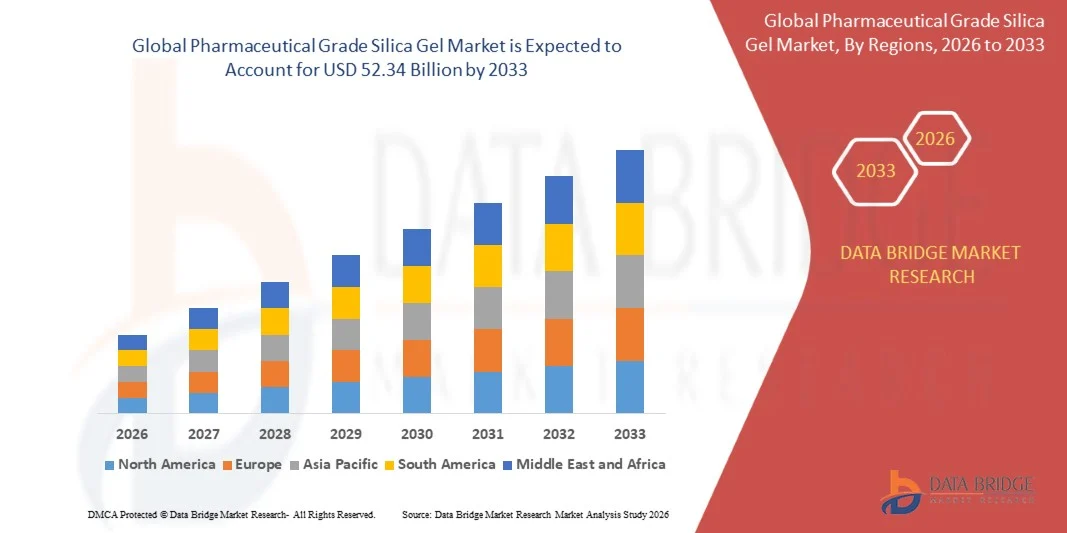
- As per Data Bridge Market Research analysis, the pharmaceutical grade silica gel market was valued at USD 41.00 million in 2025 and is projected to reach USD 52.34 million by 2033, growing at a CAGR of 3.1% from 2026 to 2033.
- The market is experiencing consistent growth driven by rising demand for moisture-control solutions in pharmaceutical packaging, increasing requirements for drug stability and shelf-life extension, and expanding applications of high-purity silica gel in pharmaceutical formulations and healthcare products.
- The growing production of moisture-sensitive medicines, combined with stringent pharmaceutical quality standards and increasing emphasis on product safety, is encouraging pharmaceutical manufacturers to adopt advanced desiccant and silica-based solutions. Pharmaceutical-grade silica gel is increasingly used in packaging systems, drug formulation processes, and storage applications, helping protect medicines from moisture-related degradation and maintain product quality throughout distribution.
Market Size & Forecast
- Global Market Value (2025): USD 41.00 Million
- Expected Market Value (2033): USD 52.34 Million
- Forecast CAGR (2026–2033): 3.1%
- Leading Region in 2025: North America
- Fastest Growing Region: Asia Pacific
What are the Major Takeaways of the Pharmaceutical Grade Silica Gel Market?
- North America dominated the pharmaceutical grade silica gel market with the largest revenue share of 38.5% in 2025, supported by advanced pharmaceutical manufacturing infrastructure, stringent drug quality standards, and strong demand for moisture-control solutions in pharmaceutical packaging.
- Asia-Pacific is expected to be the fastest-growing region at a CAGR of 3.6% from 2026 to 2033, fueled by expanding pharmaceutical production, rising healthcare investments, and increasing demand for moisture-resistant packaging solutions across China, India, and Japan.
- The solid segment led the market with a 68% share in 2025, driven by its extensive use in pharmaceutical packaging, moisture adsorption, purification, and separation applications.
- Liquid are the fastest-growing type, projected to register a CAGR of 4.0%, reflecting the surge in demand for advanced silica dispersions, specialized pharmaceutical formulations, and innovative drug-delivery research applications.
- The white silica gel beads segment dominated the type category with a 60% revenue share in 2025, led by their widespread use in pharmaceutical moisture-control applications.
- Fillers and diluents accounted for 35% of the market share in 2025, preferred by the widespread use of pharmaceutical excipients in tablet and capsule manufacturing.
- The canisters segment is the fastest-growing packaging type category, with a CAGR of 4.6%, driven by increasing demand for integrated moisture-control solutions in pharmaceutical packaging.
Report Scope and Pharmaceutical Grade Silica Gel Market Segmentation
|
Attributes |
Pharmaceutical Grade Silica Gel Key Market Insights |
|
Segments Covered |
|
|
Countries Covered |
North America
Europe
Asia-Pacific
Middle East and Africa
South America
|
|
Key Market Players |
|
|
Market Opportunities |
|
|
Value Added Data Infosets |
In addition to the insights on market scenarios such as market value, growth rate, segmentation, geographical coverage, and major players, the market reports curated by the Data Bridge Market Research also include import export analysis, production capacity overview, production consumption analysis, price trend analysis, climate change scenario, supply chain analysis, value chain analysis, raw material/consumables overview, vendor selection criteria, PESTLE Analysis, Porter Analysis, and regulatory framework. |
What is the Key Trend in the Pharmaceutical Grade Silica Gel Market?
- Pharmaceutical manufacturers are increasingly adopting advanced silica gel desiccants and moisture-control packaging to protect sensitive medicines, maintain product stability, and extend shelf life during storage and distribution.
- For instance, in December 2025, ACG launched DryPod, a desiccant-based cold-form laminate designed to protect highly moisture-sensitive pharmaceutical products while improving packaging compatibility and manufacturing flexibility.
- High-performance moisture adsorption is becoming increasingly important for protecting tablets, capsules, and other pharmaceutical products from humidity-related degradation.
- Packaging manufacturers are integrating desiccant technologies directly into pharmaceutical containers and blister systems to improve moisture protection while streamlining packaging operations.
- For instance, in May 2025, Sanner introduced an optimized TabTec CR packaging solution featuring integrated desiccant technology and a child-resistant design to improve product stability and packaging efficiency. Read the announcement.
- As pharmaceutical manufacturers prioritize drug stability, packaging efficiency, and reliable moisture protection, demand for high-quality pharmaceutical-grade silica gel and advanced desiccant systems is expected to increase.
What are the Key Drivers of the Pharmaceutical Grade Silica Gel Market?
- The growing need to protect moisture-sensitive pharmaceutical products is increasing demand for pharmaceutical-grade silica gel used in desiccants, drug carriers, adsorbents, and pharmaceutical excipients.
- For instance, in January 2023, Airnov Healthcare Packaging launched its IDC Integrated Desiccant Closure, combining a desiccant system with a pharmaceutical bottle closure to simplify packaging and protect moisture-sensitive medicines. The closure can accommodate silica gel or molecular sieve, demonstrating growing demand for integrated moisture-control solutions.
- Pharmaceutical manufacturers are increasingly prioritizing consistent raw-material purity, controlled adsorption properties, and quality assurance to maintain drug stability and meet pharmaceutical manufacturing requirements.
- For instance, in August 2022, Sanner announced its pharmaceutical packaging portfolio for Pack Expo 2022, featuring AdCap desiccant canisters, AdPack desiccant packets, and TabTec® CR containers with integrated desiccant. These solutions help control moisture and protect tablets, capsules, and other sensitive healthcare products during storage.
- As pharmaceutical production expands and manufacturers place greater emphasis on moisture control and quality compliance, demand for reliable pharmaceutical-grade silica gel products is expected to remain an important market driver.
What Factors are Challenging the Growth of the Pharmaceutical Grade Silica Gel Market?
- Pharmaceutical-grade silica gel manufacturers face challenges from raw-material price fluctuations, production costs, and the need to maintain consistent purity and adsorption performance across batches.
- For instance, in December 2024, China's National Medical Products Administration issued updated good manufacturing practice requirements for pharmaceutical excipients and packaging materials, emphasizing quality management systems, supplier assessments, batch inspections, and documented manufacturing controls.
- These pressures can increase procurement expenses and complicate quality assurance for manufacturers supplying pharmaceutical packaging and drug formulation applications
- Pharmaceutical suppliers must also maintain documented quality systems, appropriate material testing, and manufacturing controls to meet applicable pharmaceutical requirements, increasing operational complexity and compliance costs.
- For instance, in August 2024, Health Canada's Good Manufacturing Practices guidance continued to require pharmaceutical packaging materials to be examined or tested against approved specifications before use, illustrating the additional testing and quality-assurance burden on pharmaceutical supply
- These cost pressures and quality-control requirements can constrain smaller suppliers, complicate production scaling, and limit market expansion where price competitiveness and compliance capabilities are challenging.
How is the Pharmaceutical Grade Silica Gel Market Segmented?
The pharmaceutical grade silica gel market is segmented on the basis of type, gel beads type, form, packaging type, and chromatography.
- By Type
On the basis of type, the pharmaceutical grade silica gel market is segmented into liquid and solid. The solid segment dominated the market with an estimated 68% share in 2025, owing to its extensive use in pharmaceutical packaging, moisture adsorption, purification, and separation applications. Solid silica gel is widely utilized as a desiccant to protect moisture-sensitive tablets, capsules, active pharmaceutical ingredients, and other pharmaceutical products. Its porous structure enables effective moisture adsorption and helps maintain product stability during storage and transportation. Pharmaceutical manufacturers prefer solid silica gel because of its handling convenience, storage stability, and suitability for integration into sachets, canisters, and packaging closures. Increasing demand for moisture-control solutions and pharmaceutical product preservation further supports the segment's dominance.
The liquid segment is projected to register the fastest growth at an estimated CAGR of 4.0% from 2026 to 2033, as pharmaceutical research and manufacturing increasingly explore silica-based dispersions, specialty formulations, and advanced material-processing applications. Liquid silica-based systems can support formulation development, surface treatment, and specialized pharmaceutical processing requirements. Growing investment in nanotechnology and advanced drug-delivery research is encouraging the development of silica-based materials in dispersed forms. Improvements in particle-size control and dispersion stability are expanding potential applications in pharmaceutical research. Increasing interest in tailored silica formulations may further support adoption in specialized applications. However, growth will depend on pharmaceutical-grade suitability, regulatory compliance, and the specific performance requirements of individual formulations.
- By Gel Beads Type
On the basis of gel beads type, the pharmaceutical grade silica gel market is segmented into white silica gel beads, orange silica gel beads, and blue silica gel beads. The white silica gel beads segment dominated the market with an estimated 60% share in 2025, supported by their widespread use in pharmaceutical moisture-control applications. These beads are commonly used in sachets, canisters, packets, and pharmaceutical containers to protect moisture-sensitive medicines. Their established availability and adsorption capabilities make them suitable for protecting tablets, capsules, and pharmaceutical ingredients during storage and transportation. White silica gel beads can be formulated to meet different particle-size and moisture-adsorption requirements. Their suitability for use without color-indicating additives makes them attractive for applications prioritizing straightforward moisture control.
The orange silica gel beads segment is projected to register the fastest growth at an estimated CAGR of 4.2% from 2026 to 2033, driven by interest in color-indicating desiccants that provide a visual indication of moisture exposure. These beads can change color as they absorb moisture, helping users assess desiccant condition during storage and handling. Such visual monitoring can be useful in pharmaceutical packaging and controlled-storage environments when the indicator is appropriate for the intended application. Increasing emphasis on quality assurance and moisture monitoring is supporting interest in indicator-based products. Manufacturers may also benefit from their use in specialized packaging and storage systems. However, pharmaceutical applications require careful evaluation of indicator chemistry, potential contamination risks, and applicable safety requirements. Their growth will depend on the availability of suitable pharmaceutical-compliant formulations.
- By Form
On the basis of form, the pharmaceutical grade silica gel market is segmented into colorants, lubricants and glidants, binders, disintegrants, flavoring agents, capsules, solvents, coatings, preservatives, fillers and diluents, suspension, viscosity agents, and others. The fillers and diluents segment dominated the market with an estimated 35% share in 2025, supported by the widespread use of pharmaceutical excipients in tablet and capsule manufacturing. Silica-based materials can contribute to powder handling and formulation performance when their properties meet the relevant excipient specifications. Pharmaceutical manufacturers rely on suitable excipients to support consistent processing, dosage uniformity, and finished-product quality. Increasing production of solid oral dosage forms continues to support demand for functional formulation ingredients. The segment also benefits from the established use of silica-based excipients in pharmaceutical manufacturing.
The lubricants and glidants segment is projected to register the fastest growth at an estimated CAGR of 4.5% from 2026 to 2033, driven by increasing demand for improved powder flow and manufacturing efficiency in solid dosage production. Pharmaceutical-grade colloidal silica is commonly used as a glidant to improve the flow properties of powders during tablet compression and capsule filling. Better powder flow can support more consistent manufacturing operations and help reduce processing difficulties. Increasing automation in pharmaceutical production is encouraging manufacturers to optimize powder handling and process reliability. Continued development of complex formulations and high-speed production lines may further support the use of functional silica-based excipients. However, adoption depends on material specifications, formulation compatibility, and regulatory requirements. This segment's growth relates primarily to pharmaceutical-grade silica excipients rather than desiccant-grade silica gel.
- By Packaging Type
On the basis of packaging type, the pharmaceutical grade silica gel market is segmented into canisters, pouches, sachets, packets, containers, bottles, and others. The sachets segment dominated the market with an estimated 35% share in 2025, owing to their widespread use in pharmaceutical bottles, medicine containers, and bulk packaging systems. Silica gel sachets provide a convenient method of controlling moisture in packaged tablets, capsules, and other moisture-sensitive products. Their flexible design allows manufacturers to select different sizes and adsorption capacities according to packaging requirements. Sachets can be incorporated into established packaging processes without major changes to container designs. Their availability in different materials and formats supports applications across pharmaceutical manufacturing and distribution.
The canisters segment is projected to register the fastest growth at an estimated CAGR of 4.6% from 2026 to 2033, supported by increasing demand for integrated moisture-control solutions in pharmaceutical packaging. Desiccant canisters can be placed inside medicine bottles to absorb moisture and protect sensitive tablets and capsules throughout product storage. Their rigid design can facilitate controlled placement and reduce the risk of loose desiccant material mixing with pharmaceutical products. Canisters are available in different sizes and adsorption capacities to accommodate varying packaging requirements. Growing adoption of specialized packaging for hygroscopic medicines and diagnostic products is supporting their use. Improvements in automated insertion and packaging-line compatibility may further encourage adoption. Their growth will depend on packaging design, product requirements, and the ability to meet pharmaceutical quality standards.
- By Chromatography
On the basis of chromatography, the pharmaceutical grade silica gel market is segmented into analytical chromatography, preparative chromatography, process chromatography, and gravity chromatography. The analytical chromatography segment dominated the market with an estimated 40% share in 2025, supported by the extensive use of silica-based stationary phases in pharmaceutical testing, research, and quality control. Silica gel is widely employed in chromatographic techniques for separating and analyzing chemical compounds, impurities, and pharmaceutical ingredients. Pharmaceutical laboratories use chromatography to support raw-material identification, purity assessment, and analytical method development. The segment benefits from continued demand for reliable testing throughout pharmaceutical research and manufacturing. Advancements in chromatographic methods and growing emphasis on pharmaceutical quality assurance further support adoption.
The preparative chromatography segment is projected to register the fastest growth at an estimated CAGR of 4.8% from 2026 to 2033, driven by increasing demand for compound purification in pharmaceutical research and development. Preparative chromatography uses stationary phases to isolate target compounds from mixtures for further analysis, development, or production. Silica-based materials are widely used in suitable preparative separation techniques, particularly during purification of organic compounds and pharmaceutical intermediates. Growing investment in drug discovery and development is increasing the need for efficient purification processes. Improvements in separation methods and column technologies are helping laboratories enhance recovery and processing efficiency. Demand for purified compounds in research and specialized manufacturing may further support growth. Adoption will depend on the separation method, target compound properties, and suitability of the silica material.
Which Region Holds the Largest Share of the Pharmaceutical Grade Silica Gel Market?
- North America dominated the pharmaceutical grade silica gel market with the largest revenue share of 38.5% in 2025, supported by advanced pharmaceutical manufacturing infrastructure, stringent drug quality standards, and strong demand for moisture-control solutions in pharmaceutical packaging.
- The region also benefits from established pharmaceutical companies, increasing demand for moisture-sensitive drug protection, and widespread adoption of desiccant technologies across medicine packaging and storage applications. Growing emphasis on drug stability, product quality, and regulatory compliance continues to strengthen North America's leadership position in the global market.
U.S. Pharmaceutical Grade Silica Gel Market Insight
The U.S. pharmaceutical grade silica gel market is witnessing steady growth due to rising demand for moisture-control solutions, pharmaceutical packaging innovations, and stringent drug quality requirements. The country’s advanced pharmaceutical manufacturing ecosystem, along with increasing adoption of desiccant-based packaging systems, is driving demand across drug production, storage, and distribution applications. In addition, growing emphasis on maintaining medicine stability, extending shelf life, and protecting moisture-sensitive pharmaceutical ingredients is accelerating the adoption of pharmaceutical-grade silica gel across manufacturers and packaging suppliers.
Asia-Pacific Pharmaceutical Grade Silica Gel Market Insight
The Asia-Pacific pharmaceutical grade silica gel market is expected to witness significant growth, driven by expanding pharmaceutical production, increasing healthcare investments, and rising demand for moisture-control packaging across countries such as China, India, and Japan. Growing pharmaceutical exports, expanding manufacturing infrastructure, and increasing awareness of drug stability requirements are supporting regional market expansion. Additionally, the growing presence of generic drug manufacturers and contract development and manufacturing organizations is accelerating the adoption of silica gel desiccants across pharmaceutical packaging and storage applications.
Japan Pharmaceutical Grade Silica Gel Market Insight
The Japan pharmaceutical grade silica gel market is witnessing consistent growth due to rising demand for high-quality pharmaceutical packaging, advanced drug manufacturing technologies, and effective moisture-control solutions. Pharmaceutical manufacturers and packaging companies are increasingly adopting silica gel desiccants to protect moisture-sensitive medicines, maintain product stability, and improve storage reliability. Moreover, Japan’s focus on pharmaceutical quality assurance, advanced manufacturing processes, and stringent product safety requirements is further contributing to market growth.
China Pharmaceutical Grade Silica Gel Market Insight
The China pharmaceutical grade silica gel market is growing steadily, driven by expanding pharmaceutical manufacturing, increasing domestic demand for medicines, and rising investments in pharmaceutical packaging infrastructure. Growing adoption of desiccant-based packaging systems across pharmaceutical production and distribution is significantly supporting market demand. In addition, increasing pharmaceutical exports, expanding generic drug production, and greater emphasis on moisture protection and product quality are strengthening China's position as an important market for pharmaceutical-grade silica gel.
U.K. Pharmaceutical Grade Silica Gel Market Insight
The U.K. pharmaceutical grade silica gel market is experiencing steady growth, supported by demand for reliable pharmaceutical packaging, increasing focus on medicine stability, and stringent quality-control requirements. Pharmaceutical manufacturers and packaging suppliers are increasingly utilizing silica gel desiccants to protect moisture-sensitive products during storage and transportation. Furthermore, continued developments in pharmaceutical packaging technologies and growing emphasis on product integrity, regulatory compliance, and extended shelf life are supporting market growth across the U.K. pharmaceutical sector.
Germany Pharmaceutical Grade Silica Gel Market Insight
The Germany pharmaceutical grade silica gel market is expanding steadily due to the country's established pharmaceutical manufacturing base, advanced chemical industry, and increasing demand for high-performance moisture-control solutions. Pharmaceutical companies and packaging manufacturers are increasingly utilizing silica gel desiccants to maintain medicine stability, protect sensitive ingredients, and support reliable storage conditions. Continuous advancements in pharmaceutical packaging, strong quality-management practices, and Germany's focus on manufacturing precision and regulatory compliance are further contributing to market growth.
Which are the Top Companies in Pharmaceutical Grade Silica Gel Market?
The pharmaceutical grade silica gel industry is primarily led by well-established companies, including:
- Merck KGaA (Germany)
- W. R. Grace & Co. (U.S.)
- FUJI SILYSIA CHEMICAL LTD. (Japan)
- Tosoh Corporation (Japan)
- Zeochem AG (Switzerland)
- SiliCycle Inc. (Canada)
- Sanner GmbH (Germany)
- Sorbchem India Pvt Ltd (India)
- Desiccants India LLP (India)
- SILICA GEL PRODUCTS MFG.CO. (India)
- Ravi Industries (India)
- CHARMIL CHEMICALS (India)
- Trade-Link (India)
- Aharnish Desiccant (India)
- DryCon (India)
- Thermo Fisher Scientific Inc. (U.S.)
- Agilent Technologies, Inc. (U.S.)
- YMC Co., Ltd. (Japan)
- KANTO CHEMICAL CO., INC. (Japan)
- Sorbead India (India)
What are Latest Developments in Pharmaceutical Grade Silica Gel Market?
- In December 2025, ACG launched DryPod, a desiccant-based cold-form laminate designed to protect moisture-sensitive pharmaceutical products. The laminate uses a lamination-based structure compatible with standard blister-forming technologies, helping pharmaceutical manufacturers improve moisture protection without requiring specialized equipment modifications. The launch represents a development in pharmaceutical packaging materials designed to help preserve drug potency and product stability.
- In May 2025, Sanner launched an optimized TabTec CR packaging solution for oral solid-dose healthcare products. The child-resistant packaging incorporates desiccant technology to help protect tablets and capsules from moisture while improving packaging-line efficiency by eliminating the need for separate desiccant insertion. The solution supports pharmaceutical manufacturers seeking packaging that combines product stability, patient convenience, and efficient processing.
- In April 2023, Airnov Healthcare Packaging highlighted the expanded production of moisture-protection packaging solutions at its Dongguan facility in China. The facility produces desiccant packets, DRICARD™ flat desiccants, and desiccant tablets for healthcare packaging applications. Its product range includes materials such as silica gel and molecular sieve, supporting pharmaceutical and diagnostic packaging requirements while strengthening local supply capabilities.
- In December 2022, Airnov Healthcare Packaging announced additions to its moisture-protection product portfolio, including the HAT-B vial. Launched in July 2022, the vial features an integrated desiccant at the bottom of the container to help protect test strips, pharmaceuticals, and nutraceuticals from moisture. Airnov also reported increased manufacturing capacity in China for its HAT-SNAP product range, supporting supply of moisture-control packaging solutions.
- In September 2021, Airnov Healthcare Packaging announced a new 27 mm desiccant stopper for tube-style packaging. The stopper was designed to make packaging easier to open while protecting moisture-sensitive pharmaceutical, nutraceutical, and probiotic products. Airnov also highlighted the use of fewer raw materials and polymers sourced from renewable-focused suppliers, reflecting efforts to combine moisture protection with more sustainable packaging design.
- Interactive Data Analysis Dashboard
- Company Analysis Dashboard for high growth potential opportunities
- Research Analyst Access for customization & queries
- Competitor Analysis with Interactive dashboard
- Latest News, Updates & Trend analysis
- Harness the Power of Benchmark Analysis for Comprehensive Competitor Tracking
Global Pharmaceutical Grade Silica Gel Market, Supply Chain Analysis and Ecosystem Framework
To support market growth and help clients navigate the impact of geopolitical shifts, DBMR has integrated in-depth supply chain analysis into its Global Pharmaceutical Grade Silica Gel Market research reports. This addition empowers clients to respond effectively to global changes affecting their industries. The supply chain analysis section includes detailed insights such as Global Pharmaceutical Grade Silica Gel Market consumption and production by country, price trend analysis, the impact of tariffs and geopolitical developments, and import and export trends by country and HSN code. It also highlights major suppliers with data on production capacity and company profiles, as well as key importers and exporters. In addition to research, DBMR offers specialized supply chain consulting services backed by over a decade of experience, providing solutions like supplier discovery, supplier risk assessment, price trend analysis, impact evaluation of inflation and trade route changes, and comprehensive market trend analysis.
Data collection and base year analysis are done using data collection modules with large sample sizes. The stage includes obtaining market information or related data through various sources and strategies. It includes examining and planning all the data acquired from the past in advance. It likewise envelops the examination of information inconsistencies seen across different information sources. The market data is analysed and estimated using market statistical and coherent models. Also, market share analysis and key trend analysis are the major success factors in the market report. To know more, please request an analyst call or drop down your inquiry.
The key research methodology used by DBMR research team is data triangulation which involves data mining, analysis of the impact of data variables on the market and primary (industry expert) validation. Data models include Vendor Positioning Grid, Market Time Line Analysis, Market Overview and Guide, Company Positioning Grid, Patent Analysis, Pricing Analysis, Company Market Share Analysis, Standards of Measurement, Global versus Regional and Vendor Share Analysis. To know more about the research methodology, drop in an inquiry to speak to our industry experts.
Data Bridge Market Research is a leader in advanced formative research. We take pride in servicing our existing and new customers with data and analysis that match and suits their goal. The report can be customized to include price trend analysis of target brands understanding the market for additional countries (ask for the list of countries), clinical trial results data, literature review, refurbished market and product base analysis. Market analysis of target competitors can be analyzed from technology-based analysis to market portfolio strategies. We can add as many competitors that you require data about in the format and data style you are looking for. Our team of analysts can also provide you data in crude raw excel files pivot tables (Fact book) or can assist you in creating presentations from the data sets available in the report.