


What is the Plant Based Creamers Market Size and Growth Rate?
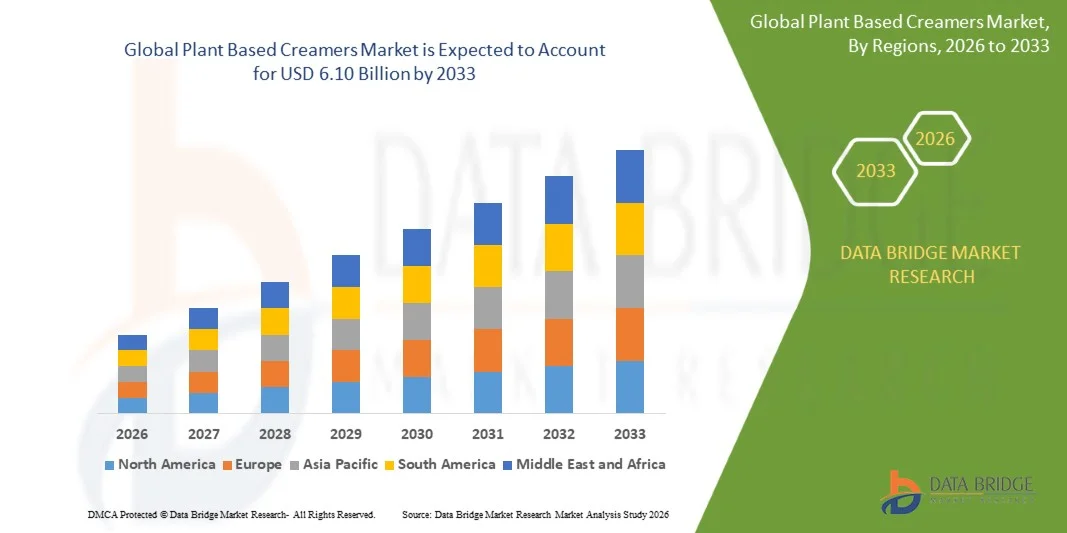
- As per Data Bridge Market Research analysis, the plant based creamers market was valued at USD 4.39 billion in 2025 and is projected to reach USD 6.10 billion by 2033, growing at a CAGR of 4.20% from 2026 to 2033.
- The market is experiencing consistent growth driven by rising consumer preference for dairy-free and lactose-free alternatives, increasing adoption of vegan and flexitarian diets, and growing demand for low-fat, non-GMO, and plant-based food products.
- The increasing focus on health-conscious consumption, sustainability, and clean-label formulations, combined with expanding applications in coffee, tea, foodservice, and household consumption, is compelling manufacturers to introduce innovative plant-based creamers. Almond, soy, coconut, and oat-based creamers are gaining adoption as consumers seek convenient alternatives to conventional dairy creamers.
Market Size & Forecast
- Global Market Value (2025): USD 4.39 Billion
- Expected Market Value (2033): USD 6.10 Billion
- Forecast CAGR (2026–2033): 4.20%
- Leading Region in 2025: North America
- Fastest Growing Region: Asia Pacific
What are the Major Takeaways of the Plant Based Creamers Market?
- North America dominated the plant based creamers market with the largest revenue share of 49.44% in 2025, supported by strong consumer adoption of plant-based diets, established coffee culture, and broad availability of dairy-free alternatives.
- Asia-Pacific is expected to be the fastest-growing region at a CAGR of 6.2% from 2026 to 2033, fueled by rising vegan trends, growing awareness of lactose intolerance, expanding urban populations, and increasing adoption in China, India, and Southeast Asia.
- The liquid segment led the market with a 73% share in 2025, driven by its ready-to-use format, convenience, and ability to blend smoothly into coffee and other beverages.
- Powder are the fastest-growing form type, projected to register a CAGR of 7.2%, reflecting the surge in its longer shelf life, portability, and storage convenience.
- The conventional segment dominated the nature type category with a 89% revenue share in 2025, led by its broad availability, established manufacturing base, and comparatively accessible pricing.
- Regular accounted for 60% of the market share in 2025, preferred by its widespread consumer acceptance and ability to provide a creamy texture in beverages
- The coconut milk segment is the fastest-growing source category, with a CAGR of 8.0%, driven by its creamy texture and growing use in plant-based food and beverage applications.
Report Scope and Plant Based Creamers Market Segmentation
|
Attributes |
Plant Based Creamers Key Market Insights |
|
Segments Covered |
|
|
Countries Covered |
North America
Europe
Asia-Pacific
Middle East and Africa
South America
|
|
Key Market Players |
|
|
Market Opportunities |
|
|
Value Added Data Infosets |
In addition to the insights on market scenarios such as market value, growth rate, segmentation, geographical coverage, and major players, the market reports curated by the Data Bridge Market Research also include in-depth expert analysis, pricing analysis, brand share analysis, consumer survey, demography analysis, supply chain analysis, value chain analysis, raw material/consumables overview, vendor selection criteria, PESTLE Analysis, Porter Analysis, and regulatory framework. |
What is the Key Trend in the Plant Based Creamers Market?
- Plant-based creamer manufacturers are increasingly developing barista-focused formulations that deliver improved frothing, foam stability, texture, and coffee compatibility, supporting expansion across specialty coffee shops and home brewing applications worldwide.
- For instance, in February 2024, Oatly launched four flavored Oatmilk Creamers in the United States, including Sweet & Creamy, Vanilla, Caramel, and Mocha, expanding its plant-based creamer portfolio for at-home coffee consumption.
- Consumers are increasingly seeking flavored and indulgent plant-based creamers that replicate familiar dairy experiences while meeting vegan and dairy-free preferences, encouraging manufacturers to diversify product portfolios with differentiated tastes and formats.
- Clean-label positioning is gaining importance as consumers increasingly examine ingredients, additives, sugar content, and nutritional profiles when purchasing plant-based creamers, encouraging brands to simplify formulations and communicate product benefits clearly.
- For instance, in November 2024, PKN launched JOY Barista Pecanmilk, formulated for frothing and micro-foam applications in lattes and cappuccinos, demonstrating continued innovation toward professional-quality plant-based coffee creamers.
- Premium plant-based creamers are increasingly being formulated with functional ingredients such as protein, vitamins, minerals, and fiber, responding to consumer interest in combining everyday coffee consumption with additional nutritional benefits conveniently.
- As consumers increasingly prioritize dairy-free choices, barista performance, flavor variety, and convenient coffee preparation, innovation in plant-based creamers is expected to accelerate, strengthening product differentiation across retail and foodservice channels.
What are the Key Drivers of the Plant Based Creamers Market?
- The rising awareness of lactose intolerance, dairy allergies, vegan diets, and flexitarian eating patterns is increasing demand for plant-based creamers that provide familiar creaminess without conventional dairy ingredients across consumer groups.
- For instance, in February 2024, Oatly launched its Oatmilk Creamers in North America, highlighting the growing demand for plant-based creamers and reporting that the category had increased 13% in dollar sales and 9% in unit sales over the previous year.
- Coffee remains a major consumption occasion for creamers, while specialty coffee and at-home brewing trends are encouraging consumers to experiment with oat, almond, coconut, soy, and other plant-based alternatives regularly.
- For instance, in April 2024, Califia Farms reported that the creamer category had nearly doubled since the pre-pandemic period, attributing the growth partly to increased investment in home coffee-making equipment and consumers creating more elaborate coffee beverages at home.
- Expanding foodservice adoption is increasing demand for plant-based creamers as coffee shops, hotels, restaurants, and workplaces respond to customers seeking dairy-free choices alongside conventional beverage customization options across global markets.
Which Factors are Challenging the Growth of the Plant Based Creamers Market?
- Plant-based creamers often carry higher prices than conventional dairy creamers because of specialized ingredients, processing requirements, formulation costs, and smaller production scales, limiting adoption among price-sensitive consumers in emerging markets.
- For instance, in September 2025, FoodNavigator reported that taste and texture remained significant barriers to plant-based dairy adoption, with consumers expressing concerns about whether plant-based products can match conventional dairy
- Supply-chain volatility affecting oats, almonds, coconuts, soybeans, peas, oils, and other plant ingredients can increase manufacturing costs and create pricing pressure, particularly for brands dependent on imported raw inputs locally.
- Many consumers continue to compare plant-based creamers against dairy products on taste, texture, functionality, and price, creating challenges for manufacturers when formulations fail to match familiar sensory expectations consistently worldwide.
- For instance, in February 2026, Food Control published an article identifying stability issues, off-flavors, allergens, and sensory and technological limitations as key challenges affecting the quality and acceptance of plant-based dairy alternatives.
- The combination of price premiums, ingredient-cost volatility, supply-chain pressures, and consumer expectations for dairy-equivalent taste and functionality continues to constrain broader adoption, particularly across price-sensitive markets.
How is the Plant Based Creamers Market Segmented?
The plant based creamers market is segmented on the basis of form, nature, type, source, end-use, and distribution channel.
- By Form
On the basis of form, the plant based creamers market is segmented into powder and liquid. The liquid segment dominated the market with an estimated 73% share in 2025, driven by its ready-to-use format, convenience, and ability to blend smoothly into coffee and other beverages. Liquid creamers are widely used in household and food service applications. Their easy pouring and dispensing characteristics support regular consumption. Manufacturers are increasingly introducing liquid products with improved emulsification and texture. Growing demand for café-style beverages is also supporting adoption.
The powder segment is projected to register the fastest growth at an estimated CAGR of 7.2% from 2026 to 2033, supported by its longer shelf life, portability, and storage convenience. Powdered creamers are suitable for applications where refrigeration is limited. They are also convenient for transportation and bulk storage. Food service operators can use powdered products for standardized beverage preparation. Increasing demand for convenient and shelf-stable products is supporting adoption. Manufacturers are improving solubility and flavor profiles to address consumer preferences. Expansion into emerging markets is further supporting the segment.
- By Nature
On the basis of nature, the plant based creamers market is segmented into organic and conventional. The conventional segment dominated the market with an estimated 89% share in 2025, supported by its broad availability, established manufacturing base, and comparatively accessible pricing. Conventional products are widely distributed through mainstream retail channels. They are also extensively used in food service and household applications. Established formulations provide manufacturers with consistent production and supply capabilities. Consumers are familiar with conventional plant based creamer products. Strong availability across supermarkets, grocery stores, and online channels further supports the segment.
The organic segment is projected to register the fastest growth at an estimated CAGR of 8.0% from 2026 to 2033, driven by rising consumer interest in organic ingredients and clean-label food products. Organic creamers appeal to consumers seeking products produced using certified organic ingredients. Growing awareness of ingredient sourcing is supporting demand. Premium positioning is also encouraging manufacturers to expand organic product portfolios. Retailers are increasing the availability of organic food and beverage products. Product innovation using organic plant sources is further supporting market penetration. Increasing consumer interest in natural and minimally processed products is expected to contribute to segment growth.
- By Type
On the basis of type, the plant based creamers market is segmented into regular, light, and fat-free. The regular segment dominated the market with an estimated 60% share in 2025, supported by its widespread consumer acceptance and ability to provide a creamy texture in beverages. Regular creamers are commonly used in coffee and tea applications. They are available across a wide range of plant-based sources and flavor profiles. Food service operators also use regular formulations for consistent beverage preparation. Consumer familiarity with traditional creamer formats supports continued demand. Manufacturers continue to introduce new flavors and formulations within this category. Broad retail availability further strengthens the segment.
The light segment is projected to register the fastest growth at an estimated CAGR of 7.5% from 2026 to 2033, driven by increasing consumer interest in lighter beverage formulations. Consumers seeking to manage their dietary intake are increasingly considering reduced-fat alternatives. Light plant based creamers provide an option for consumers who want creaminess with a lighter formulation. Manufacturers are developing formulations designed to maintain acceptable taste and texture. Growing health awareness is supporting demand across household and food service applications. Product innovation is improving the sensory characteristics of reduced-fat formulations. Increasing availability through retail and online channels is expected to support segment expansion.
- By Source
On the basis of source, the plant based creamers market is segmented into soy milk, almond milk, coconut milk, vegetable oil, and others. The almond milk segment dominated the market with an estimated 30% share in 2025, supported by its established consumer awareness, mild flavor, and widespread use in plant-based beverages. Almond-based creamers are widely available across retail and food service channels. Their flavor profile makes them suitable for coffee and other beverages. Manufacturers offer almond-based creamers in multiple formulations and flavors. Growing consumer interest in dairy alternatives continues to support demand. Strong distribution networks further improve product accessibility.
The coconut milk segment is projected to register the fastest growth at an estimated CAGR of 8.0% from 2026 to 2033, driven by its creamy texture and growing use in plant-based food and beverage applications. Coconut-based creamers can provide a rich mouthfeel in coffee and specialty beverages. Increasing consumer interest in alternative plant sources is supporting product diversification. Manufacturers are introducing coconut-based products across different flavors and formulations. The source also benefits from established coconut supply chains in major producing regions. Growing demand for dairy-free products is creating additional applications. Expansion across retail and food service channels is expected to support continued growth.
- By End-Use
On the basis of end-use, the plant based creamers market is segmented into food and beverages, food service industry, and retail/household. The retail/household segment dominated the market with an estimated 52% share in 2025, supported by rising at-home consumption of coffee and other beverages. Consumers increasingly purchase plant based creamers for daily household beverage preparation. Supermarkets and grocery stores provide broad access to different plant-based formulations. E-commerce platforms are also expanding consumer access to specialized products. Growing adoption of dairy-free diets is supporting household demand. Manufacturers are introducing products specifically designed for home coffee preparation. Increasing consumer familiarity with plant based creamers further supports the segment.
The food service industry segment is projected to register the fastest growth at an estimated CAGR of 8.0% from 2026 to 2033, driven by increasing adoption of dairy-free options across cafés, restaurants, hotels, and catering operations. Food service establishments are expanding plant-based beverage choices to accommodate changing consumer preferences. Coffee shops are increasingly incorporating non-dairy creamers into specialty beverages. Commercial users also benefit from consistent formulation and convenient preparation. Growing specialty coffee consumption is supporting demand for plant based creamers. Food service suppliers are expanding their portfolios to include different plant-based sources. Increasing availability of plant-based menu options is expected to support further adoption.
- By Distribution Channel
On the basis of distribution channel, the plant based creamers market is segmented into business to business and business to consumer. The business to consumer segment dominated the market with an estimated 60% share in 2025, supported by widespread availability of plant based creamers through supermarkets, grocery stores, specialty retailers, and online channels. Household consumers increasingly purchase creamers directly for coffee and other beverages. Retailers are expanding plant-based product selections to meet changing consumer preferences. E-commerce platforms provide access to a wider range of specialized and premium products. Brand websites and online grocery platforms are also supporting direct consumer purchases. Growing household consumption of specialty coffee is contributing to demand. Wider retail penetration continues to strengthen the B2C channel.
The business to business segment is projected to register the fastest growth at an estimated CAGR of 8.0% from 2026 to 2033, driven by increasing demand from cafés, restaurants, hotels, offices, catering businesses, and institutional food service operators. Commercial establishments require consistent supplies of creamers for beverage preparation. Growth in specialty coffee outlets is expanding demand for dairy-free creamer options. Food service operators are also responding to consumers seeking plant-based beverage choices. Bulk purchasing provides commercial users with convenient supply arrangements. Manufacturers are developing products and packaging formats suited to commercial applications. Increasing adoption of plant-based menus across food service establishments is expected to support B2B channel growth.
Which Region Holds the Largest Share of the Plant Based Creamers Market?
- North America dominated the plant based creamers market with the largest revenue share of 49.44% in 2025, supported by strong consumer adoption of plant-based diets, established coffee culture, and broad availability of dairy-free alternatives.
- The region also benefits from high awareness of lactose-free and plant-based alternatives, broad distribution networks, and strong demand for specialty coffee beverages. The U.S. represents a major market within North America, supported by established plant-based creamer brands and increasing adoption across household and food service applications. Growing product innovation, including oat-, almond-, coconut-, and other plant-based formulations, continues to strengthen North America's position in the global market.
U.S. Plant Based Creamers Market Insight
The U.S. plant based creamers market is witnessing strong growth due to rising consumer demand for dairy-free and plant-based beverage alternatives, expanding specialty coffee consumption, and increasing availability of oat, almond, coconut, and soy-based creamers. The country’s established food and beverage industry, along with strong retail and e-commerce distribution networks, is driving demand across household and food service applications. In addition, growing consumer interest in clean-label products, lactose-free alternatives, and diversified beverage choices is accelerating plant based creamer adoption across the country.
Asia-Pacific Plant Based Creamers Market Insight
The Asia-Pacific plant based creamers market is expected to witness rapid growth, driven by increasing urbanization, expanding food and beverage industries, and rising consumer awareness of plant-based and dairy-free alternatives across countries such as China, India, and Japan. Growing café culture, increasing consumption of specialty beverages, and rising availability of plant-based products through modern retail and e-commerce channels are supporting regional market expansion. Additionally, the growing presence of food service businesses and increasing product innovation using soy, coconut, almond, and other plant sources is accelerating plant based creamer adoption across the region.
Japan Plant Based Creamers Market Insight
The Japan plant-based creamers market is witnessing consistent growth due to rising consumer interest in dairy alternatives, changing dietary preferences, and increasing demand for convenient beverage products. Food and beverage manufacturers, cafés, and retailers are increasingly offering plant-based creamers to accommodate consumers seeking dairy-free options. Moreover, increasing product innovation, growing consumption of coffee and specialty beverages, and the country’s emphasis on convenient and high-quality food products are further contributing to market growth.
China Plant Based Creamers Market Insight
The China plant based creamers market is growing rapidly, driven by increasing urbanization, expanding café culture, and rising consumer awareness of plant-based and dairy-free beverage alternatives. Growing adoption of oat, soy, coconut, and other plant-based formulations across household and food service applications is significantly boosting market demand. In addition, rising disposable incomes, increasing penetration of modern retail and e-commerce channels, and rapid development of the specialty coffee sector are supporting product availability and accelerating plant based creamer adoption across China.
U.K. Plant Based Creamers Market Insight
The U.K. plant based creamers market is experiencing steady growth, supported by rising consumer adoption of plant-based diets, expanding demand for dairy-free coffee options, and increasing availability of alternative creamers across retail channels. Growing investments in innovative plant-based food and beverage products and the expansion of specialty coffee establishments are contributing to market growth. Furthermore, increasing consumer interest in sustainable ingredients, clean-label products, and diverse plant-based formulations is improving product acceptance and supporting continued market development in the U.K.
Germany Plant Based Creamers Market Insight
The Germany plant based creamers market is expanding steadily due to the country’s strong food and beverage industry, growing consumer preference for plant-based products, and increasing demand for dairy-free beverage alternatives. Food manufacturers, retailers, cafés, and food service operators are increasingly incorporating plant-based creamers into their product offerings. Continuous advancements in oat, almond, soy, and coconut-based formulations, along with strong consumer interest in sustainable and environmentally conscious food choices, are further driving market growth in Germany.
Which are the Top Companies in Plant Based Creamers Market?
The plant based creamers industry is primarily led by well-established companies, including:
- Oatly AB (Sweden)
- Starbucks Corporation (U.S.)
- Organic Valley (U.S.)
- Laird Superfood, Inc. (U.S.)
- MALK Organics LLC (U.S.)
- Forager Project LLC (U.S.)
- HP Hood LLC (U.S.)
- Chobani, LLC (U.S.)
- Danone North America (U.S.)
- Nestlé USA, Inc. (U.S.)
- Califia Farms, LLC (U.S.)
- Elmhurst 1925 (U.S.)
- milkadamia (U.S.)
- Pacific Foods of Oregon, LLC (U.S.)
- Goodmylk Co. (U.S.)
- Keurig Dr Pepper Inc. (U.S.)
- Land O'Lakes, Inc. (U.S.)
- WhiteWave Foods Company (U.S.)
- SunOpta Inc. (Canada)
- The Hain Celestial Group, Inc. (U.S.)
What are Latest Developments in Plant Based Creamers Market?
- In January 2025, Organic Valley launched its first-ever organic oat-based creamer line, introducing Vanilla, Caramel, Oatmeal Cookie, and Cinnamon Spice varieties. The creamers use oats sourced directly from the company’s U.S. organic family farms and are dairy-free, nut-free, and lactose-free, expanding the company’s portfolio into plant-based coffee creamers.
- In May 2024, MALK Organics introduced its first line of plant-based creamers, featuring Vanilla Almond, Caramel Almond, and Lightly Sweetened Oat varieties. The products were formulated without gums, oils, or fillers and were scheduled for rollout through Sprouts Farmers Market and selected Whole Foods Market, Erewhon, and Fresh Thyme locations
- In February 2024, Oatly launched its flavored Oatmilk Creamers in the U.S., introducing Sweet & Creamy, Vanilla, Caramel, and Mocha varieties. The launch expanded Oatly’s beverage portfolio into flavored creamers designed specifically for at-home coffee occasions and marked the company’s entry into the flavored creamer category.
- In January 2023, Danone North America launched new plant-based creamer offerings from Silk and So Delicious Dairy Free, including Silk Mocha Almond Creamer and So Delicious Dairy Free French Vanilla Coconutmilk Creamer. The company also expanded the So Delicious portfolio with Sweet & Creamy Coconutmilk Creamer and an improved French Vanilla formulation, strengthening its presence in the plant-based creamer category.
- In June 2021, Laird Superfood expanded its powdered coffee creamer portfolio with the launch of Aloha Oat & Macadamia Superfood Creamer, marking the company’s first non-coconut-based coffee creamer. The product was developed using oat milk powder and macadamia nut powder and was offered in Original, Unsweetened, and Original with Functional Mushrooms varieties.

- Interactive Data Analysis Dashboard
- Company Analysis Dashboard for high growth potential opportunities
- Research Analyst Access for customization & queries
- Competitor Analysis with Interactive dashboard
- Latest News, Updates & Trend analysis
- Harness the Power of Benchmark Analysis for Comprehensive Competitor Tracking
Global Plant Based Creamers Market, Supply Chain Analysis and Ecosystem Framework
To support market growth and help clients navigate the impact of geopolitical shifts, DBMR has integrated in-depth supply chain analysis into its Global Plant Based Creamers Market research reports. This addition empowers clients to respond effectively to global changes affecting their industries. The supply chain analysis section includes detailed insights such as Global Plant Based Creamers Market consumption and production by country, price trend analysis, the impact of tariffs and geopolitical developments, and import and export trends by country and HSN code. It also highlights major suppliers with data on production capacity and company profiles, as well as key importers and exporters. In addition to research, DBMR offers specialized supply chain consulting services backed by over a decade of experience, providing solutions like supplier discovery, supplier risk assessment, price trend analysis, impact evaluation of inflation and trade route changes, and comprehensive market trend analysis.
Data collection and base year analysis are done using data collection modules with large sample sizes. The stage includes obtaining market information or related data through various sources and strategies. It includes examining and planning all the data acquired from the past in advance. It likewise envelops the examination of information inconsistencies seen across different information sources. The market data is analysed and estimated using market statistical and coherent models. Also, market share analysis and key trend analysis are the major success factors in the market report. To know more, please request an analyst call or drop down your inquiry.
The key research methodology used by DBMR research team is data triangulation which involves data mining, analysis of the impact of data variables on the market and primary (industry expert) validation. Data models include Vendor Positioning Grid, Market Time Line Analysis, Market Overview and Guide, Company Positioning Grid, Patent Analysis, Pricing Analysis, Company Market Share Analysis, Standards of Measurement, Global versus Regional and Vendor Share Analysis. To know more about the research methodology, drop in an inquiry to speak to our industry experts.
Data Bridge Market Research is a leader in advanced formative research. We take pride in servicing our existing and new customers with data and analysis that match and suits their goal. The report can be customized to include price trend analysis of target brands understanding the market for additional countries (ask for the list of countries), clinical trial results data, literature review, refurbished market and product base analysis. Market analysis of target competitors can be analyzed from technology-based analysis to market portfolio strategies. We can add as many competitors that you require data about in the format and data style you are looking for. Our team of analysts can also provide you data in crude raw excel files pivot tables (Fact book) or can assist you in creating presentations from the data sets available in the report.













