


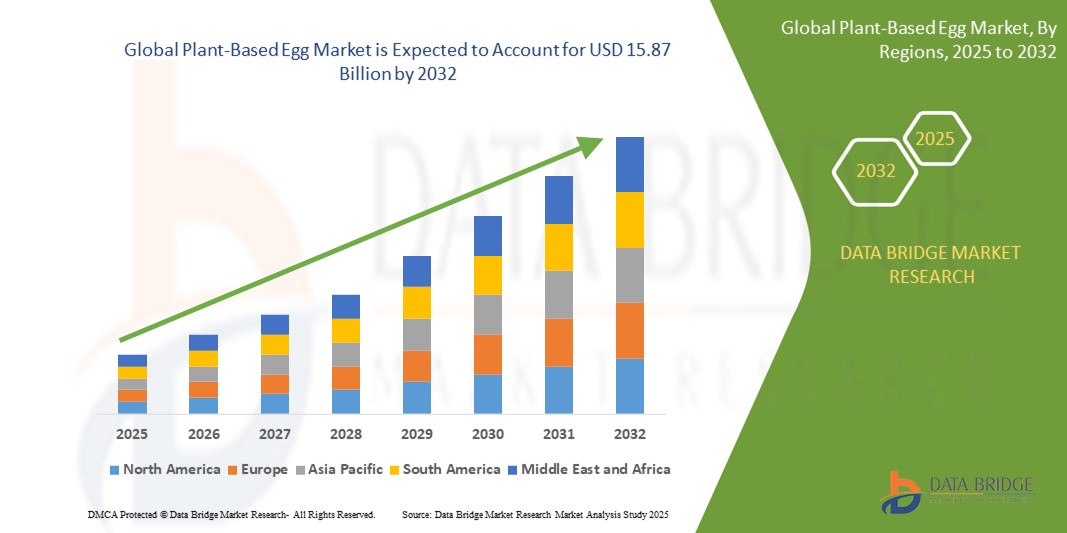
Plant-Based Egg Market Size
- The global plant-based egg market was valued at USD 3.50 billion in 2024 and is expected to reach USD 15.87 billion by 2032
- During the forecast period of 2025 to 2032 the market is likely to grow at a CAGR of 20.78%, primarily driven by the increasing consumer demand for sustainable and ethical food alternatives
- This growth is driven by factors such as the heightened awareness of the environmental impact of traditional egg production, concerns over animal welfare, and the rising adoption of plant-based diets
Plant-Based Egg Market Analysis
- The plant-based egg market is experiencing significant growth, driven by increasing consumer demand for sustainable and ethical food alternatives
- Product innovation is a key factor, with companies developing plant-based egg products that closely mimic the taste and texture of traditional eggs
- The market is characterized by a diverse range of products, including liquid, powder, and ready-to-cook mixes, catering to both retail and food service sectors
- Key ingredients in plant-based eggs include mung bean protein, pea protein, and fava beans, chosen for their functional properties and nutritional benefits
- Consumer demographics primarily consist of health-conscious individuals, vegans, vegetarians, and flexitarians seeking sustainable and ethical food options
- For instance, in the U. S., the surge in egg prices caused by avian flu outbreaks has led to a significant increase in the adoption of plant-based egg alternatives like Just Egg and Simply Eggless, as consumers seek more affordable and sustainable options
- In conclusion, the plant-based egg market is poised for continued growth, driven by consumer demand for sustainable and ethical food alternatives, with significant advancements in product development and market expansion
Report Scope and Plant-Based Egg Market Segmentation
|
Attributes |
Plant-Based Egg Key Market Insights |
|
Segments Covered |
|
|
Countries Covered |
North America
Europe
Asia-Pacific
Middle East and Africa
South America
|
|
Key Market Players |
|
|
Market Opportunities |
|
|
Value Added Data Infosets |
In addition to the insights on market scenarios such as market value, growth rate, segmentation, geographical coverage, and major players, the market reports curated by the Data Bridge Market Research also include in-depth expert analysis, pricing analysis, brand share analysis, consumer survey, demography analysis, supply chain analysis, value chain analysis, raw material/consumables overview, vendor selection criteria, PESTLE Analysis, Porter Analysis, and regulatory framework. |
Plant-Based Egg Market Trends
“Increasing Growth and Innovation in Plant-Based Egg Market”
- The plant-based egg market is experiencing significant growth, driven by increasing consumer demand for sustainable and ethical food alternatives
- Product innovation is a key factor, with companies developing plant-based egg products that closely mimic the taste and texture of traditional eggs
- The market is characterized by a diverse range of products, including liquid, powder, and ready-to-cook mixes, catering to both retail and food service sectors
- Key ingredients in plant-based eggs include mung bean protein, pea protein, and fava beans, chosen for their functional properties and nutritional benefits
- Consumer demographics primarily consist of health-conscious individuals, vegans, vegetarians, and flexitarians seeking sustainable and ethical food options
- For instance, the rise in egg prices due to supply shortages has led to increased consumer interest in plant-based egg alternatives, highlighting the market's responsiveness to external factors
- In conclusion, the plant-based egg market is poised for continued growth, driven by consumer demand for sustainable and ethical food alternatives, with significant advancements in product development and market expansion
Plant-Based Egg Market Dynamics
Driver
“Increase in Health and Safety Concerns”
- Health concerns related to traditional eggs, such as high cholesterol and the risk of salmonella contamination, are driving consumers towards plant-based egg alternatives
- Plant-based eggs are often lower in saturated fats and free from cholesterol, appealing to individuals looking to reduce animal-based product consumption
- These alternatives are produced without antibiotics or hormones, aligning with the increasing consumer demand for health-conscious products
- The safety aspect of plant-based eggs, especially in light of foodborne illness concerns, has led to higher adoption rates of these alternatives
- For instance, during avian influenza outbreaks, plant-based eggs provided a safe and reliable substitute, further boosting market growth
- In conclusion, the increasing health awareness and safety concerns surrounding traditional eggs are significantly driving the demand for plant-based egg alternatives, making them a popular choice for health-conscious consumers
Opportunity
“Expansion into Emerging Markets Vegetarian Population”
- India's large vegetarian population presents a significant opportunity for plant-based egg products. The market for plant-based eggs in India is projected to experience substantial growth, driven by cultural preferences and rising health awareness
- Many Indian consumers are open to plant-based alternatives due to dietary preferences and health considerations. Startups such as EVO Foods have developed plant-based liquid egg substitutes tailored to local tastes, using ingredients such as mung beans, chickpeas, and peas
- While India has regulations on labeling plant-based products, the government's support for sustainable agriculture and innovation through initiatives like the National Action Plan on Climate Change and the Make in India campaign provides a conducive environment for the growth of the plant-based food sector
- The increasing awareness of health and environmental benefits associated with plant-based diets is driving consumer interest. This trend is encouraging the entry of more companies into the plant-based egg market, further expanding its reach
- Adopting plant-based egg alternatives contributes to reducing reliance on animal agriculture, aligning with global sustainability efforts. This shift not only meets consumer demand but also supports environmental goals
- In conclusion, the plant-based egg market in emerging economies like India is poised for significant growth, driven by cultural acceptance, government support, and increasing consumer demand for sustainable and ethical food alternatives
Restraint/Challenge
“High Production Costs of Plant-Based Eggs”
- The high production costs of plant-based eggs are primarily due to the expense of raw materials like mung beans, peas, and fava beans, along with advanced processing techniques. These costs are often passed on to consumers, resulting in higher retail prices compared to traditional eggs
- Price sensitivity remains a significant barrier, particularly in price-conscious markets where consumers may opt for conventional eggs due to cost considerations
- To overcome this challenge, manufacturers are investing in research and development to improve production efficiency and reduce costs. Additionally, economies of scale and increased consumer demand are expected to drive down prices over time, making plant-based eggs more accessible to a broader audience
- For instance, during the avian influenza outbreaks, plant-based eggs provided a reliable and safe substitute, as they are not susceptible to such diseases
- The adoption of plant-based egg alternatives contributes to reducing reliance on animal agriculture, aligning with global sustainability efforts
- In conclusion, while high production costs pose a challenge for the plant-based egg market, ongoing investments in innovation and production efficiency are paving the way for more affordable and accessible alternatives
Plant-Based Egg Market Scope
The market is segmented on the basis of type, form, base ingredients, function, application, category, nature, packaging type, distribution channel, and end use.
|
Segmentation |
Sub-Segmentation |
|
By Type |
|
|
By Form |
|
|
By Base Ingredient |
|
|
By Function
|
|
|
By Application |
|
|
By Category
|
|
|
By Nature |
|
|
By Packaging Type |
|
|
By Distribution Channel |
|
|
By End Use |
|
Plant-Based Egg Market Regional Analysis
“Asia-Pacific is the Dominant Region in the Plant-Based Egg Market”
- Asia-Pacific leads the global plant-based egg market due to its large vegetarian population and increasing adoption of plant-based diets
- Countries like India, China, Japan, and Southeast Asian nations have traditionally been more vegetarian and flexitarian in their dietary habits
- The region benefits from a rich diversity of plant-based ingredients, facilitating the development of culturally tailored egg alternatives
- Government support for sustainable agriculture and food innovation enhances market growth
- The availability of a wide range of vegan egg options at affordable prices across all retail channels has made plant-based food integral to daily lives
- In conclusion, Asia-Pacific is witnessing significant growth in the plant-based egg market, driven by increasing consumer interest and government support
“North America is Projected to Register the Highest Growth Rate”
- North America is experiencing rapid growth in the plant-based egg market, driven by increasing demand for plant-based and vegan food products
- Rising awareness regarding the health benefits of plant-based eggs contributes to the region's market expansion
- The presence of established brands and startups innovating in plant-based egg products fuels market dynamics
- The region's robust retail infrastructure facilitates widespread distribution of plant-based egg alternatives
- Consumer interest in sustainable and ethical food choices supports the growing adoption of plant-based eggs
- In conclusion, North America is experiencing rapid growth, fueled by rising demand and awareness of health benefits
Plant-Based Egg Market Share
The market competitive landscape provides details by competitor. Details included are company overview, company financials, revenue generated, market potential, investment in research and development, new market initiatives, global presence, production sites and facilities, production capacities, company strengths and weaknesses, product launch, product width and breadth, application dominance. The above data points provided are only related to the companies' focus related to market.
The Major Market Leaders Operating in the Market Are:
- plantmade (India)
- Vezlay Foods Pvt. Ltd (India)
- Plamil Foods Ltd. (U.K.)
- The Peggs Company, Inc. (U.S.)
- Osome Pte. Ltd. (Singapore)
- Eat Just, Inc. (U.S.)
- Simply Eggless Inc. (U.S.)
- Zero Egg (U.S.)
- Crackd (U.K.)
- Orgran (Australia)
- Troofoods Ltd. (U.K.)
- NotCo (Chile)
- Clara Foods (U.S.)
- Future Kitchen (Germany)
- Good Catch (U.S.)
- ALL YOLK (U.K.)
- Vegan Eggz (U.S.)
- Oggs Ltd. (U.K.)
- TWO OGGS (U.K.)
- Alpro (Belgium)
- Flora Food Group (Netherlands)
- Hain Celestial Group (U.S.)
Latest Developments in Global Plant-Based Egg Market
- In June 2024, Madrid-based startup Awevo launched its first plant-based egg product, a liquid egg alternative made primarily from potato protein. Available in 400 ml and 1000 ml formats, the product is designed for both the food service and retail sectors. Awevo's liquid eggs are marketed as offering the same taste, texture, and appearance as conventional eggs, without cholesterol or saturated fats. The company aims to provide a more ethical and sustainable option for those following a vegan diet or seeking to reduce animal product consumption
- In June 2023, Plantible Foods launched Rubi Whisk, a plant-based egg replacer derived from lemna (duckweed) protein. This product is designed to replace eggs in various applications, including baked goods, gluten-free products, and pasta. Rubi Whisk is noted for its functional properties akin to animal proteins, such as emulsifying, gelation, and binding, at low inclusion rates. It is nearly 100% soluble in water, forms stable emulsions when mixed with oil and water at high speed, and can be whipped into stiff peaks in three minutes
- In November 2022, Nestlé introduced a shelf-stable, soy-based plant-based egg alternative in Latin America. This affordable product offers an equal amount of protein as eggs, with reduced saturated fats and cholesterol. Fortified with iron, it aims to address micronutrient deficiencies and is versatile for dishes like scrambled eggs, omelets, and baking. Currently tested under the Malher brand in Central America, it is expected to expand across more Latin American marketsIn April 2022, Eat Just announced that its plant-based egg alternative, JUST Egg, received approval from the European Commission for its key ingredient, mung bean protein. This approval paves the way for the product's launch in Europe by the end of the year. The company is actively engaging with the UK's Food Standards Agency to navigate the regulatory path for market entry in the U.K.
- In October 2022, Puris launched AcreMade, its first direct-to-consumer brand offering a plant-based egg substitute made from yellow field peas. This allergen-free, shelf-stable powder provides 5 grams of protein per serving and contains no cholesterol, positioning it as a nutritious alternative to traditional eggs. Priced at $54.99 for 96 servings, AcreMade is available for purchase online, with plans to expand into retail and foodservice channels

- Interactive Data Analysis Dashboard
- Company Analysis Dashboard for high growth potential opportunities
- Research Analyst Access for customization & queries
- Competitor Analysis with Interactive dashboard
- Latest News, Updates & Trend analysis
- Harness the Power of Benchmark Analysis for Comprehensive Competitor Tracking
Global Plant Based Eggs Market, Supply Chain Analysis and Ecosystem Framework
To support market growth and help clients navigate the impact of geopolitical shifts, DBMR has integrated in-depth supply chain analysis into its Global Plant Based Eggs Market research reports. This addition empowers clients to respond effectively to global changes affecting their industries. The supply chain analysis section includes detailed insights such as Global Plant Based Eggs Market consumption and production by country, price trend analysis, the impact of tariffs and geopolitical developments, and import and export trends by country and HSN code. It also highlights major suppliers with data on production capacity and company profiles, as well as key importers and exporters. In addition to research, DBMR offers specialized supply chain consulting services backed by over a decade of experience, providing solutions like supplier discovery, supplier risk assessment, price trend analysis, impact evaluation of inflation and trade route changes, and comprehensive market trend analysis.
Data collection and base year analysis are done using data collection modules with large sample sizes. The stage includes obtaining market information or related data through various sources and strategies. It includes examining and planning all the data acquired from the past in advance. It likewise envelops the examination of information inconsistencies seen across different information sources. The market data is analysed and estimated using market statistical and coherent models. Also, market share analysis and key trend analysis are the major success factors in the market report. To know more, please request an analyst call or drop down your inquiry.
The key research methodology used by DBMR research team is data triangulation which involves data mining, analysis of the impact of data variables on the market and primary (industry expert) validation. Data models include Vendor Positioning Grid, Market Time Line Analysis, Market Overview and Guide, Company Positioning Grid, Patent Analysis, Pricing Analysis, Company Market Share Analysis, Standards of Measurement, Global versus Regional and Vendor Share Analysis. To know more about the research methodology, drop in an inquiry to speak to our industry experts.
Data Bridge Market Research is a leader in advanced formative research. We take pride in servicing our existing and new customers with data and analysis that match and suits their goal. The report can be customized to include price trend analysis of target brands understanding the market for additional countries (ask for the list of countries), clinical trial results data, literature review, refurbished market and product base analysis. Market analysis of target competitors can be analyzed from technology-based analysis to market portfolio strategies. We can add as many competitors that you require data about in the format and data style you are looking for. Our team of analysts can also provide you data in crude raw excel files pivot tables (Fact book) or can assist you in creating presentations from the data sets available in the report.













