What is the Plant Growth Chambers Market Size and Growth Rate?
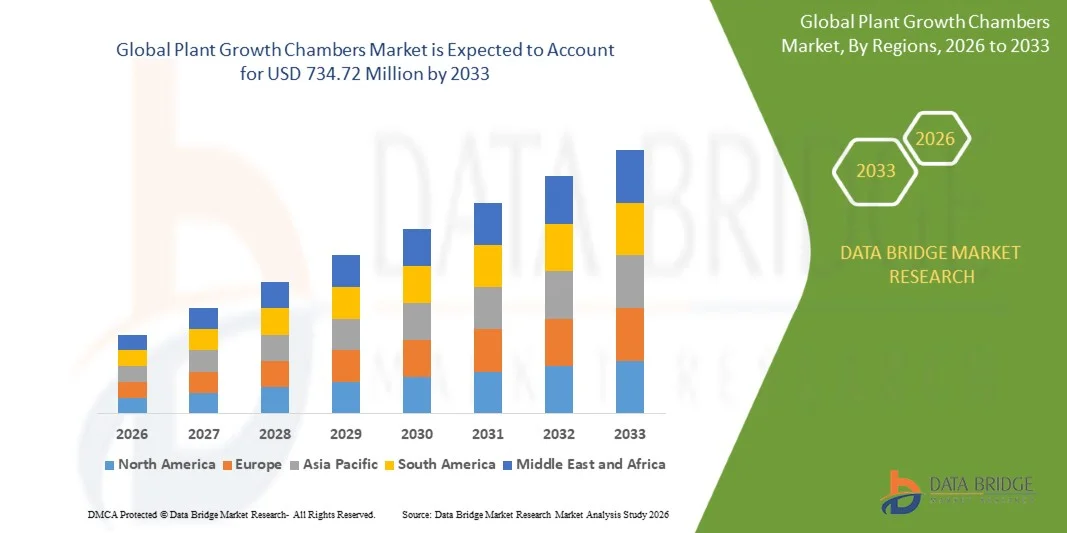
- As per Data Bridge Market Research analysis, the plant growth chambers market was valued at USD 580.00 million in 2025 and is projected to reach USD 734.72 million by 2033, growing at a CAGR of 3.00% from 2026 to 2033.
- The market is experiencing steady growth driven by rising global investment in agricultural research and crop-improvement programs, growing demand for controlled-environment plant phenotyping and breeding infrastructure, and increasing adoption of energy-efficient LED-based growth chamber systems across universities, research institutes, and agricultural biotechnology companies.
- The growing pressure on global food systems from climate variability, shrinking arable land, and rising population, combined with expanding public and private funding for accelerated crop breeding, is compelling research organizations to invest in precisely controlled growth environments that allow reproducible experiments independent of seasonal and geographic constraints. Rising adoption of speed-breeding protocols, which shorten crop generation cycles through extended photoperiods and optimized climate control, is further reinforcing demand for reliable, high-performance growth chamber platforms.
Market Size & Forecast
- Global Market Value (2025): USD 580.00 Million
- Expected Market Value (2033): USD 734.72 Million
- Forecast CAGR (2026–2033): 3.00%
- Leading Region in 2025: North America
- Fastest Growing Region: Asia-Pacific
What are the Major Takeaways of the Plant Growth Chambers Market?
- North America dominated the global plant growth chambers market with the largest revenue share of 35.84% in 2025, supported by extensive university and government agricultural research funding and a high concentration of agricultural biotechnology companies.
- Asia-Pacific is expected to be the fastest-growing region at a CAGR of 4.3% from 2026 to 2033, fueled by expanding agricultural research infrastructure, rising national crop-improvement investment, and growing seed-industry activity across China and India.
- The reach-in growth chambers type segment led the market with a 46.72% share in 2025, driven by their balance of experimental capacity, precise environmental control, and affordability across university and research-institute laboratories.
- The LED lighting technology segment is the fastest-growing lighting category, projected to register a CAGR of 5.4%, reflecting rising demand for energy-efficient, spectrally tunable illumination that reduces heat load and operating costs.
- The crop research & breeding application segment dominated the application category with a 34.63% revenue share in 2025, led by sustained global investment in yield improvement and stress-tolerant variety development.
- The universities & research institutes end user segment accounted for 44.36% of the market share in 2025, preferred for its extensive plant-science research programs and reliance on reproducible controlled-environment experimentation.
- The fully automated/IoT-enabled automation level segment is the fastest-growing category, with a CAGR of 5.9%, driven by rising demand for remote monitoring, data logging, and programmable climate-profile control in modern research facilities.
Report Scope and Plant Growth Chambers Market Segmentation
|
Attributes |
Plant Growth Chambers Key Market Insights |
|
Segments Covered |
|
|
Countries Covered |
North America
Europe
Asia-Pacific
Middle East and Africa
South America
|
|
Key Market Players |
|
|
Market Opportunities |
|
|
Value Added Data Infosets |
In addition to the insights on market scenarios such as market value, growth rate, segmentation, geographical coverage, and major players, the market reports curated by the Data Bridge Market Research also include import export analysis, production capacity overview, production consumption analysis, price trend analysis, climate change scenario, supply chain analysis, value chain analysis, raw material/consumables overview, vendor selection criteria, PESTLE Analysis, Porter Analysis, and regulatory framework. |
What is the Key Trend in the Plant Growth Chambers Market?
- Research institutions and agricultural biotechnology companies are increasingly adopting tunable LED-based growth chambers that allow precise spectral control, lower heat output, and reduced energy consumption compared to legacy fluorescent and high-intensity-discharge lighting systems.
- For instance, in April 2025, Conviron expanded its LED-equipped growth chamber portfolio with an upgraded spectrally tunable lighting platform designed to support speed-breeding and photobiology research programs at universities and seed companies.
- Rising adoption of speed-breeding protocols, which combine extended photoperiods with tightly controlled temperature and humidity, is enabling breeders to achieve multiple crop generations per year and significantly shorten variety-development timelines.
- Manufacturers are increasingly integrating IoT connectivity, cloud-based data logging, and remote-monitoring capabilities into growth chamber controllers, enabling researchers to supervise experiments and adjust environmental programs from any location.
- For instance, in January 2025, Percival Scientific introduced an upgraded chamber control platform with cloud-connected monitoring and programmable multi-stage climate profiles, allowing researchers to run complex environmental-stress experiments with improved reproducibility.
- As agricultural research organizations continue to prioritize reproducibility, energy efficiency, and accelerated crop development, the adoption of advanced, sensor-integrated growth chamber systems is expected to steadily expand, reinforcing their role as core infrastructure for modern plant-science research.
What are the Key Drivers of the Plant Growth Chambers Market?
- Rising global investment in agricultural research and crop-improvement programs, combined with growing pressure on food systems from climate variability, has significantly increased demand for controlled-environment infrastructure enabling reproducible plant experimentation.
- For instance, in March 2025, Thermo Fisher Scientific expanded its controlled-environment equipment manufacturing capacity to meet rising demand from university and government research laboratories building new plant-science facilities.
- Seed companies and agricultural biotechnology firms are increasingly incorporating growth chambers into breeding and trait-development pipelines to accelerate generation cycles, screen germplasm under defined stress conditions, and reduce dependence on seasonal field trials.
- For instance, in October 2024, BINDER announced an investment in additional climate-chamber production capacity to support rising orders from agricultural research institutions and seed-industry customers across Europe and Asia.
- For instance, in June 2024, Weiss Technik expanded its plant-climate chamber product line to include additional walk-in configurations tailored for large-scale phenotyping and breeding programs.
- With agricultural research increasingly reliant on controlled, reproducible environmental conditions to isolate genetic and environmental effects on plant performance, plant growth chambers will remain an indispensable tool across university, government, and commercial research programs worldwide.
What Factors are Challenging the Growth of the Plant Growth Chambers Market?
- Plant growth chambers require significant upfront capital investment and ongoing operating costs, encompassing refrigeration, humidification, lighting, and facility infrastructure, which creates a substantial financial barrier for smaller laboratories and institutions in budget-constrained regions.
- These high acquisition and energy costs, combined with dependence on periodic public research funding cycles, limit adoption among smaller research organizations and constrain replacement of aging chamber fleets.
- For instance, in September 2024, the National Institute of Plant Genome Research (NIPGR), India, issued a tender valued at $1.18 million for two speed-breeding walk-in growth chambers for rice and chickpea, illustrating the substantial capital investment required for advanced plant growth chamber infrastructure.
- The high capital and operating costs associated with plant growth chambers, together with the cyclical nature of public research funding, continue to restrict broader adoption, particularly among smaller institutions and in emerging markets. This cost and funding barrier slows market growth beyond well-funded research centers, moderating the pace of expansion despite steady underlying demand for controlled-environment research capacity.
How is the Plant Growth Chambers Market Segmented?
The plant growth chambers market is segmented on the basis of type, control parameter, lighting technology, capacity, application, end user, cooling technology, automation level, plant type and sales channel.
- By Type
On the basis of type, the global plant growth chambers market is segmented into walk-in growth chambers, reach-in growth chambers, and benchtop growth chambers. The reach-in growth chambers segment dominated the market with a 46.72% share in 2025, owing to their balance of experimental capacity, precise environmental control, and affordability across university and research-institute laboratories. These units deliver reliable, reproducible growing conditions in a compact footprint, making them the preferred choice for most routine plant-science experimentation.
The walk-in growth chambers segment is projected to register the fastest growth at a CAGR of 4.1% from 2026 to 2033, driven by rising demand for large-capacity environments supporting phenotyping of mature plants, tall crops, and high-throughput breeding programs. Advances in modular construction and energy-efficient refrigeration, combined with growing investment in dedicated phenotyping facilities, are accelerating segment expansion.
- By Control Parameter
On the basis of control parameter, the global plant growth chambers market is segmented into temperature control, humidity control, light/photoperiod control, CO2 control, and multi-parameter control. The multi-parameter control segment led the market with a 52.84% share in 2025, supported by researchers' need to simultaneously regulate temperature, humidity, light, and atmospheric composition to replicate realistic environmental conditions.
The CO2 control segment is expected to experience the fastest growth at a CAGR of 4.6% from 2026 to 2033, driven by increasing research into plant responses to elevated atmospheric carbon dioxide and its implications for crop yield and nutritional quality under future climate scenarios.
- By Lighting Technology
On the basis of lighting technology, the global plant growth chambers market is segmented into LED, fluorescent, HID, and others. The fluorescent segment dominated the market with a share of 38.47% in 2025 due to its long-established use across existing chamber installations, familiar spectral output, and lower initial cost. Additionally, the large installed base of fluorescent-equipped chambers continues to support replacement-lamp demand across research laboratories worldwide.
The LED segment is anticipated to witness the fastest CAGR of 5.4% from 2026 to 2033, driven by the increasing demand for energy-efficient, spectrally tunable lighting that reduces heat load and operating costs. Researchers are adopting LED arrays to conduct precise photobiology experiments, tailor spectra to specific crop responses, and lower facility cooling requirements. Additionally, falling LED costs and longer service life are further accelerating replacement of legacy lighting systems.
- By Capacity
On the basis of capacity, the global plant growth chambers market is segmented into small (<500 L), medium (500-1,500 L), and large (>1,500 L). The medium segment dominated the market with a share of 42.63% in 2025 due to its suitability for standard plant-science experiments requiring sufficient plant numbers for statistical replication without the space and energy demands of walk-in units. Additionally, established manufacturing platforms and broad laboratory compatibility are facilitating continued adoption of medium-capacity chambers.
The large (>1,500 L) segment is expected to witness the fastest CAGR of 4.2% from 2026 to 2033, driven by growing investment in high-throughput phenotyping and breeding facilities requiring greater plant capacity per experiment. Manufacturers are leveraging modular designs to enhance scalability, enable flexible chamber configurations, and support large research programs.
- By Application
On the basis of application, the global plant growth chambers market is segmented into seed germination, plant tissue culture, plant phenotyping, crop research & breeding, and insect & pest studies. The crop research & breeding segment dominated the market with a share of 34.63% in 2025 due to its critical role in supporting yield-improvement, stress-tolerance, and disease-resistance research across major food crops. High adoption is driven by the increasing need for accelerated variety development, integration with speed-breeding protocols, and enhanced experimental reproducibility. Additionally, growing investment by public and private breeding programs is reinforcing the leading position of this segment in the market.
The plant phenotyping segment is expected to witness the fastest CAGR of 4.8% from 2026 to 2033, driven by the increasing adoption of automated imaging and sensor-based trait measurement within controlled-environment settings. Growing demand for high-throughput screening of genetic diversity under defined environmental conditions is further accelerating market expansion in this segment.
- By End User
On the basis of end user, the global plant growth chambers market is segmented into universities & research institutes, agricultural biotechnology companies, seed companies, government agencies, and commercial growers. The universities & research institutes segment dominated the market with a share of 44.36% in 2025 due to its extensive plant-science research programs and reliance on reproducible controlled-environment experimentation for fundamental and applied studies. Additionally, established research-funding channels, broad laboratory infrastructure, and extensive graduate-training programs are facilitating continued adoption of growth chambers among academic institutions, while strong vendor support networks are improving accessibility, reliability, and trust, further reinforcing this segment's leading market position.
The agricultural biotechnology companies segment is expected to witness the fastest CAGR of 4.7% from 2026 to 2033, driven by the increasing use of controlled-environment chambers for trait validation, gene-editing research, and product development under standardized conditions. Biotechnology firms are leveraging growth chambers to accelerate development timelines, ensure reproducible trial conditions, and support regulatory data generation, thereby accelerating adoption across the commercial research sector.
- By Cooling Technology
On the basis of cooling technology, the global plant growth chambers market is segmented into compressor-based and Peltier/thermoelectric. The compressor-based segment dominated the market with a share of 81.36% in 2025 due to its critical role in delivering wide temperature ranges, high cooling capacity, and dependable performance across reach-in and walk-in chamber formats. Additionally, established refrigeration technology, broad service-network availability, and extensive operating history are facilitating continued adoption of compressor-based cooling across research laboratories.
The Peltier/thermoelectric segment is expected to witness the fastest CAGR of 4.4% from 2026 to 2033, driven by the increasing demand for compact, quiet, vibration-free benchtop chambers used in tissue culture and small-plant research. Manufacturers are leveraging solid-state cooling to enhance reliability, reduce maintenance requirements, and support small-footprint laboratory installations.
- By Automation Level
On the basis of automation level, the global plant growth chambers market is segmented into manual, semi-automated, and fully automated/IoT-enabled. The semi-automated segment dominated the market with a share of 47.83% in 2025 due to its preference among laboratories requiring programmable environmental settings without the cost of fully integrated automation systems. Additionally, established controller technology, broad user familiarity, and extensive compatibility with existing laboratory workflows are facilitating continued adoption of semi-automated chambers.
The fully automated/IoT-enabled segment is expected to witness the fastest CAGR of 5.9% from 2026 to 2033, driven by the increasing demand for remote monitoring, automated data logging, and programmable multi-stage climate profiles. Research facilities are leveraging connected chamber controllers to enhance experimental reproducibility, enable off-site supervision, and support regulatory-quality data records, thereby accelerating adoption across modern research environments.
- By Plant Type
On the basis of plant type, the global plant growth chambers market is segmented into cereals & grains, vegetables & fruits, ornamentals, model plants, and forest/tree species. The cereals & grains segment dominated the market with a share of 36.72% in 2025 due to its critical role in global food security and the extensive breeding and stress-tolerance research directed at staple crops such as wheat, rice, and maize. Additionally, sustained public and private investment in cereal improvement programs is reinforcing the leading position of this segment in the market.
The vegetables & fruits segment is expected to witness the fastest CAGR of 4.5% from 2026 to 2033, driven by the growing focus on nutritional quality, shelf-life improvement, and climate-resilient horticultural varieties. Breeders are increasingly using growth chambers to evaluate horticultural crops under precisely defined temperature, light, and humidity conditions.
- By Sales Channel
On the basis of sales channel, the global plant growth chambers market is segmented into direct sales, distributors, and online retail. The direct sales segment dominated the market with a share of 58.94% in 2025 due to its critical role in enabling close collaboration between manufacturers and research institutions on chamber configuration, installation, validation, and service support. Additionally, established long-term supplier relationships, tailored engineering support, and integrated after-sales service are facilitating continued adoption of direct-sourced chambers among institutional buyers.
The online retail segment is expected to witness the fastest CAGR of 5.2% from 2026 to 2033, driven by the increasing demand from smaller laboratories and educational institutions for accessible purchasing of compact benchtop chambers and accessories through e-commerce platforms. These platforms offer streamlined procurement, price transparency, and rapid delivery, enhancing overall sourcing efficiency for smaller-budget buyers.
Which Region Holds the Largest Share of the Plant Growth Chambers Market?
- North America dominated the plant growth chambers market and accounted for the largest revenue share of 35.84% in 2025, supported by extensive university and government agricultural research funding, a high concentration of agricultural biotechnology and seed companies, and the presence of established chamber manufacturers.
- The region also benefits from advanced plant-science research infrastructure, high adoption of LED and IoT-enabled chamber technology, and growing use of growth chambers across breeding, phenotyping, and climate-response research applications. Increasing focus on climate-resilient crop development continues to strengthen North America's leadership position in the global market.
U.S. Plant Growth Chambers Market Insight
The U.S. plant growth chambers market is growing steadily, driven by substantial federal and state agricultural research funding, a large network of land-grant universities, and a strong commercial seed and agricultural biotechnology sector. Growing adoption of LED-based and IoT-enabled chambers across breeding and phenotyping programs is significantly boosting market demand. In addition, rising investments in speed-breeding infrastructure, increasing collaboration between universities and industry partners, and steady replacement of aging chamber fleets are positioning the United States as the leading global market for plant growth chambers.
Canada Plant Growth Chambers Market Insight
The Canada plant growth chambers market is expanding steadily, supported by strong agricultural research institutions, a globally recognized controlled-environment equipment manufacturing base, and significant crop-improvement activity focused on cold-climate and prairie crops. Universities and government research centers are increasingly integrating advanced growth chambers into breeding and stress-physiology programs. Continued public investment in agricultural innovation is further driving market growth in Canada.
Asia-Pacific Plant Growth Chambers Market Insight
The Asia-Pacific plant growth chambers market is expanding due to increasing demand for controlled-environment agriculture, crop research, and biotechnology applications. Countries such as China, Japan, India, South Korea, and Australia are investing in agricultural R&D and sustainable food production. Technological advancements, including automated climate control, LED lighting, and energy-efficient systems, are supporting market growth. Rising urban farming, precision agriculture, and pharmaceutical research further create opportunities. However, high equipment costs, energy consumption, and maintenance requirements may challenge adoption among smaller agricultural and research institutions.
China Plant Growth Chambers Market Insight
The China plant growth chambers market is expanding rapidly, supported by growing national investment in agricultural science and technology, expanding seed-industry research capacity, and increasing domestic manufacturing of controlled-environment equipment. Research institutes and seed companies are increasingly building new phenotyping and breeding facilities equipped with modern growth chambers. Continuous expansion of agricultural research infrastructure and rising government support for food-security-focused crop improvement are further driving market growth in China.
India Plant Growth Chambers Market Insight
The India plant growth chambers market is expanding steadily, supported by rising agricultural research investment, growing private seed-industry activity, and increasing focus on climate-resilient crop varieties. Agricultural universities and research institutes are increasingly integrating growth chambers into breeding and stress-tolerance research programs. Continuous advancements in cost-optimized chamber manufacturing, along with strong government support for agricultural innovation, are further driving market growth in India.
Which are the Top Companies in Plant Growth Chambers Market?
The plant growth chambers industry is primarily led by well-established companies, including:
- Thermo Fisher Scientific Inc. (U.S.)
- Conviron (Controlled Environments Limited) (Canada)
- Percival Scientific, Inc. (U.S.)
- BINDER GmbH (Germany)
- Weiss Technik GmbH (Germany)
- PHC Holdings Corporation (Japan)
- Memmert GmbH + Co. KG (Germany)
- Aralab (Portugal)
- Darwin Chambers Company (U.S.)
- Snijders Labs (Netherlands)
- Photon Systems Instruments (Czech Republic)
- Environmental Growth Chambers (U.S.)
- Biobase Group (China)
- JEIO TECH Co., Ltd. (South Korea)
- Caron Products & Services, Inc. (U.S.)
- Nippon Medical & Chemical Instruments Co., Ltd. (Japan)
- Eppendorf SE (Germany)
- CLF Plant Climatics GmbH (Germany)
- Heliospectra AB (Sweden)
- Lab Companion (South Korea)
What are Latest Developments in Plant Growth Chambers Market?
- In September 2025, Conviron launched an expanded line of LED-equipped reach-in growth chambers featuring upgraded spectral tunability and improved energy efficiency, strengthening its position in the global plant-science research equipment market.
- In February 2025, Thermo Fisher Scientific expanded its controlled-environment chamber portfolio in North America to support growing demand from universities and government agricultural research laboratories.
- In November 2025, Percival Scientific introduced an upgraded walk-in growth chamber platform incorporating modular construction and cloud-connected environmental monitoring, improving scalability and data-logging capability for large phenotyping programs. This development strengthens Percival's position in the high-capacity chamber market by offering research facilities more flexible, remotely manageable installations.
- In October 2024, BINDER expanded its climate-chamber product range in Europe to include additional models with enhanced humidity control suited to sensitive plant-tissue and seedling research.
- In June 2023, Weiss Technik partnered with a European agricultural research institute to co-develop customized phenotyping chambers integrated with automated imaging systems, combining its climate-engineering expertise with the institute's plant-science research requirements to support high-throughput trait measurement.
- In March 2023, Photon Systems Instruments received certification for an expanded plant-phenotyping chamber production line, enabling the company to serve growing demand from research institutions seeking integrated imaging and environmental-control solutions.

- Interactive Data Analysis Dashboard
- Company Analysis Dashboard for high growth potential opportunities
- Research Analyst Access for customization & queries
- Competitor Analysis with Interactive dashboard
- Latest News, Updates & Trend analysis
- Harness the Power of Benchmark Analysis for Comprehensive Competitor Tracking
Data collection and base year analysis are done using data collection modules with large sample sizes. The stage includes obtaining market information or related data through various sources and strategies. It includes examining and planning all the data acquired from the past in advance. It likewise envelops the examination of information inconsistencies seen across different information sources. The market data is analysed and estimated using market statistical and coherent models. Also, market share analysis and key trend analysis are the major success factors in the market report. To know more, please request an analyst call or drop down your inquiry.
The key research methodology used by DBMR research team is data triangulation which involves data mining, analysis of the impact of data variables on the market and primary (industry expert) validation. Data models include Vendor Positioning Grid, Market Time Line Analysis, Market Overview and Guide, Company Positioning Grid, Patent Analysis, Pricing Analysis, Company Market Share Analysis, Standards of Measurement, Global versus Regional and Vendor Share Analysis. To know more about the research methodology, drop in an inquiry to speak to our industry experts.
Data Bridge Market Research is a leader in advanced formative research. We take pride in servicing our existing and new customers with data and analysis that match and suits their goal. The report can be customized to include price trend analysis of target brands understanding the market for additional countries (ask for the list of countries), clinical trial results data, literature review, refurbished market and product base analysis. Market analysis of target competitors can be analyzed from technology-based analysis to market portfolio strategies. We can add as many competitors that you require data about in the format and data style you are looking for. Our team of analysts can also provide you data in crude raw excel files pivot tables (Fact book) or can assist you in creating presentations from the data sets available in the report.