What is the Global Plant Molecular Farming (PMF) Market Size and Growth Rate?
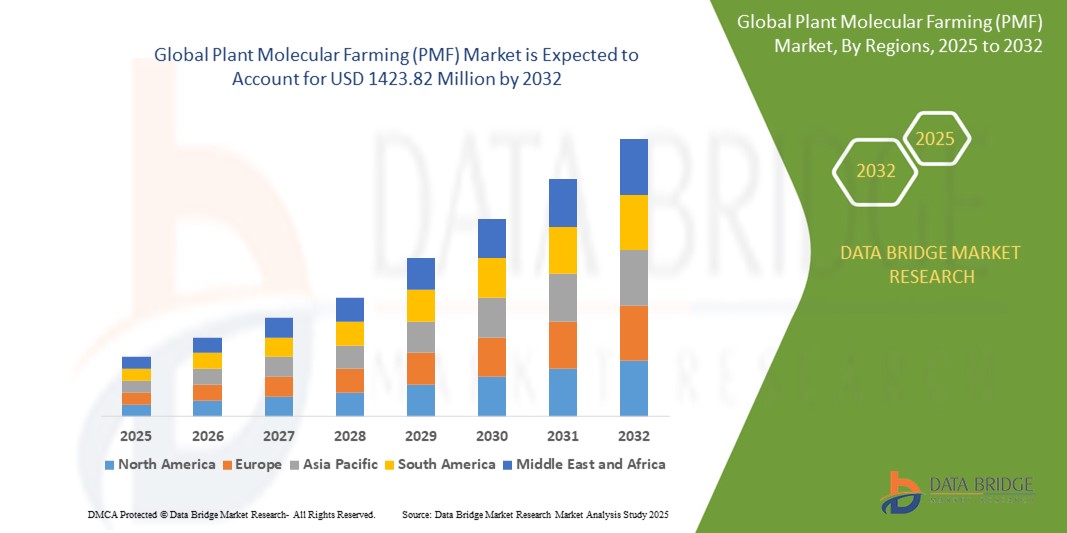
- As per Data Bridge Market Research Analysis the global plant molecular farming (PMF) market size was valued at USD 229.9 million in 2024 and is expected to reach USD 1423.82 million by 2032, at a CAGR of 25.6% during the forecast period
- The market growth is largely fuelled by the rising demand for cost-effective biopharmaceutical production, increasing adoption of plant-based platforms for recombinant protein synthesis, and expanding research initiatives focused on vaccine and antibody development using plants
- In addition, the increasing prevalence of chronic diseases and the global push for pandemic preparedness have highlighted the importance of scalable, flexible production methods such as PMF, further supporting market expansion
Market Size & Forecast
- Global Market Value (2024): USD 229.9 million
- Expected Market Value (2032): USD 1423.82 million
- Forecast CAGR (2024–2032):25.6%
What are the Major Takeaways of Global Plant Molecular Farming (PMF) Market?
- Growing concerns around scalability and cost-efficiency in traditional cell-based and microbial production systems are pushing biotech companies to explore PMF as a viable alternative for producing complex proteins
- PMF enables the cultivation of valuable therapeutic compounds in genetically modified plants, offering faster production timelines and reduced capital investment, especially beneficial for developing countries
- North America held the largest revenue share of 38.7% in the global plant molecular farming (PMF) market in 2024, supported by robust biotechnology infrastructure, favorable regulatory frameworks, and increasing investments in plant-based biopharmaceutical research
- Asia-Pacific region is expected to witness the highest growth rate in the global plant molecular farming (PMF) market, driven by increased investments in biotechnology, rising demand for cost-effective therapeutics, and supportive government policies promoting plant-based innovation. Countries such as China, India, and South Korea are accelerating R&D activities focused on plant-derived vaccines and pharmaceuticals, contributing significantly to market expansion in the region
- The plant segment dominated the market with the largest market revenue share of 72.8% in 2024, owing to its lower production cost, faster scalability, and ability to produce complex proteins safely. Plant-based systems such as Nicotiana benthamiana are widely used due to their high yield, short growth cycles, and ease of genetic manipulation. This segment also benefits from reduced risk of contamination by human pathogens, which is critical in pharmaceutical applications
Report Scope and Plant Molecular Farming (PMF) Market Segmentation
|
Attributes |
Plant Molecular Farming (PMF) Key Market Insights |
|
Segments Covered |
|
|
Countries Covered |
North America
Europe
Asia-Pacific
Middle East and Africa
South America
|
|
Key Market Players |
|
|
Market Opportunities |
|
|
Value Added Data Infosets |
|
What is the Key Trend in the Global Plant Molecular Farming (PMF) Market?
“Growing Adoption of Transient Expression Systems for Rapid Protein Production”
- Transient expression systems, particularly those using viral vectors such as Agrobacterium tumefaciens, are gaining traction for enabling fast and flexible protein production in plants
- These systems allow rapid development cycles—proteins can be produced in days rather than weeks or months, making them ideal for urgent pharmaceutical needs
- They are increasingly favored in response to emerging infectious diseases due to their quick scalability and efficient yield in plants such as Nicotiana benthamiana
- Biotech companies and academic institutions use transient expression platforms to develop vaccines, monoclonal antibodies, and enzymes with reduced production costs
- For instance, Canada-based Medicago used transient expression technology in Nicotiana plants to rapidly develop a COVID-19 vaccine candidate during the pandemic, demonstrating the method's commercial and public health potential
Plant Molecular Farming (PMF) Market Dynamics
Driver
“Increasing Demand for Cost-Effective Biopharmaceutical Manufacturing”
- Traditional bioproduction using mammalian or microbial cells often requires complex, sterile bioreactors and high capital investment, which PMF avoids
- PMF systems can be scaled through conventional farming or controlled-environment agriculture, dramatically reducing operational expenses
- The method enhances accessibility in low-resource settings where infrastructure for cell-culture-based production may be limited
- PMF supports the synthesis of therapeutic proteins, vaccines, hormones, and industrial enzymes—serving both human and veterinary healthcare sectors
- For instance, Elelyso (taliglucerase alfa), an enzyme replacement therapy approved by the FDA, is produced using genetically modified carrot cells and highlights the potential of plant-based manufacturing platforms in commercial drug development
Restraint/Challenge
“Regulatory Complexity and Standardization Issues”
- The lack of harmonized regulatory guidelines specific to PMF-based therapeutics hinders the approval and commercialization process across regions
- Manufacturers struggle to meet traditional GMP standards that were not designed for agricultural or greenhouse-based systems
- Ensuring batch-to-batch consistency and controlling environmental containment of genetically modified plants require stringent operational protocols
- Public perception and political opposition toward GMOs can impact funding, partnerships, and product acceptance in some countries
- For instance, European regulatory agencies have delayed the approval of several plant-made pharmaceuticals due to biosafety concerns and absence of clear classification standards, slowing entry into the EU market
How is the Global Plant Molecular Farming (PMF) Market Segmented?
The market is segmented on the basis of types and end uses.
• By Types
On the basis of types, the plant molecular farming market is segmented into plant-based and animal-based systems. The plant segment dominated the market with the largest market revenue share of 72.8% in 2024, owing to its lower production cost, faster scalability, and ability to produce complex proteins safely. Plant-based systems such as Nicotiana benthamiana are widely used due to their high yield, short growth cycles, and ease of genetic manipulation. This segment also benefits from reduced risk of contamination by human pathogens, which is critical in pharmaceutical applications.
The animal-based segment is expected to witness a fastest growth rate from 2025 to 2032, driven by its potential in high-value protein production and the ability to express certain therapeutic compounds that are difficult to produce in plant systems. Despite higher costs, advancements in genetic engineering and better control over animal cell lines are supporting its growth in niche applications such as rare disease treatments and advanced vaccines.
• By End Uses
On the basis of end uses, the market is segmented into nutraceutical, pharmaceutical, dairy, and others. The pharmaceutical segment accounted for the largest revenue share in 2024, driven by growing demand for biologics, enzymes, vaccines, and antibodies manufactured using PMF techniques. Plant-based production enables cost-effective and scalable alternatives to traditional biomanufacturing, attracting global pharmaceutical firms and biotech startups alike.
The nutraceutical segment is expected to witness a fastest growth rate from 2025 to 2032, fueled by rising consumer awareness regarding plant-derived functional foods and supplements. The dairy segment is also gaining momentum due to innovations in animal-free milk proteins and enzymes used in lactose-free products. Companies are increasingly exploring PMF to meet sustainability targets while addressing growing consumer demand for clean-label and cruelty-free alternatives.
Which Region Holds the Largest Share of the Global Plant Molecular Farming (PMF) Market?
• North America held the largest revenue share of 38.7% in the global plant molecular farming (PMF) market in 2024, supported by robust biotechnology infrastructure, favorable regulatory frameworks, and increasing investments in plant-based biopharmaceutical research
• The presence of major pharmaceutical companies, coupled with growing demand for cost-effective biologics and vaccines, is fueling adoption across the U.S. and Canada
• Strong academic collaborations and government grants for developing plant-derived therapeutic proteins are further supporting market penetration in the region
U.S. Plant Molecular Farming (PMF) Market Insight
The U.S. plant molecular farming market accounted for the highest share within North America in 2024, driven by significant advancements in plant-based protein expression systems and high levels of R&D investment. Companies are increasingly adopting PMF as a scalable and sustainable alternative to traditional cell culture systems. For instance, several U.S. firms are using tobacco plants and algae to produce monoclonal antibodies and oral vaccines. A growing emphasis on biomanufacturing resilience and biosecurity is further accelerating the U.S. market.
Europe Plant Molecular Farming (PMF) Market Insight
Europe is expected to witness a fastest growth rate from 2025 to 2032, supported by supportive policies for green biotechnology and rising demand for recombinant proteins. Countries such as Germany, the Netherlands, and France are spearheading research in molecular pharming through university-industry partnerships. The European Medicines Agency (EMA)’s acceptance of plant-based vaccines and growing interest in biosimilar production are strengthening market dynamics in the region.
U.K. Plant Molecular Farming (PMF) Market Insight
The U.K. plant molecular farming market is expected to witness a fastest growth rate from 2025 to 2032, driven by government-backed biotech initiatives, strong academic research, and rising demand for plant-derived pharmaceuticals. Institutions such as the John Innes Centre are actively involved in developing plant-based vaccines and therapeutic proteins, particularly through transient expression in Nicotiana benthamiana. The U.K.’s strategic focus on sustainable biomanufacturing and bioeconomy expansion is accelerating investment in PMF technologies. Moreover, the increasing interest in reducing reliance on traditional mammalian cell cultures for cost and safety reasons is further propelling market demand.
Germany Plant Molecular Farming (PMF) Market Insight
Germany is expected to witness a fastest growth rate from 2025 to 2032, bolstered by government-led biotechnology funding and the presence of strong academic institutions engaged in plant molecular biology. The nation’s emphasis on pharmaceutical innovation and biosustainability is encouraging the use of plant hosts such as barley and moss for the production of enzymes and therapeutic proteins.
Asia-Pacific Plant Molecular Farming (PMF) Market Insight
Asia-Pacific is expected to witness a fastest growth rate from 2025 to 2032, fueled by growing biopharma demand, increasing agricultural biotech adoption, and supportive government policies. Countries such as China, India, and South Korea are investing in local manufacturing of biologics using plant-based systems to reduce costs and improve accessibility. The growing nutraceutical industry in the region also boosts the demand for plant-derived functional proteins.
China Plant Molecular Farming (PMF) Market Insight
China accounted for the largest share in Asia-Pacific’s PMF market in 2024, supported by rapid expansion of domestic biotech startups and strategic government initiatives such as “Made in China 2025” aimed at boosting biopharmaceutical capabilities. Chinese institutions are leveraging rice and tobacco for recombinant protein production in therapeutics and diagnostics. The local availability of agricultural biomass and low-cost production capabilities give China a competitive edge.
Japan Plant Molecular Farming (PMF) Market Insight
Japan is expected to witness a fastest growth rate from 2025 to 2032, supported by its advanced biotechnology infrastructure and growing emphasis on pharmaceutical innovation. The country has seen increased R&D in the use of plant systems such as rice and soybean for producing vaccines, enzymes, and nutraceuticals. Japanese firms and universities are exploring plant-based production platforms to create cost-effective and scalable alternatives for biologics. As Japan continues to tackle an aging population and chronic disease burden, the demand for safer and more affordable therapeutic proteins is expected to drive adoption of plant molecular farming solutions.
Which are the Top Companies in Global Plant Molecular Farming (PMF) Market?
The Plant Molecular Farming (PMF) industry is primarily led by well-established companies, including:
• Medicago (Canada)
• Leaf Expression Systems (U.K.)
• iBio Inc. (U.S.)
• Kentucky BioProcessing (U.S.)
• ICON Genetics (Germany)
• Fraunhofer IME (Germany)
• Moolec Science (U.K.)
• Greenovation Biotech (Germany)
• Nomad Bioscience (Germany)
• PlantForm Corporation (Canada)

- Interactive Data Analysis Dashboard
- Company Analysis Dashboard for high growth potential opportunities
- Research Analyst Access for customization & queries
- Competitor Analysis with Interactive dashboard
- Latest News, Updates & Trend analysis
- Harness the Power of Benchmark Analysis for Comprehensive Competitor Tracking
Global Plant Molecular Farming Pmf Market, Supply Chain Analysis and Ecosystem Framework
To support market growth and help clients navigate the impact of geopolitical shifts, DBMR has integrated in-depth supply chain analysis into its Global Plant Molecular Farming Pmf Market research reports. This addition empowers clients to respond effectively to global changes affecting their industries. The supply chain analysis section includes detailed insights such as Global Plant Molecular Farming Pmf Market consumption and production by country, price trend analysis, the impact of tariffs and geopolitical developments, and import and export trends by country and HSN code. It also highlights major suppliers with data on production capacity and company profiles, as well as key importers and exporters. In addition to research, DBMR offers specialized supply chain consulting services backed by over a decade of experience, providing solutions like supplier discovery, supplier risk assessment, price trend analysis, impact evaluation of inflation and trade route changes, and comprehensive market trend analysis.
Data collection and base year analysis are done using data collection modules with large sample sizes. The stage includes obtaining market information or related data through various sources and strategies. It includes examining and planning all the data acquired from the past in advance. It likewise envelops the examination of information inconsistencies seen across different information sources. The market data is analysed and estimated using market statistical and coherent models. Also, market share analysis and key trend analysis are the major success factors in the market report. To know more, please request an analyst call or drop down your inquiry.
The key research methodology used by DBMR research team is data triangulation which involves data mining, analysis of the impact of data variables on the market and primary (industry expert) validation. Data models include Vendor Positioning Grid, Market Time Line Analysis, Market Overview and Guide, Company Positioning Grid, Patent Analysis, Pricing Analysis, Company Market Share Analysis, Standards of Measurement, Global versus Regional and Vendor Share Analysis. To know more about the research methodology, drop in an inquiry to speak to our industry experts.
Data Bridge Market Research is a leader in advanced formative research. We take pride in servicing our existing and new customers with data and analysis that match and suits their goal. The report can be customized to include price trend analysis of target brands understanding the market for additional countries (ask for the list of countries), clinical trial results data, literature review, refurbished market and product base analysis. Market analysis of target competitors can be analyzed from technology-based analysis to market portfolio strategies. We can add as many competitors that you require data about in the format and data style you are looking for. Our team of analysts can also provide you data in crude raw excel files pivot tables (Fact book) or can assist you in creating presentations from the data sets available in the report.