What is the Planting Equipment Market Size and Overview?
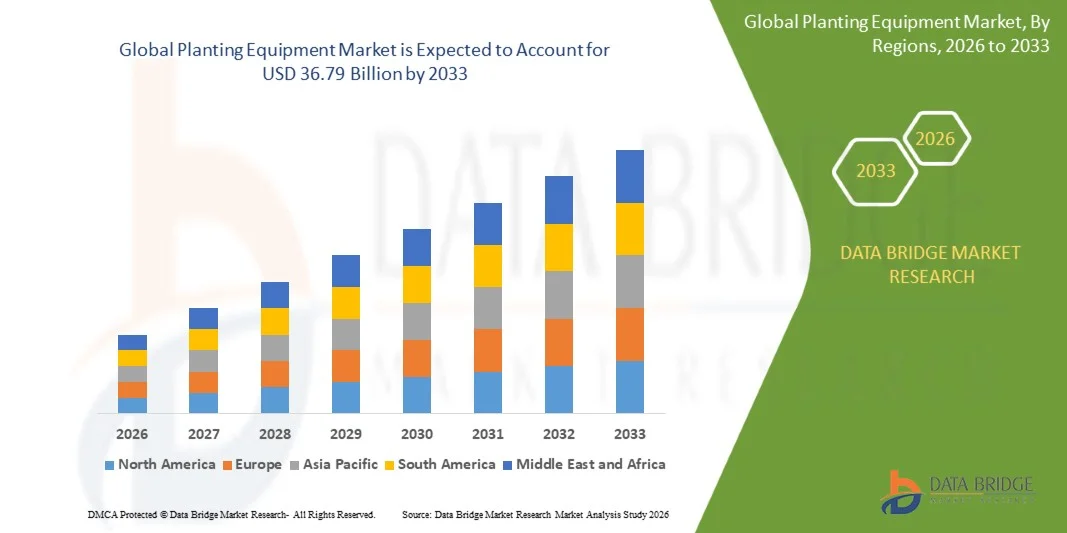
As per Data Bridge Market Research Analysis the Planting Equipment Market market was valued at USD 22.06 billion in 2025 and is projected to reach USD 36.79 billion by 2033, growing at a CAGR of 6.60% from 2026 to 2033. Market growth is supported by increasing farm mechanization, shortages of skilled agricultural labour, expansion of commercial farming, and the need to improve seed placement, crop emergence, and input efficiency. Farmers are investing in modern planters, seed drills, and air seeders to complete sowing operations within shorter weather windows and reduce dependence on manual labour.
Planting equipment includes machinery used to meter, place, and cover seeds at a controlled depth and spacing. Modern systems can integrate GPS guidance, automatic section control, variable-rate seeding, electric drives, downforce management, seed monitoring, and field-data platforms. Grain drills and conventional planters remain widely used because of their broad crop compatibility and established service networks, while air seeders and high-speed automatic planters are gaining attention in large farms. High purchase cost, maintenance requirements, seasonal equipment use, and limited access to finance continue to restrict adoption among smaller farmers.
Market Size & Forecast
- Market Value (2025): USD 22.06 Billion
- Expected Market Value (2030): USD 36.79 Billion
- Forecast CAGR (2025-2030): 6.60%
- Leading Region: Asia-Pacific
- Fastest-Growing Region: North America
What are the Major Takeaways of Planting Equipment Market?
- Asia-Pacific dominated the planting equipment market with the largest revenue share of 39.7% in 2024, supported by large agricultural economies, government-supported mechanization, expanding commercial farming, and increasing adoption of precision seed placement across China, India, Japan, Australia, and Southeast Asia.
- North America is expected to be the fastest-growing region at a CAGR of 5.7% from 2025 to 2030, fueled by investment in high-speed planters, intelligent seed placement, electric row-unit drives, automated depth and downforce control, and a large installed equipment base that can be upgraded with precision components.
- The grain drills segment held the largest market revenue share of over 29.5% in 2025 driven by widespread use in wheat, barley, rice, cover crops, pasture, and reduced-tillage systems. Grain drills are preferred because they can place seed in closely spaced rows, operate across broad cereal acreage, and support established tractor and dealer networks.
- The air seeders segment is expected to witness the fastest growth rate from 2026 to 2033, driven by increasing demand for broad working widths, high-capacity seed and fertilizer delivery, uniform pneumatic distribution, and faster completion of planting across large fields. Rising cultivation of cereals, canola, pulses, and other broad-acre crops is accelerating segment expansion.
- The automatic segment held the largest market revenue share of over 64.5% in 2025 driven by its integration with GPS guidance, precision metering, variable-rate seeding, section control, electronic monitoring, and automated depth and downforce management. Automatic systems are preferred by commercial farms seeking higher field capacity, consistent placement, lower overlap, and reduced operator fatigue.
- The automatic segment is expected to witness the fastest growth rate from 2026 to 2033, driven by increasing adoption of precision agriculture, connected machinery, real-time analytics, autonomous functions, and labour-saving equipment. Declining sensor costs and wider availability of retrofit packages are improving access beyond the largest farms.
Report Scope and Planting Equipment Market Segmentation
|
Attributes |
Planting Equipment Key Market Insights |
|
Segments Covered |
|
|
Countries Covered |
North America
Europe
Asia-Pacific
Middle East and Africa
South America
|
|
Key Market Players |
|
|
Market Opportunities |
|
|
Value Added Data Infosets |
In addition to the insights on market scenarios such as market value, growth rate, segmentation, geographical coverage, and major players, the market reports curated by the Data Bridge Market Research also include import export analysis, production capacity overview, production consumption analysis, price trend analysis, climate change scenario, supply chain analysis, value chain analysis, raw material/consumables overview, vendor selection criteria, PESTLE Analysis, Porter Analysis, and regulatory framework. |
What is the Key Trend in the Planting Equipment Market?
Trend: Rising Adoption Of Precision, Connected, And High-Speed Planting Technologies
Growing demand for higher planting accuracy, improved field productivity, and optimized input utilization is accelerating the adoption of precision, connected, and high-speed planting technologies across the global agricultural sector. Farmers are increasingly investing in advanced planters, drills, and air seeders equipped with electric row-unit drives, GPS guidance systems, automated downforce control, variable-rate seeding, section shutoff capabilities, and real-time seed monitoring technologies. These solutions help improve seed placement accuracy, reduce overlap, optimize seed and fertilizer usage, and enhance overall crop establishment performance.
The expansion of large-scale farming operations, rising seed costs, labor shortages, and increasingly narrow planting windows are creating sustained demand for advanced planting equipment capable of maintaining performance at higher operating speeds. Equipment manufacturers continue introducing innovations that improve seed spacing consistency and crop emergence. For instance, in January 2026, Precision Planting launched ArrowTube, a high-speed seed-delivery system designed to control seed spacing and orient corn seeds tip-down with the embryo positioned sideways to promote more uniform emergence, faster canopy closure, and improved yield potential. This development reflects growing industry investment in precision planting technologies that enhance agronomic performance and operational efficiency.
The increasing adoption of connected planting systems, advanced sensors, machine automation, and precision agriculture technologies is expected to reinforce long-term demand for modern planting equipment, positioning manufacturers to benefit from growing requirements for productivity, accuracy, and data-driven farming operations.
Planting Equipment Market Dynamics
Key Market Driver: Increasing Farm Mechanization And Demand For Accurate Seed Placement
The global agricultural industry continues to experience rising demand for mechanized planting solutions due to labor shortages, increasing labor costs, farm consolidation, and the need to improve crop productivity. Farmers are increasingly adopting advanced planting equipment capable of maintaining uniform seed depth, spacing, and seed-to-soil contact across large cultivated areas. Accurate seed placement improves crop emergence consistency, maximizes the effectiveness of high-value seed varieties, and enhances overall yield potential.
Government mechanization initiatives, agricultural financing programs, and advancements in automated farming equipment continue to support market expansion. Manufacturers are introducing new technologies designed to improve planting accuracy and operational efficiency. For instance, in June 2026, Väderstad introduced a next-generation row unit for its Tempo and Proceed planter platforms featuring prescription-map depth setting, electronic closing-wheel pressure adjustment, upgraded seed meters, narrower seed slots, and advanced electronic controls. These enhancements are designed to improve planting precision and support modern precision agriculture practices.
As farmers increasingly prioritize timely crop establishment, optimized plant populations, and lower operating costs, planting equipment manufacturers are expected to benefit from sustained demand driven by mechanization trends, precision farming adoption, and increasing investments in agricultural productivity.
Key Restraint/Challenge: High Equipment Costs And Limited Seasonal Utilization
Advanced planting equipment requires substantial capital investment, including planters, seed drills, precision agriculture systems, GPS guidance technologies, displays, sensors, software platforms, calibration services, and operator training. Because planting machinery is typically utilized during relatively short seasonal periods, many small and medium-sized farms face challenges in achieving rapid investment returns.
Additional ownership costs such as maintenance, software subscriptions, replacement parts, storage, transportation, and dealer service availability further increase the total cost of operation. Agricultural equipment purchasing decisions are also influenced by fluctuations in crop prices, farm income levels, interest rates, and regional economic conditions. To address affordability concerns, manufacturers are increasingly offering retrofit solutions that allow growers to upgrade existing equipment rather than purchasing entirely new machinery.
Despite strong demand for precision agriculture technologies, high upfront investment requirements and seasonal equipment utilization patterns are expected to remain significant challenges, potentially limiting adoption among cost-sensitive farming operations throughout the forecast period.
Key Market Opportunity: Expansion Of Retrofit Precision Systems And Conservation Agriculture Equipment
Growing adoption of no-till farming, minimum-tillage practices, cover cropping, and conservation agriculture is creating significant opportunities for manufacturers of advanced planting equipment and retrofit precision technologies. Farmers increasingly require planting systems capable of operating effectively through heavy crop residue while maintaining accurate seed placement, furrow closure, and crop emergence performance.
Manufacturers are responding by developing high-capacity seeding systems, precision retrofit components, and advanced air seeding technologies designed to improve productivity and support sustainable farming practices. For instance, in February 2024, John Deere announced its C-Series air cart lineup, offering expanded capacity options, flexible tank configurations, simplified calibration processes, and integrated technology solutions designed to improve seeding productivity for grain and oilseed producers. The development reflects growing industry focus on enhancing efficiency and precision across large-scale agricultural operations.
As conservation agriculture practices continue expanding globally and farmers seek cost-effective ways to modernize existing equipment, increasing adoption of retrofit precision technologies, autonomous planting systems, and high-capacity seeding solutions is expected to create substantial long-term growth opportunities for the Planting Equipment Market.
How is the Planting Equipment Market Segmented?
The planting equipment market is segmented on the basis of type, design, and crop type
- By Type
On the basis of type, the planting equipment market is segmented into row crop planters, air seeders, grain drills, and other equipment. The grain drills segment held the largest market revenue share of over 29.5% in 2025 driven by widespread use in wheat, barley, rice, cover crops, pasture, and reduced-tillage systems. Grain drills are preferred because they can place seed in closely spaced rows, operate across broad cereal acreage, and support established tractor and dealer networks.
The air seeders segment is expected to witness the fastest growth rate from 2026 to 2033, driven by increasing demand for broad working widths, high-capacity seed and fertilizer delivery, uniform pneumatic distribution, and faster completion of planting across large fields. Rising cultivation of cereals, canola, pulses, and other broad-acre crops is accelerating segment expansion.
- By Design
On the basis of design, the planting equipment market is segmented into automatic and manual. The automatic segment held the largest market revenue share of over 64.5% in 2025 driven by its integration with GPS guidance, precision metering, variable-rate seeding, section control, electronic monitoring, and automated depth and downforce management. Automatic systems are preferred by commercial farms seeking higher field capacity, consistent placement, lower overlap, and reduced operator fatigue.
The automatic segment is expected to witness the fastest growth rate from 2026 to 2033, driven by increasing adoption of precision agriculture, connected machinery, real-time analytics, autonomous functions, and labour-saving equipment. Declining sensor costs and wider availability of retrofit packages are improving access beyond the largest farms.
- By Crop Type
On the basis of crop type, the planting equipment market is segmented into grains and cereals, pulses and oilseeds, and vegetables and fruits. The grains and cereals segment held the largest market revenue share in 2025 driven by mechanized cultivation of wheat, rice, maize, barley, oats, and sorghum across extensive agricultural areas. The segment requires high-volume and timely planting, supporting sustained demand for grain drills, planters, and air seeders.
The pulses and oilseeds segment s expected to witness the fastest growth rate from 2026 to 2033, driven by rising demand for plant protein and edible oils, expanding soybean, canola, sunflower, lentil, and chickpea cultivation, and greater use of precision metering to control seed population and spacing. Crop diversification and rotation programs are further supporting segment expansion.
Which Region Holds the Largest Share of the Planting Equipment Market?
Asia-Pacific Planting Equipment Market Insight
Asia-Pacific dominated the planting equipment market with the largest revenue share of 39.7% in 2025, supported by some of the world's largest agricultural economies, government mechanization programs, expanding commercial farming, and increasing adoption of precision agriculture. The region requires both compact equipment for small holdings and high-capacity automatic systems for large farms. Local manufacturing, dealer networks, custom-hiring services, and agricultural finance are improving access to seed drills, planters, air seeders, and transplanters across China, India, Japan, Australia, and Southeast Asia.
China Planting Equipment Market Insight
China dominated the planting equipment market with the largest revenue share in 2025, supported by extensive grain, oilseed, and vegetable production and continued investment in agricultural modernization. Farm consolidation, rural labour migration, food-security priorities, and digital agriculture programs are encouraging the use of seed drills, precision planters, automated guidance, and connected equipment. Domestic manufacturers serve cost-sensitive users, while international suppliers compete in high-capacity, high-precision, and data-enabled systems for commercial farms.
Japan Planting Equipment Market Insight
Japan planting equipment market is expected to witness strong growth from 2026 to 2033, primarily driven by an ageing agricultural workforce, limited arable land, and government support for smart farming. Compact planters, rice transplanters, robotic equipment, automatic guidance, and field-data systems help growers maintain productivity with fewer workers and operate accurately in smaller fields.
North America Planting Equipment Market Insight
North America planting equipment market is expected to witness the fastest growth rate from 2026 to 2033, primarily driven by large row-crop farms, narrow planting windows, high adoption of precision agriculture, and investment in electric drives, active downforce, variable-rate seeding, GPS guidance, seed orientation, and real-time performance monitoring. A developed dealer network and a large installed equipment base also support recurring demand for replacement machines and retrofit upgrades.
U.S. Planting Equipment Market Insight
The U.S. dominated the planting equipment market with the largest revenue share in 2025 , row crop planters, grain drills, and air seeders used in corn, soybean, wheat, cotton, and other commercial crops. Large farms require wide working widths, high operating speeds, dependable seed placement, and strong seasonal service support. Precision upgrades, conservation agriculture, cover-crop planting, and the need to complete sowing within the correct agronomic window continue to influence purchasing decisions.
Europe Planting Equipment Market Insight
Europe planting equipment market is expected to grow at a CAGR of 4.6% during the forecast period, supported by a mature mechanized farming sector, farm consolidation, replacement demand, and adoption of precision systems that reduce overlap and improve seed and fertilizer placement. Conservation agriculture and soil-protection requirements are strengthening demand for no-till drills, low-disturbance seeders, high-speed planters, and connected equipment capable of handling multiple crops and field conditions.
Germany Planting Equipment Market Insight
Germany planting equipment market is expected to witness the fastest growth rate from 2026 to 2033because of its advanced agricultural machinery industry, professional farming sector, and strong emphasis on precision, durability, and environmental performance. Farmers use automatic seed drills and planters for cereals, maize, sugar beet, oilseeds, and specialty crops. Demand is supported by farm consolidation, digital compatibility, strict input-use expectations, and the need for reliable dealer service and calibration support.
U.K. Planting Equipment Market Insight
The U.K. planting equipment market is expected to witness the fastest growth rate from 2026 to 2033, supported by cereal, oilseed, vegetable, and mixed-farming operations that require dependable equipment for variable soil and weather conditions. Direct drills, low-disturbance seeders, precision planters, variable-rate systems, and field mapping are gaining relevance as growers seek fewer field passes, lower fuel use, and improved soil structure. Environmental support programs and official no-till guidance are also encouraging farmers to adapt existing equipment or use specialized direct drills.
Which are the Top Companies in Planting Equipment Market?
The Planting Equipment Market is established by well known companies:
- Deere & Company (U.S.)
- Kubota Corporation (Japan)
- CLAAS KGaA mbH (Germany)
- Bucher Industries AG (Switzerland)
- AGCO Corporation (U.S.)
- Kinze Manufacturing, Inc. (U.S.)
- Bourgault Industries Ltd. (Canada)
- CNH Industrial N.V. (U.K.)
- Mahindra & Mahindra Ltd. (India)
- Väderstad AB (Sweden)
What are Latest Developments in Planting Equipment Market?
- In January 2026, Precision Planting launched ArrowTube at the PTx Winter Conference. The system controls seed delivery and orientation while maintaining accurate spacing at high planting speeds. It is designed to place corn seed tip-down and orient the embryo sideways to support uniform emergence, faster canopy closure, and improved yield potential.
- In 2025, Väderstad introduced a next-generation row unit for its Tempo and Proceed precision planters. The redesigned unit added prescription-map planting-depth settings, electronic closing-wheel pressure adjustment, upgraded seed meters, new electronics, and improved serviceability, with installation across product models from June 2026.
- In February 2024, John Deere announced its C-Series air cart line. The expanded range was developed to improve seeding-time productivity through additional capacity options, flexible tank configurations, simplified calibration, and technology integration for broad-acre grain and oilseed farming.

- Interactive Data Analysis Dashboard
- Company Analysis Dashboard for high growth potential opportunities
- Research Analyst Access for customization & queries
- Competitor Analysis with Interactive dashboard
- Latest News, Updates & Trend analysis
- Harness the Power of Benchmark Analysis for Comprehensive Competitor Tracking
Data collection and base year analysis are done using data collection modules with large sample sizes. The stage includes obtaining market information or related data through various sources and strategies. It includes examining and planning all the data acquired from the past in advance. It likewise envelops the examination of information inconsistencies seen across different information sources. The market data is analysed and estimated using market statistical and coherent models. Also, market share analysis and key trend analysis are the major success factors in the market report. To know more, please request an analyst call or drop down your inquiry.
The key research methodology used by DBMR research team is data triangulation which involves data mining, analysis of the impact of data variables on the market and primary (industry expert) validation. Data models include Vendor Positioning Grid, Market Time Line Analysis, Market Overview and Guide, Company Positioning Grid, Patent Analysis, Pricing Analysis, Company Market Share Analysis, Standards of Measurement, Global versus Regional and Vendor Share Analysis. To know more about the research methodology, drop in an inquiry to speak to our industry experts.
Data Bridge Market Research is a leader in advanced formative research. We take pride in servicing our existing and new customers with data and analysis that match and suits their goal. The report can be customized to include price trend analysis of target brands understanding the market for additional countries (ask for the list of countries), clinical trial results data, literature review, refurbished market and product base analysis. Market analysis of target competitors can be analyzed from technology-based analysis to market portfolio strategies. We can add as many competitors that you require data about in the format and data style you are looking for. Our team of analysts can also provide you data in crude raw excel files pivot tables (Fact book) or can assist you in creating presentations from the data sets available in the report.