


Platelet Incubator Market Size
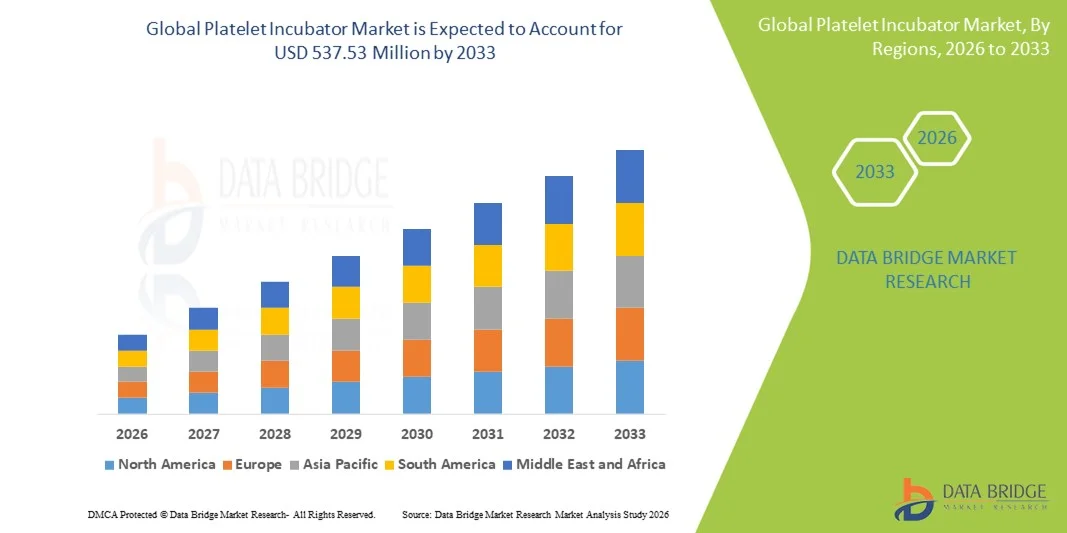
- The global platelet incubator market size was valued at USD 369.70 million in 2025 and is expected to reach USD 537.53 million by 2033, at a CAGR of 4.79% during the forecast period
- The market growth is primarily driven by the increasing demand for safe and efficient blood component storage in hospitals, blood banks, and clinical laboratories, alongside advancements in automated and temperature-controlled incubation technologies
- Moreover, the rising prevalence of blood-related disorders, growing emphasis on transfusion safety, and the need for standardized platelet storage solutions are positioning platelet incubators as essential equipment in modern healthcare settings. These factors collectively are accelerating market adoption, thereby significantly propelling industry growth
Platelet Incubator Market Analysis
- Platelet incubators, providing controlled temperature and environment for the storage and preservation of platelets, are increasingly essential in hospitals, blood banks, and clinical laboratories due to their role in maintaining platelet viability and ensuring transfusion safety
- The growing demand for platelet incubators is primarily driven by the rising prevalence of blood disorders, increasing blood transfusions, and the need for standardized and automated storage solutions to minimize contamination and enhance efficiency
- North America dominated the platelet incubator market with the largest revenue share of 39.8% in 2025, supported by advanced healthcare infrastructure, stringent regulatory standards for blood storage, and the presence of key market players investing in automated and high-capacity incubator solutions
- Asia-Pacific is expected to be the fastest-growing region in the platelet incubator market during the forecast period, owing to increasing healthcare investments, expanding hospital networks, and rising awareness about safe blood transfusion practices
- Bench-top platelet incubator segment dominated the platelet incubator market with a market share of 46.7% in 2025, driven by its compact design, ease of use, and suitability for small- to medium-scale blood banks and hospital setups
Report Scope and Platelet Incubator Market Segmentation
|
Attributes |
Platelet Incubator Key Market Insights |
|
Segments Covered |
|
|
Countries Covered |
North America
Europe
Asia-Pacific
Middle East and Africa
South America
|
|
Key Market Players |
|
|
Market Opportunities |
|
|
Value Added Data Infosets |
In addition to the insights on market scenarios such as market value, growth rate, segmentation, geographical coverage, and major players, the market reports curated by the Data Bridge Market Research also include in-depth expert analysis, patient epidemiology, pipeline analysis, pricing analysis, and regulatory framework |
Platelet Incubator Market Trends
Automation and Real-Time Monitoring Integration
- A significant and accelerating trend in the global platelet incubator market is the increasing integration of automation and real-time monitoring systems, which enhance operational efficiency and ensure consistent platelet quality
- For instance, advanced incubators from Helmer Scientific allow continuous monitoring of temperature and agitation parameters, alerting staff to deviations in real time to prevent platelet degradation
- Automation in platelet incubators enables features such as programmed agitation cycles and automated temperature adjustments to maintain optimal storage conditions, reducing manual errors and improving reliability
- The seamless integration of incubators with laboratory information management systems (LIMS) facilitates centralized control and tracking of platelet inventory, allowing hospitals and blood banks to optimize storage and utilization
- This trend toward more automated, monitored, and connected platelet storage solutions is shaping user expectations, with companies such as Thermo Fisher Scientific developing incubators equipped with IoT-enabled sensors and automated alerts
- The demand for platelet incubators offering automation and real-time monitoring is growing rapidly across blood banks and hospital laboratories, as institutions increasingly prioritize transfusion safety and operational efficiency
- Miniaturization and bench-top designs are emerging trends, enabling space-saving setups and ease of use in small- to medium-sized blood banks without compromising performance
- Integration of predictive analytics and AI in some incubators allows for early detection of platelet quality deviations, helping optimize inventory management and reduce wastage
Platelet Incubator Market Dynamics
Driver
Increasing Demand Due to Rising Blood Transfusions and Safety Requirements
- The growing prevalence of blood disorders and increasing number of transfusions are significant drivers of the heightened demand for platelet incubators
- For instance, in March 2025, Haemonetics Corporation introduced an advanced platelet incubator with automated monitoring aimed at improving transfusion safety in hospitals and blood banks
- As healthcare institutions focus on maintaining platelet viability and preventing contamination, incubators provide controlled storage conditions essential for safe transfusions
- Furthermore, expanding blood bank networks and the adoption of standardized storage protocols are making platelet incubators indispensable equipment for hospitals, laboratories, and research centers
- The ability to track platelet quality, automate agitation cycles, and ensure regulatory compliance is propelling adoption across healthcare facilities, while technological advancements make incubators more reliable and user-friendly
- Growing awareness and regulatory emphasis on reducing platelet wastage is driving hospitals to invest in advanced incubators to maintain optimal storage conditions
- Increasing investments in research and development of next-generation incubators with higher capacity and enhanced monitoring features are further fueling market growth
Restraint/Challenge
High Equipment Cost and Regulatory Compliance Hurdles
- The relatively high cost of advanced platelet incubators poses a significant challenge to wider adoption, especially for smaller hospitals and blood banks in developing regions
- For instance, institutions with limited budgets may opt for manual storage methods or basic incubators, delaying investment in high-end automated systems
- Compliance with stringent regulatory standards for blood storage and handling adds complexity, as incubators must meet national and international guidelines to ensure patient safety
- Moreover, ongoing maintenance, calibration, and staff training requirements can increase operational costs, which may discourage adoption in price-sensitive settings
- Overcoming these challenges through the development of cost-effective incubators, simplified compliance processes, and targeted training programs will be crucial for sustained market growth
- Limited awareness and technical expertise in some regions can slow adoption, as staff may be hesitant to operate advanced incubators without adequate training
- Potential malfunctions or technical failures in automated systems may lead to platelet loss, creating apprehension among hospitals and blood banks regarding reliability
Platelet Incubator Market Scope
The market is segmented on the basis of type and end-user.
- By Type
On the basis of type, the platelet incubator market is segmented into bench-top platelet incubators and floor-standing platelet incubators. The bench-top platelet incubator segment dominated the market with the largest revenue share of 46.7% in 2025, driven by its compact design, ease of installation, and suitability for small- to medium-scale blood banks and hospital laboratories. Bench-top models are preferred for their space-saving benefits, low energy consumption, and user-friendly operation, making them ideal for routine platelet storage and short-term incubation. Hospitals and diagnostic centers often choose bench-top incubators due to their flexibility, portability, and ability to fit into limited laboratory spaces without requiring major infrastructure changes. The segment’s dominance is also supported by growing automation and integration with monitoring systems in compact units, which maintain platelet viability efficiently.
The floor-standing platelet incubator segment is anticipated to witness the fastest growth rate of 20.5% from 2026 to 2033, fueled by increasing demand in large-scale hospitals, blood banks, and research facilities. Floor-standing models offer higher storage capacity, advanced automation, and better temperature uniformity, making them suitable for high-volume platelet storage. These incubators are increasingly adopted in regions with expanding hospital networks and large blood transfusion requirements. Their scalability, ability to integrate with laboratory information management systems (LIMS), and enhanced monitoring capabilities are key factors driving rapid growth. Furthermore, growing awareness about platelet wastage reduction and stringent regulatory compliance encourages institutions to invest in floor-standing units to ensure consistent quality and safety of platelets.
- By End-User
On the basis of end-user, the platelet incubator market is segmented into blood banks, hospitals and diagnostic centers, academic and research institutes, and other end-users. The hospitals and diagnostic centers segment dominated the market in 2025 due to the high frequency of platelet transfusions and the critical need to maintain platelet quality for patient safety. Hospitals increasingly adopt platelet incubators equipped with automated agitation and temperature control to reduce manual errors, comply with regulatory standards, and enhance operational efficiency. The segment benefits from growing investments in healthcare infrastructure, rising awareness about transfusion safety, and increasing hospital capacity in both developed and developing regions. Hospitals also prefer incubators that can integrate with existing laboratory systems, providing centralized monitoring of platelet storage.
The blood banks segment is expected to witness the fastest growth rate of 22.3% from 2026 to 2033, driven by the expansion of blood donation programs, increasing transfusion requirements, and the need for safe and standardized storage solutions. Blood banks are increasingly investing in high-capacity, automated incubators that minimize platelet degradation and optimize storage efficiency. The adoption of advanced incubators allows blood banks to monitor platelet quality remotely, reduce wastage, and comply with stringent regulatory requirements. Rising awareness about platelet shelf-life management, combined with growing funding and technological advancements in blood bank infrastructure, is accelerating the adoption of platelet incubators in this segment.
Platelet Incubator Market Regional Analysis
- North America dominated the platelet incubator market with the largest revenue share of 39.8% in 2025, supported by advanced healthcare infrastructure, stringent regulatory standards for blood storage, and the presence of key market players investing in automated and high-capacity incubator solutions
- Healthcare institutions in the region prioritize maintaining platelet quality and reducing wastage, leading to high adoption of automated and temperature-controlled platelet incubators
- This widespread adoption is further supported by stringent regulatory standards, growing investments in hospital and laboratory infrastructure, and the presence of leading market players, establishing platelet incubators as essential equipment for blood storage and transfusion safety
U.S. Platelet Incubator Market Insight
The e U.S. platelet incubator market captured the largest revenue share of 82% in 2025 within North America, driven by the presence of advanced healthcare infrastructure and well-established blood banks. Hospitals and diagnostic centers prioritize maintaining platelet quality and reducing wastage, fueling adoption of automated and temperature-controlled incubators. The growing demand for safe transfusions, coupled with stringent regulatory requirements, further propels market growth. In addition, increasing investments in hospital laboratories and adoption of connected monitoring systems contribute to the expansion of platelet incubator usage. The emphasis on research and development of next-generation incubators also supports market penetration.
Europe Platelet Incubator Market Insight
The Europe platelet incubator market is projected to expand at a substantial CAGR throughout the forecast period, primarily driven by stringent blood storage regulations and rising demand for safe transfusions. Growing urbanization and modernization of healthcare facilities are fostering the adoption of automated incubators. European hospitals and blood banks increasingly invest in incubators to maintain platelet quality and comply with regulatory standards. The demand spans both large hospitals and smaller diagnostic centers, with integration into laboratory management systems gaining prominence. Awareness about platelet wastage reduction and transfusion safety is further supporting market growth.
U.K. Platelet Incubator Market Insight
The U.K. platelet incubator market is anticipated to grow at a noteworthy CAGR during the forecast period, fueled by the expanding healthcare infrastructure and growing focus on transfusion safety. Rising awareness of blood-related disorders and the need for controlled platelet storage are encouraging hospitals and blood banks to adopt automated incubators. The trend of modernizing diagnostic centers with advanced equipment is also stimulating market growth. In addition, strong government support for blood donation programs and research initiatives is expected to accelerate market adoption. Integration with real-time monitoring systems further enhances operational efficiency, driving the segment.
Germany Platelet Incubator Market Insight
The Germany platelet incubator market is expected to expand at a considerable CAGR during the forecast period, driven by the country’s emphasis on healthcare quality, technological innovation, and regulatory compliance. Hospitals, blood banks, and research institutes are increasingly adopting automated incubators to ensure platelet safety and longevity. The focus on eco-friendly, energy-efficient laboratory equipment also supports market expansion. Integration with laboratory information management systems for improved monitoring and inventory control is gaining traction. Rising investments in healthcare research and transfusion services further bolster the market. Germany’s well-developed infrastructure and strong emphasis on medical standards promote high adoption rates.
Asia-Pacific Platelet Incubator Market Insight
The Asia-Pacific platelet incubator market is poised to grow at the fastest CAGR of 23% during the forecast period of 2026 to 2033, driven by expanding healthcare infrastructure, rising hospital networks, and growing blood transfusion requirements. Countries such as China, India, and Japan are witnessing increased adoption due to modernization of hospitals and government initiatives promoting safe blood storage. The region’s focus on affordable, scalable solutions is making incubators more accessible to a wider healthcare base. Growing awareness about transfusion safety and investments in automated platelet storage systems are accelerating market growth. Technological advancements and domestic manufacturing of laboratory equipment further contribute to affordability and adoption.
Japan Platelet Incubator Market Insight
The Japan platelet incubator market is gaining momentum due to the country’s technologically advanced healthcare system and increasing demand for safe transfusions. Hospitals and blood banks are adopting automated and IoT-enabled incubators for better monitoring and maintenance of platelet quality. The focus on efficiency, reduced wastage, and compliance with regulatory standards drives market growth. Integration with laboratory management systems allows centralized monitoring and improved inventory management. Aging population and increased demand for healthcare services further stimulate the adoption of user-friendly incubators. In addition, ongoing research in platelet storage optimization encourages investment in advanced incubator systems.
India Platelet Incubator Market Insight
The India platelet incubator market accounted for the largest market revenue share in Asia-Pacific in 2025, attributed to expanding hospital networks, rising blood donation programs, and increasing awareness about transfusion safety. The growing middle class and modernization of healthcare facilities are driving adoption across hospitals, blood banks, and diagnostic centers. Government initiatives promoting safe blood storage and transfusion practices are further propelling market growth. Availability of cost-effective incubators, combined with domestic manufacturing and technological advancements, supports wider adoption. Hospitals increasingly prefer automated and bench-top incubators for space-saving, efficiency, and consistent platelet quality maintenance.
Platelet Incubator Market Share
The Platelet Incubator industry is primarily led by well-established companies, including:
- Helmer Scientific Inc. (U.S.)
- Haier Biomedical (China)
- Labtron Equipment Ltd. (India)
- Scitek Global Co., Ltd. (China)
- Labnics Ltd. (India)
- Labcold Ltd. (U.K.)
- Boekel Scientific Inc. (U.S.)
- Sarstedt AG & Co. KG (Germany)
- Terumo Corporation (Japan)
- BIOBASE Group (China)
- Biolab Scientific (U.S.)
- Meditech Technologies India Pvt. Ltd. (India)
- Lmb Technologies GmbH (Germany)
- Azer Scientific (U.S.)
- Infitek Co., Ltd. (Taiwan)
- KW Apparecchi Scientifici S.r.l. (Italy)
- QED Scientific Ltd. (U.K.)
- Equipos Médicos S.A. (Argentina)
- Labcold Inc. (U.S.)
- Krew Instruments Pvt. Ltd. (India)
What are the Recent Developments in Global Platelet Incubator Market?
- In May 2025, Haier Biomedical showcased its platelet incubator with agitators at the Morocco Medical Expo 2025, underlining its global technological leadership and product recognition in multiple international markets. The expo presentation highlighted energy‑efficient incubator designs alongside other medical storage solutions, attracting attention from healthcare stakeholders and supporting global market visibility
- In April 2025, Haier Biomedical’s Platelet Incubator with Agitator was installed at Ittefaq Hospital in Lahore, Pakistan, receiving positive feedback for its precise temperature control, ease of use, and comprehensive safety monitoring features. The installation demonstrated how advanced incubation and agitation technologies are meeting real‑world needs in emerging healthcare markets, strengthening equipment uptake beyond traditional regions
- In March 2025, Haier Biomedical’s Incubator Agitator for Platelet was successfully installed and put into operation at Union Hospital in Hong Kong, demonstrating strong market acceptance and the value of enhanced safety and data traceability functions. This deployment showcased the incubator’s advanced alarm, temperature control, and energy‑efficient features, reinforcing its reliability in high‑end medical environments and supporting broader regional adoption
- In August 2023, Helmer Scientific launched its Pro Line floor model platelet storage systems featuring OptiCool™ RT cooling technology and advanced monitoring, designed to improve temperature uniformity, energy efficiency, and regulatory compliance for blood banks. The new Pro Line systems support optimized platelet storage between 20–24 °C with ±1 °C uniformity and reduced energy consumption, marking a significant product expansion in floor‑standing incubation solutions
- In June 2023, Haier Biomedical’s platelet incubator with integrated agitator was installed at the blood bank of San Juan de Dios Hospital in Santiago, Chile, after winning a competitive bid, highlighting international adoption of advanced platelet storage technology in clinical settings. This installation helped address critical platelet preservation challenges by maintaining controlled temperatures and agitation, contributing to enhanced blood product reliability and safety in a hospital facing high demands for quality storage
- https://www.haiermedical.com/news/Haier-Biomedical-Platelet-Incubator-with-Agitator-Wins-Bid-for-Chilean-Blood-Bank-Project.html
- https://blog.helmerinc.com/helmer-scientific-launches-pro-line-floor-model-platelet-storage-systems
- https://www.haiermedical.com/News/HBs-Incubator-Agitator-for-Platelet-Installed-at-Union-Hospital
- https://www.haiermedical.com/News/HB-Platelet-Incubator-with-Agitator-Installed-in-Pakistan
- https://www.haiermedical.com/News/Haier-Biomedical-Shines-at-Morocco-Medical-Expo

- Interactive Data Analysis Dashboard
- Company Analysis Dashboard for high growth potential opportunities
- Research Analyst Access for customization & queries
- Competitor Analysis with Interactive dashboard
- Latest News, Updates & Trend analysis
- Harness the Power of Benchmark Analysis for Comprehensive Competitor Tracking
Data collection and base year analysis are done using data collection modules with large sample sizes. The stage includes obtaining market information or related data through various sources and strategies. It includes examining and planning all the data acquired from the past in advance. It likewise envelops the examination of information inconsistencies seen across different information sources. The market data is analysed and estimated using market statistical and coherent models. Also, market share analysis and key trend analysis are the major success factors in the market report. To know more, please request an analyst call or drop down your inquiry.
The key research methodology used by DBMR research team is data triangulation which involves data mining, analysis of the impact of data variables on the market and primary (industry expert) validation. Data models include Vendor Positioning Grid, Market Time Line Analysis, Market Overview and Guide, Company Positioning Grid, Patent Analysis, Pricing Analysis, Company Market Share Analysis, Standards of Measurement, Global versus Regional and Vendor Share Analysis. To know more about the research methodology, drop in an inquiry to speak to our industry experts.
Data Bridge Market Research is a leader in advanced formative research. We take pride in servicing our existing and new customers with data and analysis that match and suits their goal. The report can be customized to include price trend analysis of target brands understanding the market for additional countries (ask for the list of countries), clinical trial results data, literature review, refurbished market and product base analysis. Market analysis of target competitors can be analyzed from technology-based analysis to market portfolio strategies. We can add as many competitors that you require data about in the format and data style you are looking for. Our team of analysts can also provide you data in crude raw excel files pivot tables (Fact book) or can assist you in creating presentations from the data sets available in the report.













