


Polybutylene Succinate (PBS) Market Overview
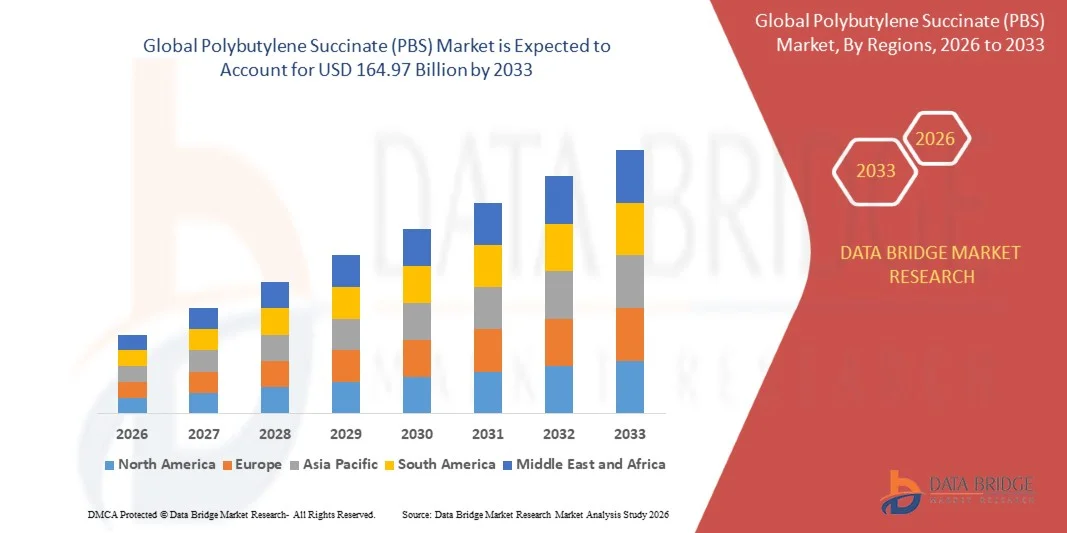
As per Data Bridge Market Research analysis, the polybutylene succinate (PBS) market was valued at USD 94.24 billion in 2025 and is projected to reach USD 164.97 billion by 2033, growing at a CAGR of 7.25% from 2026 to 2033. The market is experiencing consistent growth driven by increasing demand for biodegradable and compostable polymers, growing regulatory support for sustainable plastic alternatives, and expanding adoption across packaging, agriculture, consumer goods, and biomedical applications.
The rising global focus on reducing plastic waste, coupled with stringent environmental regulations promoting bio-based materials, is encouraging manufacturers to replace conventional petroleum-based plastics with sustainable alternatives such as polybutylene succinate. Bio-based PBS is increasingly being adopted in flexible packaging, compostable bags, agricultural mulch films, and disposable products due to its excellent biodegradability, thermal stability, and mechanical performance, while ongoing advancements in bio-based feedstocks and polymer production technologies continue to strengthen market expansion.
Market Size & Forecast
- Global Market Value (2025): USD 94.24 Billion
- Expected Market Value (2033): USD 164.97 Billion
- Forecast CAGR (2026–2033): 7.25%
- Leading Region in 2025: Asia Pacific
- Fastest Growing Region: Europe
Key Market Trends & Insights
- Asia-Pacific dominated the polybutylene succinate (PBS) market with the largest revenue share of 37.0% in 2025, supported by robust manufacturing activity, expanding biodegradable plastics production capacity, and strong demand from packaging, agriculture, and consumer goods industries
- The conventional polybutylene succinate (PBS) segment led the market with a 68.4% share in 2025, driven by its established commercial production, broader availability, and lower manufacturing cost compared with bio-based alternatives
- Europe is expected to be the fastest-growing region at a CAGR of 20.7% during the forecast period, fueled by stringent environmental regulations, circular economy initiatives, and growing investments in bio-based and biodegradable polymer technologies
- Bio-based polybutylene succinate (PBS) are the fastest-growing product type, projected to register a CAGR of 9.8%, reflecting the surge in demand for renewable materials and increasing sustainability commitments from packaging and consumer goods manufacturers
- The direct esterification segment dominated the process category with a 61.7% revenue share in 2025, led by its cost-effective production process, high operational efficiency, and widespread industrial adoption
- Single-use accounted for 72.5% of the market, preferred by extensive application in compostable bags, disposable food packaging, hygiene products, and food-service items
- The secondary packaging segment is the fastest-growing packaging layer category, with a CAGR of 9.1%, driven by increasing demand for environmentally friendly logistics and transportation packaging solutions
Report Scope and Polybutylene Succinate (PBS) Market Segmentation
|
Attributes |
Polybutylene Succinate (PBS) Key Market Insights |
|
Segments Covered |
|
|
Countries Covered |
North America
Europe
Asia-Pacific
Middle East and Africa
South America
|
|
Key Market Players |
|
|
Market Opportunities |
|
|
Value Added Data Infosets |
In addition to the insights on market scenarios such as market value, growth rate, segmentation, geographical coverage, and major players, the market reports curated by the Data Bridge Market Research also include import export analysis, production capacity overview, production consumption analysis, price trend analysis, climate change scenario, supply chain analysis, value chain analysis, raw material/consumables overview, vendor selection criteria, PESTLE Analysis, Porter Analysis, and regulatory framework. |
Polybutylene Succinate (PBS) Market Trends
Trend: Growing Adoption of Biodegradable Packaging Materials
The global shift toward sustainable packaging is accelerating the adoption of polybutylene succinate (PBS) as a biodegradable alternative to conventional petroleum-based plastics. PBS offers favorable biodegradability, thermal stability, and processability, making it suitable for compostable bags, food packaging films, disposable tableware, and flexible packaging applications. Increasing regulatory restrictions on single-use plastics and growing consumer preference for environmentally responsible products are encouraging packaging manufacturers to incorporate PBS into their product portfolios. In addition, advancements in bio-based PBS production are improving material performance while reducing dependence on fossil-derived feedstocks. For instance, in February 2024, Mitsubishi Chemical Group developed new biodegradable biopolyester resins with over 60% biomass content for applications including food packaging, plastic grocery bags, and agricultural mulch films, reinforcing the growing adoption of sustainable biodegradable materials.
The continued transition toward compostable and bio-based packaging solutions is strengthening the role of PBS as a key material in the global sustainable packaging industry.
Polybutylene Succinate (PBS) Market Dynamics
Key Market Driver: Rising Regulatory Support for Biodegradable and Compostable Plastics
Stringent regulations aimed at reducing plastic waste and promoting circular economy practices are a major driver for the polybutylene succinate market. Governments across Europe and Asia are implementing policies that restrict conventional single-use plastics while encouraging the adoption of biodegradable alternatives. PBS is increasingly gaining traction because it can be industrially composted and offers performance characteristics comparable to traditional plastics in several applications. The material is also benefiting from increasing corporate sustainability commitments among packaging, consumer goods, and agricultural product manufacturers. For instance, in June 2024, BASF introduced biomass-balanced ecoflex F Blend C1200 BMB, replacing fossil feedstocks with renewable waste-based raw materials and reducing the product carbon footprint by 60%, supporting the packaging industry's transition toward renewable and compostable biopolymers.
The commercialization of biomass-balanced biodegradable polymers demonstrates how regulatory pressure and sustainability goals are accelerating the adoption of PBS and other compostable plastics in packaging applications.
Key Restraint/Challenge: Higher Production Costs Compared with Conventional Plastics
A significant challenge facing the polybutylene succinate market is its relatively higher production cost compared with widely used petroleum-based plastics such as polyethylene and polypropylene. PBS manufacturing relies on specialized raw materials and production processes that can increase overall costs, particularly for bio-based grades. Limited economies of scale and fluctuations in feedstock availability further affect pricing competitiveness. These factors can restrict adoption among cost-sensitive industries, especially in developing markets where conventional plastics remain substantially cheaper. For instance, in December 2023 an article published in Science of the Total Environment reported that the commercialization of bioplastics, including biodegradable polymers such as PBS, remains constrained by high production costs and the need for cost-effective large-scale manufacturing technologies.
Although demand for sustainable materials is increasing, cost competitiveness remains a key barrier to widespread PBS adoption and market penetration.
Key Market Opportunity: Expansion in Agricultural Mulch Films and Bio-Based Applications
The increasing adoption of biodegradable agricultural films presents a substantial growth opportunity for the PBS market. Conventional plastic mulch films generate significant agricultural plastic waste and require costly collection and disposal processes. PBS-based biodegradable mulch films can degrade after use, reducing environmental impact and improving farm sustainability. In addition, ongoing investments in bio-based PBS production technologies are creating opportunities for manufacturers to serve packaging, agriculture, consumer goods, and biomedical markets with renewable material solutions. For instance, in April 2025, PTT Global Chemical (GC) advanced its integrated biorefinery by expanding bio-chemicals and bio-polymers derived from used cooking oil, with commercial production of several bio-based products and plans to expand into Bio-PE and other sustainable polymers for packaging applications.
Expanding applications in biodegradable agricultural products and bio-based materials are expected to create significant long-term growth opportunities for PBS manufacturers worldwide.
Polybutylene Succinate (PBS) Market Scope
The polybutylene succinate (PBS) market is segmented on the basis of product, process, application, usage, packaging layer, and end-use.
- By Product
On the basis of product, the global polybutylene succinate (PBS) market is segmented into conventional polybutylene succinate (PBS) and bio-based polybutylene succinate (PBS). The conventional polybutylene succinate (PBS) segment dominated the market with an estimated 68.4% share in 2025, owing to its established commercial production, broader availability, and lower manufacturing cost compared with bio-based alternatives. Conventional PBS is extensively utilized in packaging films, compostable bags, disposable products, and agricultural applications due to its excellent biodegradability and mechanical performance. Manufacturers continue to favor conventional PBS because of mature supply chains and stable feedstock availability. The segment benefits from strong adoption across Asia-Pacific, where most PBS production facilities are located. Increasing substitution of traditional plastics is further supporting demand. Its processing compatibility with existing manufacturing infrastructure continues to strengthen market leadership.
The bio-based polybutylene succinate (PBS) segment is projected to register the fastest growth at a CAGR of 9.8% from 2026 to 2033, driven by rising demand for renewable materials and increasing sustainability commitments from packaging and consumer goods manufacturers. Bio-based PBS offers a lower carbon footprint and aligns with circular economy initiatives. Government incentives promoting bio-based plastics are accelerating commercialization. Technological advancements in biomass feedstocks and fermentation processes are improving economic viability. Growing consumer preference for environmentally responsible products is further supporting growth. Increasing investments in green materials are expected to accelerate adoption globally.
- By Process
On the basis of process, the polybutylene succinate (PBS) market is segmented into trans-esterification and direct esterification. The direct esterification segment dominated the market with a 61.7% share in 2025, owing to its cost-effective production process, high operational efficiency, and widespread industrial adoption. The process requires fewer intermediate stages and enables large-scale commercial manufacturing. Most major PBS producers utilize direct esterification because of its superior production economics. Growing global demand for biodegradable polymers is encouraging further capacity expansion using this process. Its scalability and consistent product quality remain key advantages. Continuous investments in manufacturing optimization are supporting segment growth.
The trans-esterification segment is expected to witness the fastest growth at a CAGR of 9.3% from 2026 to 2033, driven by increasing demand for specialty PBS grades and advanced polymer formulations. The process provides enhanced control over polymer properties and enables the use of diverse feedstocks. Growing R&D activities focused on biomedical and high-performance packaging applications are supporting adoption. Manufacturers are increasingly exploring trans-esterification routes for sustainable production. Rising demand for customized biodegradable polymers is creating additional opportunities. Innovation in polymer chemistry is expected to accelerate growth.
- By Application
On the basis of application, the polybutylene succinate (PBS) market is segmented into bags, mulch film, packaging film, flushable hygiene products, fishing nets, coffee capsules, wood plastic composites, and others. The packaging film segment led the market with a 29.8% share in 2025, driven by increasing demand for biodegradable food packaging, industrial packaging, and flexible film applications. PBS packaging films provide excellent compostability, flexibility, and processing performance. Rising restrictions on conventional plastic films are accelerating adoption worldwide. Food and beverage manufacturers are increasingly utilizing biodegradable packaging solutions to achieve sustainability goals. Consumer demand for environmentally friendly packaging is further supporting growth. Ongoing innovation in film technology continues to expand application opportunities.
The mulch film segment is projected to register the fastest growth at a CAGR of 10.4% from 2026 to 2033, fueled by increasing adoption of sustainable agricultural practices. PBS-based mulch films help eliminate plastic waste accumulation in farmland and reduce disposal costs. Governments are promoting biodegradable agricultural films to improve environmental outcomes. Rising demand for high-yield crop production is encouraging adoption. Expansion of organic farming activities is creating new opportunities. Increasing focus on soil health and agricultural sustainability is expected to support long-term growth.
- By Usage
On the basis of usage, the polybutylene succinate (PBS) market is segmented into single-use and reusable. The single-use segment dominated the market with a 72.5% share in 2025, supported by extensive application in compostable bags, disposable food packaging, hygiene products, and food-service items. Increasing restrictions on petroleum-based single-use plastics are encouraging the adoption of biodegradable alternatives such as PBS. The segment benefits from strong demand across retail, food service, and consumer packaging industries. Manufacturers continue expanding compostable product portfolios to meet sustainability requirements. Regulatory support remains a key growth factor. Growing consumer awareness is further driving adoption.
The reusable segment is anticipated to witness the fastest growth at a CAGR of 8.9% from 2026 to 2033, driven by advances in material performance and increasing emphasis on circular economy principles. Manufacturers are developing durable PBS formulations suitable for long-life consumer and industrial products. Sustainability initiatives aimed at reducing waste generation are supporting demand. Improvements in polymer engineering are enhancing strength and durability characteristics. Growing investment in reusable biodegradable solutions is creating opportunities. Increasing environmental awareness is expected to accelerate growth.
- By Packaging Layer
On the basis of packaging layer, the global polybutylene succinate (PBS) market is segmented into primary packaging, secondary packaging, and tertiary packaging. The primary packaging segment accounted for the largest revenue share of 56.1% in 2025, owing to extensive use in food packaging, personal care packaging, and consumer goods applications. PBS is increasingly preferred because of its biodegradability and suitability for direct-contact packaging. Growing demand for sustainable packaging materials is accelerating adoption. Regulatory pressure on traditional plastic packaging continues to support market expansion. Food and beverage companies are investing heavily in compostable packaging innovations. The segment remains the primary revenue contributor across the value chain.
The secondary packaging segment is expected to grow at the fastest CAGR of 9.1% from 2026 to 2033, supported by increasing demand for environmentally friendly logistics and transportation packaging solutions. Companies are focusing on reducing packaging-related carbon emissions throughout supply chains. PBS-based secondary packaging products offer sustainability benefits while maintaining functional performance. Growth in e-commerce activities is creating additional demand. Corporate sustainability commitments continue to drive adoption. Expansion of green packaging initiatives is expected to support long-term growth.
- By End-Use
On the basis of end-use, the global polybutylene succinate (PBS) market is segmented into packaging, agriculture, textile, consumer goods, electrical and electronics, automotive, and others. The packaging segment dominated the market with a revenue share of more than 35.0% in 2025, driven by increasing utilization of PBS in compostable films, bags, food containers, and disposable packaging products. Rising environmental concerns and stringent regulations on conventional plastics are supporting market expansion. Packaging manufacturers are increasingly adopting PBS to meet sustainability targets and consumer expectations. The segment benefits from strong demand across food, beverage, retail, and personal care industries. Continuous innovation in biodegradable packaging materials is further expanding opportunities. Its broad commercial adoption continues to reinforce market leadership.
The agriculture segment is projected to register the fastest growth at a CAGR of 10.2% from 2026 to 2033, driven by growing adoption of biodegradable mulch films and sustainable farming solutions. PBS-based agricultural products reduce plastic waste accumulation while improving operational efficiency. Government support for environmentally friendly agricultural inputs is encouraging market penetration. Expansion of organic farming activities is creating significant growth opportunities. Farmers are increasingly seeking alternatives to conventional polyethylene films. Rising focus on sustainable agriculture and environmental conservation is expected to accelerate segment growth.
Polybutylene Succinate (PBS) Market Regional Analysis
Asia-Pacific dominated the polybutylene succinate (PBS) market with the largest revenue share of 37.0% in 2025, supported by robust manufacturing activity, expanding biodegradable plastics production capacity, and strong demand from packaging, agriculture, and consumer goods industries. The region benefits from increasing investments in bio-based materials, favorable government initiatives promoting sustainable plastics, and growing adoption of compostable packaging solutions. Rising demand for biodegradable mulch films, food packaging, and consumer goods applications is further accelerating market expansion. Continuous capacity additions and advancements in bio-polymer production technologies are strengthening the region’s competitive position. Increasing environmental awareness and regulatory efforts to reduce plastic waste continue to reinforce Asia-Pacific’s leadership in the global PBS market.
U.S. Polybutylene Succinate (PBS) Market Insight
The U.S. polybutylene succinate (PBS) market is witnessing steady growth due to increasing demand for biodegradable packaging materials, growing corporate sustainability commitments, and rising regulatory pressure to reduce plastic waste. The country's well-established packaging, consumer goods, and agricultural sectors are increasingly exploring compostable polymer solutions to meet environmental targets. Growing investments in bioplastics research and commercialization are supporting market expansion. In addition, increasing adoption of sustainable packaging by food and beverage manufacturers is accelerating demand for PBS-based materials. In July 2024, the U.S. Department of Defense announced the first awards under its Distributed Bioindustrial Manufacturing Program (DBIMP) to expand domestic bioindustrial manufacturing and strengthen U.S. production of bio-based materials and chemicals. Selected projects may receive follow-on funding of up to USD 100 million to construct U.S.-based bioindustrial manufacturing facilities
Europe Polybutylene Succinate (PBS) Market Insight
The Europe polybutylene succinate (PBS) market is experiencing steady growth, driven by stringent environmental regulations, strong circular economy initiatives, and increasing adoption of biodegradable materials across packaging and agricultural applications. The region's emphasis on reducing single-use plastics and achieving sustainability targets continues to support PBS demand. Growing investments in compostable polymers and bio-based materials are further accelerating market growth. Europe is also expected to be the fastest-growing regional market for PBS during the forecast period. According to European Bioplastics, global bioplastics production capacity is projected to increase from approximately 2.47 million tonnes in 2024 to 5.73 million tonnes by 2029, supported largely by European sustainability policies and investments in biodegradable materials.
U.K. Polybutylene Succinate (PBS) Market Insight
The U.K. polybutylene succinate (PBS) market is experiencing steady growth, supported by increasing adoption of sustainable packaging solutions, government initiatives to reduce plastic waste, and growing consumer preference for environmentally responsible products. Food retailers, packaging manufacturers, and consumer goods companies are increasingly incorporating biodegradable materials into their sustainability strategies. Furthermore, growing investment in circular economy infrastructure and compostable packaging technologies is supporting market development. The U.K. Plastic Packaging Tax, implemented by HM Revenue & Customs, continues to encourage manufacturers to shift toward sustainable and recyclable packaging materials, supporting demand for biodegradable polymers
Germany Polybutylene Succinate (PBS) Market Insight
The Germany polybutylene succinate (PBS) market is expanding steadily due to the country's advanced manufacturing sector, strong sustainability commitments, and increasing demand for biodegradable plastics. Packaging manufacturers and industrial producers are increasingly utilizing sustainable materials to comply with environmental regulations and corporate ESG objectives. Continuous innovation in bio-based polymers and growing investments in circular economy solutions are further supporting market growth. Germany also serves as a major hub for bioplastics research and development within Europe. In June 2024, BASF introduced biomass-balanced ecoflex F Blend C1200 BMB, reducing product carbon footprint by approximately 60% through the use of renewable raw materials, reinforcing Germany's leadership in sustainable polymer innovation.
Japan Polybutylene Succinate (PBS) Market Insight
The Japan polybutylene succinate (PBS) market is witnessing consistent growth due to increasing investment in sustainable materials, strong technological capabilities, and rising demand for biodegradable packaging solutions. Japanese manufacturers continue to play a leading role in PBS production and innovation. Growing adoption of bio-based polymers across packaging, consumer goods, and agricultural sectors is supporting market expansion. In addition, government efforts to promote resource efficiency and reduce plastic waste are strengthening long-term demand. Mitsubishi Chemical Group continues to develop biodegradable biopolyester materials for food packaging, shopping bags, and agricultural applications, supporting Japan's transition toward sustainable plastics.
China Polybutylene Succinate (PBS) Market Insight
The China polybutylene succinate (PBS) market is growing rapidly, driven by expanding biodegradable plastics production capacity, increasing environmental regulations, and rising demand for sustainable packaging materials. The country's restrictions on non-degradable plastic products and strong support for biodegradable alternatives are significantly boosting PBS adoption. Increasing investments in bioplastics manufacturing and packaging innovation are further strengthening market growth. China remains one of the largest producers and consumers of biodegradable polymers globally. In May 2024, the National Development and Reform Commission Action Plan for Energy Conservation and Carbon Reduction, which promotes green and low-carbon industrial transformation, encourages the development of green materials, and accelerates energy-saving and carbon reduction across key manufacturing industries. The policy supports long-term demand for biodegradable materials such as PBS as China advances its circular economy and carbon neutrality goals.
Polybutylene Succinate (PBS) Market Share
The polybutylene succinate (PBS) industry is primarily led by well-established companies, including:
- Mitsubishi Chemical Group Corporation (Japan)
- PTT Global Chemical Public Company Limited (Thailand)
- BASF (Germany)
- SK chemicals (South Korea)
- Kingfa Sci. & Tech. Co., Ltd. (China)
- Anqing Hexing Chemical Co., Ltd. (China)
- Shandong Landian Biological Technology Co., Ltd. (China)
- Roquette Frères (France)
- Braskem (Brazil)
- Novamont S.p.A. (Italy)
- NatureWorks LLC (U.S.)
- KANEKA CORPORATION (Japan)
- Toray Industries, Inc. (Japan)
- TotalEnergies Corbion (Netherlands)
- Danimer Scientific, Inc. (U.S.)
- Sulzer Ltd (Switzerland)
- Evonik (Germany)
- Biome Bioplastics Limited (U.K.
Latest Developments in Polybutylene Succinate (PBS) Market
- In April 2025, PTT MCC Biochem Co., Ltd. announced the development of new BioPBS grades for home-compostable fiber and nonwoven applications. The company stated that the new BioPBS™ materials are designed to support packaging and hygiene applications while complying with emerging European packaging regulations and increasing demand for home-compostable products. This development expands the application scope of bio-based PBS in sustainable packaging and fiber industries
- In December 2024, researchers from the Chinese Academy of Sciences developed recyclable PBS vitrimers with significantly improved heat resistance and mechanical performance while maintaining the biodegradable characteristics of polybutylene succinate. The research expands PBS potential for durable and high-performance sustainable plastic applications
- In June 2024, BASF introduced biomass-balanced ecoflex F Blend C1200 BMB, reducing the product carbon footprint by approximately 60% through renewable waste-based feedstocks. Although ecoflex is PBAT, the launch strengthens the biodegradable polymer value chain because PBAT is widely blended with PBS for compostable packaging and flexible film applications
- In March 2024, PTT MCC Biochem Co., Ltd. and Nordic Bioproducts Group signed a strategic partnership to develop advanced bioplastic solutions by combining BioPBS with AaltoCell cellulosic fibers. The collaboration aims to improve the performance and compostability of biodegradable plastics for packaging and other sustainable applications, supporting broader commercialization of PBS-based materials
- In May 2021, PTT MCC Biochem Co., Ltd. and International Fibres Group announced a strategic marketing partnership to commercialize BioPBS-based staple fibers and nonwoven materials for food packaging, filtration, geotextiles, construction, and automotive applications. The partnership expanded the industrial use of bio-based PBS across multiple sustainable material markets

- Interactive Data Analysis Dashboard
- Company Analysis Dashboard for high growth potential opportunities
- Research Analyst Access for customization & queries
- Competitor Analysis with Interactive dashboard
- Latest News, Updates & Trend analysis
- Harness the Power of Benchmark Analysis for Comprehensive Competitor Tracking
Global Polybutylene Succinate Pbs Market, Supply Chain Analysis and Ecosystem Framework
To support market growth and help clients navigate the impact of geopolitical shifts, DBMR has integrated in-depth supply chain analysis into its Global Polybutylene Succinate Pbs Market research reports. This addition empowers clients to respond effectively to global changes affecting their industries. The supply chain analysis section includes detailed insights such as Global Polybutylene Succinate Pbs Market consumption and production by country, price trend analysis, the impact of tariffs and geopolitical developments, and import and export trends by country and HSN code. It also highlights major suppliers with data on production capacity and company profiles, as well as key importers and exporters. In addition to research, DBMR offers specialized supply chain consulting services backed by over a decade of experience, providing solutions like supplier discovery, supplier risk assessment, price trend analysis, impact evaluation of inflation and trade route changes, and comprehensive market trend analysis.
Data collection and base year analysis are done using data collection modules with large sample sizes. The stage includes obtaining market information or related data through various sources and strategies. It includes examining and planning all the data acquired from the past in advance. It likewise envelops the examination of information inconsistencies seen across different information sources. The market data is analysed and estimated using market statistical and coherent models. Also, market share analysis and key trend analysis are the major success factors in the market report. To know more, please request an analyst call or drop down your inquiry.
The key research methodology used by DBMR research team is data triangulation which involves data mining, analysis of the impact of data variables on the market and primary (industry expert) validation. Data models include Vendor Positioning Grid, Market Time Line Analysis, Market Overview and Guide, Company Positioning Grid, Patent Analysis, Pricing Analysis, Company Market Share Analysis, Standards of Measurement, Global versus Regional and Vendor Share Analysis. To know more about the research methodology, drop in an inquiry to speak to our industry experts.
Data Bridge Market Research is a leader in advanced formative research. We take pride in servicing our existing and new customers with data and analysis that match and suits their goal. The report can be customized to include price trend analysis of target brands understanding the market for additional countries (ask for the list of countries), clinical trial results data, literature review, refurbished market and product base analysis. Market analysis of target competitors can be analyzed from technology-based analysis to market portfolio strategies. We can add as many competitors that you require data about in the format and data style you are looking for. Our team of analysts can also provide you data in crude raw excel files pivot tables (Fact book) or can assist you in creating presentations from the data sets available in the report.













