


What is the Porous Ceramic Market Size and Growth Rate?
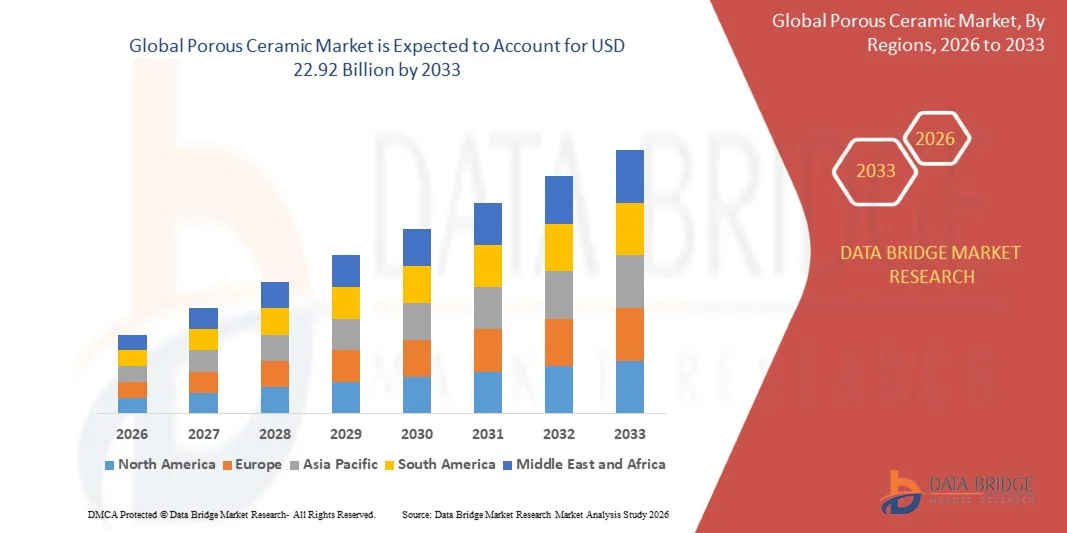
- As per Data Bridge Market Research analysis, the porous ceramic market was valued at USD 10.02 billion in 2025 and is projected to reach USD 22.92 billion by 2033, growing at a CAGR of 10.90% from 2026 to 2033.
- The market is experiencing consistent growth driven by rising demand for advanced filtration products, increasing adoption of porous ceramics in medical devices and equipment, and expanding applications across automotive, electronics and semiconductors, industrial, and energy sectors.
- The increasing need for efficient filtration and separation technologies, combined with growing demand for lightweight, thermally stable, and chemically resistant materials, is compelling manufacturers across automotive, healthcare, industrial, and semiconductor industries to adopt porous ceramic solutions. Porous ceramic filters, insulation materials, and high-purity components are gaining application due to their ability to withstand demanding temperature, pressure, and chemical environments.
Market Size & Forecast
- Global Market Value (2025): USD 10.02 Billion
- Expected Market Value (2033): USD 22.92 Billion
- Forecast CAGR (2026–2033): 10.90%
- Leading Region in 2025: North America
- Fastest Growing Region: Asia Pacific
What are the Major Takeaways of the Porous Ceramic Market?
- North America dominated the porous ceramic market with the largest revenue share of 34.2% in 2025, supported by advanced manufacturing infrastructure, stringent environmental regulations, strong automotive production, and increasing adoption of ceramic filtration technologies.
- Asia-Pacific is expected to be the fastest-growing region at a CAGR of 12.0% from 2026 to 2033, fueled by rapid industrialization, increasing demand for filtration systems, tightening environmental regulations, and growing investments in wastewater treatment infrastructure across China, Japan, and India.
- The alumina ceramics segment led the market with a 44.3% share in 2025, driven by its superior electrical insulation properties, wear resistance, corrosion resistance, and thermal performance.
- Titanate ceramics are the fastest-growing raw material type, projected to register a CAGR of 13.4%, reflecting the surge in deployment in porous piezoceramic and dielectric applications
- The filtration segment dominated the product category with a 32.8% revenue share in 2025, led by the ability of porous ceramic filters to remove particles from air and liquids under demanding operating conditions.
- Automotive accounted for 30% of the market share in 2025, preferred by the extensive use of porous ceramics in filtration, thermal management, emission-related components, and other high-performance automotive applications.
- The high purity materials segment is the fastest-growing application category, with a CAGR of 13.4%, driven by increasing demand for advanced ceramic components with superior material purity and performance characteristics
Report Scope and Porous Ceramic Market Segmentation
|
Attributes |
Porous Ceramic Key Market Insights |
|
Segments Covered |
|
|
Countries Covered |
North America
Europe
Asia-Pacific
Middle East and Africa
South America
|
|
Key Market Players |
|
|
Market Opportunities |
|
|
Value Added Data Infosets |
In addition to the insights on market scenarios such as market value, growth rate, segmentation, geographical coverage, and major players, the market reports curated by the Data Bridge Market Research also include import export analysis, production capacity overview, production consumption analysis, price trend analysis, climate change scenario, supply chain analysis, value chain analysis, raw material/consumables overview, vendor selection criteria, PESTLE Analysis, Porter Analysis, and regulatory framework. |
What is the Key Trend in the Porous Ceramic Market?
- Porous ceramics are increasingly shifting toward hierarchical and precisely engineered pore structures, enabling manufacturers to tailor permeability, surface area, mechanical strength, and biological performance for specialized filtration, biomedical, and industrial applications.
- For instance, in August 2024, according to ScienceDirect, researchers developed 3D-printed aluminum borate porous ceramics with hierarchical pore structures for catalyst-support applications, with TiO₂-coated structures achieving an 83.92% photocatalytic degradation rate for methyl orange.
- Advanced manufacturing technologies, particularly 3D printing, direct ink writing, and emulsion templating, are enabling complex porous geometries that are difficult to achieve through conventional processing.
- The integration of multiple pore sizes is gaining attention because interconnected macro- and micropores can improve fluid transport, cell infiltration, and functional performance in advanced applications.
- For instance, in March 2024, according to ScienceDirect, researchers developed hierarchical porous silicon carbide ceramics using direct ink writing and sacrificial templates for hydrogen-production catalyst supports; the best structure achieved 90.95% methanol conversion at 280°C.
- In biomedical applications, porous ceramic scaffolds are increasingly being engineered to replicate the hierarchical structure of natural bone, supporting tissue growth and regeneration.
What are the Key Drivers of the Porous Ceramic Market?
- The growing demand for high-performance filtration and separation technologies is increasing the adoption of porous ceramics because of their thermal stability, chemical resistance, mechanical strength, and ability to operate under demanding industrial conditions.
- For instance, in May 2025, according to ScienceDirect, researchers demonstrated a ceramic ultrafiltration system operating at a drinking-water treatment plant in eastern China with a capacity of 5,040 m³ per day, producing stable water quality and supporting downstream nanofiltration.
- Water and wastewater treatment is becoming an important application as industries and municipalities seek durable membrane technologies capable of removing microorganisms, suspended particles, oil, and other contaminants.
- The expanding use of porous ceramics in biomedical scaffolds is also supporting market growth, as controlled porosity can facilitate tissue integration, cell proliferation, and bone regeneration.
- For instance, in October 2025, according to ScienceDirect, researchers evaluated ceramic membrane filtration for lake water and treated wastewater in Al-Ain, UAE, achieving up to 50% total organic carbon reduction and complete suspended-solids removal.
- Increasing adoption of advanced manufacturing is further expanding application possibilities by enabling manufacturers to produce complex pore geometries and customized ceramic structures.
Which Factors are Challenging the Growth of the Porous Ceramic Market?
- The production of porous ceramics can involve energy-intensive high-temperature sintering, increasing manufacturing costs and making cost competitiveness challenging against conventional polymeric and metallic alternatives.
- For instance, in April 2025, according to ETH Zurich Research Collection, researchers highlighted that porous ceramics can suffer from poor mechanical properties and require energy-intensive, high-temperature sintering, prompting the development of a lower-temperature biocementation approach.
- Maintaining precise control over pore size, pore distribution, permeability, and mechanical strength simultaneously remains technically difficult, particularly for highly porous structures.
- High porosity can reduce mechanical strength, creating a performance trade-off that restricts the use of certain porous ceramic structures in mechanically demanding applications.
- For instance, in November 2025, according to the Journal of the American Ceramic Society, researchers reported that traditional high-temperature sintering of porous α-alumina ceramics is associated with performance degradation and high energy consumption, motivating the investigation of cold-sintering processes.
- Advanced fabrication techniques such as additive manufacturing can also require specialized equipment, process optimization, and stringent quality control, increasing production complexity.
How is the Porous Ceramic Market Segmented?
The porous ceramic market is segmented on the basis of raw material, product, application, and end user.
- By Raw Material
On the basis of raw material, the porous ceramic market is segmented into alumina ceramics, titanate ceramics, zirconate ceramics, ferrite ceramics, aluminum nitride, and others. The alumina ceramics segment dominated the market with a 44.3% share in 2025, owing to its superior electrical insulation properties, wear resistance, corrosion resistance, and thermal performance. Alumina is widely used across semiconductor, electrical, medical, automotive, and electronics applications. Its low bulk density and low thermal conductivity make it suitable for specialized porous ceramic components. The material is also well established across industrial manufacturing processes, supporting broad availability and consistent quality. Increasing demand for high-performance materials in electronics and medical applications is further supporting alumina adoption.
The titanate ceramics segment is projected to register the fastest growth at a CAGR of 13.4% from 2026 to 2033, driven by increasing deployment in porous piezoceramic and dielectric applications. Titanate ceramics offer piezoelectric, pyroelectric, and ferroelectric properties that support advanced electronic applications. They are increasingly utilized in microphones, transducers, capacitors, and sensing technologies. Barium titanate is also used in uncooled thermal-camera sensors because of its functional electrical properties. Growing demand for miniaturized and high-performance electronic components is creating additional opportunities for titanate ceramics. Expanding applications in sensors and electronic devices are further supporting segment development.
- By Product
On the basis of product, the porous ceramic market is segmented into filtration and insulation. The filtration segment dominated the market with a 32.8% share in 2025, supported by the increasing use of porous ceramic filters for separating particles and impurities from liquids and gases. Porous ceramic filtration products offer durability and reliable performance under demanding temperature and pressure conditions. They are used across industrial, automotive, chemical, pharmaceutical, and food-processing applications. Their resistance to harsh operating environments provides an advantage over several conventional filtration materials. Growing requirements for efficient separation and purification processes continue to support demand for porous ceramic filtration products.
The insulation segment is projected to register the fastest growth at a CAGR of 12% during forecast period, supported by increasing demand for lightweight and thermally resistant materials. Porous ceramic insulation materials provide low thermal conductivity while maintaining stability under elevated-temperature conditions. Their use in furnaces, refractories, industrial equipment, and high-temperature processing is expanding. Advances in ceramic foam manufacturing are improving the thermal performance and structural characteristics of insulation products. Growing emphasis on energy efficiency is also encouraging the adoption of advanced thermal insulation materials. These factors are expected to strengthen the use of porous ceramics in demanding thermal-management applications.
- By Application
On the basis of application, the porous ceramic market is segmented into filtration, insulation, high purity materials, structural components, and others. The filtration segment dominated the market with 33% share in 2025, owing to the widespread requirement for efficient separation and purification across industrial processes. Porous ceramic filtration structures provide high permeability while maintaining resistance to thermal and chemical degradation. They are suitable for applications involving air, gas, liquid, and process-fluid filtration. Their durability allows them to operate in environments where conventional filtration materials may experience performance limitations. Increasing demand for reliable filtration technologies across industrial sectors continues to support the segment.
The high purity materials segment is projected to register the fastest growth at a CAGR of 13.4% during forecast period, driven by increasing demand for advanced ceramic components with superior material purity and performance characteristics. High-purity porous ceramics offer improved hardness, strength, dielectric properties, and thermal-shock resistance. These characteristics make them suitable for demanding applications requiring controlled material performance. Growing requirements for high-quality components in advanced manufacturing are supporting adoption. Technological developments in ceramic processing are also improving the consistency and performance of high-purity materials. Rising demand for specialized ceramic components is expected to further accelerate the segment's growth.
- By End User
On the basis of end user, the porous ceramic market is segmented into medical, automotive, electronics and semiconductor, industrial, energy and power, and aerospace and defense. The industrial segment dominated the market with 30% share in 2025, supported by widespread use of porous ceramics in filtration, thermal management, catalyst supports, and high-temperature processing. Industrial users benefit from the materials' chemical resistance, thermal stability, and mechanical durability. Porous ceramics can operate in demanding temperature and pressure conditions where conventional materials may have limitations. Industrial filtration is a particularly important application because ceramic filters provide durability and resistance to aggressive operating environments. Increasing environmental requirements are also encouraging industries to adopt advanced filtration technologies.
The electronics and semiconductor segment is expected to witness the fastest growth at a CAGR of 13% from 2026 to 2033, driven by increasing demand for advanced ceramic materials in semiconductor and electronic-component manufacturing. Porous ceramics provide electrical insulation, thermal stability, and controlled structural properties required in precision applications. They are used in semiconductor processing equipment, filtration systems, sensors, substrates, and other electronic components. Expansion of semiconductor manufacturing capacity is creating additional demand for high-purity ceramic materials. Growing adoption of smartphones, connected devices, electric vehicles, and advanced computing systems is supporting electronics production. Continued miniaturization of electronic components is increasing the need for specialized materials with reliable performance.
Which Region Holds the Largest Share of the Porous Ceramic Market?
- North America dominated the porous ceramic market with the largest revenue share of 34.2% in 2025, supported by advanced manufacturing infrastructure, stringent environmental regulations, strong automotive production, and increasing adoption of ceramic filtration technologies.
- The region also benefits from stringent environmental regulations, increasing adoption of ceramic filtration systems, and strong research and development activities in advanced ceramic materials. Growing demand for emission-control components, water treatment, and high-performance ceramic solutions across the U.S. and Canada continues to strengthen North America’s leading position in the global market.
U.S. Porous Ceramic Market Insight
The U.S. porous ceramic market is witnessing steady growth due to rising demand for advanced filtration, semiconductor manufacturing, medical applications, and high-performance industrial materials. The country’s strong research and development ecosystem, along with increasing adoption of porous ceramics in water treatment, pharmaceutical production, and electronics manufacturing, is driving demand across diverse applications. In addition, growing requirements for high-purity materials, environmental compliance, and durable filtration technologies are accelerating porous ceramic adoption across industrial and advanced manufacturing sectors.
Asia-Pacific Porous Ceramic Market Insight
The Asia-Pacific porous ceramic market is expected to witness rapid growth, driven by expanding industrialization, increasing automotive production, and rising investments in water and wastewater treatment across countries such as China, India, and Japan. Growing demand for ceramic filtration systems, semiconductor manufacturing, and advanced industrial materials is supporting regional market expansion. In addition, the region’s strong electronics manufacturing base and increasing focus on environmental protection are accelerating the adoption of porous ceramics across industrial, automotive, electronics, and energy applications.
Japan Porous Ceramic Market Insight
The Japan porous ceramic market is witnessing consistent growth due to the country’s advanced manufacturing capabilities, strong electronics industry, and increasing adoption of high-performance ceramic materials. Manufacturers are increasingly utilizing porous ceramics for filtration, semiconductor processing, water treatment, medical applications, and precision industrial processes. Moreover, continued investments in advanced ceramic technologies, environmental sustainability, and high-purity manufacturing are further contributing to market growth in Japan.
China Porous Ceramic Market Insight
The China porous ceramic market is growing rapidly, driven by rapid industrialization, expanding manufacturing activities, and increasing investments in water and wastewater treatment infrastructure. Growing adoption of ceramic filtration technologies across municipal and industrial applications, together with rising demand from automotive and electronics manufacturing, is significantly boosting market demand. In addition, increasing environmental requirements, expanding semiconductor and advanced-materials production, and continued technological development are supporting China's growing role in the porous ceramic market.
U.K. Porous Ceramic Market Insight
The U.K. porous ceramic market is experiencing steady growth, supported by rising adoption of advanced filtration technologies, industrial processing solutions, and high-performance ceramic materials. Increasing demand for water treatment, environmental protection, pharmaceutical processing, and specialized manufacturing applications is contributing to market expansion. Furthermore, growing emphasis on energy efficiency, sustainable industrial processes, and advanced material technologies is supporting the adoption of porous ceramics across the U.K. market.
Germany Porous Ceramic Market Insight
The Germany porous ceramic market is expanding steadily due to the country’s strong industrial manufacturing base, advanced automotive sector, and established research capabilities in ceramic technologies. Industrial manufacturers are increasingly utilizing porous ceramics for filtration, emission control, thermal management, and specialized processing applications. Continuous advancements in advanced materials, combined with Germany’s focus on environmental compliance, energy efficiency, and high-quality industrial manufacturing, are further driving market growth in the country.
Which are the Top Companies in Porous Ceramic Market?
The porous ceramic industry is primarily led by well-established companies, including:
- CoorsTek Inc. (U.S.)
- CeramTec GmbH (Germany)
- KYOCERA Corporation (Japan)
- NGK INSULATORS, LTD. (Japan)
- Morgan Advanced Materials plc (U.K.)
- Saint-Gobain (France)
- Ferrotec (USA) Corporation (U.S.)
- MARUWA CO., LTD. (Japan)
- IBIDEN CO., LTD. (Japan)
- Porvair Plc (U.K.)
- TAMI Industries (France)
- Mantec Technical Ceramics Ltd. (U.K.)
- Nanostone Water, Inc. (U.S.)
- LiqTech International, Inc. (U.S.)
- SINTX Technologies, Inc. (U.S.)
- Paul Rauschert GmbH & Co. KG (Germany)
- Refractron Technologies Corp. (U.S.)
- Superior Technical Ceramics Corp. (U.S.)
- Ortech Ceramics (Canada)
- Advanced Ceramics Manufacturing (U.S.)
What are Latest Developments in Porous Ceramic Market?
- In December 2025, Nanostone Water launched CUF|Flow, a new PFAS-free ceramic ultrafiltration module for municipal and industrial water treatment. The product incorporates increased membrane surface area within the same housing, enabling higher water output or a reduced number of modules for the same capacity. The launch expands Nanostone’s ceramic ultrafiltration portfolio for challenging water-treatment applications.
- In September 2025, Pall Corporation launched Membralox GP-IC ceramic membrane systems, featuring graduated permeability along the length of the filter to improve filtration efficiency and processing performance. The ceramic membrane system was designed for food-processing applications and offers increased filtration capacity while supporting lower capital and operating costs. The launch highlights continued product innovation in ceramic membrane filtration for sustainable food production.
- In May 2025, Nanostone Water launched CUF|ShieldPlus, a new ceramic ultrafiltration module designed for demanding industrial wastewater applications, particularly semiconductor manufacturing. The ceramic membrane solution was developed to handle extreme fouling, chemical variability, and high particulate loads, while also targeting applications in the food and beverage and pharmaceutical industries. The product made its global debut at SEMICON Southeast Asia 2025, highlighting the expanding use of advanced ceramic filtration in high-purity industrial water treatment.
- In June 2024, CeramTec launched Sinalit Si3N4, a new silicon-nitride ceramic substrate designed for power-electronics applications. The product launch expanded CeramTec’s ceramic substrate portfolio and demonstrated the continued development of advanced ceramic materials for demanding electronic applications requiring high-performance substrates. The product was introduced in conjunction with PCIM Europe, a major power-electronics industry event.
- In May 2024, CERAFILTEC introduced FLEXX-CAP, a new ceramic membrane technology for membrane bioreactor applications at IFAT 2024. The product uses engineered micro-movements to improve fluid dynamics at the membrane surface, helping reduce solids accumulation and improve membrane performance. The development supports the wider application of ceramic membranes in municipal and industrial wastewater treatment.

- Interactive Data Analysis Dashboard
- Company Analysis Dashboard for high growth potential opportunities
- Research Analyst Access for customization & queries
- Competitor Analysis with Interactive dashboard
- Latest News, Updates & Trend analysis
- Harness the Power of Benchmark Analysis for Comprehensive Competitor Tracking
Global Porous Ceramic Market, Supply Chain Analysis and Ecosystem Framework
To support market growth and help clients navigate the impact of geopolitical shifts, DBMR has integrated in-depth supply chain analysis into its Global Porous Ceramic Market research reports. This addition empowers clients to respond effectively to global changes affecting their industries. The supply chain analysis section includes detailed insights such as Global Porous Ceramic Market consumption and production by country, price trend analysis, the impact of tariffs and geopolitical developments, and import and export trends by country and HSN code. It also highlights major suppliers with data on production capacity and company profiles, as well as key importers and exporters. In addition to research, DBMR offers specialized supply chain consulting services backed by over a decade of experience, providing solutions like supplier discovery, supplier risk assessment, price trend analysis, impact evaluation of inflation and trade route changes, and comprehensive market trend analysis.
Data collection and base year analysis are done using data collection modules with large sample sizes. The stage includes obtaining market information or related data through various sources and strategies. It includes examining and planning all the data acquired from the past in advance. It likewise envelops the examination of information inconsistencies seen across different information sources. The market data is analysed and estimated using market statistical and coherent models. Also, market share analysis and key trend analysis are the major success factors in the market report. To know more, please request an analyst call or drop down your inquiry.
The key research methodology used by DBMR research team is data triangulation which involves data mining, analysis of the impact of data variables on the market and primary (industry expert) validation. Data models include Vendor Positioning Grid, Market Time Line Analysis, Market Overview and Guide, Company Positioning Grid, Patent Analysis, Pricing Analysis, Company Market Share Analysis, Standards of Measurement, Global versus Regional and Vendor Share Analysis. To know more about the research methodology, drop in an inquiry to speak to our industry experts.
Data Bridge Market Research is a leader in advanced formative research. We take pride in servicing our existing and new customers with data and analysis that match and suits their goal. The report can be customized to include price trend analysis of target brands understanding the market for additional countries (ask for the list of countries), clinical trial results data, literature review, refurbished market and product base analysis. Market analysis of target competitors can be analyzed from technology-based analysis to market portfolio strategies. We can add as many competitors that you require data about in the format and data style you are looking for. Our team of analysts can also provide you data in crude raw excel files pivot tables (Fact book) or can assist you in creating presentations from the data sets available in the report.













