


What is the Portable Ultrasound Bladder Scanner Market Size and Overview ?
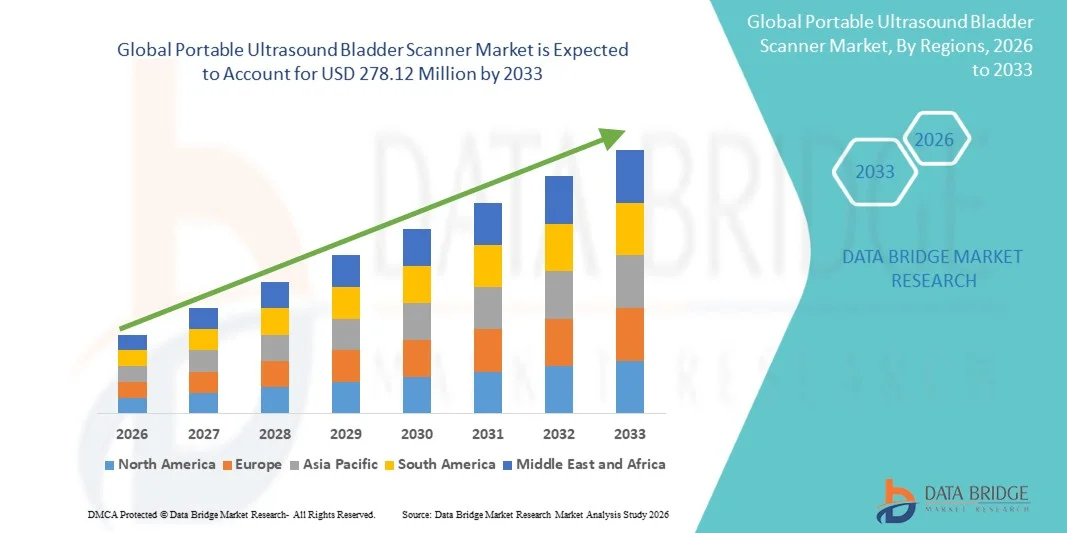
As per Data Bridge Market Research Analysis the Portable Ultrasound Bladder Scanner Market was valued at USD 164.31 Million in 2025 and is projected to reach USD 278.12 Million by 2033, growing at a CAGR of 6.80% from 2026 to 2033. The Portable Ultrasound Bladder Scanner Market is experiencing consistent growth driven by increasing demand for non-invasive diagnostic technologies, rising prevalence of urological disorders, and growing adoption of point-of-care ultrasound systems across hospitals, clinics, and long-term care facilities. Advancements in portable imaging technologies, wireless connectivity, and AI-assisted bladder volume measurement are further supporting market expansion across developed and emerging healthcare markets.
The increasing incidence of urinary incontinence, urinary retention, bladder obstruction, and post-operative urological complications, combined with growing emphasis on early diagnosis and patient safety, is compelling healthcare providers to adopt advanced portable bladder scanning technologies. Portable and handheld ultrasound bladder scanners are increasingly replacing invasive catheterization procedures in many healthcare settings by offering accurate, real-time, cost-effective, and infection-reducing diagnostic solutions for bladder volume assessment and urinary monitoring.
Key Market Trends & Insights
- North America dominated the Portable Ultrasound Bladder Scanner Market with the largest revenue share of 35.18% in 2025, supported by advanced healthcare infrastructure, high adoption of non-invasive diagnostic technologies, and increasing prevalence of urinary disorders across hospitals and long-term care facilities.
- The 3D Portable Ultrasound Bladder Scanner segment led the market with a 44.26% share in 2025, driven by superior imaging accuracy, real-time bladder volume measurement capabilities, and widespread adoption across hospitals and diagnostic centers for urinary assessment procedures.
- Asia-Pacific is expected to be the fastest-growing region at a CAGR of 7.5% from 2026 to 2033, fueled by expanding healthcare infrastructure, increasing awareness regarding early urological diagnosis, and growing adoption of portable diagnostic devices in China, India, and Japan.
- The 4D Portable Ultrasound Bladder Scanner segment is projected to register the fastest growth at a CAGR of 7.1%, reflecting increasing demand for advanced imaging technologies offering enhanced visualization, improved workflow efficiency, and higher diagnostic precision.
- The Hospitals segment dominates the end-user category with a 48.37% revenue share in 2025, led by rising patient admissions for urinary disorders, increasing post-operative bladder monitoring procedures, and growing adoption of point-of-care ultrasound systems in acute care settings.
- Offline distribution channel accounts for 61.42% of the market, preferred by hospitals, diagnostic centers, and healthcare providers due to stronger supplier relationships, product demonstrations, installation support, and after-sales service availability.
- The Online distribution channel segment is the fastest-growing category, with a CAGR of 6.9%, driven by expanding digital healthcare procurement platforms, increasing e-commerce penetration in medical devices, and growing preference for convenient purchasing solutions among clinics and ambulatory care centers.
- The 3D Portable Ultrasound Bladder Scanner segment dominated the market with a share of 44.26% in 2025 due to its superior imaging accuracy, real-time bladder volume assessment capabilities, and increasing adoption across hospitals, diagnostic centers, and urology clinics.
Market Size & Forecast
- Global Market Value (2025): USD 164.31 Million
- Expected Market Value (2033): USD 278.12 Million
- Forecast CAGR (2026–2033): 6.80%
- Leading Region in 2025: North America
- Fastest Growing Region: Asia-Pacific
Report Scope and Portable Ultrasound Bladder Scanner Market Segmentation
|
Attributes |
Portable Ultrasound Bladder Scanner Key Market Insights |
|
Segments Covered |
|
|
Countries Covered |
North America · U.S. · Canada · Mexico Europe · Germany · France · U.K. · Netherlands · Switzerland · Belgium · Russia · Italy · Spain · Turkey · Rest of Europe Asia-Pacific · China · Japan · India · South Korea · Singapore · Malaysia · Australia · Thailand · Indonesia · Philippines · Rest of Asia-Pacific Middle East and Africa · Saudi Arabia · U.A.E. · South Africa · Egypt · Israel · Rest of Middle East and Africa South America · Brazil · Argentina · Rest of South America |
|
Key Market Players |
• Verathon Inc. (U.S.) |
|
Market Opportunities |
· Expansion of Point-of-Care Ultrasound (POCUS) Adoption · Rising Demand for Non-Invasive Bladder Monitoring Solutions · Technological Advancements in AI-Enabled Portable Imaging |
|
Value Added Data Infosets |
In addition to the insights on market scenarios such as market value, growth rate, segmentation, geographical coverage, and major players, the market reports curated by the Data Bridge Market Research also include in-depth expert analysis, geographically represented company-wise production and capacity, network layouts of distributors and partners, detailed and updated price trend analysis and deficit analysis of supply chain and demand. |
What is the Key Trend in the Portable Ultrasound Bladder Scanner Market ?
Trend: Rising Adoption of Point-of-Care and Handheld Ultrasound Technologies
Healthcare providers are increasingly adopting portable and handheld Portable Ultrasound Bladder Scanner systems to support rapid, non-invasive bladder volume assessment across hospitals, emergency departments, nursing homes, and ambulatory care settings. The integration of wireless connectivity, AI-assisted imaging, and compact battery-operated devices is improving workflow efficiency and patient safety while reducing dependence on catheterization procedures. Growing use of point-of-care ultrasound (POCUS) technologies in urology and critical care is further supporting market growth. For instance, increasing adoption of handheld ultrasound platforms by hospitals in North America and Europe is enhancing bedside urinary assessment and reducing catheter-associated urinary tract infection (CAUTI) risks.
Portable Ultrasound Bladder Scanner Market Dynamics
Key Market Driver: Increasing Prevalence of Urological Disorders & Demand for Non-Invasive Diagnostics
The rising global prevalence of urinary incontinence, urinary retention, neurogenic bladder disorders, and post-operative urinary complications is a major driver for the Portable Ultrasound Bladder Scanner market. Healthcare providers are increasingly adopting portable bladder scanning technologies to improve patient monitoring while minimizing invasive catheterization procedures. According to the World Health Organization and urology research organizations, urinary incontinence affects millions of adults globally, particularly among elderly populations, increasing demand for accurate bedside diagnostic solutions. Hospitals, long-term care facilities, and rehabilitation centers are deploying portable ultrasound bladder scanners to improve patient safety, reduce infection risks, and support efficient bladder management protocols.
Key Restraint/Challenge: High Initial Investment Cost of Advanced Simulators
A significant restraint in the Portable Ultrasound Bladder Scanner Market is the high initial cost associated with advanced portable imaging systems integrated with AI-enabled diagnostics, 3D/4D imaging, and wireless data transfer capabilities. Procurement costs, software upgrades, device maintenance, and staff training requirements increase the total cost of ownership, limiting adoption among smaller clinics and healthcare facilities in cost-sensitive regions. In addition, reimbursement limitations and budget constraints in developing healthcare systems continue to restrict large-scale deployment of advanced portable bladder scanner technologies. The increasing need for regulatory compliance and periodic calibration also adds to operational costs for healthcare providers.
Key Market Opportunity: Integration of AI & Cloud-Based Diagnostic Platforms
The integration of artificial intelligence and cloud-connected imaging platforms presents a significant growth opportunity for the Portable Ultrasound Bladder Scanner market. AI-enabled systems can automate bladder volume measurements, improve diagnostic accuracy, and support real-time clinical decision-making in emergency and bedside care environments. In addition, cloud-based connectivity allows healthcare professionals to securely store, share, and analyze patient imaging data remotely, improving workflow efficiency and telemedicine integration. The development of compact wireless scanners and smartphone-compatible ultrasound platforms is further expanding accessibility across home healthcare, ambulatory care centers, and emerging healthcare markets in Asia-Pacific and Latin America.
How is the Portable Ultrasound Bladder Scanner Market Segmented ?
The Portable Ultrasound Bladder Scanner Market is segmented on the basis of product type, distribution channel, and end-user.
By Product Type
On the basis of product type, the Portable Ultrasound Bladder Scanner Market is segmented into 2D Portable Ultrasound Bladder Scanner, 3D Portable Ultrasound Bladder Scanner, and 4D Portable Ultrasound Bladder Scanner. The 3D Portable Ultrasound Bladder Scanner segment dominated the market with a share of 44.26% in 2025 due to its superior imaging accuracy, real-time bladder volume assessment capabilities, and increasing adoption across hospitals, diagnostic centers, and urology clinics. These systems provide enhanced visualization and automated bladder measurement features, improving diagnostic efficiency and reducing catheterization-associated complications. Additionally, increasing integration of AI-enabled imaging software, wireless connectivity, and compact handheld designs is supporting strong adoption across acute care and long-term care settings. Rising prevalence of urinary retention disorders, post-operative bladder complications, and neurogenic bladder conditions is further accelerating demand for advanced 3D portable bladder scanners globally. The growing focus on point-of-care diagnostics and bedside monitoring solutions also reinforces the leading position of this segment in the market.
The 4D Portable Ultrasound Bladder Scanner segment is expected to witness the fastest CAGR of 7.1% from 2026 to 2033, driven by increasing demand for advanced real-time imaging technologies capable of delivering enhanced anatomical visualization and dynamic bladder assessment. Growing adoption of AI-assisted imaging, cloud-based data integration, and portable wireless systems is improving workflow efficiency and diagnostic precision across healthcare facilities. In addition, increasing investment in advanced urology diagnostics, rising awareness regarding non-invasive bladder monitoring, and growing demand for technologically advanced portable imaging solutions are supporting segment growth. Healthcare providers are increasingly adopting 4D scanners for improved patient assessment, faster clinical decision-making, and enhanced procedural accuracy. Furthermore, advancements in miniaturized ultrasound technologies and battery-powered portable systems are expected to accelerate market expansion during the forecast period.
By Distribution Channel
On the basis of distribution channel, the Portable Ultrasound Bladder Scanner Market is segmented into Online Distribution Channel and Offline Distribution Channel. The Offline Distribution Channel segment dominated the market with a share of 61.42% in 2025 due to the strong preference among hospitals, diagnostic centers, and healthcare institutions for direct procurement through authorized distributors and medical device suppliers. Offline channels provide product demonstrations, installation support, staff training, warranty services, and immediate technical assistance, which remain critical for advanced diagnostic imaging equipment. Additionally, long-term supplier relationships, hospital procurement contracts, and availability of after-sales maintenance services continue to strengthen the dominance of offline distribution networks globally. The increasing presence of regional distributors and medical equipment dealers also supports faster product accessibility and localized customer support across healthcare facilities. Growing investment in healthcare infrastructure and rising procurement of portable imaging systems by hospitals are further contributing to segment growth.
The Online Distribution Channel segment is expected to witness the fastest CAGR of 6.9% from 2026 to 2033, driven by increasing digitalization of healthcare procurement systems and rising adoption of e-commerce platforms for medical device purchasing. Online distribution channels offer convenient product comparison, wider product availability, cost-effective procurement, and faster ordering processes for clinics and ambulatory care centers. In addition, increasing internet penetration, expansion of digital healthcare platforms, and rising adoption of telehealth services are supporting online sales growth globally. Manufacturers are also increasingly leveraging direct-to-customer digital sales strategies and online distributor partnerships to expand market reach. The growing preference for contactless procurement processes and simplified supply chain management solutions is further expected to accelerate the adoption of online distribution channels during the forecast period.
By End-user
On the basis of end-user, the Portable Ultrasound Bladder Scanner Market is segmented into Hospitals, Diagnostic Centers, Clinics, and Ambulatory Surgical Centers. The Hospitals segment dominated the market with a share of 48.37% in 2025 due to increasing patient admissions related to urinary disorders, post-operative bladder monitoring requirements, and rising adoption of point-of-care ultrasound technologies across acute care settings. Hospitals remain the primary users of portable bladder scanners because of their advanced diagnostic infrastructure, availability of skilled healthcare professionals, and high patient volume requiring bladder volume assessment and urinary retention monitoring. Additionally, increasing focus on reducing catheter-associated urinary tract infections (CAUTIs), improving patient safety, and enhancing bedside diagnostic efficiency is supporting widespread adoption across hospital settings. Growing investment in portable imaging systems and integration of AI-assisted bladder scanning technologies further reinforce the dominance of this segment globally.
The Ambulatory Surgical Centers segment is expected to witness the fastest CAGR of 6.8% from 2026 to 2033, driven by increasing preference for minimally invasive outpatient procedures and growing demand for portable diagnostic solutions in ambulatory care environments. Rising adoption of same-day surgical procedures and increasing need for rapid post-operative bladder assessment are supporting demand for portable ultrasound bladder scanners in ambulatory facilities. Additionally, compact device designs, wireless connectivity features, and cost-effective portable imaging technologies are improving accessibility for outpatient healthcare providers. The expansion of ambulatory healthcare infrastructure, particularly in emerging economies, along with growing focus on efficient patient management and reduced hospital stays, is expected to accelerate segment growth over the forecast period.
Which Region Holds the Largest Share of the Portable Ultrasound Bladder Scanner Market?
North America dominated the Portable Ultrasound Bladder Scanner market and accounted for the largest revenue share of 35.18% in 2025, supported by advanced healthcare infrastructure, high adoption of non-invasive diagnostic technologies, and increasing prevalence of urinary disorders across hospitals and long-term care facilities. The region also benefits from strong healthcare spending, growing use of portable point-of-care ultrasound systems, and rising demand for bladder volume monitoring solutions to reduce catheter-associated urinary tract infections (CAUTIs). Increasing integration of AI-enabled imaging technologies and expanding adoption of portable diagnostic devices across emergency care and outpatient settings continue to strengthen North America’s leadership position in the global market.
U.S. Portable Ultrasound Bladder Scanner Market Insight
The U.S. Portable Ultrasound Bladder Scanner market is witnessing strong growth due to increasing prevalence of urinary retention disorders, rising elderly population, and growing demand for non-invasive bedside diagnostic technologies. Hospitals, ambulatory care centers, and long-term care facilities are increasingly adopting portable bladder scanners to improve patient monitoring and reduce unnecessary catheterization procedures. In addition, growing integration of AI-assisted imaging systems, wireless ultrasound platforms, and cloud-based healthcare technologies is supporting market expansion across acute care and urology applications.
Europe Portable Ultrasound Bladder Scanner Market Insight
The Europe Portable Ultrasound Bladder Scanner market remains a major contributor to global revenue, driven by advanced healthcare systems, strong regulatory standards, and increasing adoption of portable diagnostic imaging technologies. Rising prevalence of urological disorders, increasing geriatric population, and growing awareness regarding infection prevention are supporting market growth across the region. Furthermore, increasing investments in point-of-care ultrasound technologies and expanding use of bladder scanners across hospitals and rehabilitation centers continue to accelerate adoption throughout Europe.
U.K. Portable Ultrasound Bladder Scanner Market Insight
The U.K. Portable Ultrasound Bladder Scanner market is experiencing steady growth, supported by increasing focus on patient safety, early urinary disorder diagnosis, and reduction of catheter-associated complications in healthcare settings. Hospitals and outpatient facilities are increasingly investing in portable ultrasound technologies to improve bedside diagnostics and workflow efficiency. Additionally, growing adoption of wireless imaging systems, AI-enabled diagnostic tools, and portable healthcare devices is further strengthening market growth in the country.
Germany Portable Ultrasound Bladder Scanner Market Insight
The Germany Portable Ultrasound Bladder Scanner market is expanding steadily due to the country’s advanced medical technology sector, strong hospital infrastructure, and increasing adoption of point-of-care diagnostic devices. Healthcare providers are increasingly utilizing portable bladder scanners for post-operative monitoring, elderly care, and urology diagnostics. Continuous advancements in portable imaging technologies, combined with rising investment in digital healthcare solutions and non-invasive diagnostics, are further driving market growth in Germany.
Asia-Pacific Portable Ultrasound Bladder Scanner Market Insight
The Asia-Pacific Portable Ultrasound Bladder Scanner market is expected to witness rapid growth, recording a CAGR of 7.5% from 2026 to 2033, fueled by expanding healthcare infrastructure, increasing awareness regarding early urological diagnosis, and growing adoption of portable diagnostic devices in China, India, and Japan. Rising healthcare expenditure, improving access to diagnostic services, and growing prevalence of urinary disorders are supporting regional market expansion. Additionally, increasing investments in portable medical imaging technologies and rising focus on point-of-care healthcare delivery are accelerating adoption across hospitals, clinics, and ambulatory care centers throughout the region.
Japan Portable Ultrasound Bladder Scanner Market Insight
The Japan Portable Ultrasound Bladder Scanner market is witnessing consistent growth due to rising demand for advanced non-invasive diagnostic technologies, rapidly aging population, and increasing prevalence of bladder-related disorders. Healthcare institutions are increasingly adopting compact and AI-assisted portable ultrasound systems for efficient bedside monitoring and patient management. Moreover, strong focus on healthcare innovation and increasing integration of digital diagnostic platforms are further contributing to market growth in Japan.
China Portable Ultrasound Bladder Scanner Market Insight
The China Portable Ultrasound Bladder Scanner market is growing rapidly, driven by expanding healthcare infrastructure, rising awareness regarding urinary health management, and increasing adoption of portable medical imaging technologies. Growing investments in hospital modernization, increasing demand for cost-effective diagnostic solutions, and rising prevalence of chronic urological conditions are significantly boosting market demand. In addition, rapid technological advancements, increasing healthcare digitization, and strong government support for improving diagnostic accessibility are positioning China as one of the fastest-growing markets for portable ultrasound bladder scanners globally.
Which are the Top Companies in Portable Ultrasound Bladder Scanner Market ?
The Portable Ultrasound Bladder Scanner industry is primarily led by well-established companies, including:
- Verathon Inc. (U.S.)
- Laborie Medical Technologies (Canada)
- GE HealthCare (U.S.)
- Koninklijke Philips N.V. (Netherlands)
- Siemens Healthineers AG (Germany)
- Canon Medical Systems Corporation (Japan)
- FUJIFILM Holdings Corporation (Japan)
- Mindray Medical International Limited (China)
- Becton, Dickinson and Company (U.S.)
- Vitacon AS (Norway)
- Mcube Technology Co., Ltd. (South Korea)
- DBMEDx Inc. (U.S.)
- Caresono Technology Co., Ltd. (China)
- EchoNous Inc. (U.S.)
- Clarius Mobile Health (Canada)
- EDAN Instruments, Inc. (China)
- Shenzhen Bestman Instrument Co., Ltd. (China)
- Sonostar Technologies Co., Limited (China)
- Healcerion Co., Ltd. (South Korea)
- Meda Co., Ltd. (South Korea)
- Alpinion Medical Systems Co., Ltd. (South Korea)
- Telemed Medical Systems S.r.l. (Italy)
- Promed Technology Co., Ltd. (China)
- Shantou Institute of Ultrasonic Instruments Co., Ltd. (China)
- Terason Division, Teratech Corporation (U.S.)
- CHISON Medical Technologies Co., Ltd. (China)
- Esaote S.p.A. (Italy)
- Samsung Medison Co., Ltd. (South Korea)
- Butterfly Network, Inc. (U.S.)
- Nanjing Keweisi Medical Lighting Co., Ltd. (China)
- Well.D Medical Electronics Co., Ltd. (China)
- BenQ Medical Technology Corporation (Taiwan)
- MedGyn Products, Inc. (U.S.)
- AnaSonic Medical Systems Pvt. Ltd. (India)
What are Latest Developments in Portable Ultrasound Bladder Scanner Market ?
- In June 2021, Verathon Inc. announced the launch of its next-generation BladderScan i10 portable ultrasound bladder scanner system, featuring proprietary ImageSense AI deep-learning technology for automated bladder volume measurement and enhanced workflow efficiency. The system introduced barcode-enabled charting tools, improved probe docking, and advanced portability features to support non-invasive bladder assessment across hospitals and clinical care settings
- In March 2021, GE HealthCare launched the Vscan Air wireless handheld ultrasound device for the U.S. and European markets. The compact portable ultrasound platform enabled wireless imaging through smartphone connectivity and supported the growing adoption of point-of-care ultrasound technologies across emergency medicine, primary care, and bedside diagnostics, strengthening the portable ultrasound ecosystem relevant to bladder scanning applications
- In October 2022, Koninklijke Philips N.V. introduced the Compact 5000 Series portable ultrasound systems at RSNA 2022, designed to deliver high-quality imaging in compact mobile formats. The launch supported growing demand for portable diagnostic imaging technologies across hospitals and outpatient facilities, including urology and bladder monitoring applications
- In May 2024, Butterfly Network, Inc. announced the launch of the iQ+ Bladder portable ultrasound system in the U.S. market. The device integrates semiconductor-based ultrasound-on-chip technology with automated bladder volume calculations and 3D visualization capabilities, enabling rapid bedside bladder assessment and supporting non-invasive urinary monitoring workflows in healthcare facilities
- In September 2024, GE HealthCare introduced the Venue Sprint portable point-of-care ultrasound system featuring wireless probe capability, AI-powered tools, and enhanced mobility for emergency and bedside care applications. The launch reflected the increasing industry focus on compact, AI-enabled ultrasound platforms supporting rapid diagnostic imaging and portable bladder scanning solutions

- Interactive Data Analysis Dashboard
- Company Analysis Dashboard for high growth potential opportunities
- Research Analyst Access for customization & queries
- Competitor Analysis with Interactive dashboard
- Latest News, Updates & Trend analysis
- Harness the Power of Benchmark Analysis for Comprehensive Competitor Tracking
Data collection and base year analysis are done using data collection modules with large sample sizes. The stage includes obtaining market information or related data through various sources and strategies. It includes examining and planning all the data acquired from the past in advance. It likewise envelops the examination of information inconsistencies seen across different information sources. The market data is analysed and estimated using market statistical and coherent models. Also, market share analysis and key trend analysis are the major success factors in the market report. To know more, please request an analyst call or drop down your inquiry.
The key research methodology used by DBMR research team is data triangulation which involves data mining, analysis of the impact of data variables on the market and primary (industry expert) validation. Data models include Vendor Positioning Grid, Market Time Line Analysis, Market Overview and Guide, Company Positioning Grid, Patent Analysis, Pricing Analysis, Company Market Share Analysis, Standards of Measurement, Global versus Regional and Vendor Share Analysis. To know more about the research methodology, drop in an inquiry to speak to our industry experts.
Data Bridge Market Research is a leader in advanced formative research. We take pride in servicing our existing and new customers with data and analysis that match and suits their goal. The report can be customized to include price trend analysis of target brands understanding the market for additional countries (ask for the list of countries), clinical trial results data, literature review, refurbished market and product base analysis. Market analysis of target competitors can be analyzed from technology-based analysis to market portfolio strategies. We can add as many competitors that you require data about in the format and data style you are looking for. Our team of analysts can also provide you data in crude raw excel files pivot tables (Fact book) or can assist you in creating presentations from the data sets available in the report.













