


What is the Positional Digital Pen Market Size and Growth Rate?
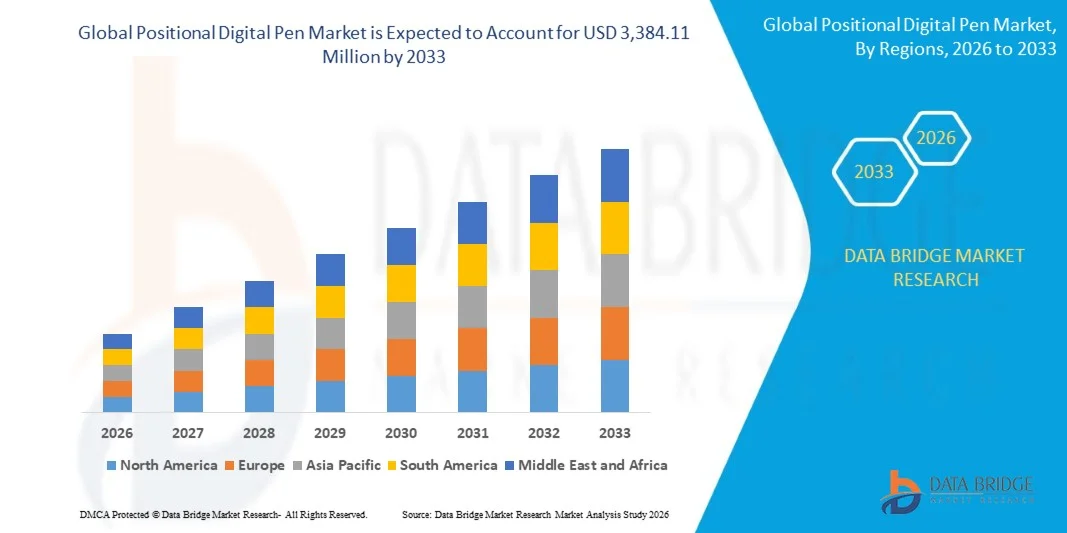
- As per Data Bridge Market Research analysis, the positional digital pen market was valued at USD 970.29 million in 2025 and is projected to reach USD 3,384.11 million by 2033, growing at a CAGR of 16.80% from 2026 to 2033.
- The market is expanding rapidly on the back of surging adoption of stylus-enabled tablets and 2-in-1 devices, large-scale government-funded digital classroom initiatives across Asia-Pacific, and growing enterprise demand for digital signature, annotation, and handwriting-to-text workflows that eliminate paper-based processes.
- Positional digital pens are input devices engineered to precisely determine and transmit the location of the pen tip on a writing surface, using technologies such as electromagnetic resonance, active electrostatic sensing, or camera-based optical positioning, enabling accurate digital capture of handwriting, sketches, and signatures. Their commercial relevance continues to expand as device makers embed increasingly sophisticated pen technology into mainstream tablets and hybrid laptops, and as artificial intelligence-based handwriting recognition makes captured pen input more directly usable across note-taking, translation, and document workflows.
Market Size & Forecast
- Global Market Value (2025): USD 970.29 Million
- Expected Market Value (2033): USD 3,384.11 Million
- Forecast CAGR (2026–2033): 16.80%
- Leading Region in 2025: North America
- Fastest Growing Region: Asia-Pacific
What are the Major Takeaways of the Positional Digital Pen Market?
- North America dominated the global positional digital pen market with the largest revenue share of 34.45% in 2025, supported by strong adoption of tablets, 2-in-1 laptops, and smart devices across education, corporate, and creative industries, and by the concentration of leading device and pen technology developers headquartered in the region.
- Asia-Pacific is expected to be the fastest-growing region at a CAGR of 19.3% from 2026 to 2033, driven by large-scale government investment in digital classroom infrastructure across China and India, a substantial student population, and expanding regional electronics manufacturing ecosystems.
- The electromagnetic resonance (EMR) technology segment led the market with a 41.28% share in 2025, owing to its superior pressure sensitivity, tilt detection, and precision, which have made it the standard technology embedded in premium tablets, e-notebooks, and creative design devices.
- Active capacitive technology is the fastest-growing segment, projected to register a CAGR of 19.6%, reflecting its lower manufacturing cost and growing adoption across mid-range and budget stylus-enabled devices targeting price-sensitive education and consumer markets.
- The Bluetooth/wireless connectivity segment dominated the connectivity category with a 68.72% revenue share in 2025, favoured for the mobility, reduced cable dependency, and seamless multi-device pairing it offers relative to wired alternatives.
- Education accounted for 28.74% of the market by end user in 2025, reflecting large, multi-year, government-funded procurement cycles, while the healthcare end-user segment is the fastest-growing category at a CAGR of 13.1%, driven by rising adoption of digital pens for electronic health record annotation and telehealth documentation.
- Tablets & 2-in-1 devices represented the leading platform compatibility segment, while e-notebooks & digital paper devices are the fastest-growing platform category, reflecting rising consumer interest in distraction-free, paper-like digital writing experiences.
Report Scope and Positional Digital Pen Market Segmentation
|
Attributes |
Positional Digital Pen Key Market Insights |
|
Segments Covered |
|
|
Countries Covered |
North America
Europe
Asia-Pacific
Middle East and Africa
South America
|
|
Key Market Players |
|
|
Market Opportunities |
|
|
Value Added Data Infosets |
In addition to the insights on market scenarios such as market value, growth rate, segmentation, geographical coverage, and major players, the market reports curated by the Data Bridge Market Research also include in-depth expert analysis, geographically represented company-wise production and capacity, network layouts of distributors and partners, detailed and updated price trend analysis and deficit analysis of supply chain and demand. |
What is the Key Trend in the Positional Digital Pen Market?
- Digital pen manufacturers are increasingly focusing on improved interoperability, ergonomic design, pressure sensitivity, and seamless integration with tablets, laptops, and other connected devices. This reflects a broader shift toward multifunctional digital pens that can support writing, drawing, navigation, and productivity applications across diverse digital environments.
- For instance, in October 2025, Wacom announced that its digital pen technology had been adopted in the redesigned S Pen for Samsung’s Galaxy Tab S11 and Galaxy Tab S11 Ultra. The new S Pen introduced a hexagonal design and cone-shaped tip to improve comfort, tilt control, and writing and drawing performance.
- AI integration is also becoming an important area of development, with digital pens increasingly positioned as interfaces for intelligent writing, drawing, search, and content-creation functions. This is encouraging manufacturers to combine advanced pen hardware with software ecosystems and AI-enabled device features.
- For instance, in March 2026, Wacom announced that its pen technology and signature pen experience continued to support Samsung’s Galaxy S26 Ultra, demonstrating the continued integration of specialized digital-pen technology into flagship smartphones.
- Overall, the positional digital pen market is increasingly shaped by product innovation around ergonomics, cross-device compatibility, AI-enabled functionality, and integration with broader digital ecosystems. Manufacturers are therefore focusing not only on improving pen hardware but also on strengthening the interaction between digital pens, operating systems, applications, and connected devices.
What are the Key Drivers of the Positional Digital Pen Market?
- Government investment in digital education, smart classrooms, and e-learning infrastructure is increasing the adoption of tablets, interactive displays, and stylus-enabled devices, creating demand for compatible positional digital pens across schools, universities, and training institutions.
- For instance, in January 2025, Samsung Electronics expanded its education-focused device ecosystem with the Galaxy Tab S10 FE series, which supports S Pen functionality and is positioned for education and productivity use cases. The continued availability of S Pen-compatible tablets supports the expansion of the installed base for positional digital pens.
- The growing penetration of stylus-compatible tablets, 2-in-1 laptops, and premium smartphones across corporate, creative, and professional markets is expanding the potential user base for positional digital pens. Increased adoption of digital note-taking, illustration, design, annotation, and document-marking applications is further supporting demand.
- For instance, in October 2025, Wacom announced that its digital pen technology was incorporated into the redesigned S Pen for Samsung’s Galaxy Tab S11 and Galaxy Tab S11 Ultra. The redesigned pen featured a hexagonal body and cone-shaped tip intended to improve grip, control, and writing and drawing performance, demonstrating continued investment in advanced pen hardware. (Wacom)
- The integration of artificial intelligence into handwriting recognition and digital writing software is expanding the functionality of positional digital pens beyond basic note-taking. Features such as handwriting-to-text conversion, searchable notes, translation, summarization, and AI-assisted writing are increasing the practical value of pen-enabled devices and encouraging users to adopt digital pens as part of broader AI-enabled productivity ecosystems.
Which Factors are Challenging the Growth of the Positional Digital Pen Market?
- The coexistence of multiple positioning technologies, including electromagnetic resonance (EMR), active electrostatic (AES), and active capacitive systems, continues to fragment the positional digital pen market and creates compatibility challenges for consumers and institutional buyers.
- This fragmentation increases the complexity and potential cost of adoption, as digital pens are often designed for specific devices or operating ecosystems. Users and institutions with mixed-device fleets may therefore need to purchase different pen technologies, limiting interchangeability and increasing procurement complexity.
- For instance, in September 2024, Apple introduced the Apple Pencil Pro at USD 129 in the U.S., with compatibility restricted to specific iPad models, illustrating how premium pricing and device-specific compatibility can increase the cost and complexity of adopting advanced positional digital pens.
- Premium digital pen prices can also restrict adoption in cost-sensitive education and emerging markets. When digital pens are sold separately from tablets or laptops, the additional purchase can represent a significant cost for budget-conscious consumers and institutions.
How is the Positional Digital Pen Market Segmented?
The positional digital pen market is segmented on the basis of technology, connectivity, platform compatibility, end user, application and distribution channel.
- By Technology
On the basis of technology, the global positional digital pen market is segmented into electromagnetic resonance (EMR), active electrostatic (AES), active capacitive, ultrasonic & infrared positioning, and camera/optical dot-pattern. The electromagnetic resonance segment dominated the market with a 41.28% share in 2025, owing to its superior pressure sensitivity, tilt detection, and battery-free pen design, which have made it the standard technology embedded in premium tablets, e-notebooks, and professional creative design devices.
The active capacitive technology segment is projected to register the fastest growth at a CAGR of 19.6% from 2026 to 2033, driven by its comparatively lower manufacturing and licensing cost, supporting rapid adoption across mid-range and budget stylus-enabled tablets targeted at price-sensitive education and consumer markets.
- By Connectivity
On the basis of connectivity, the global positional digital pen market is segmented into Bluetooth/wireless, wired/USB, and hybrid. The Bluetooth/wireless segment dominated the market with a share of 68.72% in 2025, favoured for the mobility, reduced cable dependency, and seamless multi-device pairing capability it offers relative to wired alternatives.
The hybrid segment is expected to witness the fastest CAGR of 14.8% from 2026 to 2033, driven by rising demand for pens that combine wireless connectivity with onboard memory, allowing users to capture and store notes even when not actively connected to a paired device.
- By Platform Compatibility
On the basis of platform compatibility, the global positional digital pen market is segmented into tablets & 2-in-1 devices, smartphones, e-notebooks & digital paper devices, and interactive displays & whiteboards. The tablets & 2-in-1 devices segment dominated the market, reflecting the sheer scale of the global installed base of stylus-compatible tablets and hybrid laptops across education, enterprise, and consumer markets.
The e-notebooks & digital paper devices segment is expected to witness the fastest CAGR of 17.9% from 2026 to 2033, driven by rising consumer interest in distraction-free, paper-like digital writing experiences and the growing compatibility of third-party pen brands with popular e-notebook platforms.
- By End User
On the basis of end user, the global positional digital pen market is segmented into education, enterprise & corporate, healthcare, BFSI, creative & design professionals, and government & public sector. The education segment dominated the market with a share of 28.74% in 2025, reflecting large-scale, multi-year, government-funded digital classroom procurement cycles that represent the single largest institutional demand source for stylus-enabled devices and compatible pens.
The healthcare segment is expected to witness the fastest CAGR of 13.1% from 2026 to 2033, driven by rising adoption of digital pens for electronic health record annotation, clinical documentation, and telehealth session capture, supported by broader regulatory mandates around digital health record-keeping.
- By Application
On the basis of application, the global positional digital pen market is segmented into note-taking & document annotation, digital signatures & forms, creative design & illustration, and handwriting recognition & data capture. The note-taking & document annotation segment dominated the market, reflecting its status as the most universal and widely adopted use case for positional digital pens across education, enterprise, and consumer settings.
The handwriting recognition & data capture segment is expected to witness the fastest CAGR of 18.2% from 2026 to 2033, driven by rapid advances in AI-based handwriting-to-text conversion, which is expanding the practical utility of captured pen input into searchable, editable, and translatable digital content.
- By Distribution Channel
On the basis of distribution channel, the global positional digital pen market is segmented into OEM bundled sales, retail & consumer electronics stores, online/e-commerce, and direct enterprise sales. The OEM bundled sales segment dominated the market, reflecting the growing practice among device manufacturers of including a compatible pen as standard equipment with premium tablet and 2-in-1 device purchases.
The online/e-commerce segment is expected to witness the fastest CAGR of 17.4% from 2026 to 2033, driven by rising consumer comfort purchasing third-party and replacement digital pens directly through e-commerce platforms, supported by expanding compatibility information and user reviews available online.
Which Region Holds the Largest Share of the Positional Digital Pen Market?
- North America dominated the positional digital pen market and accounted for the largest revenue share of 34.45% in 2025, supported by strong adoption of tablets, 2-in-1 laptops, and smart devices across education, corporate, and creative industries in the U.S. and Canada, and by the concentration of leading device and pen technology developers headquartered in the region.
- The region also benefits from rapid digital transformation, widespread hybrid work adoption, and continued expansion of e-learning platforms, all of which reinforce sustained demand for digital pens with AI-enabled handwriting recognition and seamless cloud synchronization. Continued flagship product launches by regionally headquartered device manufacturers are expected to reinforce North America’s leadership through the forecast period.
U.S. Positional Digital Pen Market Insight
The U.S. positional digital pen market holds the leading position within North America, underpinned by the scale of the domestic education technology, enterprise collaboration, and creative professional markets, and by the concentration of major device manufacturers and pen technology developers in the country. U.S. buyers show strong engagement with premium, AI-integrated pen and tablet ecosystems, supported by broad enterprise adoption of digital signature and document annotation workflows. Continued innovation from both flagship device makers and specialist accessory brands is reinforcing the country’s position as the primary innovation and commercialization hub for the category.
Canada Positional Digital Pen Market Insight
The Japan positional digital pen market is growing steadily, supported by the country’s deep engineering heritage in precision writing instruments and the presence of the world’s leading digital pen technology developer headquartered domestically. Japanese consumers and enterprises prioritize precision writing, compact digital workflows, and design-forward stylus hardware, reflected in the country’s role as host to major global industry showcase events where flagship pen technologies are regularly unveiled.
Asia-Pacific Positional Digital Pen Market Insight
The Asia-Pacific positional digital pen market is expected to witness the fastest growth globally, driven by a large student population, expanding creative industries, rising smartphone and tablet penetration, and substantial government investment in digital classroom infrastructure across China, India, Japan, and South Korea. Affordable digital pens from regional manufacturers, combined with government-funded e-learning initiatives, continue to accelerate adoption across both urban and semi-urban markets in the region.
China Positional Digital Pen Market Insight
The China positional digital pen market is expanding rapidly, supported by the country’s position as a major center for pen-enabled device manufacturing, large-scale online education platforms, and digital government service adoption. Widespread deployment of stylus-enabled tablets across schools and universities is driving substantial volume demand, while domestic manufacturers continue to expand affordable pen offerings targeted at both education and consumer markets.
Japan Positional Digital Pen Market Insight
The Japan positional digital pen market is growing steadily, supported by the country’s deep engineering heritage in precision writing instruments and the presence of the world’s leading digital pen technology developer headquartered domestically. Japanese consumers and enterprises prioritize precision writing, compact digital workflows, and design-forward stylus hardware, reflected in the country’s role as host to major global industry showcase events where flagship pen technologies are regularly unveiled.
Which are the Top Companies in Positional Digital Pen Market?
The positional digital pen industry is primarily led by well-established companies, including:
- Wacom Co., Ltd. (Japan)
- Samsung Electronics Co., Ltd. (South Korea)
- Apple Inc. (U.S.)
- Microsoft Corporation (U.S.)
- Lenovo Group Limited (China)
- Huawei Technologies Co., Ltd. (China)
- Logitech International S.A. (Switzerland)
- Anoto Group AB (Sweden)
- Neo Smartpen Co., Ltd. (South Korea)
- Moleskine S.p.A. (Italy)
- reMarkable AS (Norway)
- Onyx International Inc. (BOOX) (China)
- XP-PEN Technology Co., Ltd. (China)
- HUION Animation Technology Co., Ltd. (China)
- STAEDTLER Mars GmbH & Co. KG (Germany)
- LAMY GmbH (Germany)
- Montblanc-Simplo GmbH (Germany)
- Adonit (China)
- Pilot Corporation (Japan)
- Mitsubishi Pencil Co., Ltd. (Japan)
- Sony Corporation (Japan)
- Google LLC (U.S.)
- Synaptics Incorporated (U.S.)
- N-trig Ltd. (a Microsoft company) (Israel)
- Zebra Imaging, Inc. (U.S.)
What are Latest Developments in Positional Digital Pen Market?
- In May 2026, Wacom unveiled the Wacom Art Pen 2, a rotation-sensitive digital pen offering 360° barrel rotation in addition to pressure and tilt capabilities. The pen was designed to provide digital artists with more expressive control by allowing brush and line characteristics to respond to the pen’s rotational angle.
- In March 2026, Wacom announced that its pen technology and signature pen experience continued to support Samsung’s Galaxy S26 Ultra, demonstrating the continued integration of specialized digital-pen technology into flagship mobile devices.
- In September 2025, Samsung introduced the Galaxy Tab S11 series with a redesigned S Pen, featuring a hexagonal design for improved grip, a cone-shaped tip supporting greater tilt angles, and Quick Tools for easier control while drawing and editing.
- In November 2025, Wacom hosted Connected Ink 2025 in Tokyo, bringing together technology, creative, and education communities to showcase developments around digital pen technology and digital interaction. The event highlighted the continued expansion of pen technology across creative and digital workflows.
- In May 2024, Apple introduced the Apple Pencil Pro alongside the new iPad Pro, adding features such as squeeze gestures, haptic feedback, barrel rotation, Apple Pencil hover, and Find My support. The development expanded the functionality of positional digital pens beyond conventional writing and drawing applications.
- On November 14 and 15, 2025, Pilot unveiled a new 2026 stylus lineup comprising the Dr. Grip Digital 2, designed with an ergonomic sinking grip; the Digital Rotation pen, featuring a twist-based mechanism to switch between digital pen and stylus modes; and a Dual Protocol Pen designed to work across both Surface and Chromebook device families, addressing a long-standing cross-ecosystem compatibility gap.

- Interactive Data Analysis Dashboard
- Company Analysis Dashboard for high growth potential opportunities
- Research Analyst Access for customization & queries
- Competitor Analysis with Interactive dashboard
- Latest News, Updates & Trend analysis
- Harness the Power of Benchmark Analysis for Comprehensive Competitor Tracking
Global Positional Digital Pen Market, Supply Chain Analysis and Ecosystem Framework
To support market growth and help clients navigate the impact of geopolitical shifts, DBMR has integrated in-depth supply chain analysis into its Global Positional Digital Pen Market research reports. This addition empowers clients to respond effectively to global changes affecting their industries. The supply chain analysis section includes detailed insights such as Global Positional Digital Pen Market consumption and production by country, price trend analysis, the impact of tariffs and geopolitical developments, and import and export trends by country and HSN code. It also highlights major suppliers with data on production capacity and company profiles, as well as key importers and exporters. In addition to research, DBMR offers specialized supply chain consulting services backed by over a decade of experience, providing solutions like supplier discovery, supplier risk assessment, price trend analysis, impact evaluation of inflation and trade route changes, and comprehensive market trend analysis.
Data collection and base year analysis are done using data collection modules with large sample sizes. The stage includes obtaining market information or related data through various sources and strategies. It includes examining and planning all the data acquired from the past in advance. It likewise envelops the examination of information inconsistencies seen across different information sources. The market data is analysed and estimated using market statistical and coherent models. Also, market share analysis and key trend analysis are the major success factors in the market report. To know more, please request an analyst call or drop down your inquiry.
The key research methodology used by DBMR research team is data triangulation which involves data mining, analysis of the impact of data variables on the market and primary (industry expert) validation. Data models include Vendor Positioning Grid, Market Time Line Analysis, Market Overview and Guide, Company Positioning Grid, Patent Analysis, Pricing Analysis, Company Market Share Analysis, Standards of Measurement, Global versus Regional and Vendor Share Analysis. To know more about the research methodology, drop in an inquiry to speak to our industry experts.
Data Bridge Market Research is a leader in advanced formative research. We take pride in servicing our existing and new customers with data and analysis that match and suits their goal. The report can be customized to include price trend analysis of target brands understanding the market for additional countries (ask for the list of countries), clinical trial results data, literature review, refurbished market and product base analysis. Market analysis of target competitors can be analyzed from technology-based analysis to market portfolio strategies. We can add as many competitors that you require data about in the format and data style you are looking for. Our team of analysts can also provide you data in crude raw excel files pivot tables (Fact book) or can assist you in creating presentations from the data sets available in the report.













