


What is the Poultry Processing Equipment Market Size and Growth Rate?
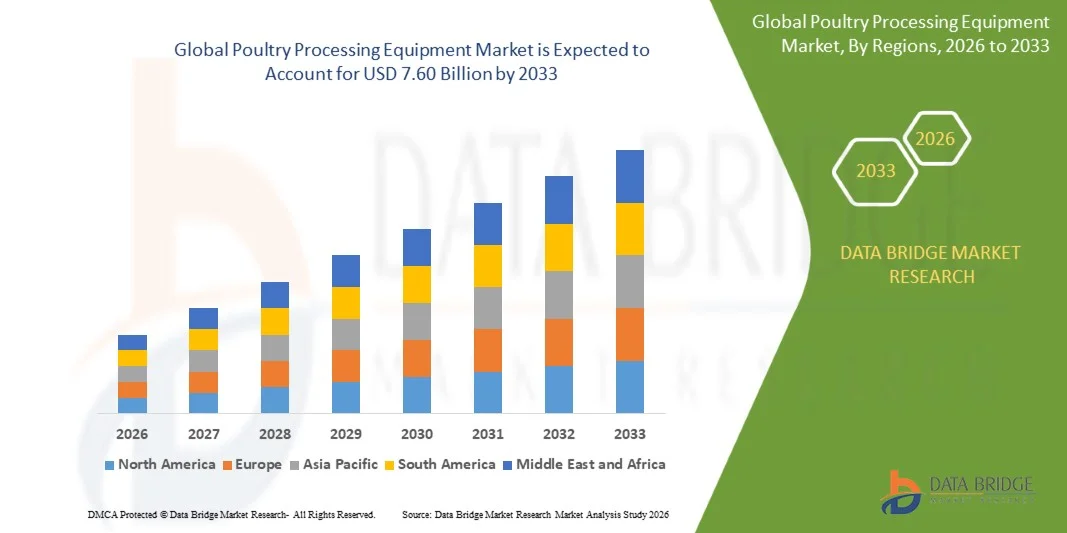
- AS per Data Bridge Market Research analysis indicates that the poultry processing equipment market was valued at USD 4.92 billion in 2025 and is projected to reach USD 7.60 billion by 2033, growing at a CAGR of 5.60% from 2026 to 2033.
- Growth continues to be underpinned by rising global poultry meat consumption, tightening food-safety regulation, and the accelerating shift from manual and semi-automated lines toward fully automated processing systems.
- Persistent labor shortages at processing plants, combined with rising demand for ready-to-cook and value-added chicken and turkey products, are pushing OEMs, integrators, and government-linked poultry boards to invest in high-throughput killing, evisceration, and deboning systems that reduce contamination risk while lifting line speed.
Market Size & Forecast
- Global Market Value (2025): USD 4.92 Billion
- Expected Market Value (2033): USD 7.60 Billion
- Forecast CAGR (2026–2033): 5.60%
- Leading Region in 2025: North America
- Fastest Growing Region: Asia-Pacific
What are the Major Takeaways of the Poultry Processing Equipment Market?
- North America dominated the global poultry processing equipment market with the largest revenue share of 43.10% in 2025, supported by large-scale integrated poultry operations and a high concentration of automated, high-capacity processing plants.
- Asia-Pacific is expected to be the fastest-growing region at a CAGR of 7.80% from 2026 to 2033, driven by expanding poultry production capacity, rising protein consumption, and growing investment in processing infrastructure across China, India, and Southeast Asia.
- The killing & defeathering equipment segment led the market with a 27.85% share in 2025, reflecting its position as the mandatory first processing stage in every commercial poultry line.
- Evisceration equipment is the fastest-growing equipment type, projected to register a CAGR of 6.85%, reflecting stricter hygiene and food-safety compliance requirements in regulated markets.
- The chicken segment dominated the poultry type category with a 74.60% revenue share in 2025, owing to its high global consumption volume relative to turkey and duck.
Report Scope and Poultry Processing Equipment Market Segmentation
|
Attributes |
Poultry Processing Equipment Key Market Insights |
|
Segments Covered |
|
|
Countries Covered |
North America
Europe
Asia-Pacific
Middle East and Africa
South America
|
|
Key Market Players |
|
|
Market Opportunities |
|
|
Value Added Data Infosets |
In addition to the insights on market scenarios such as market value, growth rate, segmentation, geographical coverage, and major players, the market reports curated by the Data Bridge Market Research also include in-depth expert analysis, pricing analysis, brand share analysis, consumer survey, demography analysis, supply chain analysis, value chain analysis, raw material/consumables overview, vendor selection criteria, PESTLE Analysis, Porter Analysis, and regulatory framework. |
What is the Key Trend in the Poultry Processing Equipment Market?
- The End-to-end automation and industry consolidation are transforming the poultry processing equipment market, as processors increasingly prefer integrated solutions that combine slaughtering, evisceration, deboning, portioning, inspection, packaging, and digital production management from a single supplier. This trend is helping improve throughput, traceability, labor efficiency, and overall plant productivity.
- For instance, in January 2025, John Bean Technologies Corporation (JBT) completed its acquisition of Marel hf., creating JBT Marel Corporation. The combined company generated approximately USD 3.5 billion in combined 2024 revenue and now offers one of the industry's broadest portfolios of poultry, meat, fish, and food-processing equipment, strengthening its position as a global end-to-end processing technology provider.
- Equipment manufacturers are also investing heavily in AI-enabled vision inspection, robotics, digital monitoring, and predictive maintenance to improve yield, reduce labor dependency, and enhance food safety. These technologies are increasingly becoming standard features in newly commissioned poultry processing facilities, particularly in North America and Europe.
- For instance, in 2024, BAADER acquired AI specialist EMYDEX Technology, strengthening its digital food processing capabilities by integrating production management, traceability, and quality-control software with poultry and meat processing equipment. The acquisition supports the growing demand for smart, data-driven processing plants.
- As poultry processors continue expanding production capacity to meet rising global meat consumption while addressing labor shortages and stricter food safety regulations, investment in fully integrated, highly automated processing lines is expected to accelerate throughout the forecast period.
What are the Key Drivers of the Poultry Processing Equipment Market?
- Rising global poultry meat production is the primary growth driver for poultry processing equipment. According to the FAO Food Outlook, global poultry meat production continues to expand due to its affordability, shorter production cycle, and lower environmental footprint compared with beef and pork, creating sustained demand for high-capacity processing equipment.
- Labor shortages across poultry processing facilities are accelerating automation investments. Automated defeathering, evisceration, deboning, grading, and packaging systems help processors maintain production volumes while reducing labor dependency, improving yield consistency, and lowering operating costs.
- Stringent food safety and traceability regulations enforced by organizations such as the USDA Food Safety and Inspection Service (FSIS) and the European Food Safety Authority (EFSA) are encouraging processors to replace manual operations with automated inspection, sanitation, and quality-control equipment that minimizes contamination risks and supports regulatory compliance.
- Growing demand for processed and convenience poultry products such as portioned cuts, marinated chicken, ready-to-cook, and ready-to-eat products is driving investment in advanced cut-up, seasoning, weighing, packaging, and labeling equipment, enabling processors to capture higher-value product segments.
Which Factors are Challenging the Growth of the Poultry Processing Equipment Market?
- The high capital cost of advanced poultry processing systems remains one of the biggest barriers to market expansion. Fully automated processing lines incorporating robotics, AI-based vision inspection, automated deboning, and digital control systems require substantial initial investment, making them economically challenging for many small and medium-sized poultry processors.
- Beyond the initial purchase price, processors must also bear significant installation, maintenance, spare-parts, software upgrades, and workforce training costs, increasing the total cost of ownership and extending investment payback periods.
- In many developing markets, processors continue relying on manual or semi-automated processing facilities because of limited financial resources, lower production volumes, and lower labor costs, slowing the adoption of next-generation automated equipment.
- In addition, integrating advanced processing equipment into existing production lines often requires plant redesign, infrastructure upgrades, and temporary production downtime, creating further challenges for processors planning modernization projects .
How is the Poultry Processing Equipment Market Segmented?
The poultry processing equipment market is segmented on the basis of equipment type, poultry type, and product type.
- By Equipment Type
On the basis of equipment type, the global poultry processing equipment market is segmented into killing & defeathering equipment, evisceration equipment, cut-up equipment, deboning & skinning equipment, chilling & marination equipment, and weighing, grading & packaging equipment. The killing & defeathering equipment segment dominated the market with a 27.85% share in 2025, owing to its role as the mandatory first stage in every commercial poultry processing line and its high per-unit equipment cost relative to downstream machinery.
The evisceration equipment segment is projected to register the fastest growth at a CAGR of 6.85% from 2026 to 2033, driven by tightening hygiene regulations and rising adoption of automated inspection and contamination-control systems.
- By Poultry Type
On the basis of poultry type, the global poultry processing equipment market is segmented into chicken, turkey, duck, and others. The chicken segment led the market with a 74.60% share in 2025, supported by chicken's dominant share of global poultry meat consumption and the resulting scale of chicken-specific processing infrastructure.
The duck segment is expected to experience the fastest growth at a CAGR of 8.10% from 2026 to 2033, driven by rising duck meat consumption in Asia-Pacific and growing investment in duck-specific processing lines.
- By Product Type
On the basis of product type, the global poultry processing equipment market is segmented into fresh processed, raw cooked, pre-cooked, cured & dried, and others. The fresh processed segment dominated the market with a share of 31.20% in 2025 due to strong retail and food-service demand for minimally processed chicken and turkey cuts.
The raw cooked segment is anticipated to witness the fastest CAGR of 6.55% from 2026 to 2033, driven by rising demand for convenient, ready-to-eat poultry products among urban consumers.
Which Region Holds the Largest Share of the Poultry Processing Equipment Market?
- North America dominated the poultry processing equipment market and accounted for the largest revenue share of 43.10% in 2025, supported by a high concentration of large-scale, vertically integrated poultry producers and early adoption of fully automated processing lines.
- The region also benefits from established food-safety regulatory frameworks, high replacement demand for aging equipment, and continued investment in automation to offset persistent labor shortages across the meat and poultry processing workforce.
U.S. Poultry Processing Equipment Market Insight
The U.S. poultry processing equipment market continues to lead North America, supported by the country's position as the world's second-largest poultry meat producer. Furthermore, stringent food safety regulations enforced by the USDA Food Safety and Inspection Service (FSIS), including pathogen reduction and inspection requirements, are driving replacement of conventional processing lines with automated, hygienic, and digitally monitored equipment that improves production efficiency, traceability, product quality, and labor productivity. Additionally, persistent labor shortages across U.S. meat processing facilities continue to accelerate investments in AI-enabled vision inspection, robotic deboning, and automated material handling systems, supporting long-term market growth.
Germany Poultry Processing Equipment Market Insight
Germany represents one of Europe's leading markets for poultry processing equipment owing to its strong engineering expertise and the presence of globally recognized machinery manufacturers such as GEA Group and BAADER. According to Eurostat, Germany produced approximately 1.7 million metric tons of poultry meat in 2024, supported by highly automated commercial processing facilities. Increasing labor shortages and rising energy costs are encouraging processors to invest in energy-efficient chilling systems, automated deboning equipment, AI-enabled inspection technologies, and digital production monitoring. Furthermore, the implementation of stringent European Union hygiene regulations, including Regulation (EC) No. 852/2004 and 853/2004, continues to drive demand for advanced processing systems designed to improve food safety, traceability, and operational efficiency.
Asia-Pacific Poultry Processing Equipment Market Insight
Asia-Pacific is projected to register the fastest growth in the poultry processing equipment market, driven by rapidly expanding poultry consumption, rising disposable incomes, urbanization, and increasing investments in commercial poultry processing infrastructure. According to the OECD-FAO Agricultural Outlook 2025–2034, poultry is expected to account for around 41% of the additional global meat consumption by 2034, with Asia contributing a significant share of this demand growth. Countries including China, India, Indonesia, Thailand, and Vietnam are witnessing increasing investments in automated slaughterhouses and integrated poultry processing facilities to meet modern retail and export-quality standards. Government initiatives focused on strengthening food safety, reducing disease transmission, and improving cold-chain infrastructure are further accelerating adoption of automated processing technologies across the region.
China Poultry Processing Equipment Market Insight
China remains the largest poultry processing equipment market in Asia-Pacific, supported by the country's extensive poultry production and rapidly expanding processed food industry. According to the USDA Foreign Agricultural Service (FAS), China's chicken meat production reached approximately 15.8 million metric tons in 2025, making it one of the world's largest poultry producers. Rising demand for packaged, chilled, and ready-to-cook poultry products through modern retail channels and foodservice operators is driving investment in automated slaughtering, evisceration, chilling, portioning, and packaging equipment. In addition, China's continuous modernization of food safety regulations under the National Food Safety Standards (GB Standards) and growing investments by leading domestic poultry companies are encouraging wider deployment of intelligent processing lines incorporating robotics, machine vision, and digital traceability systems to improve production efficiency and export competitiveness.
Which are the Top Companies in the Poultry Processing Equipment Market?
The poultry processing equipment industry is primarily led by well-established companies, including:
- JBT Marel Corporation (US)
- GEA Group Aktiengesellschaft (Germany)
- BAADER Group (Germany)
- Meyn Food Processing Technology B.V. (Netherlands)
- Middleby Corporation (US)
- Duravant LLC (US)
- Mayekawa Mfg. Co., Ltd. (Japan)
- Bayle SA (France)
- Cattaruzzi Srl (Italy)
- Drobtech (Poland)
- Cantrell
- •Gainco Group, Inc. (US)
- Jilin SSK Electromechanical Co., Ltd. (China)
- Dutch Poultry Technology B.V. (Netherlands)
- Meitech (Brazil)
- Wrightfield Ltd. (UK)
What are the Latest Developments in the Poultry Processing Equipment Market?
- In January 2025, John Bean Technologies Corporation (JBT) completed its acquisition of Marel hf., with the combined company renamed JBT Marel Corporation and its shares beginning trading on the New York Stock Exchange and Nasdaq Iceland, bringing together JBT's food and beverage technology portfolio with Marel's poultry, meat, and fish processing equipment, systems, and software business.
- In December 2023, Foodmate B.V., a member of the Duravant family of companies, acquired Barth Industrial Automation (BIA) of the Netherlands, a provider of engineering, vision, robotics, and automation solutions, strengthening Foodmate's design and development capabilities across its weighing, grading, cutting, and deboning technology portfolio.

- Interactive Data Analysis Dashboard
- Company Analysis Dashboard for high growth potential opportunities
- Research Analyst Access for customization & queries
- Competitor Analysis with Interactive dashboard
- Latest News, Updates & Trend analysis
- Harness the Power of Benchmark Analysis for Comprehensive Competitor Tracking
Global Poultry Processing Equipment Market, Supply Chain Analysis and Ecosystem Framework
To support market growth and help clients navigate the impact of geopolitical shifts, DBMR has integrated in-depth supply chain analysis into its Global Poultry Processing Equipment Market research reports. This addition empowers clients to respond effectively to global changes affecting their industries. The supply chain analysis section includes detailed insights such as Global Poultry Processing Equipment Market consumption and production by country, price trend analysis, the impact of tariffs and geopolitical developments, and import and export trends by country and HSN code. It also highlights major suppliers with data on production capacity and company profiles, as well as key importers and exporters. In addition to research, DBMR offers specialized supply chain consulting services backed by over a decade of experience, providing solutions like supplier discovery, supplier risk assessment, price trend analysis, impact evaluation of inflation and trade route changes, and comprehensive market trend analysis.
Data collection and base year analysis are done using data collection modules with large sample sizes. The stage includes obtaining market information or related data through various sources and strategies. It includes examining and planning all the data acquired from the past in advance. It likewise envelops the examination of information inconsistencies seen across different information sources. The market data is analysed and estimated using market statistical and coherent models. Also, market share analysis and key trend analysis are the major success factors in the market report. To know more, please request an analyst call or drop down your inquiry.
The key research methodology used by DBMR research team is data triangulation which involves data mining, analysis of the impact of data variables on the market and primary (industry expert) validation. Data models include Vendor Positioning Grid, Market Time Line Analysis, Market Overview and Guide, Company Positioning Grid, Patent Analysis, Pricing Analysis, Company Market Share Analysis, Standards of Measurement, Global versus Regional and Vendor Share Analysis. To know more about the research methodology, drop in an inquiry to speak to our industry experts.
Data Bridge Market Research is a leader in advanced formative research. We take pride in servicing our existing and new customers with data and analysis that match and suits their goal. The report can be customized to include price trend analysis of target brands understanding the market for additional countries (ask for the list of countries), clinical trial results data, literature review, refurbished market and product base analysis. Market analysis of target competitors can be analyzed from technology-based analysis to market portfolio strategies. We can add as many competitors that you require data about in the format and data style you are looking for. Our team of analysts can also provide you data in crude raw excel files pivot tables (Fact book) or can assist you in creating presentations from the data sets available in the report.













