


Predictive Analytics for Hospital Readmissions Market Size
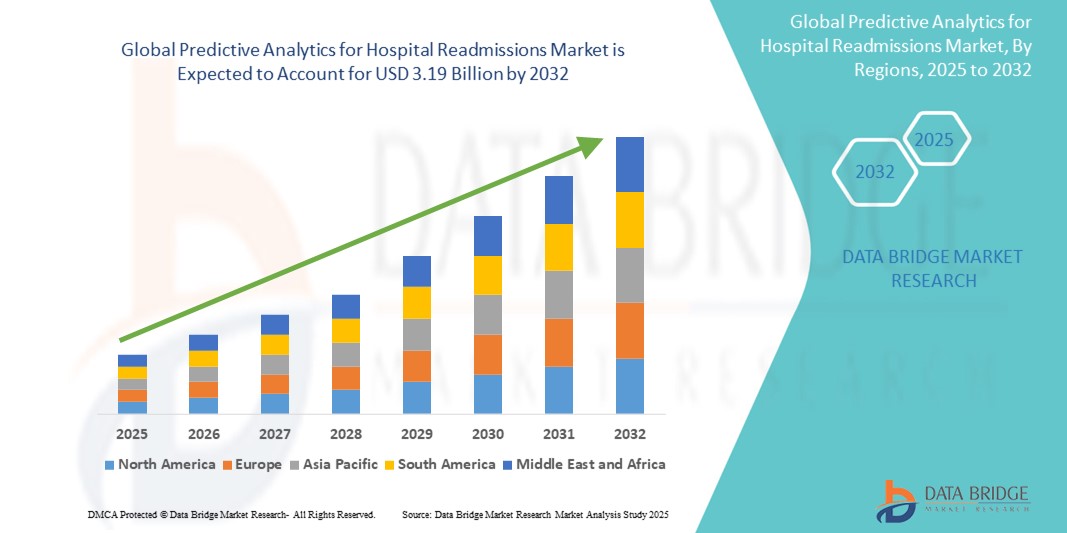
- The global predictive analytics for hospital readmissions market size was valued at USD 1.18 billion in 2024 and is expected to reach USD 3.19 billion by 2032, at a CAGR of 13.30% during the forecast period
- The market growth is largely fueled by the growing adoption and technological progress within healthcare IT and data analytics, leading to increased digitalization across hospital systems and clinical settings
- Furthermore, rising healthcare costs and the need to reduce avoidable readmissions are establishing predictive analytics as the essential solution for hospital readmission management. These converging factors are accelerating the uptake of Predictive Analytics for Hospital Readmissions solutions, thereby significantly boosting the industry's growth
Predictive Analytics for Hospital Readmissions Market Analysis
- Predictive analytics tools, which leverage artificial intelligence (AI) and machine learning algorithms, are becoming increasingly vital in reducing hospital readmission rates by identifying at-risk patients and enabling timely interventions. These technologies are being integrated into electronic health records (EHRs) and care management platforms to support both clinical and operational decision-making
- The rising demand for predictive analytics in healthcare is primarily fueled by the growing burden of chronic diseases, increasing healthcare costs, and a global emphasis on value-based care models that penalize unnecessary readmissions
- North America dominated the predictive analytics for hospital readmissions market with the largest revenue share of 42.7% in 2024, driven by advanced healthcare infrastructure, robust adoption of health IT systems, and strong regulatory support for quality outcomes. In particular, the U.S. has experienced substantial growth in the deployment of predictive analytics platforms across hospitals and accountable care organizations (ACOs), fueled by Centers for Medicare & Medicaid Services (CMS) readmission penalties and increasing focus on population health management
- Asia-Pacific is expected to be the fastest growing region in the predictive analytics for hospital readmissions market during the forecast period, projected to register a CAGR of 19.3% from 2025 to 2032. Factors contributing to this growth include rising investments in healthcare digitization, expanding hospital networks, and the growing need for efficient resource utilization in densely populated countries such as China and India
- The cloud-based segment dominated the predictive analytics for hospital readmissions market with a market share of 61.8% in 2024, owing to benefits such as flexibility, remote access, and seamless integration with hospital systems. The growing shift toward cloud infrastructure in healthcare is enabling real-time data analytics, cost-effective scalability, and enhanced interoperability across electronic health records (EHRs) and predictive platforms, thereby driving the widespread adoption of cloud-based solutions
Report Scope and Predictive Analytics for Hospital Readmissions Market Segmentation
|
Attributes |
Predictive Analytics for Hospital Readmissions Key Market Insights |
|
Segments Covered |
|
|
Countries Covered |
North America
Europe
Asia-Pacific
Middle East and Africa
South America
|
|
Key Market Players |
|
|
Market Opportunities |
|
|
Value Added Data Infosets |
In addition to the insights on market scenarios such as market value, growth rate, segmentation, geographical coverage, and major players, the market reports curated by the Data Bridge Market Research also include in-depth expert analysis, pricing analysis, brand share analysis, consumer survey, demography analysis, supply chain analysis, value chain analysis, raw material/consumables overview, vendor selection criteria, PESTLE Analysis, Porter Analysis, and regulatory framework. |
Predictive Analytics for Hospital Readmissions Market Trends
“Accelerated Adoption Due to Technological Advancements and Workflow Automation”
- A significant and accelerating trend in the global predictive analytics for hospital readmissions market is the growing integration of advanced technologies within clinical decision-making and care management systems. These enhancements are dramatically improving efficiency, accuracy, and operational ease across healthcare settings
- For instance, solutions developed by IBM Watson Health and SAS Health Analytics are being integrated into hospital IT ecosystems, offering predictive insights that assist providers in identifying high-risk patients more accurately and promptly. These tools support proactive care planning and resource optimization to reduce unnecessary readmissions
- Predictive models embedded in hospital workflows can learn from historical health records and patient behavior patterns, allowing for customized recommendations and alerts that guide timely interventions. This level of intelligence contributes to improved patient outcomes and reduced operational costs for healthcare providers
- The convergence of analytics platforms with electronic health records (EHRs), telehealth solutions, and remote monitoring systems is fostering a seamless data exchange environment. Through centralized dashboards, healthcare professionals can manage risk assessments, care coordination, and post-discharge follow-up programs efficiently
- This evolution toward more intuitive, interoperable, and scalable predictive systems is transforming hospital readmission strategies. Consequently, companies such as Epic Systems and Cerner are enhancing their analytics offerings to align with hospital needs for actionable insights and patient-centric solutions
- The rising demand for healthcare tools that promote clinical efficiency and reduce readmission penalties is accelerating the adoption of predictive analytics solutions across hospitals, long-term care facilities, and home healthcare settings. Healthcare stakeholders increasingly prioritize such innovations to comply with policy mandates and value-based care models
Predictive Analytics for Hospital Readmissions Market Dynamics
Driver
“Growing Need Due to Rising Readmission Rates and Demand for Value-Based Care”
- The increasing financial and clinical burden of hospital readmissions, especially among patients with chronic conditions, has prompted healthcare providers and payers to seek predictive analytics tools for early risk identification and proactive intervention
- For instance, in April 2024, Onity, Inc. (Honeywell International, Inc.) announced advancements in healthcare IoT solutions aimed at improving inpatient monitoring systems, reflecting the broader industry push toward integrating predictive analytics into clinical workflows
- As healthcare systems shift toward value-based reimbursement models, reducing avoidable readmissions has become a key performance metric. Predictive analytics solutions offer insights based on historical and real-time patient data—such as demographics, comorbidities, medication adherence, and post-discharge behavior—to flag high-risk individuals
- Furthermore, the growing integration of electronic health records (EHRs), wearable health tech, and remote patient monitoring tools is enhancing the quality and breadth of data available for predictive modeling, driving market adoption
- Healthcare providers are increasingly turning to predictive analytics to improve discharge planning, personalize follow-up care, and allocate resources more efficiently—resulting in improved patient outcomes and reduced penalties under programs such as the Hospital Readmissions Reduction Program (HRRP)
Restraint/Challenge
“Data Privacy, Integration Complexity, and High Implementation Costs”
- Concerns over data privacy and security present a major challenge to the adoption of predictive analytics in hospital settings. Handling sensitive patient data requires compliance with strict regulations such as HIPAA (in the U.S.) and GDPR (in Europe), making robust encryption and access control mechanisms essential
- Moreover, many hospitals face interoperability issues due to fragmented health IT systems. Integrating predictive analytics platforms with diverse EHR systems and clinical workflows can be time-consuming and costly, especially for underfunded or rural healthcare facilities
- While cloud-based analytics tools are emerging as more scalable alternatives, the initial setup costs—including training, infrastructure upgrades, and vendor subscriptions—remain a barrier for smaller hospitals
- To gain broader acceptance, vendors must focus on providing interoperable, cost-effective, and easy-to-implement solutions, while ensuring transparent data governance and compliance support. Government funding and public-private partnerships can also play a crucial role in easing the financial burden of adoption
Predictive Analytics for Hospital Readmissions Market Scope
The Predictive Analytics for Hospital Readmissions Market is segmented into four notable categories based on component type, delivery mode, end user, and application.
• By Component Type
On the basis of component type, the predictive analytics for hospital readmissions market is segmented into software, services, and hardware. The software segment dominated the largest market revenue share of 45.3% in 2024, driven by increasing demand for advanced data analytics tools to monitor patient health and anticipate readmissions.
The services segment is anticipated to witness the fastest growth rate of 22.6% CAGR from 2025 to 2032, attributed to rising demand for training, consulting, and integration services.
• By Delivery Mode
On the basis of delivery mode, the predictive analytics for hospital readmissions market is segmented into cloud-based and on-premise solutions. The cloud-based segment held the largest revenue share of 61.8% in 2024, owing to benefits such as flexibility, remote access, and ease of integration with hospital systems.
The on-premise segment is anticipated to witness the fastest growth rate during the forecast period, preferred by large institutions concerned with data control and regulatory compliance.
• By End User
On the basis of end user, the predictive analytics for hospital readmissions market is segmented into hospitals, clinics, ambulatory surgical centers, and others. The hospitals segment captured the largest revenue share of 58.6% in 2024, due to high patient volumes, stricter readmission penalties, and stronger budgets for predictive technologies.
The ambulatory surgical centers segment is projected to grow at the fastest CAGR of 23.1% from 2025 to 2032, as they increasingly adopt tech-enabled patient follow-ups.
• By Application
On the basis of application, the predictive analytics for hospital readmissions market is segmented into chronic disease management, surgical recovery tracking, mental health readmission prevention, elderly care monitoring, and others. The chronic disease management segment dominated with a market share of 39.5% in 2024, driven by the need to manage readmissions related to heart disease, diabetes, and COPD.
The surgical recovery tracking segment is anticipated to witness the fastest growth rate during the forecast period, as post-operative complications remain a leading cause of unplanned readmissions.
Predictive Analytics for Hospital Readmissions Market Regional Analysis
- North America dominated the predictive analytics for hospital readmissions market with the largest revenue share of 42.7% in 2024, driven by the increasing demand for AI-enabled risk assessment tools, growing pressure to reduce healthcare costs, and strong government support for digital health solutions
- The widespread integration of predictive tools into Electronic Health Records (EHRs) and value-based care programs is further propelling market growth in this region
- The regional market benefits from a mature healthcare IT infrastructure, robust reimbursement frameworks, and proactive healthcare providers seeking to reduce avoidable hospital readmissions through early intervention strategies
U.S. Predictive Analytics for Hospital Readmissions Market Insight
The U.S. predictive analytics for hospital readmissions market captured the largest revenue share of 83% within North America in 2024. This dominance is attributed to initiatives by CMS (Centers for Medicare & Medicaid Services) penalizing hospitals for excessive readmissions, which has spurred widespread adoption of predictive analytics platforms. Leading players such as Epic Systems, IBM Watson Health, and Cerner are heavily investing in AI and machine learning tools designed to improve patient outcomes while reducing costs.
Europe Predictive Analytics for Hospital Readmissions Market Insight
The Europe predictive analytics for hospital readmissions market is projected to expand at a substantial CAGR throughout the forecast period, supported by stricter hospital performance regulations and an increasing need for cost containment across national health services. Countries such as Germany, France, and the U.K. are investing in digital health transformation, which includes predictive analytics to improve clinical decision-making and reduce hospital stay durations. Interoperability initiatives and collaborative research programs across the EU also contribute to market acceleration.
U.K. Predictive Analytics for Hospital Readmissions Market Insight
The U.K. predictive analytics for hospital readmissions market is anticipated to grow at a noteworthy CAGR during the forecast period. Government-led efforts such as the NHS Long Term Plan emphasize predictive modeling and risk stratification tools to proactively manage chronic diseases and reduce readmission rates. The increasing availability of real-time patient data and cloud-based analytics platforms is supporting faster adoption across public and private hospitals.
Germany Predictive Analytics for Hospital Readmissions Market Insight
The Germany predictive analytics for hospital readmissions market is expected to expand at a considerable CAGR during the forecast period, driven by a strong focus on healthcare digitalization, aging population, and the need for proactive chronic care management. Local companies are collaborating with tech providers to develop predictive models using real-world evidence (RWE), enhancing risk prediction accuracy and boosting market penetration in academic medical centers and regional hospitals.
Asia-Pacific Predictive Analytics for Hospital Readmissions Market Insight
The Asia-Pacific predictive analytics for hospital readmissions market is projected to witness the fastest CAGR of 19.3% from 2025 to 2032, supported by rising investments in healthcare infrastructure, growing disease burden, and digital transformation initiatives in countries such as China, India, Japan, and South Korea. The region is seeing increased interest in remote monitoring, AI-powered triage, and mobile health apps that leverage predictive analytics to reduce hospital revisits.
Japan Predictive Analytics for Hospital Readmissions Market Insight
The Japan predictive analytics for hospital readmissions market is gaining significant traction due to its rapidly aging population, rising healthcare costs, and strong government push for AI integration in clinical settings. With a projected CAGR of 21.8%, Japan is leveraging advanced predictive platforms to optimize discharge planning and long-term care strategies. Collaborations between hospitals and technology companies are further enhancing market maturity.
China Predictive Analytics for Hospital Readmissions Market Insight
China predictive analytics for hospital readmissions market accounted for the largest revenue share of 41.3% in the Asia-Pacific market in 2024. This leadership is driven by national digital health initiatives, investments in smart hospital infrastructure, and a strong ecosystem of local tech innovators. Predictive analytics is widely used in tertiary hospitals for managing high-risk patients, particularly in cardiology, oncology, and post-surgical care. Government-backed projects are promoting AI integration to manage rural healthcare disparities and streamline readmission workflows.
Predictive Analytics for Hospital Readmissions Market Share
The predictive analytics for hospital readmissions industry is primarily led by well-established companies, including:
- IBM Corporation (U.S.)
- SAS Institute Inc. (U.S.)
- Optum, Inc. (U.S.)
- Cerner Corporation (U.S.)
- Epic Systems Corporation (U.S.)
- Allscripts Healthcare Solutions, Inc. (U.S.)
- Health Catalyst (U.S.)
- Oracle Corporation (U.S.)
- Veradigm (U.S.)
- Change Healthcare (U.S.)
- 3M (U.S.)
- MedeAnalytics, Inc. (U.S.)
- Inovalon Holdings, Inc. (U.S.)
- Cognizant Technology Solutions (U.S.)
- Philips Healthcare (Netherlands)
Latest Developments in Global Predictive Analytics for Hospital Readmissions Market
- In April 2025, the National Institutes of Health (NIH) funded a clinical study that introduced an AI-based screening tool to reduce hospital readmissions related to opioid use disorder. The tool achieved a 47% reduction in 30-day readmission odds and saved over USD 100,000 in hospital costs during the study. This validates the potential of predictive analytics in improving care transitions and targeting high-risk patients
- In March 2025, Mount Sinai Health System implemented a real-time predictive model that integrates with patient electronic health records to proactively manage post-discharge care. This reduced readmission rates by 10%, enabling better care coordination and patient monitoring through data-driven insights
- In February 2025, a safety-net hospital in California used predictive AI and automated care workflows to decrease readmissions from 27.9% to 23.9%, while eliminating racial disparities in discharge quality. The program retained USD 7.2 million in performance-based funding and was hailed as a replicable model for vulnerable population
- In April 2025, Campbellford Memorial Hospital (Canada) launched the “Smart Discharge” program, using cloud-based predictive analytics to identify high-risk rural patients for home-based post-discharge follow-up. The initiative aims to reduce avoidable readmissions and improve healthcare accessibility in remote communities
- In January 2025, healthcare AI company Jvion expanded partnerships with multiple U.S. hospitals to deploy its machine-learning-powered "Clinical AI Readmission Risk" platform. The solution analyzes over 4,500 variables to predict readmissions and recommend targeted interventions, significantly enhancing operational and clinical decision-making

- Interactive Data Analysis Dashboard
- Company Analysis Dashboard for high growth potential opportunities
- Research Analyst Access for customization & queries
- Competitor Analysis with Interactive dashboard
- Latest News, Updates & Trend analysis
- Harness the Power of Benchmark Analysis for Comprehensive Competitor Tracking
Data collection and base year analysis are done using data collection modules with large sample sizes. The stage includes obtaining market information or related data through various sources and strategies. It includes examining and planning all the data acquired from the past in advance. It likewise envelops the examination of information inconsistencies seen across different information sources. The market data is analysed and estimated using market statistical and coherent models. Also, market share analysis and key trend analysis are the major success factors in the market report. To know more, please request an analyst call or drop down your inquiry.
The key research methodology used by DBMR research team is data triangulation which involves data mining, analysis of the impact of data variables on the market and primary (industry expert) validation. Data models include Vendor Positioning Grid, Market Time Line Analysis, Market Overview and Guide, Company Positioning Grid, Patent Analysis, Pricing Analysis, Company Market Share Analysis, Standards of Measurement, Global versus Regional and Vendor Share Analysis. To know more about the research methodology, drop in an inquiry to speak to our industry experts.
Data Bridge Market Research is a leader in advanced formative research. We take pride in servicing our existing and new customers with data and analysis that match and suits their goal. The report can be customized to include price trend analysis of target brands understanding the market for additional countries (ask for the list of countries), clinical trial results data, literature review, refurbished market and product base analysis. Market analysis of target competitors can be analyzed from technology-based analysis to market portfolio strategies. We can add as many competitors that you require data about in the format and data style you are looking for. Our team of analysts can also provide you data in crude raw excel files pivot tables (Fact book) or can assist you in creating presentations from the data sets available in the report.













