


What is the Predictive Diagnostic Software Market Size and Growth Rate?
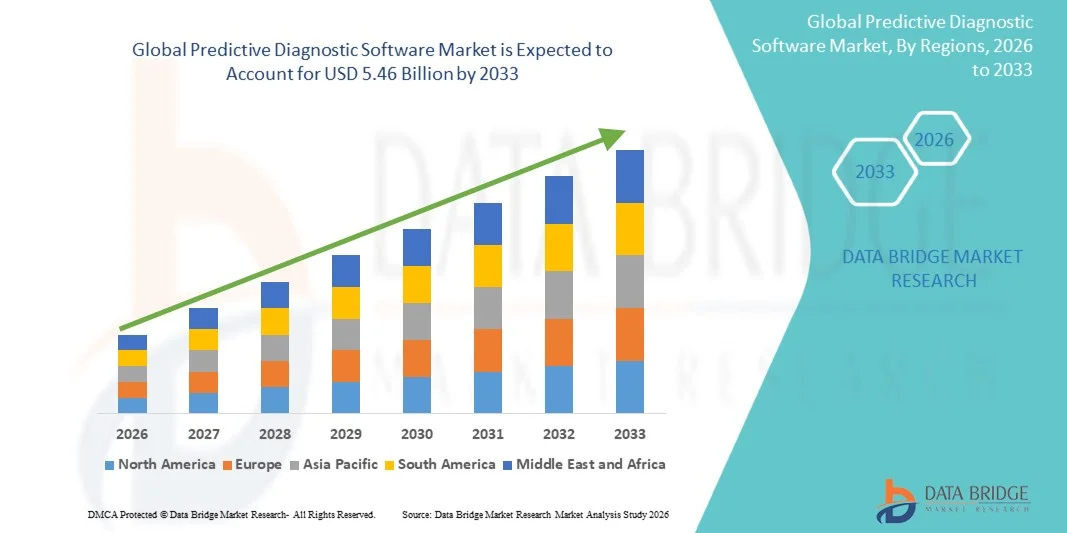
- As per Data Bridge Market Research analysis, the predictive diagnostic software market was valued at USD 1.44 billion in 2025 and is projected to reach USD 5.46 billion by 2033, growing at a CAGR of 18.15% from 2026 to 2033.
- The market is experiencing consistent growth driven by expanding availability of multimodal clinical data, increasing integration of predictive models into electronic health record workflows, the shift toward proactive and value-based care, and growing adoption of cloud and artificial intelligence infrastructure.
- The increasing availability of electronic health records, genomic information, medical imaging, laboratory data, and connected-device information is enabling healthcare providers to identify patient risks and potential diseases earlier. Predictive diagnostic software is increasingly being integrated into clinical workflows for risk stratification, early-warning systems, remote patient monitoring, and clinical decision support, while advances in AI and cloud-based technologies are expanding its use across hospitals, healthcare providers, and life sciences organizations.
Market Size & Forecast
- Global Market Value (2025): USD 1.44 Billion
- Expected Market Value (2033): USD 5.46 Billion
- Forecast CAGR (2026–2033): 18.15%
- Leading Region in 2025: North America
- Fastest Growing Region: Asia Pacific
What are the Major Takeaways of the Predictive Diagnostic Software Market?
- North America dominated the predictive diagnostic software market with the largest revenue share of 41.1% in 2025, supported by high electronic health record adoption, risk-based healthcare models, and a well-established clinical artificial intelligence ecosystem.
- Asia-Pacific is expected to be the fastest-growing region at a CAGR of 19.5% from 2026 to 2033, fueled by expanding healthcare digitization, increasing availability of clinical data, and rising adoption of predictive technologies across healthcare systems.
- The predictive diagnostic software platforms segment led the market with a 34.5% share in 2025, driven by increasing preference of healthcare organizations for integrated software environments that combine data ingestion, predictive models, clinical workflows, and model governance.
- Predictive monitoring and early-warning applications are the fastest-growing product & offering type projected to register a CAGR of 18.6%, reflecting the surge in demand for continuous monitoring and earlier identification of patient deterioration.
- The predictive analytics segment dominated the function category with a 31.8% revenue share in 2025, led by its extensive application in forecasting disease progression, patient risks, and potential clinical events.
- Electronic health records and clinical notes accounted for 38.2% of the market share in 2025, preferred by the extensive availability of longitudinal patient information within electronic healthcare systems.
- The edge and embedded deployment segment is the fastest-growing deployment category, with a CAGR of 19.3%, driven by increasing demand for real-time predictive analysis close to the point where healthcare data is generated.
Report Scope and Predictive Diagnostic Software Market Segmentation
|
Attributes |
Predictive Diagnostic Software Key Market Insights |
|
Segments Covered |
|
|
Countries Covered |
North America
Europe
Asia-Pacific
Middle East and Africa
South America
|
|
Key Market Players |
|
|
Market Opportunities |
|
|
Value Added Data Infosets |
In addition to the insights on market scenarios such as market value, growth rate, segmentation, geographical coverage, and major players, the market reports curated by the Data Bridge Market Research also include in-depth expert analysis, patient epidemiology, pipeline analysis, pricing analysis, and regulatory framework. |
What is the Key Trend in the Predictive Diagnostic Software Market?
- Predictive diagnostic software is increasingly shifting healthcare from reactive diagnosis toward proactive risk identification by combining artificial intelligence with electronic health records, medical imaging, laboratory results, genomic information, and remote monitoring data
- For instance, in September 2024, AstraZeneca introduced MILTON, a machine-learning technology capable of predicting more than 1,000 diseases using routine clinical biomarkers and other biological data, demonstrating the growing use of predictive analytics for identifying disease risks before diagnosis
- Real-time predictive analytics enables clinicians to identify deterioration, disease risks, and abnormal patterns earlier, supporting faster intervention and more personalized care.
- Healthcare providers are also integrating predictive models into cloud-based platforms and clinical workflows to improve accessibility, scalability, and continuous patient monitoring.
- The increasing use of multimodal healthcare data is enabling predictive software to combine clinical histories, diagnostic results, physiological measurements, and other patient information for more comprehensive risk assessment.
- For instance, in October 2024, researchers at Imperial College London and Imperial College Healthcare NHS Trust reported an AI model called AIRE that analyzes ECG data to predict patients' risks of developing or worsening disease and early death, highlighting the expansion of predictive software into cardiovascular diagnostics
- As healthcare systems continue prioritizing earlier intervention and data-driven decision-making, predictive diagnostic software adoption is expected to accelerate across clinical environments and healthcare delivery settings.
What are the Key Drivers of the Predictive Diagnostic Software Market?
- The rapid growth of electronic health records and digitally generated clinical data is significantly increasing demand for predictive diagnostic software capable of converting large datasets into actionable risk insights.
- For instance, in April 2024, Prenosis received FDA De Novo marketing authorization for its Sepsis ImmunoScore, an AI/ML software that combines diagnostic and predictive capabilities to support rapid sepsis diagnosis and prediction, with integration into hospital electronic medical records.
- Hospitals, diagnostic providers, and healthcare technology companies are integrating predictive models into clinical decision-support systems to improve early detection, risk stratification, treatment planning, and patient monitoring.
- Increasing adoption of AI and machine learning is allowing healthcare organizations to analyze longitudinal patient information and identify disease patterns that may not be easily recognized through conventional diagnostic workflows.
- Growing demand for personalized and preventive healthcare is further encouraging providers to use predictive models for earlier diagnosis, patient deterioration monitoring, disease-risk assessment, and population health management.
- For instance, in June 2024, the U.S. FDA highlighted the expanding use of AI/ML-enabled medical devices across prevention, diagnosis, and treatment, noting that these software-based technologies can support clinical decision-making and earlier disease detection.
- With healthcare organizations increasingly seeking earlier diagnosis, personalized care, and efficient clinical workflows, the growing availability of structured and longitudinal patient data will remain a major driver of predictive diagnostic software adoption worldwide across hospitals, clinics, laboratories, insurers, and healthcare networks worldwide, supporting data-driven decisions.
Which Factors are Challenging the Growth of the Predictive Diagnostic Software Market?
- Limited data quality, model bias, interoperability challenges, and regulatory requirements can constrain the deployment of predictive diagnostic software because inaccurate or poorly validated predictions may affect clinical decision-making and patient safety.
- For instance, in November 2024, the FDA Digital Health Advisory Committee discussed concerns surrounding AI-enabled medical devices, including data privacy, liability for AI errors, clinical validation, and the risk that models trained on underrepresented populations may produce inaccurate results.
- Healthcare organizations must validate models across diverse populations, maintain transparent algorithms, protect sensitive patient information, and integrate software with existing clinical systems, increasing implementation complexity and costs.
- Differences in healthcare data formats and incomplete patient records can reduce the reliability and generalizability of predictive models across hospitals, geographic regions, and patient populations.
- Regulatory scrutiny can further extend development and deployment timelines for software providing diagnostic outputs or risk scores, particularly when systems influence clinical decisions or analyze medical images and patient-specific signals.
- For instance, in January 2024, the World Health Organization highlighted that AI systems used in healthcare can generate false, inaccurate, biased, or incomplete outputs and can create cybersecurity risks involving patient information, requiring stronger oversight and governance.
- These factors continue to slow adoption where clinical validation, data governance, cybersecurity, interoperability, and regulatory compliance requirements remain demanding for healthcare organizations.
How is the Predictive Diagnostic Software Market Segmented?
The predictive diagnostic software market is segmented on the basis of product & offering, function, data source, and deployment.
- By Product & Offering
On the basis of product & offering, the predictive diagnostic software market is segmented into predictive diagnostic software platforms, clinical decision support modules, diagnostic risk-stratification engines, predictive monitoring and early-warning applications, implementation, integration, and managed services, and maintenance, validation, and model-governance services. The predictive diagnostic software platforms segment dominated the market with a 34.5% share in 2025, owing to the increasing preference of healthcare organizations for integrated software environments that combine data ingestion, predictive models, clinical workflows, and model governance. These platforms allow providers to consolidate multiple predictive diagnostic functions within a unified infrastructure. They can integrate information from electronic health records, laboratory systems, imaging platforms, and connected devices. Their broad functionality reduces the need for multiple disconnected predictive tools across clinical departments. Integration capabilities also support expansion from individual pilot projects to enterprise-wide deployments.
The predictive monitoring and early-warning applications segment is projected to register the fastest growth at a CAGR of 18.6% from 2026 to 2033, driven by growing demand for continuous monitoring and earlier identification of patient deterioration. These applications analyze patient information continuously to identify potential clinical risks before they become severe. They are increasingly relevant for monitoring conditions such as sepsis, renal failure, and other acute complications. Integration with wearable devices, remote monitoring systems, and Internet of Medical Things technologies is expanding the availability of continuous physiological data. Predictive alerts can support healthcare professionals in prioritizing high-risk patients and initiating interventions earlier. Increasing adoption of connected healthcare technologies is creating additional demand for real-time predictive monitoring.
- By Function
On the basis of function, the predictive diagnostic software market is segmented into predictive analytics, diagnostic analytics, prescriptive analytics, cognitive analytics, risk scoring and stratification, and anomaly detection and early warning. The predictive analytics segment dominated the market with a 31.8% share in 2025, supported by its extensive application in forecasting disease progression, patient risks, and potential clinical events. Predictive analytics enables healthcare organizations to analyze historical and real-time clinical information to identify patterns associated with future outcomes. It is used across areas such as oncology, cardiology, and sepsis prediction. Established risk models can be incorporated into clinical workflows to support earlier intervention and patient management. Increasing availability of structured and unstructured healthcare data is creating additional opportunities for predictive modeling.
The cognitive analytics segment is projected to register the fastest growth at a CAGR of 18.4% from 2026 to 2033, driven by increasing integration of advanced artificial intelligence and language-model technologies into clinical reasoning. Cognitive analytics can combine patient context with multiple sources of clinical information to support more sophisticated diagnostic analysis. These capabilities extend predictive software beyond conventional risk scoring toward more complex clinical reasoning applications. Increasing availability of large healthcare datasets is supporting the development and training of advanced cognitive models. Integration with electronic health records can provide these systems with broader patient context during clinical assessment. Healthcare technology providers are also combining cognitive capabilities with predictive and prescriptive functions to connect risk identification with potential clinical actions.
- By Data Source
On the basis of data source, the predictive diagnostic software market is segmented into electronic health records and clinical notes, medical imaging and radiology data, laboratory and pathology data, genomic and multi-omic data, claims and billing data, wearable, remote monitoring, and Internet of Medical Things data, and social, behavioral, and environmental data. The electronic health records and clinical notes segment dominated the market with a 38.2% share in 2025, owing to the extensive availability of longitudinal patient information within electronic healthcare systems. EHRs can provide diagnoses, medications, laboratory results, procedures, clinical histories, and other information required for predictive modeling. Predictive software can analyze these records to identify disease risks and support clinical decision-making. Clinical notes also contain unstructured information that can increasingly be processed using natural-language-processing technologies. Integration with existing hospital information systems makes EHR-based data readily accessible for predictive applications.
The genomic and multi-omic data segment is projected to register the fastest growth at a CAGR of 18.4% from 2026 to 2033, driven by increasing use of molecular information for personalized and predictive healthcare. Genomic and multi-omic datasets can provide detailed information about genetic, molecular, and biological characteristics associated with disease risk. Predictive software can combine this information with clinical records to improve patient stratification and disease-risk assessment. Growing adoption of precision medicine is increasing demand for software capable of processing complex molecular datasets. Advances in sequencing and bioinformatics are also expanding the availability of genomic information for clinical and research applications. Pharmaceutical and biotechnology organizations are using predictive models to support patient selection and clinical development activities.
- By Deployment
On the basis of deployment, the predictive diagnostic software market is segmented into on-premises, cloud-based, hybrid, and edge and embedded deployment. The cloud-based segment dominated the market with a 48.6% share in 2025, owing to its scalability, centralized processing capabilities, and suitability for handling large healthcare datasets. Cloud-based deployment allows healthcare organizations to access predictive software without maintaining extensive local computing infrastructure. It can support centralized model updates, data processing, and integration across multiple healthcare facilities. Cloud infrastructure also provides the computing resources required for increasingly sophisticated artificial intelligence models. Integration with electronic health records, remote monitoring systems, and other digital healthcare platforms further supports cloud adoption. Healthcare organizations can also expand predictive applications across departments without requiring equivalent expansion of on-site infrastructure.
The edge and embedded deployment segment is projected to register the fastest growth at a CAGR of 19.3% from 2026 to 2033, driven by increasing demand for real-time predictive analysis close to the point where healthcare data is generated. Edge and embedded systems can process information locally rather than relying entirely on centralized cloud infrastructure. This capability can reduce latency and support rapid identification of abnormal patient conditions. It is particularly relevant for connected medical devices, wearable technologies, remote monitoring equipment, and diagnostic systems requiring immediate analysis. Local processing can also reduce the amount of sensitive clinical information transmitted across networks. Advances in compact computing hardware and optimized artificial intelligence models are making edge-based predictive applications increasingly practical.
Which Region Holds the Largest Share of the Predictive Diagnostic Software Market?
- North America dominated the predictive diagnostic software market with the largest revenue share of 41.1% in 2025, supported by high electronic health record adoption, risk-based healthcare models, and a well-established clinical artificial intelligence ecosystem.
- The region also benefits from substantial healthcare technology investments, widespread adoption of AI-enabled clinical tools, and the presence of established healthcare software and technology providers. Increasing use of predictive analytics for early risk identification, clinical decision support, and patient monitoring continues to strengthen North America’s leadership position in the global market.
U.S. Predictive Diagnostic Software Market Insight
The U.S. predictive diagnostic software market is witnessing strong growth due to rising investments in artificial intelligence-enabled healthcare, electronic health records, and advanced clinical decision-support technologies. The country’s mature healthcare IT ecosystem, along with increasing adoption of predictive analytics, machine learning, and cloud-based healthcare platforms, is driving demand across hospitals, diagnostic centers, and research institutions. In addition, growing emphasis on early disease detection, personalized care, and improving clinical outcomes is accelerating the adoption of predictive diagnostic software across healthcare providers.
Asia-Pacific Predictive Diagnostic Software Market Insight
The Asia-Pacific predictive diagnostic software market is expected to witness rapid growth, driven by increasing healthcare digitization, expanding electronic health record infrastructure, and rising investments in artificial intelligence technologies across countries such as China, India, and Japan. Growing demand for early disease detection, remote patient monitoring, and data-driven clinical decision-making is supporting regional market expansion. Additionally, increasing healthcare expenditure, expanding digital health initiatives, and the growing adoption of cloud-based healthcare solutions are accelerating predictive diagnostic software adoption across hospitals, diagnostic centers, and research institutions.
Japan Predictive Diagnostic Software Market Insight
The Japan predictive diagnostic software market is witnessing consistent growth due to rising investments in healthcare digitalization, artificial intelligence, and advanced diagnostic technologies. Healthcare providers, research institutions, and technology companies are increasingly adopting predictive software for disease-risk assessment, clinical decision support, and early detection applications. Moreover, increasing integration of electronic health records, medical imaging, and remote monitoring technologies, along with Japan’s focus on efficient and technology-enabled healthcare delivery, is further contributing to market growth.
China Predictive Diagnostic Software Market Insight
The China predictive diagnostic software market is growing rapidly, driven by increasing healthcare digitalization, expanding medical data infrastructure, and rising government focus on artificial intelligence-enabled healthcare. Growing adoption of predictive analytics and AI-based diagnostic platforms across hospitals, research institutions, and healthcare technology companies is significantly boosting market demand. In addition, rising investments in smart healthcare infrastructure, increasing use of electronic health records, and rapid advancements in medical AI technologies are positioning China as one of the fastest-growing markets for predictive diagnostic software globally.
U.K. Predictive Diagnostic Software Market Insight
The U.K. predictive diagnostic software market is experiencing steady growth, supported by rising adoption of artificial intelligence, digital health technologies, and predictive analytics across healthcare services. Increasing investments in healthcare data infrastructure and growing demand for early disease detection and clinical decision-support solutions are contributing to market growth. Furthermore, integration of AI with electronic health records, medical imaging, and patient-monitoring systems is improving predictive capabilities and diagnostic efficiency, positioning the U.K. as a key innovation hub in the predictive diagnostic software industry.
Germany Predictive Diagnostic Software Market Insight
The Germany predictive diagnostic software market is expanding steadily due to the country’s advanced healthcare infrastructure, strong research capabilities, and increasing adoption of digital diagnostic technologies. Hospitals, healthcare organizations, research institutes, and technology companies are increasingly utilizing predictive software for risk assessment, early disease detection, and clinical decision support. Continuous advancements in artificial intelligence, healthcare data analytics, and interoperable digital systems, along with strong focus on healthcare innovation and data-driven medical care, are further driving market growth in Germany.
Which are the Top Companies in Predictive Diagnostic Software Market?
The predictive diagnostic software industry is primarily led by well-established companies, including:
- IBM Corporation (U.S.)
- Microsoft Corporation (U.S.)
- Oracle (U.S.)
- SAS Institute Inc. (U.S.)
- Epic Systems Corporation (U.S.)
- GE HealthCare (U.S.)
- Koninklijke Philips N.V. (Netherlands)
- Siemens Healthineers AG (Germany)
- Tempus AI, Inc. (U.S.)
- Aidoc (U.S.)
- Viz.ai, Inc. (U.S.)
- Heartflow, Inc. (U.S.)
- Health Catalyst (U.S.)
- Komodo Health, Inc. (U.S.)
- Owkin, Inc (France)
- Qure.ai Technologies Private Limited (India)
- Paige AI, Inc. (U.S.)
- PathAI, Inc. (U.S.)
- Eko Health, Inc. (U.S.)
- Lunit Inc. (South Korea)
What are Latest Developments in Predictive Diagnostic Software Market?
- In July 2025, AliveCor launched its Kardia 12L ECG system in India, an AI-powered handheld 12-lead ECG system designed to detect serious cardiac conditions, including acute myocardial infarction and cardiac ischemia. The system uses AI to provide multiple cardiac determinations and received regulatory approval for use in India, expanding access to AI-supported cardiac diagnosis across healthcare settings.
- In July 2024, WELL Health Technologies launched an AI-powered co-pilot for cardiologists, powered by HEALWELL AI, to help identify patients at high risk of cardiovascular disease. The solution was deployed across WELL Diagnostic Centres in Ontario and expanded the company's AI Decision Support offering into cardiovascular disease detection, demonstrating the growing use of predictive AI within clinical diagnostic workflows.
- In April 2024, GE HealthCare launched Caption AI software on its Vscan Air SL wireless handheld ultrasound system, providing real-time guidance for acquiring diagnostic-quality cardiac images and automatically estimating ejection fraction. The technology was developed to help more clinicians perform rapid cardiac assessments and support clinical decision-making at the point of care.
- In February 2023, Apollo Hospitals launched its Clinical Intelligence Engine (CIE), an AI- and machine-learning-based clinical decision-support tool available to doctors through the Apollo 24|7 platform. The system analyzes large volumes of healthcare data to identify patterns that may otherwise be missed and is designed to support diagnosis, condition management, primary care, and other clinical decisions.
- In May 2021, Quest Diagnostics and Paige announced a collaboration to advance AI-generated pathology insights for cancer diagnosis and care. The collaboration involved applying Paige's machine-learning capabilities to Quest's digital pathology data with the objective of developing regulatory-approved software products that could support pathologists and oncologists in diagnosing cancer and other diseases.

- Interactive Data Analysis Dashboard
- Company Analysis Dashboard for high growth potential opportunities
- Research Analyst Access for customization & queries
- Competitor Analysis with Interactive dashboard
- Latest News, Updates & Trend analysis
- Harness the Power of Benchmark Analysis for Comprehensive Competitor Tracking
Data collection and base year analysis are done using data collection modules with large sample sizes. The stage includes obtaining market information or related data through various sources and strategies. It includes examining and planning all the data acquired from the past in advance. It likewise envelops the examination of information inconsistencies seen across different information sources. The market data is analysed and estimated using market statistical and coherent models. Also, market share analysis and key trend analysis are the major success factors in the market report. To know more, please request an analyst call or drop down your inquiry.
The key research methodology used by DBMR research team is data triangulation which involves data mining, analysis of the impact of data variables on the market and primary (industry expert) validation. Data models include Vendor Positioning Grid, Market Time Line Analysis, Market Overview and Guide, Company Positioning Grid, Patent Analysis, Pricing Analysis, Company Market Share Analysis, Standards of Measurement, Global versus Regional and Vendor Share Analysis. To know more about the research methodology, drop in an inquiry to speak to our industry experts.
Data Bridge Market Research is a leader in advanced formative research. We take pride in servicing our existing and new customers with data and analysis that match and suits their goal. The report can be customized to include price trend analysis of target brands understanding the market for additional countries (ask for the list of countries), clinical trial results data, literature review, refurbished market and product base analysis. Market analysis of target competitors can be analyzed from technology-based analysis to market portfolio strategies. We can add as many competitors that you require data about in the format and data style you are looking for. Our team of analysts can also provide you data in crude raw excel files pivot tables (Fact book) or can assist you in creating presentations from the data sets available in the report.













