


Predictive Population Health Analytics Services Market Overview
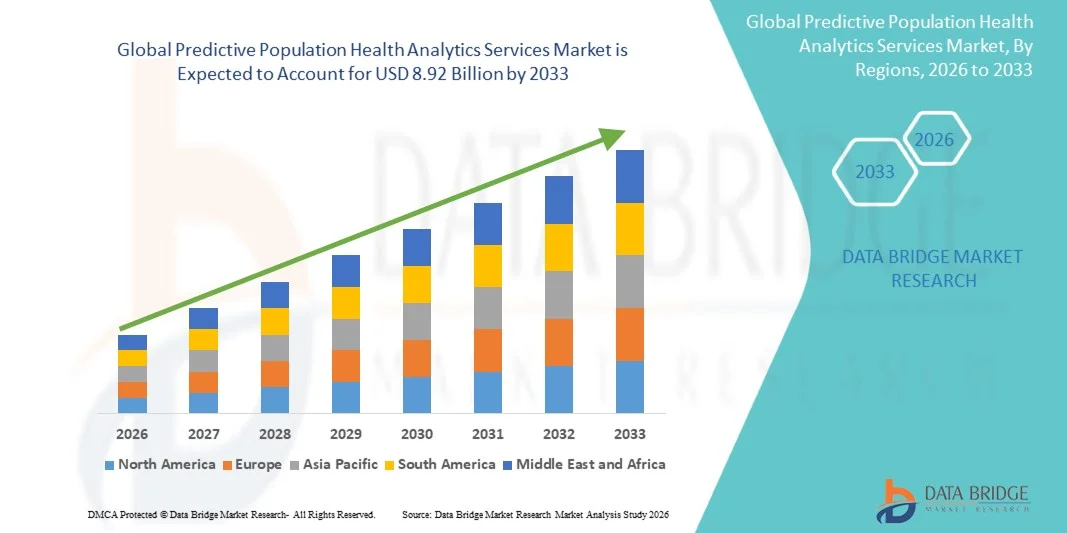
The Predictive Population Health Analytics Services Market was valued at USD 2.74 billion in 2025 and is projected to reach USD 8.92 billion by 2033, growing at a CAGR of 15.90% from 2026 to 2033. The market is experiencing steady growth driven by increasing adoption of data-driven healthcare strategies, rising demand for proactive patient care management, and expanding utilization of artificial intelligence and predictive analytics across healthcare systems.
The growing prevalence of chronic diseases worldwide, combined with escalating healthcare costs and the shift toward value-based care models, is encouraging healthcare providers, payers, and government agencies to invest in predictive population health analytics services. Advanced analytics platforms are increasingly being used to identify at-risk populations, optimize care coordination, reduce hospital readmissions, and improve clinical outcomes. In addition, the integration of electronic health records, real-time patient data, and machine learning technologies is enabling more accurate forecasting and personalized intervention strategies, supporting widespread adoption across healthcare organizations.
Key Market Trends & Insights
- North America dominated the Predictive Population Health Analytics Services Market with the largest revenue share of 39.82% in 2025, supported by widespread adoption of value-based care models, advanced healthcare IT infrastructure, and strong investments in healthcare analytics technologies.
- The Predictive Analytics Services segment led the market with a 34.86% share in 2025, driven by increasing demand for proactive healthcare management and early identification of high-risk patient populations.
- Asia-Pacific is expected to be the fastest-growing region at a CAGR of 14.1% from 2026 to 2033, fueled by rapid healthcare digitalization, expanding healthcare coverage, and growing investments in data-driven healthcare systems across China, India, and Southeast Asia.
- Population Risk Stratification Services are the fastest-growing service type, projected to register a CAGR of 15.2%, reflecting the surge in demand for precise patient segmentation and targeted care management programs
- The Predictive Analytics segment dominated the analytics type category with a 39.41% revenue share in 2025, led by its ability to forecast future health events, identify vulnerable populations, and support proactive clinical interventions.
- Population Health Management accounted for 31.74% of the market, preferred by increasing efforts to improve healthcare outcomes across large patient populations
- The Remote Patient Monitoring segment is the fastest-growing application category, with a CAGR of 16.1%, driven by the increasing adoption of digital health technologies and connected medical devices
Market Size & Forecast
- Global Market Value (2025): USD 2.74 Billion
- Expected Market Value (2033): USD 8.92 Billion
- Forecast CAGR (2026–2033): 15.90%
- Leading Region in 2025: North America
- Fastest Growing Region: Asia Pacific
Report Scope and Predictive Population Health Analytics Services Market Segmentation
|
Attributes |
Predictive Population Health Analytics Services Key Market Insights |
|
Segments Covered |
|
|
Countries Covered |
North America · U.S. · Canada · Mexico Europe · Germany · France · U.K. · Netherlands · Switzerland · Belgium · Russia · Italy · Spain · Turkey · Rest of Europe Asia-Pacific · China · Japan · India · South Korea · Singapore · Malaysia · Australia · Thailand · Indonesia · Philippines · Rest of Asia-Pacific Middle East and Africa · Saudi Arabia · U.A.E. · South Africa · Egypt · Israel · Rest of Middle East and Africa South America · Brazil · Argentina · Rest of South America |
|
Key Market Players |
· Oracle America, Inc. (U.S.) · Health Catalyst, Inc. (U.S.) · Innovaccer Inc. (U.S.) · Arcadia Solutions, LLC (U.S.) · Veradigm LLC (U.S.) · MedeAnalytics, Inc. (U.S.) · Cotiviti, Inc. (U.S.) · Lightbeam Health Solutions, Inc. (U.S.) · HealthEC, LLC (U.S.) · Conifer Health Solutions, LLC (U.S.) · Evolent Health LLC (U.S.) · Cedar Gate Technologies LLC (U.S.) · ZeOmega Inc. (U.S.) · Milliman, Inc. (U.S.) · Clinical Architecture, LLC (U.S.) · SPH Analytics, LLC (U.S.) · Jvion, Inc. (U.S.) · Inovalon, Inc. (U.S.) · CitiusTech Inc. (U.S.) · Persivia Inc. (U.S.) |
|
Market Opportunities |
· Expansion of value-based healthcare programs · Growing integration of social determinants of health (SDOH) data · Increasing adoption of AI-powered preventive care and remote patient monitoring initiatives |
|
Value Added Data Infosets |
In addition to the insights on market scenarios such as market value, growth rate, segmentation, geographical coverage, and major players, the market reports curated by the Data Bridge Market Research also include in-depth expert analysis, patient epidemiology, pipeline analysis, pricing analysis, and regulatory framework. |
Predictive Population Health Analytics Services Market Trends
Trend: Growing Adoption of AI-Driven Predictive Care Management
Healthcare providers and payers are increasingly adopting predictive population health analytics services to identify high-risk patient populations, forecast disease progression, and optimize preventive care interventions before costly complications occur. The integration of artificial intelligence and machine learning enables more accurate risk stratification, personalized treatment recommendations, and proactive outreach programs. Health systems and accountable care organizations are similarly leveraging analytics platforms to improve care coordination through standardized, data-driven population management strategies, while cloud-based technologies provide scalable environments that closely support real-world clinical decision-making processes.
For instance, in February 2025, Oracle Health expanded AI-powered population health capabilities within its healthcare analytics portfolio to help providers identify care gaps, predict patient risks, and improve population-wide health outcomes.
Predictive Population Health Analytics Services Market Dynamics
Key Market Driver: Rising Shift Toward Value-Based Care and Preventive Healthcare
The rapid transition toward value-based healthcare models and preventive care initiatives has created substantial demand for predictive population health analytics services that can identify at-risk individuals, optimize resource allocation, and improve patient outcomes across large populations. Healthcare providers, payers, and public health agencies are deploying analytics platforms as a core component of their care management strategies, reducing costs, enhancing intervention effectiveness, and improving quality performance metrics.
For instance, in January 2025, Health Catalyst strengthened its population health analytics offerings to support value-based care organizations with predictive insights, risk adjustment, and quality improvement programs.
Key Restraint/Challenge: Data Integration Complexity and Interoperability Limitations
A significant restraint in the Predictive Population Health Analytics Services Market is the complexity of integrating diverse healthcare datasets across fragmented systems. Modern analytics platforms require seamless access to electronic health records, claims databases, laboratory information systems, and patient-generated health data, demanding substantial investment in interoperability infrastructure and governance frameworks. The implementation burden extends to data standardization, privacy compliance, and ongoing system maintenance, making adoption difficult for smaller healthcare organizations and resource-constrained providers.
For instance, in 2024, several healthcare organizations across North America reported delays in population health analytics deployments due to challenges associated with integrating multi-source clinical and administrative datasets into unified analytics environments.
Key Market Opportunity: Expansion of AI-Powered Population Risk Stratification Platforms
The integration of artificial intelligence into population health analytics presents a significant market opportunity. AI-enabled platforms can identify emerging health risks, generate predictive insights for chronic disease management, and support personalized intervention planning across diverse patient populations. The development of cloud-native analytics solutions and real-time data integration capabilities is further democratizing access to advanced predictive services, opening growth opportunities across developing healthcare markets in Asia-Pacific, Latin America, and the Middle East.
For instance, in March 2025, Innovaccer expanded its AI-powered population health platform with enhanced predictive risk stratification and care management capabilities designed to improve preventive healthcare delivery and operational efficiency.
Predictive Population Health Analytics Services Market Scope
The predictive population health analytics services market is segmented on the basis of service type, analytics type, application, and end user.
- By Service Type
On the basis of service type, the Predictive Population Health Analytics Services Market is segmented into predictive analytics services, population risk stratification services, care management & coordination services, data integration & management services, patient engagement analytics services, clinical decision support services, and consulting, implementation & support services. The Predictive Analytics Services segment dominated the market with a 34.86% share in 2025, owing to increasing demand for proactive healthcare management and early identification of high-risk patient populations. Healthcare providers increasingly rely on predictive models to forecast disease progression, hospital admissions, and treatment outcomes. These services help organizations reduce healthcare costs while improving patient outcomes through timely interventions. Growing adoption of artificial intelligence and machine learning technologies is further enhancing prediction accuracy and operational efficiency. The segment also benefits from expanding use of electronic health records and real-time clinical data. Its ability to support value-based care initiatives continues to strengthen its market leadership globally.
The Population Risk Stratification Services segment is projected to register the fastest growth at a CAGR of 15.2% from 2026 to 2033, driven by rising demand for precise patient segmentation and targeted care management programs. These services enable healthcare organizations to categorize patient populations based on risk levels and clinical needs. Increasing prevalence of chronic diseases is encouraging providers and payers to invest in advanced risk assessment solutions. Continuous advancements in predictive modeling and data analytics are improving the effectiveness of risk stratification frameworks. Healthcare systems are increasingly using these services to optimize resource allocation and reduce avoidable healthcare expenditures. Growing emphasis on preventive healthcare and population health management is expected to accelerate segment growth.
- By Analytics Type
On the basis of analytics type, the Predictive Population Health Analytics Services Market is segmented into predictive analytics, prescriptive analytics, descriptive analytics, diagnostic analytics, and real-time analytics. The Predictive Analytics segment led the market with a 39.41% share in 2025, driven by its ability to forecast future health events, identify vulnerable populations, and support proactive clinical interventions. Healthcare organizations increasingly utilize predictive tools to reduce hospital readmissions and improve patient engagement. The technology enables data-driven decision-making by analyzing historical and real-time health information. Rising adoption of AI-powered healthcare platforms is further supporting segment expansion. Predictive analytics also plays a critical role in chronic disease management and value-based care programs. Its broad applicability across healthcare settings continues to reinforce its dominant position.
The Real-Time Analytics segment is expected to witness the fastest growth at a CAGR of 15.8% from 2026 to 2033, driven by increasing demand for immediate clinical insights and rapid decision-making capabilities. Real-time analytics solutions provide continuous monitoring of patient data, enabling faster responses to changing health conditions. Growing adoption of connected healthcare devices and remote patient monitoring technologies is fueling demand. These platforms improve care coordination and operational efficiency through instant access to actionable information. Advances in cloud computing and interoperability frameworks are enhancing real-time data processing capabilities. The growing focus on personalized and responsive healthcare delivery is expected to drive significant growth in this segment.
- By Application
On the basis of application, the Predictive Population Health Analytics Services Market is segmented into population health management, chronic disease management, risk stratification & patient segmentation, preventive care management, clinical workflow optimization, financial & operational analytics, remote patient monitoring, and readmission risk prediction. The Population Health Management segment dominated the market with a 31.74% share in 2025, driven by increasing efforts to improve healthcare outcomes across large patient populations. Healthcare organizations are utilizing predictive analytics to identify health trends, monitor population risks, and implement targeted intervention programs. The segment supports value-based healthcare initiatives by improving quality metrics and reducing unnecessary healthcare utilization. Expanding integration of clinical, financial, and social determinants of health data is enhancing analytical effectiveness. Government programs promoting preventive care are also contributing to adoption. Its central role in healthcare transformation continues to drive segment leadership.
The Remote Patient Monitoring segment is projected to register the fastest growth at a CAGR of 16.1% from 2026 to 2033, driven by the increasing adoption of digital health technologies and connected medical devices. Predictive analytics enhances remote monitoring by identifying early signs of patient deterioration and enabling timely interventions. Rising prevalence of chronic diseases and aging populations are creating substantial demand for continuous patient monitoring solutions. Healthcare providers are increasingly leveraging remote monitoring programs to improve care accessibility and reduce hospitalization rates. Advances in wearable devices and cloud-based analytics platforms are further accelerating adoption. Growing emphasis on home-based care models is expected to support rapid segment expansion.
- By End User
On the basis of end user, the Predictive Population Health Analytics Services Market is segmented into healthcare providers, healthcare payers, government & public health agencies, accountable care organizations, employer health programs, and research organizations. The Healthcare Providers segment led the market with a 44.27% share in 2025, driven by widespread adoption of predictive analytics to improve clinical outcomes and operational performance. Hospitals, physician groups, and integrated delivery networks increasingly utilize analytics services to identify at-risk patients and optimize care pathways. The segment benefits from growing investments in healthcare digitalization and data-driven decision-making. Predictive insights help providers reduce readmissions, improve resource utilization, and enhance patient engagement. Integration of analytics with electronic health records is further supporting adoption. Strong focus on value-based care continues to reinforce segment dominance.
The Government & Public Health Agencies segment is expected to witness the fastest growth at a CAGR of 14.7% from 2026 to 2033, driven by increasing investments in population health surveillance and preventive healthcare initiatives. Public health organizations are leveraging predictive analytics to monitor disease trends, identify vulnerable communities, and improve healthcare planning. The growing need for data-driven policy development is supporting adoption across national and regional healthcare systems. These solutions enable efficient allocation of public health resources and support early intervention programs. Rising emphasis on pandemic preparedness and chronic disease prevention is further accelerating demand. Expanding digital health infrastructure across emerging economies is expected to contribute significantly to segment growth.
Predictive Population Health Analytics Services Market Regional Analysis
North America dominated the Predictive Population Health Analytics Services Market with the largest revenue share of 39.82% in 2025, supported by widespread adoption of value-based care models, advanced healthcare IT infrastructure, and strong investments in healthcare analytics technologies. The region also benefits from extensive electronic health record adoption, high utilization of artificial intelligence and machine learning platforms, and growing deployment of predictive analytics across healthcare providers, payers, and public health organizations. Increasing focus on population health management, chronic disease prevention, and data-driven clinical decision-making continues to strengthen North America's leadership position in the global market.
U.S. Predictive Population Health Analytics Services Market Insight
The U.S. predictive population health analytics services market is witnessing strong growth due to rising investments in value-based healthcare programs, population health management initiatives, and advanced healthcare analytics technologies. The country’s mature healthcare IT ecosystem, along with increasing adoption of AI-powered, cloud-based, and predictive analytics platforms, is driving demand across providers, payers, and public health organizations. In addition, growing emphasis on reducing healthcare costs and improving patient outcomes is accelerating analytics adoption across hospitals, health systems, and insurance companies.
Europe Predictive Population Health Analytics Services Market Insight
The Europe predictive population health analytics services market remains a major contributor to global revenue, driven by strong government support, healthcare digitalization, and high demand for data-driven care management solutions. The widespread use of predictive analytics platforms in population health management, chronic disease monitoring, and preventive healthcare programs is supporting market expansion across the region. Increasing investments in artificial intelligence technologies, coupled with stringent healthcare quality regulations and advanced digital infrastructure, continue to enhance the adoption of predictive population health analytics services throughout Europe.
U.K. Predictive Population Health Analytics Services Market Insight
The U.K. predictive population health analytics services market is experiencing steady growth, supported by rising adoption of analytics technologies in population health management, clinical decision-making, and preventive care initiatives. Increasing investments in healthcare data infrastructure and growing demand for cost-effective, outcome-based healthcare solutions are contributing to market growth. Furthermore, integration of AI, machine learning, and real-time analytics technologies is improving predictive accuracy and care coordination efficiency, positioning the U.K. as a key innovation hub in the predictive healthcare analytics industry.
Germany Predictive Population Health Analytics Services Market Insight
The Germany predictive population health analytics services market is expanding steadily due to the country’s advanced healthcare infrastructure, strong digital health capabilities, and increasing adoption of next-generation analytics technologies. Healthcare providers, insurers, and research organizations are increasingly utilizing predictive analytics for patient risk assessment, care optimization, and population health management activities. Continuous advancements in artificial intelligence, machine learning, and healthcare interoperability solutions, along with strong government focus on healthcare innovation and efficiency, are further driving market growth in Germany.
Asia-Pacific Predictive Population Health Analytics Services Market Insight
The Asia-Pacific predictive population health analytics services market is expected to witness rapid growth, driven by increasing healthcare digitalization, expanding healthcare access, and rising investments in health information technology across countries such as China, India, and Japan. Growing awareness regarding preventive healthcare, rising adoption of advanced analytics technologies, and increasing demand for scalable and cost-effective healthcare solutions are supporting regional market expansion. In addition, the growing presence of digital health initiatives and healthcare modernization programs is accelerating analytics adoption across healthcare systems and public health agencies.
Japan Predictive Population Health Analytics Services Market Insight
The Japan predictive population health analytics services market is witnessing consistent growth due to rising investments in healthcare analytics technologies, digital transformation initiatives, and population health management programs. Healthcare providers, insurers, and research institutes are increasingly adopting predictive analytics platforms for disease forecasting, patient risk stratification, and healthcare planning purposes. Moreover, increasing integration of AI-driven technologies and the country’s focus on efficient and sustainable healthcare delivery models are further contributing to market growth.
China Predictive Population Health Analytics Services Market Insight
The China predictive population health analytics services market is growing rapidly, driven by increasing healthcare modernization, expanding digital health infrastructure, and rising government focus on preventive healthcare and population health management. Growing adoption of AI-enabled and cloud-based analytics platforms across hospitals, public health organizations, and insurance providers is significantly boosting market demand. In addition, rising investments in healthcare IT, increasing awareness regarding chronic disease prevention, and rapid technological advancements are positioning China as one of the fastest-growing markets for predictive population health analytics services globally.
Predictive Population Health Analytics Services Market Share
The predictive population health analytics services industry is primarily led by well-established companies, including:
- Oracle America, Inc. (U.S.)
- Health Catalyst, Inc. (U.S.)
- Innovaccer Inc. (U.S.)
- Arcadia Solutions, LLC (U.S.)
- Veradigm LLC (U.S.)
- MedeAnalytics, Inc. (U.S.)
- Cotiviti, Inc. (U.S.)
- Lightbeam Health Solutions, Inc. (U.S.)
- HealthEC, LLC (U.S.)
- Conifer Health Solutions, LLC (U.S.)
- Evolent Health LLC (U.S.)
- Cedar Gate Technologies LLC (U.S.)
- ZeOmega Inc. (U.S.)
- Milliman, Inc. (U.S.)
- Clinical Architecture, LLC (U.S.)
- SPH Analytics, LLC (U.S.)
- Jvion, Inc. (U.S.)
- Inovalon, Inc. (U.S.)
- CitiusTech Inc. (U.S.)
- Persivia Inc. (U.S.)
Latest Developments in Predictive Population Health Analytics Services Market
- In May 2025, Innovaccer announced the launch of Innovaccer Gravity™, a Healthcare Intelligence Platform designed to help healthcare organizations unify enterprise data and accelerate AI-driven transformation. The platform integrates clinical, financial, operational, and population health data into a single ecosystem, enabling advanced predictive analytics, risk identification, and value-based care initiatives. This development highlights the growing role of AI-powered analytics in population health management
- In March 2025, Innovaccer announced the launch of its 360-Degree Gap Closure Solution for Payers, aimed at improving risk adjustment and quality gap closure through predictive analytics and automation. The solution enables health plans to identify care gaps, enhance member engagement, and improve outcomes across care settings using real-time data integration. This launch reflects the increasing adoption of predictive population health technologies by payers
- In January 2025, Percipio Health unveiled its AI-powered Population Health Monitoring Platform following a USD 20 million funding round. The platform uses smartphone-based technology and artificial intelligence to collect and analyze health signals, enabling real-time assessment of current and predictive health risks without requiring dedicated monitoring devices. The launch expands access to scalable population health management solutions
- In September 2024, MedeAnalytics announced the acquisition of SubPop Health, strengthening its AI-powered healthcare analytics capabilities for employer health management. The acquisition enhances MedeAnalytics’ ability to deliver predictive insights, healthcare cost optimization, and population health intelligence for employer-sponsored healthcare programs. This move demonstrates the growing consolidation within healthcare analytics and population health services
- In August 2024, Milliman announced the acquisition of Pluritem Health, a clinical data platform focused on unlocking patient information for advanced analytics applications. The acquisition expands Milliman’s healthcare intelligence portfolio by enabling real-time clinical data aggregation, predictive analytics, identification of care gaps, and population-level health management capabilities. The development strengthens the use of integrated data platforms in predictive population health analytics

- Interactive Data Analysis Dashboard
- Company Analysis Dashboard for high growth potential opportunities
- Research Analyst Access for customization & queries
- Competitor Analysis with Interactive dashboard
- Latest News, Updates & Trend analysis
- Harness the Power of Benchmark Analysis for Comprehensive Competitor Tracking
Data collection and base year analysis are done using data collection modules with large sample sizes. The stage includes obtaining market information or related data through various sources and strategies. It includes examining and planning all the data acquired from the past in advance. It likewise envelops the examination of information inconsistencies seen across different information sources. The market data is analysed and estimated using market statistical and coherent models. Also, market share analysis and key trend analysis are the major success factors in the market report. To know more, please request an analyst call or drop down your inquiry.
The key research methodology used by DBMR research team is data triangulation which involves data mining, analysis of the impact of data variables on the market and primary (industry expert) validation. Data models include Vendor Positioning Grid, Market Time Line Analysis, Market Overview and Guide, Company Positioning Grid, Patent Analysis, Pricing Analysis, Company Market Share Analysis, Standards of Measurement, Global versus Regional and Vendor Share Analysis. To know more about the research methodology, drop in an inquiry to speak to our industry experts.
Data Bridge Market Research is a leader in advanced formative research. We take pride in servicing our existing and new customers with data and analysis that match and suits their goal. The report can be customized to include price trend analysis of target brands understanding the market for additional countries (ask for the list of countries), clinical trial results data, literature review, refurbished market and product base analysis. Market analysis of target competitors can be analyzed from technology-based analysis to market portfolio strategies. We can add as many competitors that you require data about in the format and data style you are looking for. Our team of analysts can also provide you data in crude raw excel files pivot tables (Fact book) or can assist you in creating presentations from the data sets available in the report.













