What is the Premium Pet Food Market Size and Growth Rate?
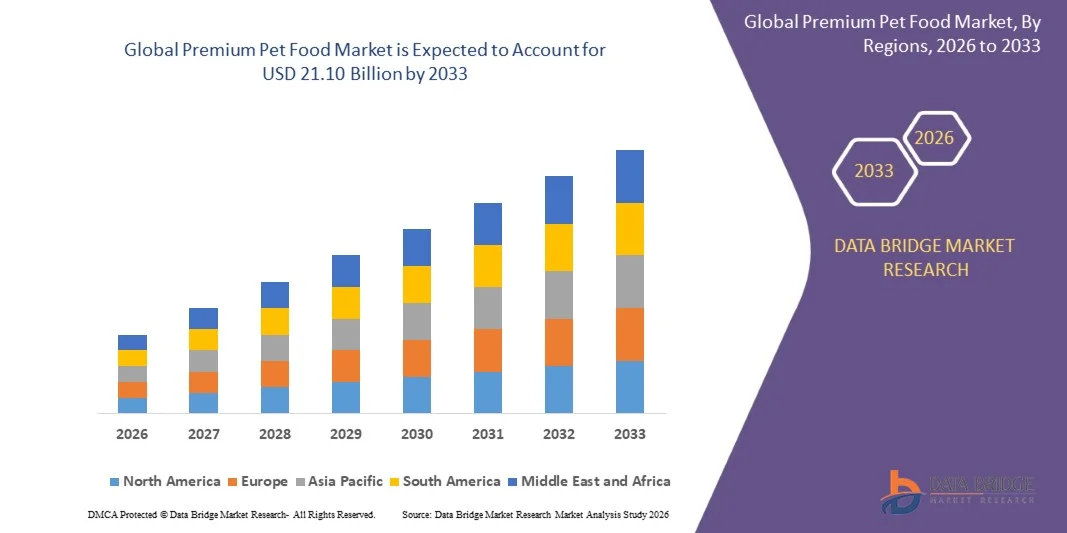
- As per Data Bridge Market Research analysis, the premium pet food market was valued at USD 10.70 billion in 2025 and is projected to reach USD 21.10 billion by 2033, growing at a CAGR of 8.86% from 2026 to 2033.
- The market is experiencing consistent growth driven by rising pet humanization, growing disposable incomes, increasing awareness of pet health and nutrition, and the expanding premiumization trend across both developed and emerging markets.
- The increasing prevalence of pet obesity and diet-related health conditions, combined with rising demand for clean-label, natural, and functional pet food, is compelling manufacturers to innovate premium formulations. Specialty retail and e-commerce channels are replacing traditional mass-market purchasing in many regions, offering curated, subscription-based, and personalized nutrition options for pet owners.
Market Size & Forecast
- Global Market Value (2025): USD 10.70 Billion
- Expected Market Value (2033): USD 21.10 Billion
- Forecast CAGR (2026–2033): 8.86%
- Leading Region in 2025: North America
- Fastest Growing Region: Asia-Pacific
What are the Major Takeaways of the Premium Pet Food Market?
- North America dominated the global premium pet food market with the largest revenue share of 38.72% in 2025, supported by high pet ownership rates, strong premiumization trends, and well-established specialty retail and e-commerce infrastructure.
- Asia-Pacific is expected to be the fastest-growing region at a CAGR of 10.50% from 2026 to 2033, fueled by rising urbanization, increasing pet adoption, and growing disposable incomes in China, India, and Japan.
- The dry pet food segment led the market with a 41.80% share in 2025, driven by cost-effectiveness, long shelf life, and widespread availability across retail and online channels.
- Freeze-dried & raw pet food is the fastest-growing product type, projected to register a CAGR of 11.20%, reflecting rising demand for minimally processed, nutrient-dense diets.
- The dogs segment dominated the pet type category with a 53.60% revenue share in 2025, led by the large global population of pet dogs and strong owner spending on premium nutrition.
- The premium price category accounted for 48.25% of the market share in 2025, supported by steady consumer trade-up from mass-market products and rising brand trust.
- The novel protein segment is the fastest-growing ingredient category, with a CAGR of 12.10%, driven by rising pet food allergies and demand for sustainable alternative proteins.
Report Scope and Premium Pet Food Market Segmentation
|
Attributes |
Premium Pet Food Key Market Insights |
|
Segments Covered |
|
|
Countries Covered |
North America
Europe
Asia-Pacific
Middle East and Africa
South America
|
|
Key Market Players |
|
|
Market Opportunities |
|
|
Value Added Data Infosets |
In addition to the insights on market scenarios such as market value, growth rate, segmentation, geographical coverage, and major players, the market reports curated by the Data Bridge Market Research also include in-depth expert analysis, pricing analysis, brand share analysis, consumer survey, demography analysis, supply chain analysis, value chain analysis, raw material/consumables overview, vendor selection criteria, PESTLE Analysis, Porter Analysis, and regulatory framework. |
What is the Key Trend in the Premium Pet Food Market?
- Rising humanization of pets is driving demand for human-grade, restaurant-quality pet food formulations across premium and super-premium categories.
- For instance, in October 2025, Inspired Pet Nutrition (IPN) acquired Ultra Premium Direct (UPD), a French direct-to-consumer premium pet food brand, expanding its human-grade and premium product portfolio and strengthening its presence across European e-commerce channels.
- Direct-to-consumer and subscription-based delivery models are gaining traction, offering personalized nutrition plans tailored to a pet's breed, age, weight, and health profile.
- Manufacturers are increasingly leveraging AI-driven formulation and data-based personalization platforms to develop customized diets informed by pet health and activity data.
- As pet owners continue to prioritize convenience, transparency, and premiumization, brands are expected to expand personalized and subscription-based offerings, reinforcing direct-to-consumer channels as a core growth driver.
What are the Key Drivers of the Premium Pet Food Market?
- Rising disposable incomes and the growing trend of pet humanization are increasing consumer willingness to spend on premium, natural, and functional pet food products.
- For instance, in February 2025, Colgate-Palmolive's Hill's Pet Nutrition completed its acquisition of Australia-based Prime100, expanding its therapeutic and fresh pet food offerings to meet rising consumer demand for premium, functional nutrition.
- Increasing awareness of pet obesity, allergies, and other diet-related health conditions is driving demand for specialized, clean-label pet food formulations.
- For instance, in January 2025, AlphaPet Ventures acquired JR Pet Products, strengthening its portfolio of natural, premium dog treats and chews in response to rising consumer demand for clean-label products.
- With pet owners increasingly viewing pets as family members, sustained investment in premiumization, natural ingredients, and functional nutrition is expected to remain a key growth driver for the market.
Which Factors are Challenging the Growth of the Premium Pet Food Market?
- Premium and super-premium pet food products require high-quality, ethically sourced ingredients, which increases production costs and retail prices compared with mass-market alternatives.
- These elevated price points limit adoption among price-sensitive consumers, particularly across emerging economies and value-conscious households.
- For instance, tariff-related uncertainty introduced in 2025 raised input and logistics costs across pet food supply chains, prompting several manufacturers to extend diligence timelines and delay expansion and acquisition decisions.
- The high cost of premium ingredients, combined with input cost inflation and ongoing supply chain disruptions, continues to restrict broader adoption of premium pet food, slowing market penetration in cost-sensitive and emerging regions despite rising underlying demand.
How is the Premium Pet Food Market Segmented?
The premium pet food market is segmented on the basis of product type, pet type, ingredient type, distribution channel, price range, packaging type, life stage, form, application, and end user.
- By Product Type
On the basis of product type, the global premium pet food market is segmented into dry pet food, wet/canned pet food, treats & snacks, freeze-dried & raw pet food, and veterinary/prescription diet. The dry pet food segment dominated the market with a 41.80% share in 2025, owing to its long shelf life, ease of storage, cost-effectiveness, and wide availability across supermarkets, specialty stores, and online channels. Continuous innovation in kibble formulations, including grain-free and high-protein variants, is reinforcing the segment's leading position among pet owners seeking convenient, nutritionally balanced options.
The freeze-dried & raw pet food segment is projected to register the fastest growth at a CAGR of 11.20% from 2026 to 2033, driven by rising pet humanization and growing consumer preference for minimally processed, nutrient-dense diets. Increasing awareness of raw feeding benefits, combined with improved cold-chain logistics and expanding specialty retail and e-commerce distribution, is accelerating adoption of this premium format.
- By Pet Type
On the basis of pet type, the global premium pet food market is segmented into dogs, cats, birds, fish, and other pets. The dogs segment dominated the market with a 53.60% share in 2025, supported by the high global population of pet dogs, strong owner spending on premium nutrition, and the wide availability of breed- and life-stage-specific formulations across retail and veterinary channels.
The cats segment is expected to witness the fastest growth at a CAGR of 9.60% from 2026 to 2033, driven by rising cat ownership in urban households, growing demand for grain-free and high-protein cat diets, and increasing premiumization within the feline nutrition category.
- By Ingredient Type
On the basis of ingredient type, the global premium pet food market is segmented into meat-based, plant-based, grain-free, organic & natural, and novel protein. The meat-based segment dominated the market with a 46.30% share in 2025, owing to strong consumer preference for high-protein, biologically appropriate diets and the perception of meat-based formulations as closer to a pet's natural nutritional needs.
The novel protein segment is anticipated to witness the fastest CAGR of 12.10% from 2026 to 2033, driven by rising incidence of pet food allergies and growing interest in alternative and insect-based proteins as sustainable, hypoallergenic ingredient sources.
- By Distribution Channel
On the basis of distribution channel, the global premium pet food market is segmented into supermarkets & hypermarkets, specialty pet stores, online retail, veterinary clinics, and convenience stores. The specialty pet stores segment dominated the market with a 33.15% share in 2025, owing to knowledgeable staff, curated premium product assortments, and strong brand trust among pet owners seeking tailored nutrition advice.
The online retail segment is projected to register the fastest CAGR of 12.40% from 2026 to 2033, fueled by the convenience of subscription-based delivery models, growing digital penetration, and expanding direct-to-consumer offerings from premium pet food brands.
- By Price Range
On the basis of price range, the global premium pet food market is segmented into premium, super-premium, and value-added categories. The premium category dominated the market with a 48.25% share in 2025, supported by widespread availability, established brand recognition, and steady consumer trade-up from mass-market products.
The super-premium category is expected to witness the fastest CAGR of 10.80% from 2026 to 2033, driven by rising pet humanization, growing demand for human-grade and functional formulations, and increasing willingness among pet owners to pay a premium for perceived health benefits.
- By Packaging Type
On the basis of packaging type, the global premium pet food market is segmented into bags & pouches, cans & tins, boxes & cartons, and tubs & containers. The bags & pouches segment dominated the market with a 44.10% share in 2025, owing to convenience, resealability, lightweight transport, and cost efficiency across dry and semi-moist product formats.
The cans & tins segment is projected to witness the fastest CAGR of 9.40% from 2026 to 2033, supported by rising demand for wet and freeze-dried premium formulations that require airtight, extended-shelf-life packaging formats.
- By Life Stage
On the basis of life stage, the global premium pet food market is segmented into puppy & kitten, adult, and senior. The adult segment dominated the market with a 52.40% share in 2025, driven by the large base of adult companion animals globally and consistent demand for maintenance-focused nutritional formulations.
The senior segment is expected to register the fastest CAGR of 9.90% from 2026 to 2033, driven by rising pet life expectancy and growing demand for formulations that support joint health, cognitive function, and age-related dietary needs.
- By Form
On the basis of form, the global premium pet food market is segmented into kibble, pate & gravy, chunks, and freeze-dried. The kibble segment dominated the market with a 47.20% share in 2025, owing to ease of portioning, long shelf stability, and dental health benefits associated with dry food formats.
The freeze-dried segment is anticipated to witness the fastest CAGR of 11.50% from 2026 to 2033, driven by rising demand for minimally processed, nutrient-retentive formats that combine the convenience of dry food with the nutritional profile of raw diets.
- By Application
On the basis of application, the global premium pet food market is segmented into weight management, digestive health, skin & coat health, joint & mobility support, and allergy management. The digestive health segment dominated the market with a 28.60% share in 2025, supported by rising awareness of gut-health-linked immunity and growing adoption of prebiotic- and probiotic-fortified formulations.
The weight management segment is projected to witness the fastest CAGR of 10.20% from 2026 to 2033, driven by rising prevalence of pet obesity and increasing veterinary recommendations for calorie-controlled, functional diets.
- By End User
On the basis of end user, the global premium pet food market is segmented into households, commercial breeders & kennels, and veterinary clinics. The households segment dominated the market with a 68.30% share in 2025, driven by rising pet adoption rates, increasing disposable incomes, and growing consumer focus on at-home pet wellness and nutrition.
The veterinary clinics segment is expected to witness the fastest CAGR of 9.10% from 2026 to 2033, supported by rising prescription and therapeutic diet recommendations for pets with specific health conditions and growing veterinary-retail partnerships.
Which Region Holds the Largest Share of the Premium Pet Food Market?
- North America dominated the premium pet food market and accounted for the largest revenue share of 38.72% in 2025, supported by high pet ownership rates, strong premiumization trends, and the presence of established pet food manufacturers and specialty retail networks.
- The region also benefits from high consumer spending on pet health and wellness, robust cold-chain and e-commerce infrastructure, and growing adoption of functional and personalized nutrition. Increasing focus on clean-label formulations and direct-to-consumer models continues to strengthen North America's leadership position in the global market.
U.S. Premium Pet Food Market Insight
The U.S. premium pet food market is experiencing steady growth, supported by high pet humanization, rising disposable incomes, and strong demand for natural, functional, and human-grade pet food formulations. Increasing investment in specialty retail, e-commerce, and subscription-based delivery models is contributing to market growth. Furthermore, growing consumer focus on clean-label ingredients and personalized nutrition is positioning the U.S. as a key innovation hub in the premium pet food industry.
Germany Premium Pet Food Market Insight
The Germany premium pet food market is expanding steadily due to the country's strong pet ownership culture, advanced retail infrastructure, and increasing adoption of natural and functional pet food formulations. Manufacturers and specialty retailers are increasingly offering premium, grain-free, and novel-protein diets to meet rising consumer demand. Continuous innovation in packaging and ingredient sourcing, along with strong regulatory focus on pet food safety, is further driving market growth in Germany.
Asia-Pacific Premium Pet Food Market Insight
The Asia-Pacific premium pet food market is expected to witness rapid growth, driven by increasing urbanization, rising pet adoption, and growing disposable incomes across countries such as China, India, and Japan. Growing awareness of pet health and nutrition, rising adoption of premium and functional pet food, and expanding e-commerce and specialty retail penetration are supporting regional market expansion. Additionally, the growing presence of international and domestic pet food manufacturers is accelerating premiumization across the region.
Japan Premium Pet Food Market Insight
The Japan premium pet food market is witnessing consistent growth due to rising pet humanization, an aging pet population, and increasing demand for senior and functional nutrition formulations. Manufacturers and specialty retailers are increasingly adopting high-quality, natural ingredients to meet evolving consumer preferences. Moreover, growing integration of e-commerce and subscription-based delivery models is further contributing to market growth.
China Premium Pet Food Market Insight
The China premium pet food market is growing rapidly, driven by increasing urbanization, rising disposable incomes, and growing pet ownership among younger consumers. Growing adoption of premium, natural, and functional pet food across e-commerce and specialty retail channels is significantly boosting market demand. In addition, rising domestic manufacturing capacity, increasing awareness of pet health, and rapid growth of direct-to-consumer platforms are positioning China as one of the fastest-growing markets for premium pet food globally.
Which are the Top Companies in Premium Pet Food Market?
The premium pet food industry is primarily led by well-established companies, including:
- Mars, Incorporated (U.S.)
- Nestlé Purina PetCare (Switzerland)
- Hill's Pet Nutrition, Inc. (U.S.)
- General Mills, Inc. (U.S.)
- The J.M. Smucker Company (U.S.)
- Diamond Pet Foods (U.S.)
- Champion Petfoods LP (Canada)
- WellPet LLC (U.S.)
- Affinity Petcare S.A. (Spain)
- Royal Canin SAS (France)
- Simmons Pet Food, Inc. (U.S.)
- United Petfood (Belgium)
- Farmina Pet Foods (Italy)
- Ainsworth Pet Nutrition (U.S.)
- Petcurean Pet Nutrition (Canada)
What are Latest Developments in Premium Pet Food Market?
- In February 2025, Colgate-Palmolive's Hill's Pet Nutrition completed its acquisition of Care TopCo Pty Ltd, owner of Australia's Prime100 pet food brand, giving Hill's a foothold in the rapidly growing fresh and therapeutic pet food category in Australia and strengthening its premium and functional nutrition portfolio.
- In January 2025, AlphaPet Ventures, a European digital-first platform for premium pet food, acquired JR Pet Products, a UK-based brand known for natural dog chews and treats, expanding AlphaPet's premium treat portfolio and enhancing its presence in the UK market.
- In October 2025, Inspired Pet Nutrition (IPN) acquired Ultra Premium Direct (UPD) from Eurazeo, a French direct-to-consumer premium pet food brand, broadening IPN's premium portfolio alongside its Harringtons and Wagg brands and expanding access to e-commerce distribution across European markets.
- In December 2025, The Nutriment Company (TNC) acquired Antos, a Dutch manufacturer of natural pet treats and dental chews, extending TNC's premium treats portfolio and expanding its distribution network across the Benelux region as part of a broader European expansion strategy that included ten acquisitions during 2025.

- Interactive Data Analysis Dashboard
- Company Analysis Dashboard for high growth potential opportunities
- Research Analyst Access for customization & queries
- Competitor Analysis with Interactive dashboard
- Latest News, Updates & Trend analysis
- Harness the Power of Benchmark Analysis for Comprehensive Competitor Tracking
Data collection and base year analysis are done using data collection modules with large sample sizes. The stage includes obtaining market information or related data through various sources and strategies. It includes examining and planning all the data acquired from the past in advance. It likewise envelops the examination of information inconsistencies seen across different information sources. The market data is analysed and estimated using market statistical and coherent models. Also, market share analysis and key trend analysis are the major success factors in the market report. To know more, please request an analyst call or drop down your inquiry.
The key research methodology used by DBMR research team is data triangulation which involves data mining, analysis of the impact of data variables on the market and primary (industry expert) validation. Data models include Vendor Positioning Grid, Market Time Line Analysis, Market Overview and Guide, Company Positioning Grid, Patent Analysis, Pricing Analysis, Company Market Share Analysis, Standards of Measurement, Global versus Regional and Vendor Share Analysis. To know more about the research methodology, drop in an inquiry to speak to our industry experts.
Data Bridge Market Research is a leader in advanced formative research. We take pride in servicing our existing and new customers with data and analysis that match and suits their goal. The report can be customized to include price trend analysis of target brands understanding the market for additional countries (ask for the list of countries), clinical trial results data, literature review, refurbished market and product base analysis. Market analysis of target competitors can be analyzed from technology-based analysis to market portfolio strategies. We can add as many competitors that you require data about in the format and data style you are looking for. Our team of analysts can also provide you data in crude raw excel files pivot tables (Fact book) or can assist you in creating presentations from the data sets available in the report.