


Presbyopia-Correcting Devices Market Size
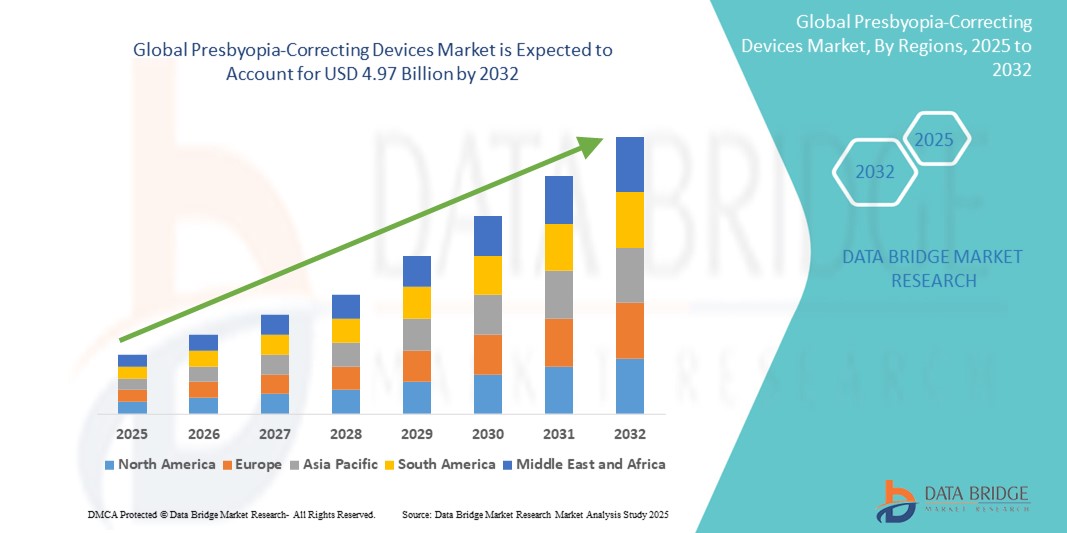
- The global presbyopia-correcting devices market size was valued at USD 2.94 billion in 2024 and is expected to reach USD 4.97 billion by 2032, at a CAGR of 6.8% during the forecast period
- The market growth is largely fuelled by the growing adoption and technological advancements in vision care solutions, coupled with increasing awareness about age-related vision problems such as presbyopia, leading to higher demand for effective corrective devices
- Furthermore, rising consumer preference for non-invasive, convenient, and customizable vision correction options is establishing presbyopia-correcting devices as the preferred choice among aging populations. These converging factors are accelerating the uptake of presbyopia-correcting devices, thereby significantly boosting the industry’s growth
Presbyopia-Correcting Devices Market Analysis
- Presbyopia-correcting devices, which include a range of vision-enhancing solutions such as multifocal contact lenses, intraocular lenses, and corneal inlays, are becoming essential in addressing age-related vision deterioration, particularly in aging populations across both developed and emerging markets. These devices offer improved near-vision functionality without compromising distance vision, making them a preferred option over conventional reading glasses for many patients
- The demand for presbyopia-correcting devices is being driven by increasing global awareness of vision correction options, greater patient willingness to adopt advanced ophthalmic technologies, and a growing emphasis on lifestyle and aesthetic benefits associated with spectacle independence
- North America dominates the presbyopia-correcting devices market, holding the largest revenue share of 37.5% in 2024. This leadership is supported by a well-established healthcare infrastructure, early adoption of advanced ophthalmic technologies, and a growing aging population seeking long-term, high-quality vision correction solutions
- Asia-Pacific is expected to be the fastest growing region in the presbyopia-correcting devices market, with a CAGR of 9.10% during the forecast period. This growth is attributed to rapid urbanization, rising disposable incomes, and increasing access to eye care services in countries such as China, India, and Japan
- Progressive addition lenses dominates the presbyopia-correcting devices market with a market share of 34.5% in 2024, owing to their ability to provide seamless vision correction across all distances (near, intermediate, and far) without the visible lines found in bifocal or trifocal lenses, coupled with continuous advancements in lens design for improved aesthetics and patient adaptation
Report Scope and Presbyopia-Correcting Devices Market Segmentation
|
Attributes |
Presbyopia-Correcting Devices Key Market Insights |
|
Segments Covered |
|
|
Countries Covered |
North America
Europe
Asia-Pacific
Middle East and Africa
South America
|
|
Key Market Players |
|
|
Market Opportunities |
|
|
Value Added Data Infosets |
In addition to the insights on market scenarios such as market value, growth rate, segmentation, geographical coverage, and major players, the market reports curated by the Data Bridge Market Research also include in-depth expert analysis, pricing analysis, brand share analysis, consumer survey, demography analysis, supply chain analysis, value chain analysis, raw material/consumables overview, vendor selection criteria, PESTLE Analysis, Porter Analysis, and regulatory framework. |
Presbyopia-Correcting Devices Market Trends
“Rising Demand for Voice-Enabled and Connected Vision Solutions”
- The presbyopia-correcting devices market is witnessing a notable shift as manufacturers increasingly incorporate voice-activated features and seamless integration with smart home and healthcare systems. This movement toward more intuitive user interfaces is particularly impactful for older adults—the primary demographic affected by presbyopia—who often benefit from hands-free, accessible technologies
- New-generation vision correction tools and diagnostic equipment are being designed to work alongside virtual assistants such as Amazon Alexa and Google Assistant, allowing users or healthcare professionals to receive real-time updates, set reminders for treatment routines, or adjust settings without manual intervention
- In clinical settings, hands-free operation is becoming more valuable, enabling surgeons to maintain sterility and improve workflow efficiency by adjusting devices via verbal commands or interconnected systems
- At the consumer level, voice-compatible home devices are being used to support post-operative care, send medication reminders, and guide patients through exercises or therapies meant to support visual recovery
- This expanding ecosystem of connected health technologies is shaping a new standard in patient engagement and clinical convenience. As a result, companies in the presbyopia space are prioritizing ease of use, accessibility, and integration to meet rising expectations for smarter, more responsive care experiences
Presbyopia-Correcting Devices Market Dynamics
Driver
“Increasing Global Incidence of Presbyopia and Demand for Non-Invasive Correction”
- The rising global prevalence of presbyopia, particularly among aging populations, is a key factor fueling demand for advanced vision correction devices. As life expectancy increases worldwide, more individuals are seeking effective, comfortable solutions that reduce dependency on reading glasses or contact lenses
- For instance, minimally invasive presbyopia-correcting intraocular lenses (IOLs) and corneal inlays are gaining attention due to their ability to offer improved near and intermediate vision without the need for corrective eyewear
- In addition to clinical efficacy, the growing focus on lifestyle-driven eye care—where convenience, aesthetics, and long-term results matter—has made these advanced devices more attractive to consumers
- Innovations in optics, including extended depth of focus and multifocal technologies, are pushing the boundaries of what non-glasses-based correction can achieve. These advancements are contributing to a growing acceptance and adoption of surgical and device-based solutions, especially in developed regions with better access to ophthalmic care
- Furthermore, increased awareness, improved access to vision screenings, and rising disposable incomes in emerging markets are broadening the customer base for presbyopia-correcting devices
Restraint/Challenge
“High Cost and Limited Access to Advanced Surgical Technologies”
- One of the major barriers to growth in the presbyopia-correcting devices market is the high cost of surgical procedures and premium lens implants. These advanced solutions, while effective, often remain out of reach for large segments of the population, particularly in low- and middle-income countries
- In many regions, public health insurance or government-funded healthcare systems do not cover elective procedures such as presbyopia correction with premium IOLs or corneal inlays, leaving patients to bear the full cost
- In addition, the availability of skilled ophthalmic surgeons and advanced surgical infrastructure can be limited outside urban centers, creating a gap in access to care
- Even in developed markets, concerns over the long-term safety, adaptation period, or potential side effects of these corrective solutions can make some patients hesitant to pursue device-based treatments
- To address these challenges, manufacturers are working on developing more cost-effective alternatives, expanding clinical training programs, and investing in awareness campaigns that highlight the safety, effectiveness, and long-term value of presbyopia-correcting devices. Bridging the gap between innovation and accessibility will be key to unlocking the market’s full potential
Presbyopia-Correcting Devices Market Scope
The market is segmented on the basis of type, technology, end user, and application.
• By Type
On the basis of type, the presbyopia-correcting devices market is segmented into Multifocal contact lenses, progressive addition lenses, corneal inlays, intraocular lenses, and others. Progressive addition lenses dominates the presbyopia-correcting devices market with a market share of 34.5% in 2024, owing to their ability to provide seamless vision correction across all distances (near, intermediate, and far) without the visible lines found in bifocal or trifocal lenses, coupled with continuous advancements in lens design for improved aesthetics and patient adaptation
The intraocular lenses (IOLs) segment is expected to witness the fastest growth rate of 22.1% from 2025 to 2032, fueled by an increasing number of cataract surgeries globally and growing acceptance of premium IOLs for presbyopia correction. The long-term efficacy and growing preference for surgical solutions, especially in developed regions, are accelerating this trend.
• By Technology
On the basis of technology, the presbyopia-correcting devices market is segmented into soft lenses, rigid gas permeable (RGP) lenses, hybrid lenses, and others. The soft lenses segment held the largest market share of 46.4% in 2024, primarily due to their comfort, affordability, and wide availability across global retail channels. Soft lenses are the default choice for most presbyopic patients starting lens correction.
The hybrid lenses segment is expected to grow at the highest CAGR of 20.3% from 2025 to 2032, due to their ability to combine the clarity of RGP lenses with the comfort of soft lenses. These lenses are gaining popularity among users with high visual demands who experience discomfort with traditional rigid lenses.
• By End User
On the basis of end user, the presbyopia-correcting devices market is segmented into ophthalmology clinics, hospitals, optical retail stores, and others. Optical retail stores dominate the market with a revenue share of 40.7% in 2024, driven by high patient footfall, direct product availability, and consumer preference for walk-in vision correction solutions. The increasing adoption of contact lenses and non-surgical options is also contributing to the growth of this channel.
The ophthalmology clinics segment is expected to witness the fastest growth at a CAGR of 18.9% from 2025 to 2032, as they are the primary setting for surgical procedures, including corneal inlays and intraocular lens implantations. The rise in elective vision correction surgeries is bolstering this segment.
• By Application
On the basis of application, the presbyopia-correcting devices market is segmented into age-related presbyopia, post-cataract surgery, and others. Age-related presbyopia held the largest share of 57.5% in 2024, as it represents the natural decline in near vision associated with aging, affecting a vast global population over the age of 40. The demand for both surgical and non-surgical correction methods continue to grow with demographic aging trends.
The post-cataract surgery segment is expected to grow at the fastest CAGR of 21.4% from 2025 to 2032, due to increasing patient willingness to opt for presbyopia-correcting IOLs during cataract removal. Advancements in lens technology and combined vision correction solutions are further supporting this trend.
Presbyopia-Correcting Devices Market Regional Analysis
- North America dominates the Presbyopia-Correcting Devices market with the largest revenue share of 37.5 %in 2024, driven by a high prevalence of presbyopia among the aging population and strong adoption of innovative vision correction technologies. The region benefits from advanced healthcare infrastructure, high patient awareness, and early access to premium ophthalmic treatments such as intraocular lenses and corneal inlays. Leading medical device manufacturers based in the U.S. and Canada are also accelerating product innovation and clinical research, further supporting market expansion
- Consumers in North America are increasingly opting for advanced presbyopia-correcting solutions due to their convenience, long-term effectiveness, and compatibility with lifestyle needs. Premium products such as multifocal contact lenses and progressive addition lenses are seeing strong demand from individuals seeking non-surgical or minimally invasive correction options
- This widespread adoption is further supported by high healthcare spending, favorable insurance coverage in select regions, and a growing interest in improving quality of life through advanced ophthalmic care, establishing presbyopia-correcting devices as a key component of modern eye health management in both clinical and outpatient settings\
U.S. presbyopia-correcting devices market insight
The U.S. presbyopia-correcting devices market accounted for approximately 70.4% of the North American market revenue in 2024, supported by a large aging population, high levels of health awareness, and strong spending capacity. A growing preference for advanced corrective solutions such as intraocular lenses and multifocal contact lenses is shaping market growth. The presence of leading ophthalmic device manufacturers and widespread access to specialized eye care clinics are further strengthening adoption. In addition, frequent product launches and clinical innovations are helping the U.S. maintain its dominant position in the region.
Europe presbyopia-correcting devices market insight
The Europe presbyopia-correcting devices market is projected to register a CAGR of 8.8% from 2025 to 2032, fueled by rising healthcare investments, an aging population, and favorable reimbursement policies in key countries. Increasing demand for progressive addition lenses and rigid gas permeable lenses among individuals over 40 is boosting product adoption. European governments’ focus on preventative eye care and ongoing technological upgrades in clinical ophthalmology practices are also playing a key role in driving the market across the region.
U.K. presbyopia-correcting devices market insight
The U.K. presbyopia-correcting devices market is expected to grow at a CAGR of 10.2% during the forecast period, driven by a growing elderly demographic and a strong private eye care sector. The country's high awareness of vision correction options, combined with a strong retail optical chain presence, supports the increasing demand for non-invasive devices such as multifocal lenses and corneal inlays. Innovations in patient-centric care and a willingness to adopt premium vision correction solutions are further accelerating market expansion.
Germany presbyopia-correcting devices market insight
Germany's presbyopia-correcting devices market is anticipated to grow at a CAGR of 9.4% through 2032, underpinned by a well-established healthcare infrastructure, increasing focus on early diagnosis, and a tech-savvy aging population. Germany's emphasis on clinical precision and evidence-based treatment is encouraging the adoption of advanced intraocular lenses and hybrid contact lenses. In addition, sustainability and high product standards remain a priority, leading to a preference for long-lasting, biocompatible vision correction devices.
Asia-Pacific presbyopia-correcting devices market insight
The Asia-Pacific presbyopia-correcting devices market is forecasted to experience the fastest CAGR of 9.10% from 2025 to 2032, driven by expanding healthcare access, a rapidly aging population, and increasing awareness of eye health. Countries such as China, Japan, and India are witnessing a strong shift towards modern vision correction devices due to rising disposable incomes and urbanization. Government-led healthcare reforms and the proliferation of ophthalmology centers are further enhancing product accessibility and adoption across the region.
Japan presbyopia-correcting devices market insight
The Japan presbyopia-correcting devices market is growing steadily, expected to achieve a CAGR of 10.9% by 2032, supported by the country's aging demographic and strong technological infrastructure in healthcare. High penetration of smart medical devices and advanced surgical options such as intraocular lens implants are common in Japan. The cultural emphasis on eye health and wellness, alongside innovations in compact, comfortable vision aids, continues to drive adoption in both outpatient and hospital-based settings.
China presbyopia-correcting devices market insight
The China presbyopia-correcting devices market accounted for 37% of the Asia-Pacific presbyopia-correcting devices market revenue in 2024, making it the region’s leading contributor. Rapid urbanization, a growing middle class, and aggressive investments in domestic medical manufacturing are accelerating market growth. The increasing availability of vision screening programs and growing acceptance of multifocal lenses in both retail and clinical environments are also propelling the market. Local production has helped lower costs and expand device access to rural and semi-urban populations.
Presbyopia-Correcting Devices Market Share
The presbyopia-correcting devices industry is primarily led by well-established companies, including:
- Johnson & Johnson Services, Inc. (U.S.)
- Alcon (Switzerland)
- Bausch + Lomb (U.S.)
- Carl Zeiss AG (Germany)
- CooperVision (U.S.)
- Essilor (France)
- Hoya Corporation (Japan)
- NIDEK CO., LTD. (Japan)
- STAAR SURGICAL (U.S.)
- medennium Co., Ltd. (U.S.)
- Shamir Ltd. (Israel)
- Alimera Sciences (U.S.)
- SynergEyes (U.S.)
- Santen Pharmaceutical Co., Ltd. (Japan)
- BVI (U.S.)
- Visioneering Technologies, Inc. (U.S.)
- Menicon (Japan)
- Contamac (U.K.)
Latest Developments in Global Presbyopia-Correcting Devices Market
- In May 2025, Johnson & Johnson Vision announced the launch of its next-generation multifocal contact lenses featuring enhanced light-adjusting technology designed to improve visual clarity for presbyopic patients. This innovation aims to reduce eye strain and improve comfort for daily wearers, reinforcing Johnson & Johnson’s position as a leader in vision correction solutions globally
- In April 2025, Alcon introduced an advanced intraocular lens (IOL) system equipped with extended depth-of-focus technology to improve visual outcomes after cataract surgery. The new lens received regulatory approval in key markets including the U.S. and Europe, marking a significant step forward in presbyopia management for ophthalmologists worldwide
- In March 2025, Bausch + Lomb launched a hybrid presbyopia-correcting lens designed for patients requiring both rigid gas permeable and soft lens benefits. This new product targets niche patient groups with complex vision needs, broadening the company’s portfolio and addressing unmet clinical demands.
- In February 2025, CooperVision expanded its range of progressive addition lenses (PALs) with the introduction of customizable options tailored to different occupational needs, such as digital device use and outdoor activities. This move reflects the growing trend towards personalized vision care solutions and enhances CooperVision’s competitive edge
- In January 2025, Carl Zeiss Meditec announced a strategic partnership with leading ophthalmology clinics across Asia-Pacific to accelerate adoption of its cutting-edge corneal inlay technology. This collaboration focuses on clinical training and research, aiming to improve treatment outcomes and raise awareness of presbyopia-correcting devices in emerging markets

- Interactive Data Analysis Dashboard
- Company Analysis Dashboard for high growth potential opportunities
- Research Analyst Access for customization & queries
- Competitor Analysis with Interactive dashboard
- Latest News, Updates & Trend analysis
- Harness the Power of Benchmark Analysis for Comprehensive Competitor Tracking
Data collection and base year analysis are done using data collection modules with large sample sizes. The stage includes obtaining market information or related data through various sources and strategies. It includes examining and planning all the data acquired from the past in advance. It likewise envelops the examination of information inconsistencies seen across different information sources. The market data is analysed and estimated using market statistical and coherent models. Also, market share analysis and key trend analysis are the major success factors in the market report. To know more, please request an analyst call or drop down your inquiry.
The key research methodology used by DBMR research team is data triangulation which involves data mining, analysis of the impact of data variables on the market and primary (industry expert) validation. Data models include Vendor Positioning Grid, Market Time Line Analysis, Market Overview and Guide, Company Positioning Grid, Patent Analysis, Pricing Analysis, Company Market Share Analysis, Standards of Measurement, Global versus Regional and Vendor Share Analysis. To know more about the research methodology, drop in an inquiry to speak to our industry experts.
Data Bridge Market Research is a leader in advanced formative research. We take pride in servicing our existing and new customers with data and analysis that match and suits their goal. The report can be customized to include price trend analysis of target brands understanding the market for additional countries (ask for the list of countries), clinical trial results data, literature review, refurbished market and product base analysis. Market analysis of target competitors can be analyzed from technology-based analysis to market portfolio strategies. We can add as many competitors that you require data about in the format and data style you are looking for. Our team of analysts can also provide you data in crude raw excel files pivot tables (Fact book) or can assist you in creating presentations from the data sets available in the report.













