


What is the Printed Textile Market Size and Growth Rate?
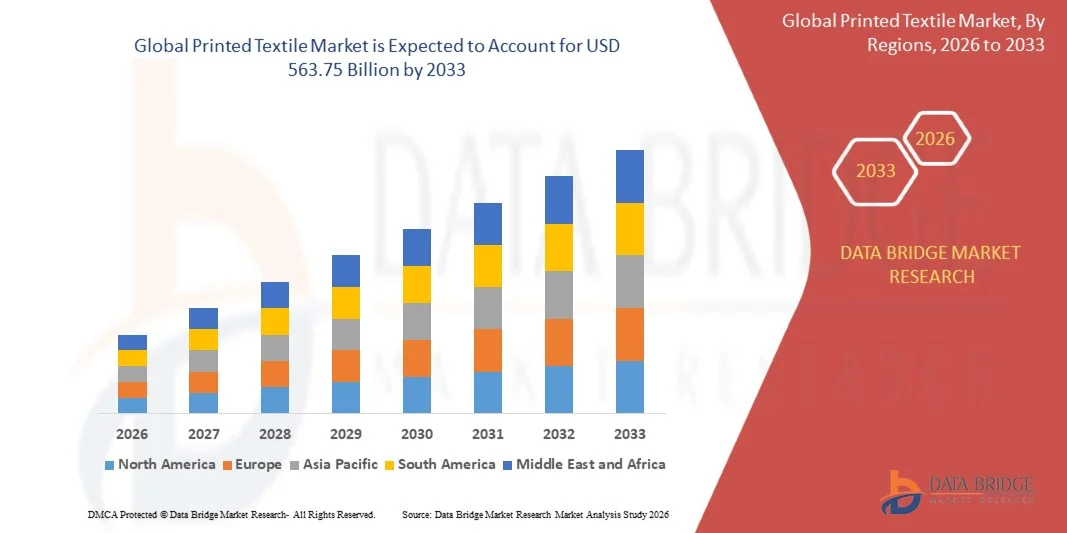
- As per Data Bridge Market Research analysis, the printed textile market was valued at USD 274.76 billion in 2025 and is projected to reach USD 563.75 billion by 2033, growing at a CAGR of 9.40% from 2026 to 2033.
- The market is experiencing consistent growth driven by rising demand for customized and visually appealing textiles, rapid advancements in digital printing technologies, increasing adoption of sustainable printing methods, and expanding applications across apparel, home textiles, and technical textiles.
- The increasing consumer preference for personalized fashion and shorter production cycles, combined with the expansion of e-commerce and fast-fashion channels, is encouraging textile manufacturers to adopt advanced digital printing solutions. Digital printing enables complex designs, small-batch production, faster turnaround, and reduced material and water consumption compared with several conventional printing processes, supporting its growing adoption across the textile industry.
Market Size & Forecast
- Global Market Value (2025): USD 274.76 Billion
- Expected Market Value (2033): USD 563.75 Billion
- Forecast CAGR (2026–2033): 9.40%
- Leading Region in 2025: North America
- Fastest Growing Region: Asia Pacific
What are the Major Takeaways of the Printed Textile Market?
- North America dominated the printed textile market with the largest revenue share of 35.2% in 2025, supported by strong demand for customized textiles, advanced printing technologies, and established apparel and home furnishing industries.
- Asia-Pacific is expected to be the fastest-growing region at a CAGR of 9.5% from 2026 to 2033, fueled by expanding textile manufacturing capacity, rising apparel production, increasing consumer demand for customized designs, and growing adoption of digital printing technologies.
- The reactive dye segment led the market with a 38% share in 2025, driven by its excellent color fastness, superior wash durability, and extensive compatibility with natural-fiber textiles.
- Pigment dye are the fastest-growing ink type, projected to register a CAGR of 8.2%, reflecting the surge in emphasis on sustainable and resource-efficient textile printing.
- The cotton segment dominated the product category with a 52.1% revenue share in 2025, led by its extensive use in apparel, home textiles, and fashion products
- Digital printing accounted for 62.5% of the market share in 2025, preferred by its ability to produce customized designs, high-resolution graphics, and short production runs
- The technical textiles segment is the fastest-growing application category, with a CAGR of 13.6%, driven by increasing demand for specialized printed fabrics across industrial, automotive, healthcare, sports, and protective applications
Report Scope and Printed Textile Market Segmentation
|
Attributes |
Printed Textile Key Market Insights |
|
Segments Covered |
|
|
Countries Covered |
North America
Europe
Asia-Pacific
Middle East and Africa
South America
|
|
Key Market Players |
|
|
Market Opportunities |
|
|
Value Added Data Infosets |
In addition to the insights on market scenarios such as market value, growth rate, segmentation, geographical coverage, and major players, the market reports curated by the Data Bridge Market Research also include import export analysis, production capacity overview, production consumption analysis, price trend analysis, climate change scenario, supply chain analysis, value chain analysis, raw material/consumables overview, vendor selection criteria, PESTLE Analysis, Porter Analysis, and regulatory framework. |
What is the Key Trend in the Printed Textile Market?
- Textile manufacturers and fashion brands are increasingly shifting toward digital and on-demand textile printing to support shorter production runs, rapid design changes, personalization, and reduced inventory requirements compared with conventional printing processes.
- For instance, in July 2024, Epson highlighted Leaf & Co., Ltd., a Japanese textile printer that adopted digital textile printing to meet growing short-run orders and reduce the labor-intensive screen preparation and washing required by analog printing.
- Advanced digital printing systems are enabling manufacturers to reproduce complex patterns, photographic details, and customized designs at industrial production speeds, strengthening the use of printed textiles across fashion, home décor, and specialty applications.
- Sustainability is also becoming increasingly important as textile producers adopt digital printing technologies that can reduce water consumption, material waste, and chemical use while supporting more efficient production workflows.
- For instance, in June 2024, EFI showcased its next-generation Reggiani BOLT XS single-pass textile printer at drupa 2024, highlighting high-speed, on-demand textile production and digital technology designed to support more efficient manufacturing.
- As fashion and textile manufacturers continue prioritizing customization, shorter lead times, on-demand production, and environmentally responsible manufacturing, the transition from conventional printing toward advanced digital textile printing is expected to accelerate, reinforcing digitalization as a core trend in the printed textile market.
What are the Key Drivers of the Printed Textile Market?
- The rapid expansion of customized apparel, fast fashion, and e-commerce has significantly increased demand for printed textiles capable of supporting short production runs, personalized designs, and rapid product launches without extensive setup requirements.
- For instance, in April 2024, Epson introduced the SureColor F11070 and F11070H industrial dye-sublimation printers, designed to support increasing demand from textile print shops through high-volume production capabilities and continuous printing workflows.
- Textile manufacturers, fashion brands, and home-furnishing companies are increasingly integrating digital printing into production workflows to shorten turnaround times, reduce design-to-market cycles, and respond efficiently to changing consumer preferences.
- For instance, in July 2024, French children's apparel manufacturer Petit Bateau adopted an Epson Monna Lisa digital production unit as part of its strategic move toward digital textile production amid changing market and environmental requirements.
- With textile production increasingly influenced by customization, e-commerce-driven demand, rapid fashion cycles, and the need for flexible manufacturing, advanced printing technologies will remain an important driver of printed textile market expansion, particularly across apparel, home textiles, and specialty textile applications.
Which Factors are Challenging the Growth of the Printed Textile Market?
- Advanced digital textile printing systems require significant upfront capital investment for industrial printers, specialized inks, workflow software, printheads, maintenance infrastructure, and skilled technical personnel, creating financial barriers for smaller textile manufacturers.
- For instance, in December 2022, the American Association of Textile Chemists and Colorists (AATCC) reported that high capital investment in digital textile printing machines was a major factor contributing to resistance toward adoption, particularly when compared with conventional printing equipment.
- These investment requirements can restrict technology adoption among small and medium-sized textile businesses, particularly those transitioning from conventional screen and rotary printing systems or operating in price-sensitive manufacturing markets.
- The transition also requires manufacturers to upgrade production workflows, train operators, integrate color-management systems, and maintain specialized equipment, increasing the operational complexity associated with digital printing adoption.
- For instance, in May 2025, research published in Discover Applied Sciences identified high investment requirements, uncertain return on investment, lack of skilled workers, and equipment-related costs as significant barriers to Industry 4.0 adoption in Indian textile and clothing industries.
- The high capital expenditure, specialized workforce requirements, and need for ongoing technical support therefore continue to challenge widespread adoption of advanced printed textile technologies, particularly among smaller manufacturers and businesses with limited investment capacity.
How is the Printed Textile Market Segmented?
The printed textile market is segmented on the basis of ink type, product, technology, and application.
- By Ink Type
On the basis of ink type, the printed textile market is segmented into acid dye, disperse dye, pigment dye, reactive dye, and others. The reactive dye segment dominated the market with 38% share in 2025, owing to its excellent color fastness, superior wash durability, and extensive compatibility with natural-fiber textiles. Reactive dyes form strong bonds with textile fibers, allowing printed fabrics to retain color through repeated washing. They are particularly suitable for cotton, linen, silk, and other cellulosic materials. The technology is widely established across apparel and home-textile manufacturing. Strong demand for durable and vibrant printed fabrics continues to support the segment's leading position.
The pigment dye segment is projected to register the fastest growth at a CAGR of 8.2% during forecast period, driven by increasing emphasis on sustainable and resource-efficient textile printing. Pigment-based printing can reduce water consumption because it does not require the extensive washing and steaming stages associated with some conventional dyeing processes. The technology can also be used across a broad range of natural, synthetic, and blended fabrics. Growing demand for environmentally responsible textile production is supporting adoption among manufacturers. Improvements in pigment formulations are also enhancing color performance and durability. These advantages are encouraging wider use of pigment-based printing across apparel, home textiles, and customized textile products.
- By Product
On the basis of product, the printed textile market is segmented into cotton, silk, polyester, and others. The cotton segment dominated the market with 52.1% share in 2025, supported by its extensive use in apparel, home textiles, and fashion products. Cotton offers favorable printing characteristics and is compatible with reactive and pigment-based printing technologies. Its breathability, comfort, and widespread availability make it a preferred material for printed clothing. Cotton is also extensively used in customized and digitally printed garments. The continued demand for natural-fiber textiles is strengthening its position across printed textile applications.
The polyester segment is projected to register the fastest growth at a CAGR of 7.8% during forecast period, driven by increasing demand for sportswear, activewear, home décor, and performance textiles. Polyester is highly compatible with sublimation and disperse printing technologies, enabling vibrant colors and durable designs. Growing adoption of recycled polyester is also supporting demand as textile manufacturers pursue more sustainable material choices. The material's durability and moisture-management properties make it suitable for functional apparel. Its expanding use in customized sports and fashion products is further supporting printed polyester demand.
- By Technology
On the basis of technology, the printed textile market is segmented into digital printing, screen printing, rotary printing, block printing, heat transfer printing, and other printing technologies. The Digital Printing segment dominated the market with 62.5% share in 2025, supported by its ability to produce customized designs, high-resolution graphics, and short production runs. Digital printing eliminates many of the preparation requirements associated with conventional screen and rotary processes. It enables manufacturers to respond rapidly to changing fashion trends and personalized-order requirements. The technology also supports on-demand production and complex variable designs. Increasing adoption by textile manufacturers, fashion brands, and specialty printers continues to strengthen its market position.
The digital printing segment is also projected to register the fastest growth at a CAGR of 13.0% during forecast period, driven by the expansion of e-commerce, fast fashion, customization, and on-demand textile production. Advances in printheads, ink formulations, color management, and automated printing systems are improving production efficiency. Digital systems allow manufacturers to produce smaller batches without the extensive setup associated with conventional printing. Growing sustainability requirements are also encouraging technologies that can reduce water consumption and textile waste. The increasing demand for personalized apparel and digitally designed home textiles is further supporting adoption.
- By Application
On the basis of application, the printed textile market is segmented into fashion, household, technical textiles, and others. The fashion segment dominated the market with 46.2% share in 2025, driven by extensive use of printed fabrics in garments, apparel, accessories, and seasonal collections. Fashion brands increasingly use printed textiles to differentiate products through colors, patterns, graphics, and customized designs. The expansion of fast fashion and online apparel retail is increasing demand for flexible and rapid textile production. Digital printing further enables fashion manufacturers to produce limited collections and personalized designs efficiently. Rising consumer demand for visually differentiated apparel continues to support the segment's leading position.
The technical textiles segment is projected to register the fastest growth at a CAGR of 13.6% during forecast period, driven by increasing demand for specialized printed fabrics across industrial, automotive, healthcare, sports, and protective applications. Digital printing enables precise and customized designs on specialized textile substrates. Growing use of functional textiles is expanding printed textile applications beyond conventional apparel and household products. Manufacturers are increasingly using advanced printing technologies to deliver customized patterns and surface characteristics for specialized applications. Rising investment in performance-oriented and application-specific textiles is further supporting segment expansion.
Which Region Holds the Largest Share of the Printed Textile Market?
- North America dominated the printed textile market with the largest revenue share of 35.2% in 2025, supported by strong demand for customized textiles, advanced printing technologies, and established apparel and home furnishing industries.
- The region also benefits from growing e-commerce activity, increasing demand for personalized fashion and décor products, and greater emphasis on sustainable and water-efficient textile production. The U.S. remains a major contributor, with digital printing gaining traction because of its precision, faster production cycles, reduced material waste, and ability to support localized manufacturing. Government-backed initiatives supporting domestic textile innovation and reshoring are also encouraging investments in digitally enabled printing infrastructure.
U.S. Printed Textile Market Insight
The U.S. printed textile market is witnessing strong growth due to rising demand for customized apparel, home décor, sportswear, and digitally printed fabrics. The country’s established fashion, retail, and textile ecosystem, along with increasing adoption of digital printing technologies, is driving demand across commercial and industrial applications. In addition, growing preference for on-demand production, shorter production cycles, and sustainable printing processes is accelerating the adoption of advanced textile printing solutions across manufacturers and brands.
Asia-Pacific Printed Textile Market Insight
The Asia-Pacific printed textile market is expected to witness rapid growth, driven by expanding textile manufacturing, rising apparel consumption, and increasing investments in advanced printing technologies across countries such as China, India, and Japan. Growing demand for customized fabrics, increasing adoption of digital printing, and the region’s strong textile export base are supporting regional market expansion. In addition, the presence of large-scale textile production facilities and increasing focus on environmentally efficient printing processes is accelerating the adoption of modern textile printing technologies.
Japan Printed Textile Market Insight
The Japan printed textile market is witnessing consistent growth due to rising demand for high-quality customized fabrics, advanced textile technologies, and innovative fashion products. Textile manufacturers and fashion companies are increasingly adopting digital printing for intricate designs, smaller production batches, and faster product customization. Moreover, growing emphasis on precision, sustainability, and smart textile applications, along with continued investment in advanced printing technologies, is further contributing to market growth in Japan.
China Printed Textile Market Insight
The China printed textile market is growing rapidly, driven by the country’s extensive textile manufacturing base, strong apparel production, and increasing adoption of advanced digital printing technologies. Growing environmental requirements, rising demand for customized textile products, and increasing investments in modern production equipment are significantly boosting market demand. In addition, China’s strong position in textile exports, expanding fashion industry, and continued modernization of printing facilities are supporting its position as a major market for printed textiles globally.
U.K. Printed Textile Market Insight
The U.K. printed textile market is experiencing steady growth, supported by rising adoption of digital printing technologies across fashion, apparel, home décor, and customized textile applications. Increasing demand for on-demand production, personalized designs, and sustainable manufacturing solutions is contributing to market expansion. Furthermore, investments in domestic textile manufacturing and digitally enabled production systems are supporting greater customization and reducing textile waste, strengthening the adoption of advanced printing technologies across the U.K.
Germany Printed Textile Market Insight
The Germany printed textile market is expanding steadily due to the country’s strong textile manufacturing capabilities, advanced industrial infrastructure, and increasing adoption of digital printing technologies. Textile manufacturers and fashion companies are increasingly utilizing modern printing systems for customized fabrics, apparel, household textiles, and technical textile applications. Continuous advancements in digital production, smart manufacturing, and environmentally efficient printing processes, along with Germany’s strong industrial and research capabilities, are further driving market growth in the country.
Which are the Top Companies in Printed Textile Market?
The printed textile industry is primarily led by well-established companies, including:
- MIMAKI ENGINEERING CO., LTD. (Japan)
- Kornit Digital Ltd. (Israel)
- Durst Group AG (Italy)
- Seiko Epson Corporation (Japan)
- Brother Industries, Ltd. (Japan)
- Ricoh Company, Ltd. (Japan)
- Konica Minolta, Inc. (Japan)
- Roland DG Corporation (Japan)
- M&R Printing Equipment, Inc. (U.S.)
- Workhorse Products (U.S.)
- Anatol Equipment Manufacturing Co. (U.S.)
- ColorJet India Limited (India)
- SPGPrints B.V. (Netherlands)
- Zimmer Austria GmbH (Austria)
- Hangzhou Honghua Digital Technology Stock Co., Ltd. (China)
- Archroma Management GmbH (Switzerland)
- Sun Chemical Corporation (U.S.)
- Nazdar (U.S.)
- Fujifilm Corporation (Japan)
- Avient Corporation (U.S.)
What are Latest Developments in Printed Textile Market?
- In February 2025, Mimaki Europe announced the launch of the Tx330-1800 and Tx330-1800B direct-to-textile printers, designed for on-demand, high-quality, and more sustainable textile applications. The new systems support textile pigment and dye-sublimation inks, while the Tx330-1800 can print on both fabric and paper. The launch highlights the industry's shift toward flexible, water-efficient, and space-saving digital textile printing solutions.
- In October 2024, Archroma introduced its NTR Printing System, enabling commercial bio-based pigment printing using renewable raw materials across pigment dispersion, binder, and fixing agent components. The technology was developed to provide textile and apparel producers with a more sustainable printing solution while maintaining color quality, durability, and production performance.
- In April 2024, Stratasys launched its Direct-to-Garment solution for the J850 TechStyle printer, extending its 3DFashion direct-to-textile technology into personalized garment production. The solution enables full-color, multi-material 3D printing directly onto assembled garments, including denim, cotton, polyester, and linen, supporting customized and bespoke fashion applications.
- In May 2023, Kyocera announced FOREARTH, a sustainable inkjet textile printer designed to virtually eliminate water usage in fabric printing. The system combines Kyocera's inkjet, ink, and printing technologies to address water consumption and wastewater pollution associated with conventional textile printing processes. The development demonstrates increasing industry emphasis on water-efficient and environmentally responsible textile printing.
- In September 2021, EFI Reggiani launched the HYPER digital textile printer, a high-quality scanning printer designed for knitted and woven fabrics and compatible with Industry 4.0 integration. The system incorporates automated calibration, real-time image processing, precision fabric handling, and multiple printing modes to improve production flexibility and efficiency.

- Interactive Data Analysis Dashboard
- Company Analysis Dashboard for high growth potential opportunities
- Research Analyst Access for customization & queries
- Competitor Analysis with Interactive dashboard
- Latest News, Updates & Trend analysis
- Harness the Power of Benchmark Analysis for Comprehensive Competitor Tracking
Global Printed Textile Market, Supply Chain Analysis and Ecosystem Framework
To support market growth and help clients navigate the impact of geopolitical shifts, DBMR has integrated in-depth supply chain analysis into its Global Printed Textile Market research reports. This addition empowers clients to respond effectively to global changes affecting their industries. The supply chain analysis section includes detailed insights such as Global Printed Textile Market consumption and production by country, price trend analysis, the impact of tariffs and geopolitical developments, and import and export trends by country and HSN code. It also highlights major suppliers with data on production capacity and company profiles, as well as key importers and exporters. In addition to research, DBMR offers specialized supply chain consulting services backed by over a decade of experience, providing solutions like supplier discovery, supplier risk assessment, price trend analysis, impact evaluation of inflation and trade route changes, and comprehensive market trend analysis.
Data collection and base year analysis are done using data collection modules with large sample sizes. The stage includes obtaining market information or related data through various sources and strategies. It includes examining and planning all the data acquired from the past in advance. It likewise envelops the examination of information inconsistencies seen across different information sources. The market data is analysed and estimated using market statistical and coherent models. Also, market share analysis and key trend analysis are the major success factors in the market report. To know more, please request an analyst call or drop down your inquiry.
The key research methodology used by DBMR research team is data triangulation which involves data mining, analysis of the impact of data variables on the market and primary (industry expert) validation. Data models include Vendor Positioning Grid, Market Time Line Analysis, Market Overview and Guide, Company Positioning Grid, Patent Analysis, Pricing Analysis, Company Market Share Analysis, Standards of Measurement, Global versus Regional and Vendor Share Analysis. To know more about the research methodology, drop in an inquiry to speak to our industry experts.
Data Bridge Market Research is a leader in advanced formative research. We take pride in servicing our existing and new customers with data and analysis that match and suits their goal. The report can be customized to include price trend analysis of target brands understanding the market for additional countries (ask for the list of countries), clinical trial results data, literature review, refurbished market and product base analysis. Market analysis of target competitors can be analyzed from technology-based analysis to market portfolio strategies. We can add as many competitors that you require data about in the format and data style you are looking for. Our team of analysts can also provide you data in crude raw excel files pivot tables (Fact book) or can assist you in creating presentations from the data sets available in the report.













