


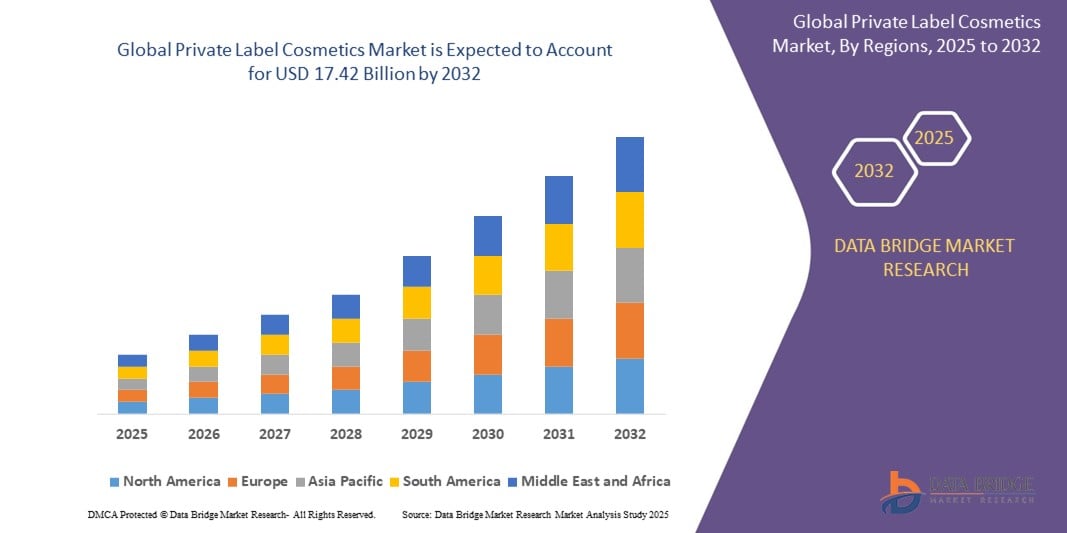
Private Label Cosmetics Market Size
- The global private label cosmetics market size was valued at USD 12.28 billion in 2024 and is expected to reach USD 18.01 billion by 2032, at a CAGR of 4.90% during the forecast period
- The market growth is primarily driven by increasing demand for affordable yet high-quality beauty products, coupled with the growing preference among retailers and consumers for customized cosmetic offerings under exclusive brands
- In addition, the rise of e-commerce platforms, advancements in formulation technology, and increased outsourcing of production to specialized manufacturers are empowering retailers to expand their private label cosmetic lines, further fueling market expansion
Private Label Cosmetics Market Analysis
- Private label cosmetics, which include skincare, haircare, color cosmetics, and personal care products sold under a retailer’s brand name, are gaining traction globally as retailers capitalize on shifting consumer preferences toward high-quality yet cost-effective beauty solutions
- The growing demand for private label cosmetics is driven by increased consumer trust in retailer brands, rising interest in personalized and niche beauty products, and faster product innovation cycles enabled by contract manufacturing partnerships
- North America dominates the private label cosmetics market, holding the largest revenue share of 38.7% in 2025, supported by a strong retail infrastructure, the popularity of store-owned beauty brands, and consumers’ increasing preference for value-for-money offerings with clean or natural formulations
- Asia-Pacific is expected to be the fastest-growing region in the private label cosmetics market during the forecast period due to rising disposable incomes, beauty consciousness, and expanding modern retail and e-commerce penetration in countries such as China, India, and South Korea
- The skincare segment is expected to dominate the private label cosmetics market with a market share of 41.6% in 2025, fueled by consumer interest in anti-aging, hydration, and natural ingredient-based products that offer premium quality at accessible prices
Report Scope and Private Label Cosmetics Market Segmentation
|
Attributes |
Private Label Cosmetics Key Market Insights |
|
Segments Covered |
|
|
Countries Covered |
North America
Europe
Asia-Pacific
Middle East and Africa
South America
|
|
Key Market Players |
|
|
Market Opportunities |
|
|
Value Added Data Infosets |
In addition to the insights on market scenarios such as market value, growth rate, segmentation, geographical coverage, and major players, the market reports curated by the Data Bridge Market Research also include in-depth expert analysis, pricing analysis, brand share analysis, consumer survey, demography analysis, supply chain analysis, value chain analysis, raw material/consumables overview, vendor selection criteria, PESTLE Analysis, Porter Analysis, and regulatory framework. |
Private Label Cosmetics Market Trends
“Rising Demand for Clean Beauty and Personalized Solutions”
- A significant and accelerating trend in the global private label cosmetics market is the growing consumer preference for clean, natural, and organic beauty products that avoid harmful chemicals, reflecting increased health and environmental awareness
- For instance, many private label brands are now offering formulations free from parabens, sulfates, and synthetic fragrances, appealing to eco-conscious and sensitive-skin consumers. Brands such as Beauty counter and Herbivore Botanicals have inspired retailers to incorporate similar clean-label standards in their private lines
- Personalization is also reshaping the market, with consumers demanding customized skincare and makeup products tailored to their unique skin types and concerns. Technologies such as AI-driven skin analysis apps and online quizzes are enabling private label manufacturers to offer bespoke formulations
- For instance, Function of Beauty’s personalized haircare model is influencing cosmetic retailers to explore tailored private label offerings
- The rise of influencer collaborations and social media-driven product launches accelerates trend adoption and consumer engagement. Many retailers partner with influencers to co-create limited edition private label collections, driving rapid growth and brand visibility
- In addition, the expansion of direct-to-consumer e-commerce platforms is allowing private label brands to bypass traditional retail constraints, offering convenience, competitive pricing, and deeper consumer data insights to fuel innovation
- This trend towards clean, personalized, and digitally-enabled private label cosmetics is fundamentally transforming consumer expectations, prompting retailers and manufacturers to invest in research, technology, and sustainable practices to stay competitive
Private Label Cosmetics Market Dynamics
Driver
“Increasing Consumer Demand for Affordable, High-Quality, and Customized Beauty Products”
- The rising preference among consumers for affordable yet high-quality cosmetics is a significant driver fueling the growth of the private label cosmetics market globally.
- For instance, in March 2024, Sephora launched several exclusive private label skincare lines aimed at providing premium formulations at competitive prices, highlighting a growing trend among major retailers to expand private label offerings.
- Consumers are increasingly seeking personalized and niche beauty products that cater to individual skin types, tones, and preferences, encouraging retailers to collaborate with specialized manufacturers to develop customized private label products.
- In addition, the surge in online beauty shopping and the expansion of direct-to-consumer channels enable private label brands to reach wider audiences, improving accessibility and consumer engagement.
- The trend toward clean, vegan, and cruelty-free formulations within private label cosmetics further drives demand as consumers become more conscious of product ingredients and ethical considerations.
- Retailers benefit from enhanced profit margins and stronger brand loyalty by offering unique private label products that differentiate them in a highly competitive market, propelling continued investment and innovation in this space.
Restraint/Challenge
“Intense Market Competition and Quality Control Concerns”
- The highly competitive nature of the cosmetics industry, with numerous established brands and new entrants, poses a significant challenge for private label cosmetics manufacturers and retailers striving to differentiate their offerings
- For instance, many private label brands face skepticism from consumers regarding product efficacy and safety compared to well-known branded cosmetics, which can limit market acceptance and growth
- Maintaining consistent quality and compliance with increasingly stringent regulatory standards across different regions is a complex and costly process for private label manufacturers. Incidents of product recalls or negative consumer feedback can severely impact brand reputation
- In addition, supply chain disruptions and variability in raw material availability—especially for natural and organic ingredients—can affect production timelines and product consistency, adding operational challenges
- Price sensitivity among consumers, especially in developing markets, also limits the extent to which private label brands can invest in premium ingredients or innovative formulations without increasing product costs
- Overcoming these challenges requires investment in quality assurance, transparent ingredient sourcing, strong regulatory compliance, and effective marketing to build consumer trust and brand loyalty
Private Label Cosmetics Market Scope
The market is segmented on the basis product, type, end use, and distribution channel.
By Product
On the basis of product, the private label cosmetics market is segmented into skincare, haircare, color cosmetics, and fragrance. The skincare segment dominates the largest market revenue share in 2025, driven by increasing consumer focus on skin health, anti-aging, and personalized skincare solutions. Products such as moisturizers, serums, and sunscreens are key contributors to this segment’s growth.
The haircare segment is anticipated to witness the fastest growth rate from 2025 to 2032, fueled by rising demand for natural and damage-repair products, along with innovations in formulations targeting diverse hair types and concerns. Shampoos, conditioners, and styling products under private labels are increasingly gaining consumer preference.
• By Type
On the basis of type, the market is segmented into organic/natural, conventional/synthetic, and other types. The organic/natural segment holds the largest market revenue share in 2025, reflecting growing consumer awareness about clean beauty and preference for eco-friendly, chemical-free ingredients. This segment benefits from trends toward sustainability and health-conscious consumption.
The conventional/synthetic segment is expected to witness steady growth due to the availability of a wider variety of formulations and cost-effective manufacturing processes. Conventional products continue to appeal to consumers seeking high-performance and innovative cosmetic solutions.
• By End Use
On the basis of end use, the market is segmented into men, women, and others. The women’s segment accounted for the largest market revenue share in 2024, driven by extensive product offerings, evolving beauty trends, and strong marketing campaigns targeting female consumers across age groups. Skincare and color cosmetics are particularly popular in this segment.
The men’s segment is expected to witness the fastest CAGR from 2025 to 2032, supported by rising awareness about personal grooming, increasing availability of men-specific private label products, and growing acceptance of cosmetics among male consumers globally.
•By Distribution Channel
On the basis of distribution channel, the market is segmented into offline, online/e-commerce, and others. The offline segment held the largest market revenue share in 2025, supported by well-established retail networks such as department stores, specialty beauty stores, and supermarkets offering private label cosmetics with direct consumer interaction.
The online/e-commerce segment is expected to witness the fastest growth due to the rising popularity of digital shopping platforms, convenience of home delivery, and enhanced consumer access to a wide range of private label cosmetic products, boosted further by social media marketing and influencer endorsements.
Private Label Cosmetics Market Regional Analysis
- North America dominates the private label cosmetics market with the largest revenue share of 38.7% in 2024, driven by strong consumer demand for innovative and personalized beauty products alongside widespread adoption of clean and sustainable cosmetics
- Consumers in the region prioritize quality, brand transparency, and product efficacy, with a growing preference for private label offerings from major retailers and e-commerce platforms that provide value without compromising on performance
- This dominance is further supported by high disposable incomes, advanced retail infrastructure, and robust online sales channels, enabling seamless access to a diverse range of private label cosmetic products across skincare, haircare, and color cosmetics categories
U.S. Private Label Cosmetics Market Insight
The U.S. private label cosmetics market captured the largest revenue share of 82% within North America in 2024, fueled by increasing consumer preference for personalized and clean beauty products. Growing awareness around organic and natural ingredients, combined with the expansion of major retail chains and e-commerce platforms offering private label cosmetics, is driving market growth. Moreover, rising demand for affordable yet high-quality cosmetics in categories such as skincare and color cosmetics is significantly boosting adoption.
Europe Private Label Cosmetics Market Insight
The European private label cosmetics market is projected to expand at a substantial CAGR throughout the forecast period, driven by the rising demand for natural and organic products alongside strict regulatory frameworks promoting product safety. Increasing urbanization and sustainability concerns among consumers are fostering the growth of private label cosmetics. The region sees strong demand across skincare and haircare segments, with private labels gaining traction in both established retail outlets and online channels.
U.K. Private Label Cosmetics Market Insight
The U.K. private label cosmetics market is anticipated to grow at a noteworthy CAGR during the forecast period, supported by rising consumer inclination toward value-for-money products with high quality and natural ingredients. The expanding influence of beauty influencers and social media campaigns promoting private label brands is enhancing market penetration. Additionally, the U.K.’s well-developed retail and e-commerce infrastructure further accelerates market growth.
Germany Private Label Cosmetics Market Insight
The German private label cosmetics market is expected to expand at a considerable CAGR during the forecast period, fueled by growing consumer awareness of sustainable and cruelty-free beauty products. Germany’s emphasis on eco-friendly practices and innovation promotes the adoption of organic and natural private label cosmetics. The integration of private label products in both drugstores and specialty retail outlets supports steady market growth.
Asia-Pacific Private Label Cosmetics Market Insight
The Asia-Pacific private label cosmetics market is poised to grow at the fastest CAGR of over 22% in 2024, driven by rising disposable incomes, urbanization, and increasing demand for personalized and affordable beauty products in countries such as China, India, Japan, and South Korea. Government initiatives promoting domestic manufacturing and digital retail channels are boosting market accessibility. Additionally, the region’s growing beauty-conscious population and evolving consumer preferences toward natural and organic cosmetics are key growth factors.
Japan Private Label Cosmetics Market Insight
The Japan private label cosmetics market is gaining momentum due to the country’s sophisticated beauty culture and demand for high-quality skincare and anti-aging products. Japanese consumers prioritize product efficacy and safety, driving demand for innovative private label cosmetics incorporating natural ingredients and advanced formulations. The growth of e-commerce platforms and collaborations with local retailers further support market expansion.
China Private Label Cosmetics Market Insight
The China private label cosmetics market accounted for the largest market revenue share in Asia-Pacific in 2024, attributed to rapid urbanization, a rising middle-class population, and increasing beauty awareness. China is witnessing growing demand for clean, organic, and customized private label products. The expansion of online sales channels, social media marketing, and government support for local manufacturing are significant factors accelerating market growth in China.
Private Label Cosmetics Market Share
The private label cosmetics industry is primarily led by well-established companies, including:
- Cosmax Inc. (South Korea)
- Intercos Group (Italy)
- Kolmar Korea Co., Ltd. (South Korea)
- Fareva (France)
- Schwan-STABILO Cosmetics GmbH & Co. KG (Germany)
- HCT Group (South Korea)
- Coptis (France)
- Cosmetic Solutions (U.S.)
- Manucurist (France)
- Garcoa Laboratories (U.S.)
- MakeUp Cosmetics (India)
- Vee Pak Inc. (U.S.)
- Anjac Health & Beauty (U.S.)
- HCP Packaging (China)
- BPI Labs (U.S.)
Latest Developments in Global Private Label Cosmetics Market
- In March 2025, Chromavis Fareva unveiled Dynaverse, a groundbreaking makeup line that seamlessly integrates skincare benefits. Presented at the Cosmoprof trade fair in Bologna, this innovative collection redefines the interaction between makeup and light, offering coverage while maintaining transparency. The formulations within Dynaverse work intuitively with the skin, enhancing natural beauty through hybridized technologies. Chromavis also won the Cosmopack Award for its Sheer Dream Creamy Remover, a vegan nail polish remover stick featuring a 100% natural formula
- In February 2025, Kolmar Korea introduced the Packaged Product Service (PPS), a streamlined solution designed to accelerate cosmetic product development. PPS provides predeveloped formulations and packaging options, significantly reducing the time required to launch new products—cutting the typical timeline from 9–12 months to just 3–6 months. By integrating advanced stability testing and leveraging its subsidiary Yenu, Kolmar Korea enhances efficiency while maintaining high-quality standards. This initiative strengthens K-beauty’s global competitiveness and supports emerging brands entering the market
- In September 2024, Cosmewax, a leading Spanish private-label cosmetics manufacturer, announced the construction of a new production facility in Puzol, Valencia. This expansion is dedicated to skincare products and is expected to boost the company’s production capacity by 50%. The state-of-the-art factory will integrate advanced technology and sustainable solutions, including solar energy systems, to enhance efficiency and environmental responsibility. This strategic move aligns with Cosmewax’s commitment to innovation and eco-friendly manufacturing
- In April 2024, Intercos S.p.A. entered into a new commercial agreement with The Estée Lauder Companies, strengthening their long-standing partnership of over 40 years. Under this agreement, Estée Lauder will transition the majority of its U.S.-based cosmetic powder production to Intercos America Inc., reinforcing Intercos’s expertise in the cosmetic powders segment. This strategic move highlights Intercos’s leadership in innovation and manufacturing, further expanding its global presence in beauty product development
- In August 2024, Walgreens Boots Alliance introduced an eco-friendly private-label cosmetics line, emphasizing sustainability and cruelty-free formulations. This new range aligns with the company’s commitment to responsible beauty, offering high-quality skincare and makeup products free from parabens, sulfates, and phthalates. Designed to meet growing consumer demand for ethical and environmentally conscious beauty solutions, the collection integrates sustainable packaging and clean ingredients

- Interactive Data Analysis Dashboard
- Company Analysis Dashboard for high growth potential opportunities
- Research Analyst Access for customization & queries
- Competitor Analysis with Interactive dashboard
- Latest News, Updates & Trend analysis
- Harness the Power of Benchmark Analysis for Comprehensive Competitor Tracking
Data collection and base year analysis are done using data collection modules with large sample sizes. The stage includes obtaining market information or related data through various sources and strategies. It includes examining and planning all the data acquired from the past in advance. It likewise envelops the examination of information inconsistencies seen across different information sources. The market data is analysed and estimated using market statistical and coherent models. Also, market share analysis and key trend analysis are the major success factors in the market report. To know more, please request an analyst call or drop down your inquiry.
The key research methodology used by DBMR research team is data triangulation which involves data mining, analysis of the impact of data variables on the market and primary (industry expert) validation. Data models include Vendor Positioning Grid, Market Time Line Analysis, Market Overview and Guide, Company Positioning Grid, Patent Analysis, Pricing Analysis, Company Market Share Analysis, Standards of Measurement, Global versus Regional and Vendor Share Analysis. To know more about the research methodology, drop in an inquiry to speak to our industry experts.
Data Bridge Market Research is a leader in advanced formative research. We take pride in servicing our existing and new customers with data and analysis that match and suits their goal. The report can be customized to include price trend analysis of target brands understanding the market for additional countries (ask for the list of countries), clinical trial results data, literature review, refurbished market and product base analysis. Market analysis of target competitors can be analyzed from technology-based analysis to market portfolio strategies. We can add as many competitors that you require data about in the format and data style you are looking for. Our team of analysts can also provide you data in crude raw excel files pivot tables (Fact book) or can assist you in creating presentations from the data sets available in the report.













