


What is the Produced Water Polishing Systems Market Size and Growth Rate?
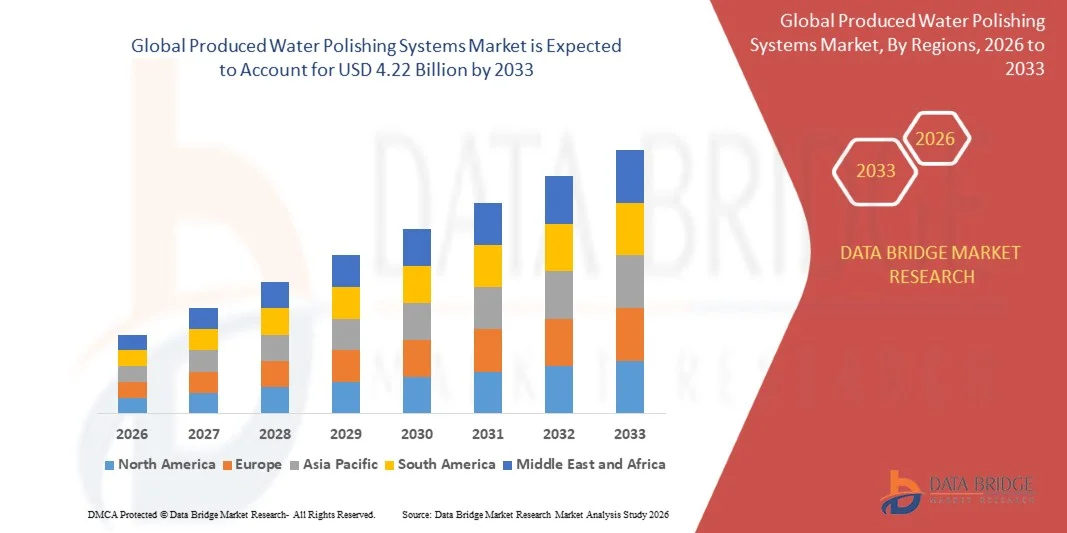
- As per Data Bridge Market Research analysis the produced water polishing systems market was valued at USD 2.20 billion in 2025 and is projected to reach USD 4.22 billion by 2033, growing at a CAGR of 8.50% from 2026 to 2033.
- The market is experiencing consistent growth driven by rising volumes of produced water from oil and gas operations, increasing adoption of advanced water treatment and polishing technologies, and growing demand for efficient treatment solutions that enable water reuse and discharge compliance.
- Stringent environmental regulations governing produced water discharge, combined with increasing offshore and onshore oil and gas production and the need to reduce freshwater consumption, is compelling operators to invest in advanced filtration, membrane, flotation, and other polishing systems.
Market Size & Forecast
- Market Value (2025): USD 2.20 Billion
- Expected Market Value (2033): USD 4.22 Billion
- Forecast CAGR (2026–2033): 8.50%
- Leading Region in 2025: North America
- Fastest Growing Region: Asia-Pacific
What are the Major Takeaways of the Produced Water Polishing Systems Market?
- North America dominated the produced water treatment market with the largest revenue share in 2025, supported by extensive oil and gas production across the U.S. and Canada, particularly in major shale basins such as the Permian Basin, Bakken, and Eagle Ford.
- Asia-Pacific produced water polishing systems market is expected to witness the fastest growth from 2026 to 2033, driven by rising energy demand and increasing investments in oil and gas exploration and production across China, India, Indonesia, and Australia.
- The physical treatment category, which includes filtration and separation technologies, held the largest market share in 2025, driven by its widespread use for removing suspended solids, oil droplets, and other contaminants from produced water. These technologies are preferred because of their reliability, cost-effectiveness, and ability to process large volumes across onshore and offshore oil and gas operations.
- Membrane filtration is projected to register the fastest growth at a CAGR from 2026 to 2033, driven by increasing demand for high-quality treated water suitable for reuse, reinjection, and discharge. Advancements in membrane technologies and growing emphasis on water recycling are accelerating adoption of membrane-based polishing systems for applications requiring tighter contaminant removal.
- Modular systems accounted for a significant market share in 2025, supported by their scalability, flexible installation, and suitability for oil and gas facilities with changing produced water volumes. Modular treatment solutions enable operators to expand treatment capacity without replacing the complete system.
- Compact systems is projected to register the fastest growth at a CAGR from 2026 to 2033, particularly in offshore and space-constrained applications, driven by the need for smaller footprints, lower transportation requirements, and efficient treatment performance. Customized systems will continue to gain adoption where produced water characteristics and treated-water quality requirements vary significantly between individual facilities.
Report Scope and Produced Water Polishing Systems Market Segmentation
|
Attributes |
Produced Water Polishing Systems Key Market Insights |
|
Segments Covered |
|
|
Countries Covered |
North America
Europe
Asia-Pacific
Middle East and Africa
South America
|
|
Key Market Players |
|
|
Market Opportunities |
|
|
Value Added Data Infosets |
In addition to the insights on market scenarios such as market value, growth rate, segmentation, geographical coverage, and major players, the market reports curated by the Data Bridge Market Research also include import export analysis, production capacity overview, production consumption analysis, price trend analysis, climate change scenario, supply chain analysis, value chain analysis, raw material/consumables overview, vendor selection criteria, PESTLE Analysis, Porter Analysis, and regulatory framework. |
What is the Key Trend in the Produced Water Polishing Systems Market?
- Oil and gas operators are increasingly adopting advanced polishing and filtration systems as final-stage treatment solutions to remove fine oil, suspended solids, and other contaminants before produced water is discharged or reinjected, supporting higher water quality and greater reuse.
- For instance, SLB’s current produced water treatment portfolio includes tertiary polishing and filtration technologies, including walnut shell media filtration and advanced regenerative treatment media, designed for fine solids and oil removal before discharge or reinjection.
- Advanced polishing systems are increasingly being integrated with multiple treatment stages to accommodate changing produced-water characteristics and achieve tighter water-quality specifications.
- For instance, Veolia Water Technologies states that its produced water solutions are customized according to water characteristics, required treated-water quality, and discharge requirements, with applications covering injection, reuse, and disposal.
- As operators increasingly prioritize water reuse, discharge compliance, and reduced freshwater consumption, the adoption of advanced polishing and filtration technologies is expected to accelerate, reinforcing final-stage treatment as an important component of produced water management.
What are the Key Drivers of the Produced Water Polishing Systems Market?
- The growing volume of produced water generated during oil and gas production, combined with increasing water scarcity and environmental requirements, is significantly increasing demand for advanced treatment and polishing systems capable of making produced water suitable for reuse and beneficial applications.
- For instance, the U.S. Department of Energy reported that the Permian Basin generated approximately 22 million barrels of produced water per day in 2025, highlighting the substantial treatment requirement associated with oil and gas production.
- Governments and energy companies are increasingly investing in technologies that reduce the cost of produced water treatment and enable beneficial reuse instead of relying solely on underground disposal.
- For instance, in July 2026, the U.S. Department of Energy announced up to USD 150 million in federal funding for oil and gas research, including advanced field-testing of multi-scale produced water treatment technologies and processes.
- With increasing produced-water volumes, freshwater constraints, and investment in treatment technologies, polishing systems are expected to remain essential for achieving the water-quality requirements needed for reinjection, discharge, and broader reuse applications.
Which Factors are Challenging the Growth of the Produced Water Polishing Systems Market?
- Advanced produced water polishing systems require significant capital investment and can involve multiple treatment stages, specialized equipment, membranes, filtration media, and chemical management, increasing overall treatment costs.
- These cost and complexity challenges can limit adoption where disposal remains less expensive than advanced treatment, particularly for highly saline or chemically complex produced-water streams.
- For instance, the U.S. Department of Energy notes that the high cost of removing constituents specific to produced water can make disposal less expensive than treatment, while high-total-dissolved-solids water can require intensive energy inputs for treatment.
- The variable composition of produced water, including salts, hydrocarbons, dissolved gases, metals, and other constituents, can also increase treatment complexity and create fouling and maintenance challenges for advanced polishing technologies.
- The high treatment costs, variable water chemistry, energy requirements, and need for customized treatment trains continue to restrict widespread deployment, particularly in cost-sensitive operations, despite growing demand for water reuse and stricter environmental requirements.
How is the Produced Water Polishing Systems Market Segmented?
The market is segmented on the basis of treatment technology, system type, application, and end-use industry.
- By Treatment Technology
On the basis of treatment technology, the produced water polishing systems market is segmented into membrane filtration, hydrocyclones, media filtration, dissolved air flotation, activated carbon, and others. The physical treatment category, which includes filtration and separation technologies, held the largest market share in 2025, driven by its widespread use for removing suspended solids, oil droplets, and other contaminants from produced water. These technologies are preferred because of their reliability, cost-effectiveness, and ability to process large volumes across onshore and offshore oil and gas operations.
Membrane filtration is projected to register the fastest growth at a CAGR from 2026 to 2033, driven by increasing demand for high-quality treated water suitable for reuse, reinjection, and discharge. Advancements in membrane technologies and growing emphasis on water recycling are accelerating adoption of membrane-based polishing systems for applications requiring tighter contaminant removal.
- By System Type
On the basis of system type, the produced water polishing systems market is segmented into compact systems, modular systems, and customized systems. Modular systems accounted for a significant market share in 2025, supported by their scalability, flexible installation, and suitability for oil and gas facilities with changing produced water volumes. Modular treatment solutions enable operators to expand treatment capacity without replacing the complete system.
Compact systems is projected to register the fastest growth at a CAGR from 2026 to 2033, particularly in offshore and space-constrained applications, driven by the need for smaller footprints, lower transportation requirements, and efficient treatment performance. Customized systems will continue to gain adoption where produced water characteristics and treated-water quality requirements vary significantly between individual facilities.
- By Application
On the basis of application, the produced water polishing systems market is segmented into onshore, offshore, and subsea. The onshore segment held the largest market share in 2025, driven by the large number of land-based oil and gas fields and continuous drilling activities worldwide. Onshore operations generate substantial produced water volumes requiring treatment before disposal, reinjection, or reuse, supporting widespread deployment of polishing systems.
The offshore segment is projected to register the fastest growth at a CAGR from 2026 to 2033, driven by increasing investments in deepwater and offshore oil and gas developments and the need for compact, reliable treatment equipment. Offshore facilities face stringent discharge requirements and space constraints, accelerating demand for advanced polishing technologies with low footprints and continuous operating capabilities.
- By End-Use Industry
On the basis of end-use industry, the produced water polishing systems market is segmented into oil and gas, petrochemical, and others. The oil and gas segment held the largest market share in 2025, driven by the substantial volumes of produced water generated during hydrocarbon extraction and the increasing requirement for treatment before disposal, reinjection, or reuse. Produced water treatment remains closely linked to upstream oil and gas operations, where regulatory requirements and water-management costs are major considerations.
The petrochemical segment is projected to register the fastest growth at a CAGR from 2026 to 2033, supported by increasing investments in refining and petrochemical infrastructure and growing requirements for efficient wastewater treatment and water reuse. Rising environmental compliance requirements and the adoption of advanced filtration and polishing technologies are further supporting demand across petrochemical processing facilities.
Which Region Holds the Largest Share of the Produced Water Polishing Systems Market?
- North America dominated the produced water treatment market with the largest revenue share in 2025, supported by extensive oil and gas production across the U.S. and Canada, particularly in major shale basins such as the Permian Basin, Bakken, and Eagle Ford.
- The region generates substantial volumes of produced water during hydrocarbon extraction, creating strong demand for advanced polishing, filtration, and separation systems. Stringent environmental regulations governing wastewater disposal, together with increasing emphasis on water recycling and reuse, is further supporting adoption of produced water treatment technologies.
U.S. Produced Water Polishing Systems Market Insight
The U.S. produced water polishing systems market captured the largest share within North America in 2025, driven by extensive shale oil and gas production and significant upstream investments. Large-scale operations generate substantial produced water volumes requiring treatment before disposal, reinjection, or reuse. Growing environmental requirements, increasing water-management costs, and rising interest in recycling produced water are encouraging U.S. operators to deploy advanced treatment and polishing solutions across onshore production facilities. ([Grand View Research][1])
Europe Produced Water Polishing Systems Market Insight
The Europe produced water polishing systems market is expected to witness steady growth from 2026 to 2033, supported by environmental regulations, mature offshore oil and gas operations, and increasing emphasis on improving produced water management. Operators are increasingly focusing on advanced treatment systems to meet discharge requirements and reduce environmental impacts associated with offshore production. The U.K. represents an important market in the region due to its North Sea offshore activities and continued investment in extending the operational life of mature fields.
U.K. Produced Water Polishing Systems Market Insight
The U.K. produced water polishing systems market is expected to experience steady growth from 2026 to 2033, driven by continued offshore oil and gas activities in the North Sea and stringent requirements for wastewater management. Operators are increasingly adopting advanced produced water treatment technologies to improve water quality before discharge or reinjection while minimizing environmental impacts. Investments aimed at extending the life of mature offshore fields are also supporting demand for efficient and compact treatment systems.
Germany Produced Water Polishing Systems Market Insight
The Germany produced water polishing systems market is expected to experience steady growth from 2026 to 2033, supported by stringent environmental standards, advanced industrial infrastructure, and increasing emphasis on water efficiency. Demand is supported by the country's chemical, petrochemical, and industrial processing activities, where advanced water treatment technologies are increasingly required to improve wastewater quality and support water reuse. The broader European focus on environmental compliance and resource efficiency is further creating opportunities for produced water polishing solutions.
Asia-Pacific Produced Water Polishing Systems Market Insight
The Asia-Pacific produced water polishing systems market is expected to witness the fastest growth from 2026 to 2033, driven by rising energy demand and increasing investments in oil and gas exploration and production across China, India, Indonesia, and Australia. Growing onshore and offshore production is generating larger volumes of produced water, while tightening wastewater discharge standards and increasing environmental awareness are encouraging operators to adopt advanced treatment and polishing technologies.
Japan Produced Water Polishing Systems Market Insight
The Japan produced water polishing systems market is expected to witness steady growth from 2026 to 2033, supported by advanced industrial infrastructure, environmental standards, and the country's emphasis on efficient water management. Demand for sophisticated filtration and polishing technologies is supported by industrial and petrochemical operations requiring reliable wastewater treatment and water reuse solutions. Japan's focus on resource efficiency and advanced environmental technologies is expected to create opportunities for high-performance produced water treatment systems.
China Produced Water Polishing Systems Market Insight
The China produced water polishing systems market is expected to experience steady growth from 2026 to 2033, supported by large-scale oil and gas production and continued efforts to strengthen domestic energy output. Major oilfields such as Daqing and Shengli generate substantial produced water during hydrocarbon extraction, increasing demand for efficient treatment and recycling systems. Government emphasis on environmental protection and improved wastewater management is further encouraging oil and gas operators to adopt advanced produced water polishing and treatment technologies.
Which are the Top Companies in Produced Water Polishing Systems Market?
The produced water polishing systems industry is primarily led by well-established companies, including:
- SLB (U.S.)
- Baker Hughes Company (U.S.)
- Halliburton Company (U.S.)
- TechnipFMC plc (U.K.)
- Veolia Environnement S.A. (France)
- Siemens Energy AG (Germany)
- Aker Solutions ASA (Norway)
- Aquatech International LLC (U.S.)
- Frames Group B.V. (Netherlands)
- Weatherford International plc (U.S.)
- Ovivo Inc. (Canada)
- CETCO Energy Services (U.S.)
- Cannon Artes S.p.A. (Italy)
- LiqTech International, Inc. (Denmark)
- Alderley plc (U.K.)
What are Latest Developments in Produced Water Polishing Systems Market?
- In July 2026, SLB completed the acquisition of Sulzer’s Vessel Internal Electrostatic Coalescer (VIEC) technology, strengthening its production and recovery portfolio with advanced oil-water separation technology. VIEC can reduce water content to below 1% in a single treatment stage, supporting improved processing efficiency and lower treatment costs across onshore and offshore operations.
- In May 2026, Veolia introduced its Hydrotech cloth filter Confidence series, a new filtration technology focused on improving filtration reliability and predictable operating costs. The development supports the broader shift toward advanced filtration solutions for industrial water treatment and water reuse applications.
- In July 2026, Aquatech announced an agreement to acquire METICHEM, a UAE-based provider of advanced water-treatment chemicals and operations and maintenance services across industrial markets in the Middle East, North Africa, and Southeast Asia. The acquisition is expected to strengthen Aquatech’s regional water-treatment and service capabilities.
- In October 2025, QUA, an Aquatech company, launched EDR-Q, an advanced electrodialysis reversal technology designed for high-recovery desalination, water reuse, and specialty process applications. The development reflects growing industry emphasis on high-recovery treatment and water reuse technologies.
- The market is increasingly moving toward integrated treatment trains combining separation, flotation, filtration, and tertiary polishing technologies to achieve tighter water-quality specifications. SLB currently offers produced water solutions spanning free-oil removal, compact flotation, advanced filtration, and tertiary polishing, including walnut shell media filtration and regenerative treatment media capable of removing oils and oily solids down to 5 micrometers.
- Aquatech is also expanding its produced water treatment portfolio around reuse, resource recovery, and discharge compliance, with technologies designed to remove difficult impurities such as silica, boron, and organic compounds and reduce produced water disposal costs.

- Interactive Data Analysis Dashboard
- Company Analysis Dashboard for high growth potential opportunities
- Research Analyst Access for customization & queries
- Competitor Analysis with Interactive dashboard
- Latest News, Updates & Trend analysis
- Harness the Power of Benchmark Analysis for Comprehensive Competitor Tracking
Global Produced Water Polishing Systems Market, Supply Chain Analysis and Ecosystem Framework
To support market growth and help clients navigate the impact of geopolitical shifts, DBMR has integrated in-depth supply chain analysis into its Global Produced Water Polishing Systems Market research reports. This addition empowers clients to respond effectively to global changes affecting their industries. The supply chain analysis section includes detailed insights such as Global Produced Water Polishing Systems Market consumption and production by country, price trend analysis, the impact of tariffs and geopolitical developments, and import and export trends by country and HSN code. It also highlights major suppliers with data on production capacity and company profiles, as well as key importers and exporters. In addition to research, DBMR offers specialized supply chain consulting services backed by over a decade of experience, providing solutions like supplier discovery, supplier risk assessment, price trend analysis, impact evaluation of inflation and trade route changes, and comprehensive market trend analysis.
Data collection and base year analysis are done using data collection modules with large sample sizes. The stage includes obtaining market information or related data through various sources and strategies. It includes examining and planning all the data acquired from the past in advance. It likewise envelops the examination of information inconsistencies seen across different information sources. The market data is analysed and estimated using market statistical and coherent models. Also, market share analysis and key trend analysis are the major success factors in the market report. To know more, please request an analyst call or drop down your inquiry.
The key research methodology used by DBMR research team is data triangulation which involves data mining, analysis of the impact of data variables on the market and primary (industry expert) validation. Data models include Vendor Positioning Grid, Market Time Line Analysis, Market Overview and Guide, Company Positioning Grid, Patent Analysis, Pricing Analysis, Company Market Share Analysis, Standards of Measurement, Global versus Regional and Vendor Share Analysis. To know more about the research methodology, drop in an inquiry to speak to our industry experts.
Data Bridge Market Research is a leader in advanced formative research. We take pride in servicing our existing and new customers with data and analysis that match and suits their goal. The report can be customized to include price trend analysis of target brands understanding the market for additional countries (ask for the list of countries), clinical trial results data, literature review, refurbished market and product base analysis. Market analysis of target competitors can be analyzed from technology-based analysis to market portfolio strategies. We can add as many competitors that you require data about in the format and data style you are looking for. Our team of analysts can also provide you data in crude raw excel files pivot tables (Fact book) or can assist you in creating presentations from the data sets available in the report.













