


Prosopagnosia Treatment Market Size
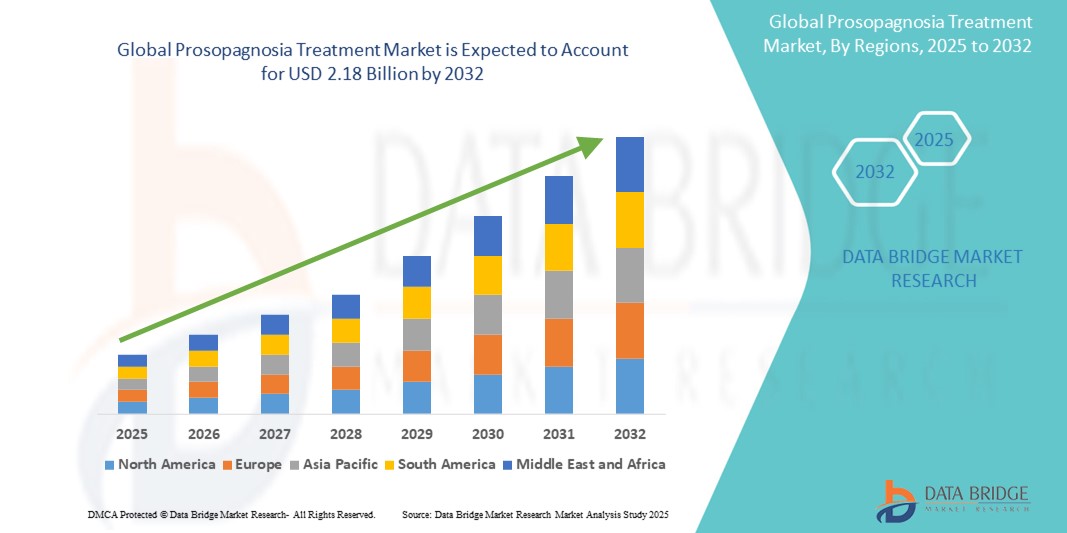
- The global prosopagnosia treatment market size was valued at USD 1.26 billion in 2024 and is expected to reach USD 2.18 billion by 2032, at a CAGR of 7.10% during the forecast period
- This growth is driven by factors such as increased awareness of neurological disorders, advancements in neuroimaging and cognitive therapy, and growing demand for personalized treatment approaches
Prosopagnosia Treatment Market Analysis
- Prosopagnosia, also known as face blindness, is a neurological condition characterized by the inability to recognize faces. It can result from brain injury or be present from birth. Treatment options are currently limited but evolving, with cognitive behavioral therapies, emerging pharmacological interventions, and assistive technologies playing a significant role.
- The market is being driven by increased diagnostic rates due to improved neuroimaging, public awareness initiatives, and research funding. As understanding of the neurological basis of prosopagnosia expands, so does the potential for targeted interventions.
- Asia-Pacific is the dominant region in the Prosopagnosia Treatment market, attributed to rising awareness of neurodevelopmental disorders, enhanced healthcare infrastructure, and increased research collaborations. Countries like China, Japan, and South Korea lead the regional growth with technological advancements in neuroscience, supportive health policies, and increasing funding for rare disease management.
- Middle East and Africa is the fastest-growing region in the global Prosopagnosia Treatment market, driven by improved access to neurological care, government investment in health systems, and growing collaboration with global research institutions. Countries such as UAE, South Africa, and Egypt are strengthening diagnostic capabilities and access to cognitive therapies, fueling regional market expansion.
- Cognitive behavioral therapy is expected to dominate the Prosopagnosia Treatment market with the largest market share of 54.6% in 2025 due to its effectiveness in enhancing facial recognition skills and adaptability. Increasing clinical validation and integration into rehabilitation protocols contribute to its dominance.
Report Scope and Prosopagnosia Treatment Market Segmentation
|
Attributes |
Prosopagnosia Treatment Key Market Insights |
|
Segments Covered |
|
|
Countries Covered |
North America
Europe
Asia-Pacific
Middle East and Africa
South America
|
|
Key Market Players |
|
|
Market Opportunities |
|
|
Value Added Data Infosets |
In addition to the insights on market scenarios such as market value, growth rate, segmentation, geographical coverage, and major players, the market reports curated by the Data Bridge Market Research also include import export analysis, production capacity overview, production consumption analysis, price trend analysis, climate change scenario, supply chain analysis, value chain analysis, raw material/consumables overview, vendor selection criteria, PESTLE Analysis, Porter Analysis, and regulatory framework. |
Global Prosopagnosia Treatment Market Trends
“"Adoption of Augmented Reality and AI in Assistive Technology"
- A major trend shaping the prosopagnosia treatment market is the integration of augmented reality (AR) and artificial intelligence (AI) in assistive technologies.
- These innovations are aimed at enhancing patients’ ability to recognize faces and navigate social interactions. Real-time tagging, facial identification, and alert mechanisms are being incorporated into wearable devices and smartphone applications.
- The continuous evolution of wearable tech platforms and smart glasses is providing patients with increased autonomy and better quality of life.
- For instance, in 2024, a clinical pilot conducted at Kyoto University in Japan tested a prototype of AI-powered AR glasses that successfully identified and tagged individuals in real-time with an 82% recognition accuracy. Positive user feedback emphasized ease of use and reduced anxiety in social settings, accelerating commercial development.
- The integration of AR and AI in assistive technologies is revolutionizing prosopagnosia treatment by enabling real-time facial recognition, reducing social anxiety, and enhancing patient autonomy, with ongoing advancements poised to drive market growth
Global Prosopagnosia Treatment Market Dynamics
Driver
"Rising Neurological Screening and Awareness Campaigns"
- The growing emphasis on cognitive health and neurological awareness has resulted in increased early screening and diagnosis of prosopagnosia.
- Governments and neurological organizations are introducing public health initiatives to educate both clinicians and the general public about rare conditions like face blindness. These campaigns also aim to destigmatize cognitive impairments, encouraging affected individuals to seek timely help and therapy.
- For instance, in 2024, the U.K. Department of Health collaborated with the British Neuroscience Association to roll out a national screening program targeting school-age children and elderly individuals. Over 200,000 participants were screened within the first six months, resulting in a notable increase in early-stage prosopagnosia diagnosis and subsequent treatment enrollment.
- Rising neurological screening and awareness campaigns are driving early prosopagnosia diagnoses, increasing treatment demand and fostering a supportive environment for affected individuals
Opportunity
"Technological Innovation in Cognitive Therapy Interfaces"
- Rapid innovation in software-based cognitive rehabilitation platforms is offering new opportunities to personalize therapy for prosopagnosia.
- These include gamified training, facial emotion matching, and memory recall modules designed to enhance neural plasticity. Such solutions are increasingly being hosted on cloud-based platforms, enabling remote patient access and real-time monitoring by clinicians.
- For instance, In May 2024, a U.S.-based digital therapeutics company received a USD 3.8 million grant from the NIH to develop a multilingual, voice-activated cognitive training app tailored for patients with facial recognition impairments. Preliminary studies indicated significant gains in facial memory retention and daily functional performance among trial users.
- Technological innovations in cognitive therapy interfaces are expanding personalized treatment options for prosopagnosia, improving patient outcomes and accessibility through cloud-based, interactive platforms.
Restraint/Challenge
"Limited Physician Familiarity and Diagnostic Delays"
- Despite growing awareness, many primary care providers and pediatricians remain unfamiliar with the symptoms and diagnostic criteria for prosopagnosia.
- As a result, misdiagnosis and delayed referrals to neurology or cognitive rehabilitation services remain prevalent, particularly in rural and underserved areas.
- For instance, a 2023 study published in the European Neurology Journal revealed that 47% of prosopagnosia patients in Germany and France reported a diagnosis delay exceeding five years. These patients were often misdiagnosed with general learning disorders or behavioral conditions, leading to inappropriate interventions and delayed access to effective treatment.
- Limited physician familiarity and diagnostic delays hinder timely prosopagnosia treatment, particularly in underserved regions, necessitating improved clinician education and diagnostic protocols.
Prosopagnosia Treatment Market Scope
The market is segmented on the basis therapy type, indication, end user, and distribution channel.
|
Segmentation |
Sub-Segmentation |
|
By Therapy Type |
|
|
By Indication |
|
|
By End User |
|
|
By Distribution Channel
|
|
In 2025, the Cognitive Behavioral Therapy is projected to dominate the market with a largest share in therapy type segment
In 2025, the Cognitive Behavioral Therapy segment is expected to dominate the Prosopagnosia Treatment market with the largest market share of 54.55% due to its strong efficacy in personalized training and neural plasticity enhancement. This dominance is attributed to its evidence-based approach in restructuring cognitive deficits associated with facial recognition impairments. The therapy supports behavioral modification through repetition and reinforcement, helping patients improve social interactions and adaptive responses. Growing clinical adoption and integration into multi-disciplinary treatment protocols further reinforce its leading position in the therapy landscape.
The Developmental Prosopagnosia is expected to account for the largest share during the forecast period in indication market
In 2025, the Developmental Prosopagnosia segment is expected to dominate the market with the largest market share of 47.8% due to rising early screening, educational integration, and therapeutic research. The segment's dominance is driven by the increasing diagnosis rate among children and young adults, facilitated by school-based screening initiatives and better clinical awareness. As research in neurodevelopmental deficits expands, early detection of prosopagnosia and subsequent therapeutic engagement is witnessing a notable surge, strengthening its market share across the forecast period.
Prosopagnosia Treatment Market Regional Analysis
“Asia-Pacific Holds the Largest Share in the Prosopagnosia Treatment Market”
- Asia-Pacific is projected to dominate the global Prosopagnosia Treatment market in 2025, accounting for an estimated 41.21% of the total market share. This dominance is attributed to the region's government health initiatives, rising neurology specialty centers, and academic research hubs.
- China holds a significant share of 15.32% of the Asia-Pacific market, driven by strong government backing for mental health diagnostics and international R&D collaborations. The country's focus on integrating AI-powered diagnostic innovations and therapy personalization has further bolstered its market position.
- Collaborations with technology firms and increased investment in neural rehabilitation devices are enhancing the region's capabilities in addressing prosopagnosia. Countries like Japan and South Korea are leading in AI-powered diagnostic innovations and therapy personalization, contributing to the region's market growth.
- The region's emphasis on early diagnosis, public health education, and integration of advanced technologies in treatment protocols is expected to sustain its leading position in the global market.
“Middle East and Africa is Projected to Register the Highest CAGR in the Prosopagnosia Treatment Market”
- Middle East and Africa is expected to register the highest growth rate, supported by rising public-private partnerships in healthcare innovation and access initiatives.
- South Africa and Egypt are expected to lead growth due to their expanding neurological diagnostics infrastructure and foreign aid-supported cognitive rehabilitation programs.
- UAE and Saudi Arabia are investing heavily in neurotechnology and digital health infrastructure as part of their national health visions, which support tele-rehabilitation, remote cognitive therapy platforms, and AI-driven cognitive assessment tools for facial recognition disorders.
- Regional university hospitals and research centers, such as Cairo University and the University of Cape Town, have initiated pilot clinical programs in collaboration with European neuroscience labs to explore genetic and neurophysiological underpinnings of prosopagnosia, promoting knowledge transfer and clinical innovation.
- International health organizations and NGOs are launching awareness campaigns and caregiver training programs aimed at reducing the stigma of cognitive and perceptual disorders, which is further driving early diagnosis and treatment-seeking behavior in underserved areas.
Prosopagnosia Treatment Market Share
The market competitive landscape provides details by competitor. Details included are company overview, company financials, revenue generated, market potential, investment in research and development, new market initiatives, global presence, production sites and facilities, production capacities, company strengths and weaknesses, product launch, product width and breadth, application dominance. The above data points provided are only related to the companies' focus related to market.
The Major Market Leaders Operating in the Market Are:
- Harvard Medical School (U.S.)
- University College London (U.K.)
- Massachusetts General Hospital (U.S.)
- Stanford University (U.S.)
- Johns Hopkins Medicine (U.S.)
- National Institute of Neurological Disorders and Stroke (U.S.)
- University of Cambridge (U.K.)
- Mayo Clinic (U.S.)
- Bournemouth University (U.K.)
- University of Western Australia (Australia)
- Mount Sinai Hospital (U.S.)
- Duke University Medical Center (U.S.)
- Kyoto University (Japan)
- National Institute of Mental Health and Neurosciences (NIMHANS) (India)
- Vidyasagar Institute of Mental Health, Neuro & Allied Sciences (VIMHANS) (India)
- University of British Columbia (Canada)
- King’s College London (U.K.)
- University of Minnesota (U.S.)
Latest Developments in Global Prosopagnosia Treatment Market
- In February 2025, Stanford University initiated a clinical trial on combined pharmacological and behavioral therapy for developmental prosopagnosia Stanford University launched a pioneering clinical trial in February 2025 to evaluate a novel combined approach for developmental prosopagnosia, a congenital condition impairing face recognition. The trial integrates pharmacological agents, such as selective serotonin reuptake inhibitors (SSRIs), to enhance neural plasticity, with tailored behavioral therapy, including gamified facial recognition training. This approach targets neuroplasticity in the fusiform face area, aiming to improve facial memory and social functioning
- In December 2024, a Japanese AI firm launched a mobile diagnostic tool that screens for facial recognition deficits in children.The app uses AI-driven facial recognition algorithms to assess response times and accuracy in identifying faces, offering a non-invasive, scalable screening solution. Targeted at schools and pediatric clinics, the tool integrates gamified tasks to engage young users, achieving a reported 90% sensitivity in detecting early signs of face blindness. This development supports the market driver of rising neurological screening and awareness, particularly for early diagnosis in pediatric populations.
- In August 2024, UCL published findings from a pilot study testing wearable face-recognition aids in patients with acquired prosopagnosia. The study, involving 30 participants, tested a prototype that uses real-time facial tagging and AI-driven identity prompts, achieving an 78% accuracy in recognizing familiar faces. Patients reported reduced social anxiety and improved confidence in public settings, aligning with the market trend of adopting AR and AI in assistive technologies. The findings have spurred partnerships with tech firms to refine the devices for commercial use.
- In March 2025, Massachusetts General Hospital launched a multicenter study on neuromodulation for prosopagnosia treatment. Massachusetts General Hospital initiated a multicenter study in March 2025 to explore transcranial magnetic stimulation (TMS) as a treatment for both developmental and acquired prosopagnosia. The study targets the fusiform face area to enhance neural activity and improve facial recognition. Involving 50 participants across the U.S., it combines TMS with cognitive training to boost neuroplasticity, aligning with the market opportunity for innovative cognitive therapy interfaces. Early results show a 10% improvement in face memory tasks after four weeks.
- In January 2025, a German neurotech startup released a cloud-based cognitive training platform for prosopagnosia. A German neurotech startup launched a cloud-based cognitive training platform in January 2025, designed for prosopagnosia patients to improve facial recognition through gamified exercises. The platform uses AI to adapt tasks to individual performance, focusing on emotion recognition and memory recall. Accessible via smartphones, it supports remote therapy with clinician oversight, reflecting the market trend toward technological innovation in cognitive therapy interfaces. Over 1,000 users reported a 12% improvement in daily social interactions.

- Interactive Data Analysis Dashboard
- Company Analysis Dashboard for high growth potential opportunities
- Research Analyst Access for customization & queries
- Competitor Analysis with Interactive dashboard
- Latest News, Updates & Trend analysis
- Harness the Power of Benchmark Analysis for Comprehensive Competitor Tracking
Data collection and base year analysis are done using data collection modules with large sample sizes. The stage includes obtaining market information or related data through various sources and strategies. It includes examining and planning all the data acquired from the past in advance. It likewise envelops the examination of information inconsistencies seen across different information sources. The market data is analysed and estimated using market statistical and coherent models. Also, market share analysis and key trend analysis are the major success factors in the market report. To know more, please request an analyst call or drop down your inquiry.
The key research methodology used by DBMR research team is data triangulation which involves data mining, analysis of the impact of data variables on the market and primary (industry expert) validation. Data models include Vendor Positioning Grid, Market Time Line Analysis, Market Overview and Guide, Company Positioning Grid, Patent Analysis, Pricing Analysis, Company Market Share Analysis, Standards of Measurement, Global versus Regional and Vendor Share Analysis. To know more about the research methodology, drop in an inquiry to speak to our industry experts.
Data Bridge Market Research is a leader in advanced formative research. We take pride in servicing our existing and new customers with data and analysis that match and suits their goal. The report can be customized to include price trend analysis of target brands understanding the market for additional countries (ask for the list of countries), clinical trial results data, literature review, refurbished market and product base analysis. Market analysis of target competitors can be analyzed from technology-based analysis to market portfolio strategies. We can add as many competitors that you require data about in the format and data style you are looking for. Our team of analysts can also provide you data in crude raw excel files pivot tables (Fact book) or can assist you in creating presentations from the data sets available in the report.













