What is the Purpureocillium Lilacinus Bionematicides Market Size and Overview?
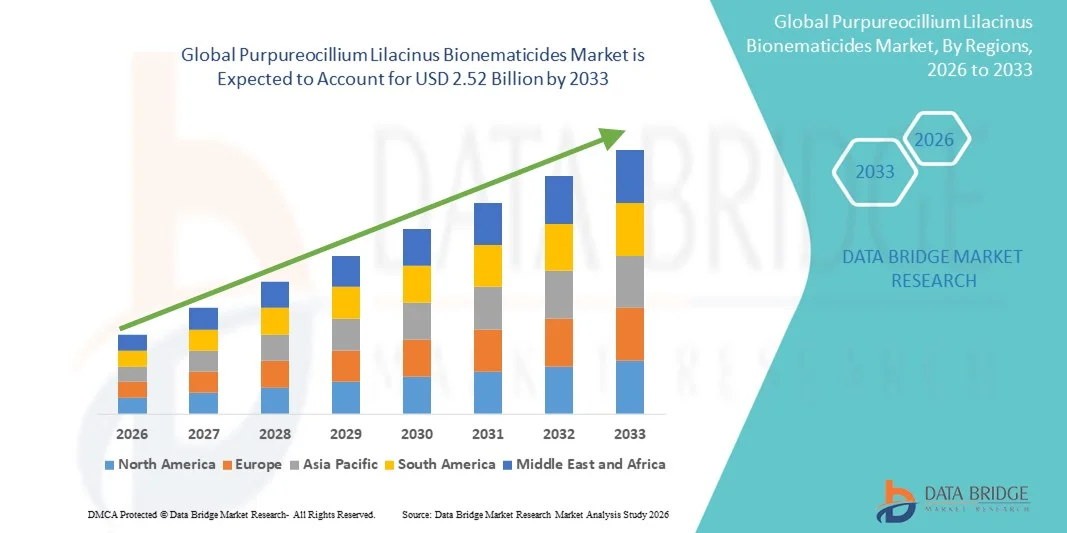
- As per Data Bridge Market Research analysis The global purpureocillium lilacinus bionematicides market size was valued at USD 1.04 billion in 2025 and is expected to reach USD 2.52 billion by 2033, at a CAGR of 11.7% during the forecast period
- The market growth is largely driven by the increasing shift toward sustainable agriculture and the rising adoption of biological crop protection solutions to manage nematode infestations effectively
- Furthermore, growing awareness of soil health preservation, stricter regulations on chemical nematicides, and the demand for residue-free agricultural produce are accelerating the uptake of purpureocillium lilacinus bionematicides, thereby supporting overall market expansion
Market Size & Forecast
- Global Market Value (2025): USD1.04 billion
- Expected Market Value (2033): USD 2.52 billion
- Forecast CAGR (2026–2033):11.7%
What are the Major Takeaways of Purpureocillium Lilacinus Bionematicides Market?
- Purpureocillium lilacinus bionematicides, used for biological control of plant-parasitic nematodes, are becoming essential inputs in modern farming systems due to their targeted action, environmental safety, and compatibility with integrated pest management practices
- The rising demand for these bionematicides is primarily supported by increasing nematode-related yield losses, expanding organic and sustainable farming practices, and the growing preference for bio-based alternatives over conventional chemical treatments
- North America dominated the purpureocillium lilacinus bionematicides market in 2025, due to increasing adoption of biological crop protection solutions and growing awareness of sustainable nematode management practices
- Asia-Pacific is expected to be the fastest growing region in the purpureocillium lilacinus bionematicides market during the forecast period due to expanding agricultural activities, rising awareness of yield losses caused by nematodes, and growing adoption of sustainable farming practices
- Soil treatment segment dominated the market with a market share of 38.5% in 2025, due to its direct application at the root zone where nematode infestation is most active and damaging to crop health. This method allows purpureocillium lilacinus to establish effectively in the soil, ensuring sustained suppression of root-knot, cyst, and lesion nematodes. Widespread adoption across cereals, oilseeds, pulses, and high-value horticultural crops further supports its dominance, as soil treatment provides consistent protection during critical early growth stages and contributes to improved yield stability
Report Scope and Purpureocillium Lilacinus Bionematicides Market Segmentation
Attributes |
Purpureocillium Lilacinus Bionematicides Key Market Insights |
|
Segments Covered |
|
|
Countries Covered |
North America
Europe
Asia-Pacific
Middle East and Africa
South America
|
|
Key Market Players |
|
|
Market Opportunities |
|
|
Value Added Data Infosets |
In addition to the insights on market scenarios such as market value, growth rate, segmentation, geographical coverage, and major players, the market reports curated by the Data Bridge Market Research also include import export analysis, production capacity overview, production consumption analysis, price trend analysis, climate change scenario, supply chain analysis, value chain analysis, raw material/consumables overview, vendor selection criteria, PESTLE Analysis, Porter Analysis, and regulatory framework. |
What is the Key Trend in the Purpureocillium Lilacinus Bionematicides Market?
Increasing Adoption of Biological Solutions for Sustainable Crop Protection
- A significant trend in the Purpureocillium lilacinus bionematicides market is the growing adoption of biological solutions for sustainable crop protection, driven by increasing environmental concerns, stricter regulations on chemical pesticides, and rising demand for organic and eco-friendly agricultural practices. Farmers and agribusinesses are increasingly incorporating P. lilacinus-based bionematicides to manage nematode infestations without harming soil health or beneficial microorganisms
- For instance, Bayer AG and Syngenta AG have been actively promoting biological nematicide solutions, offering products that target root-knot and cyst nematodes while minimizing chemical residue. Such solutions are enabling safer and more sustainable crop protection strategies across large-scale commercial farms
- The rising awareness of the negative impacts of chemical nematicides on ecosystems and human health is reinforcing the transition toward biological alternatives. Adoption is expanding across cereals, oilseeds, pulses, and vegetable crops where nematode infestations significantly affect yield and quality
- Agricultural research institutions and universities are increasingly validating the efficacy of P. lilacinus formulations, which is encouraging wider farmer adoption and establishing these bionematicides as reliable alternatives in integrated pest management programs
- The market is also witnessing innovation in formulation development, including liquid and dry forms, to enhance shelf life, ease of application, and compatibility with existing crop protection routines. These advancements are strengthening the role of biological nematicides as sustainable solutions in modern agriculture
- Growing government initiatives supporting organic farming and sustainable agriculture are further boosting market momentum. Regulatory incentives, subsidies, and awareness campaigns are encouraging farmers to adopt environmentally friendly pest management approaches
Purpureocillium Lilacinus Bionematicides Market Dynamics
Driver
Rising Demand for Eco-Friendly and Chemical-Free Crop Protection Methods
- The rising global emphasis on sustainability and safe food production is driving the demand for eco-friendly, chemical-free crop protection solutions. P. lilacinus bionematicides are increasingly preferred for their ability to control nematodes while preserving soil microbiome and minimizing chemical residues
- For instance, BASF SE and Valent BioSciences LLC offer commercially successful P. lilacinus-based products that are being adopted across large agricultural operations in Europe and North America. These products are particularly valued for their efficacy against multiple nematode species and compatibility with organic farming certifications
- Farmers are also seeking solutions that reduce environmental footprint and regulatory risks associated with synthetic nematicides. This has accelerated the adoption of biological alternatives as part of integrated pest management practices
- The adoption of sustainable farming practices, coupled with increasing consumer demand for organic and chemical-free produce, is strengthening the growth trajectory of biological nematicides. This driver is further supported by rising awareness of nematode-related crop losses and the need for targeted solutions
- In addition, collaborations between agritech companies and research institutions are enhancing product effectiveness and application methods, making biological nematicides more accessible and reliable for farmers globally
Restraint/Challenge
Limited Awareness and Adoption Among Smallholder Farmers
- The Purpureocillium lilacinus bionematicides market faces challenges due to low awareness and limited knowledge among smallholder and resource-constrained farmers, particularly in developing regions. Many farmers remain unfamiliar with the application methods, benefits, and long-term advantages of biological nematicides
- For instance, smallholder farmers in parts of India and Africa continue to rely heavily on traditional chemical nematicides due to perceived ease of use and immediate effects, limiting the penetration of P. lilacinus-based solutions. This restricts market growth in high-potential agricultural regions
- High costs relative to conventional chemical treatments and lack of localized distribution channels further constrain adoption. Farmers often hesitate to invest in products without clear demonstrations of efficacy and return on investment
- The need for farmer education, on-field trials, and technical support is critical to overcome adoption barriers. Without extensive outreach and training programs, the market may face slower growth in regions with fragmented agricultural landscapes
- Scaling up the use of biological nematicides requires coordinated efforts from companies, government agencies, and agricultural extension services to build trust, demonstrate effectiveness, and provide affordable solutions, particularly for small and mid-sized farms
How is the Purpureocillium Lilacinus Bionematicides Market Segmented?
The market is segmented on the basis of crop type, form, mode of application, and infestation.
- By Crop Type
On the basis of crop type, the market is segmented into cereals and grains, oilseeds and pulses, and fruits and vegetables. The cereals and grains segment accounted for the largest market share in 2025, supported by extensive cultivation areas and the consistent need to protect staple crops from yield losses caused by infestations. High-volume production and routine crop protection practices continue to sustain strong demand within this segment.
The fruits and vegetables segment is expected to register the fastest growth from 2026 to 2033, driven by increasing focus on high-value crops and quality output. Growers of fruits and vegetables increasingly adopt targeted protection solutions to improve crop health, enhance productivity, and meet quality standards required for fresh consumption and exports
- By Form
On the basis of form, the market is segmented into dry and liquid. The liquid segment dominated the market in 2025, owing to its ease of application, uniform distribution, and quicker action during treatment processes. Liquid formulations are widely preferred across large-scale farming operations due to their compatibility with standard spraying and irrigation systems.
The dry segment is projected to witness steady growth during the forecast period, supported by its longer shelf life and convenience in storage and transportation. Farmers also favor dry formulations in regions where handling stability and precise dosage application are prioritized
- By Mode of Application
On the basis of mode of application, the market is segmented into seed treatment, soil treatment, foliar spray, and others. Soil treatment held the largest market share of 38.5% in 2025, driven by its direct application at the root zone where nematode infestation is most active and damaging to crop health. This method allows purpureocillium lilacinus to establish effectively in the soil, ensuring sustained suppression of root-knot, cyst, and lesion nematodes. Widespread adoption across cereals, oilseeds, pulses, and high-value horticultural crops further supports its dominance, as soil treatment provides consistent protection during critical early growth stages and contributes to improved yield stability.
Seed treatment is anticipated to grow at a significant rate from 2026 to 2033, driven by its preventive approach and cost efficiency. Treating seeds before planting helps ensure early-stage protection, supports uniform crop establishment, and reduces the need for repeated field applications
- By Infestation
On the basis of infestation, the market is segmented into root-knot nematodes, cyst nematodes, lesion nematodes, and others. The root-knot nematodes segment dominated the market in 2025, due to their widespread presence across multiple crop types and their significant impact on crop yield and root development. Farmers prioritize control measures for this infestation to minimize economic losses.
The cyst nematodes segment is expected to experience notable growth during the forecast period, supported by rising awareness of their long-term persistence in soil and crop-specific damage patterns. Increased monitoring and targeted management practices are driving demand within this segment
Purpureocillium Lilacinus Bionematicides Market Regional Analysis
- North America dominated the purpureocillium lilacinus bionematicides market with the largest revenue share in 2025, driven by increasing adoption of biological crop protection solutions and growing awareness of sustainable nematode management practices
- Farmers in the region are increasingly shifting toward bio-based nematicides to reduce chemical residue concerns and comply with stricter environmental regulations, particularly in high-value crops
- This strong adoption is further supported by advanced agricultural practices, high penetration of organic farming, and robust research activities, positioning purpureocillium lilacinus as a preferred solution across commercial farming operations
U.S. Purpureocillium Lilacinus Bionematicides Market Insight
The U.S. market accounted for the largest revenue share within North America in 2025, supported by widespread cultivation of cereals, vegetables, and specialty crops vulnerable to nematode infestations. Growers are increasingly integrating biological nematicides into integrated pest management programs to improve soil health and long-term productivity. Strong presence of agri-biotech companies, coupled with supportive regulatory frameworks for biopesticides, continues to drive market expansion.
Europe Purpureocillium Lilacinus Bionematicides Market Insight
The Europe market is projected to grow at a steady CAGR during the forecast period, driven by stringent regulations limiting chemical nematicide usage and increasing emphasis on sustainable agriculture. Rising demand for residue-free produce and expansion of organic farming are accelerating adoption. European farmers are increasingly relying on microbial-based solutions to meet environmental compliance while maintaining crop yields.
U.K. Purpureocillium Lilacinus Bionematicides Market Insight
The U.K. market is expected to witness consistent growth, supported by growing awareness of soil biodiversity and sustainable crop protection practices. The gradual phase-out of conventional chemical nematicides is encouraging farmers to adopt biological alternatives. Increasing focus on sustainable food production and government-backed environmental initiatives further supports market growth.
Germany Purpureocillium Lilacinus Bionematicides Market Insight
Germany is anticipated to register notable growth during the forecast period, driven by strong emphasis on environmentally responsible farming and advanced agronomic practices. The country’s well-established organic farming sector and high acceptance of biological inputs promote adoption. Increasing investments in soil health management are reinforcing demand for purpureocillium lilacinus-based solutions.
Asia-Pacific Purpureocillium Lilacinus Bionematicides Market Insight
Asia-Pacific is expected to grow at the fastest CAGR from 2026 to 2033, driven by expanding agricultural activities, rising awareness of yield losses caused by nematodes, and growing adoption of sustainable farming practices. Rapid population growth and increasing food demand are encouraging farmers to improve crop productivity using biological solutions. Government initiatives promoting bio-inputs are further accelerating market growth across the region.
China Purpureocillium Lilacinus Bionematicides Market Insight
China accounted for the largest market share in Asia-Pacific in 2025, supported by extensive cultivation of vegetables, fruits, and cash crops highly susceptible to nematode infestations. Increasing concerns over soil degradation and chemical overuse are driving adoption of biological nematicides. Strong domestic production capabilities and government support for green agriculture are key contributors to market expansion.
India Purpureocillium Lilacinus Bionematicides Market Insight
The India market is witnessing rapid growth, driven by rising adoption of bio-based agricultural inputs and increasing awareness among farmers regarding sustainable pest management. High dependence on agriculture, coupled with severe nematode-related yield losses in horticultural crops, is supporting demand. Expanding organic farming practices and favorable government initiatives are expected to further propel market growth.
Purpureocillium Lilacinus Bionematicides Market Share
The purpureocillium lilacinus bionematicides industry is primarily led by well-established companies, including:
- Bayer AG (Germany)
- Syngenta AG (Switzerland)
- BASF SE (Germany)
- FMC Corporation (U.S.)
- Valent BioSciences LLC (U.S.)
- Marrone Bio Innovations (U.S.)
- Certis USA L.L.C. (U.S.)
- Novozymes (Denmark)
- Vegalab S.A. (Spain)
- Koppert Biological Systems (Netherlands)
- UPL (India)
- Nufarm (Australia)
- Andermatt Biocontrol Suisse AG (Switzerland)

- Interactive Data Analysis Dashboard
- Company Analysis Dashboard for high growth potential opportunities
- Research Analyst Access for customization & queries
- Competitor Analysis with Interactive dashboard
- Latest News, Updates & Trend analysis
- Harness the Power of Benchmark Analysis for Comprehensive Competitor Tracking
Data collection and base year analysis are done using data collection modules with large sample sizes. The stage includes obtaining market information or related data through various sources and strategies. It includes examining and planning all the data acquired from the past in advance. It likewise envelops the examination of information inconsistencies seen across different information sources. The market data is analysed and estimated using market statistical and coherent models. Also, market share analysis and key trend analysis are the major success factors in the market report. To know more, please request an analyst call or drop down your inquiry.
The key research methodology used by DBMR research team is data triangulation which involves data mining, analysis of the impact of data variables on the market and primary (industry expert) validation. Data models include Vendor Positioning Grid, Market Time Line Analysis, Market Overview and Guide, Company Positioning Grid, Patent Analysis, Pricing Analysis, Company Market Share Analysis, Standards of Measurement, Global versus Regional and Vendor Share Analysis. To know more about the research methodology, drop in an inquiry to speak to our industry experts.
Data Bridge Market Research is a leader in advanced formative research. We take pride in servicing our existing and new customers with data and analysis that match and suits their goal. The report can be customized to include price trend analysis of target brands understanding the market for additional countries (ask for the list of countries), clinical trial results data, literature review, refurbished market and product base analysis. Market analysis of target competitors can be analyzed from technology-based analysis to market portfolio strategies. We can add as many competitors that you require data about in the format and data style you are looking for. Our team of analysts can also provide you data in crude raw excel files pivot tables (Fact book) or can assist you in creating presentations from the data sets available in the report.