


q-PCR Reagents Market Size
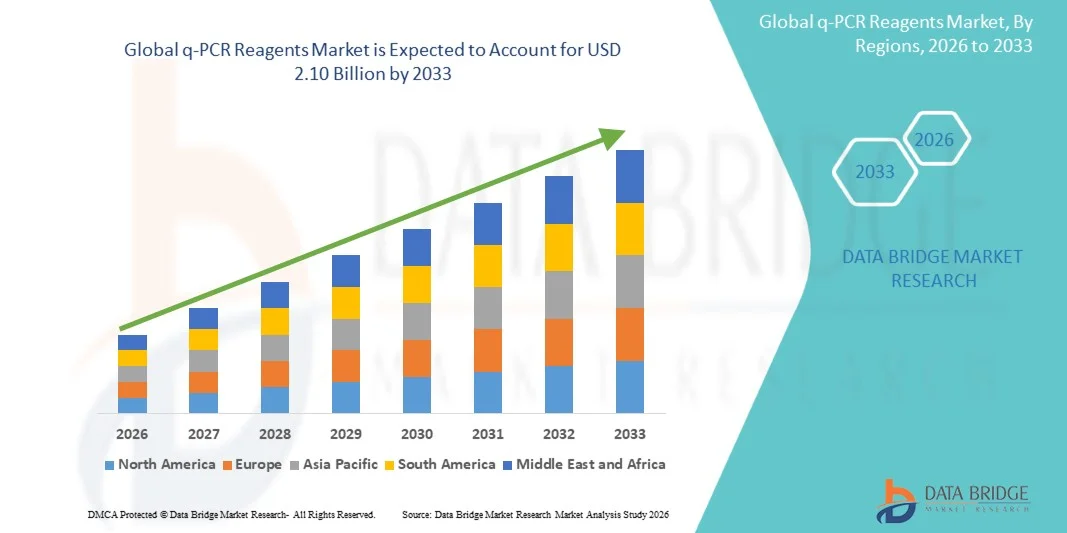
- The global q-PCR reagents market size was valued at USD 1.26 billion in 2025and is expected to reach USD 2.10 billion by 2033, at a CAGR of 6.60% during the forecast period
- The market growth is largely fueled by the increasing demand for accurate, rapid, and sensitive molecular diagnostic tools, along with expanding applications in infectious disease detection, oncology research, and genetic analysis, driving higher adoption of quantitative PCR technologies
- Furthermore, rising investments in life sciences research, growing focus on early disease detection, and continuous advancements in reagent formulations and assay efficiency are establishing q-PCR reagents as a critical component in modern molecular biology workflows. These converging factors are accelerating the uptake of q-PCR reagent solutions, thereby significantly boosting the industry's growth
q-PCR Reagents Market Analysis
- q-PCR reagents, including master mixes, probes, primers, and enzymes, are essential components of quantitative real-time PCR workflows used for precise nucleic acid amplification and detection across diagnostics, research, and biotechnology applications due to their high sensitivity, specificity, and reproducibility in gene expression and pathogen analysis
- The escalating demand for q-PCR reagents is primarily driven by the rising prevalence of infectious diseases, increasing adoption of molecular diagnostics in clinical laboratories, and expanding applications in oncology research, genetic testing, and drug development
- North America dominated the q-PCR reagents market with the largest revenue share of 38.6% in 2025, supported by advanced healthcare infrastructure, strong R&D investment, and widespread adoption of molecular diagnostic technologies, with the U.S. leading due to high testing volumes and strong presence of major life science companies
- Asia-Pacific is expected to be the fastest growing region in the q-PCR reagents market during the forecast period due to expanding healthcare access, increasing government initiatives for disease screening, and growing biotechnology and pharmaceutical research activities in countries such as China and India
- Master mix segment dominated the q-PCR reagents market with a market share of 46.5% in 2025, driven by their ease of use, reduced preparation time, and high consistency in amplification performance, making them the preferred choice in both clinical diagnostics and research laboratories
Report Scope and q-PCR Reagents Market Segmentation
|
Attributes |
q-PCR Reagents Key Market Insights |
|
Segments Covered |
|
|
Countries Covered |
North America · U.S. · Canada · Mexico Europe · Germany · France · U.K. · Netherlands · Switzerland · Belgium · Russia · Italy · Spain · Turkey · Rest of Europe Asia-Pacific · China · Japan · India · South Korea · Singapore · Malaysia · Australia · Thailand · Indonesia · Philippines · Rest of Asia-Pacific Middle East and Africa · Saudi Arabia · U.A.E. · South Africa · Egypt · Israel · Rest of Middle East and Africa South America · Brazil · Argentina · Rest of South America |
|
Key Market Players |
|
|
Market Opportunities |
· Increasing adoption of multiplex q-PCR assays is creating strong opportunities for reagent manufacturers · Expanding use of q-PCR reagents in companion diagnostics for personalized medicine |
|
Value Added Data Infosets |
In addition to the insights on market scenarios such as market value, growth rate, segmentation, geographical coverage, and major players, the market reports curated by the Data Bridge Market Research also include in-depth expert analysis, patient epidemiology, pipeline analysis, pricing analysis, and regulatory framework |
q-PCR Reagents Market Trends
“Rising Adoption of Multiplex and High-Throughput q-PCR Assays”
- A significant and accelerating trend in the global q-PCR reagents market is the increasing shift toward multiplex and high-throughput real-time PCR workflows, enabling simultaneous detection of multiple genetic targets in a single reaction for improved efficiency and diagnostic accuracy
- For instance, Thermo Fisher Scientific TaqMan multiplex q-PCR reagent systems are widely used in infectious disease panels, allowing clinicians to detect multiple pathogens in one assay with higher speed and reduced sample consumption
- Advances in reagent chemistry, including improved polymerase fidelity and inhibitor-resistant master mixes, are enhancing assay sensitivity and enabling reliable amplification even in complex clinical and environmental samples
- The integration of q-PCR reagents with automated liquid handling systems and digital PCR platforms is further improving reproducibility and reducing human error in high-volume laboratory settings
- This trend towards more scalable, efficient, and multi-target molecular testing systems is fundamentally reshaping diagnostic and research workflows. Consequently, companies such as Bio-Rad and Roche are developing next-generation q-PCR reagent kits optimized for multiplex detection and rapid turnaround time
- The growing integration of q-PCR reagents with AI-driven data analysis platforms is enhancing result interpretation accuracy and enabling faster clinical decision-making in complex diagnostic cases
- The demand for advanced q-PCR reagent formulations supporting multiplexing, automation, and digital integration is growing rapidly across clinical diagnostics, pharmaceutical research, and academic laboratories due to increasing testing volumes and precision medicine needs
q-PCR Reagents Market Dynamics
Driver
“Growing Demand Driven by Expanding Molecular Diagnostics and Infectious Disease Testing”
- The increasing demand for accurate, rapid, and scalable molecular diagnostic solutions, coupled with the rising burden of infectious diseases and genetic disorders, is a significant driver for the heightened demand for q-PCR reagents
- For instance, in March 2025, Roche Diagnostics expanded its q-PCR assay portfolio with improved reagent kits for respiratory virus detection, strengthening its position in high-demand clinical testing segments
- As healthcare systems increasingly prioritize early disease detection and personalized treatment approaches, q-PCR reagents offer essential tools for precise quantification of nucleic acids in clinical samples
- Furthermore, growing investment in pharmaceutical and biotechnology research is expanding the use of q-PCR reagents in gene expression analysis, vaccine development, and biomarker validation studies
- The expanding use of q-PCR reagents in environmental monitoring and food safety testing is further broadening market demand beyond traditional healthcare applications
- The increasing adoption of automated laboratory workflows and expanding diagnostic laboratory infrastructure are key factors propelling q-PCR reagent consumption in both developed and emerging markets
Restraint/Challenge
“High Sensitivity to Sample Quality and Technical Variability Constraints”
- Concerns surrounding the sensitivity of q-PCR reactions to sample quality, contamination risks, and technical variability pose a significant challenge to consistent and reliable market performance
- For instance, degraded RNA samples or improper handling conditions can lead to inaccurate amplification results, affecting diagnostic reliability and requiring strict workflow standardization in clinical laboratories
- Addressing these limitations through improved reagent stabilization technologies, optimized extraction protocols, and robust quality control measures is crucial for ensuring reproducible outcomes and maintaining user confidence
- Additionally, the relatively high cost of premium q-PCR reagent kits and dependence on specialized laboratory infrastructure can limit adoption in resource-constrained settings, particularly in developing regions
- Variability in assay standardization across different manufacturers and platforms can also create challenges in result comparability, especially in multi-center clinical studies and regulatory approvals
- While cost-efficient reagent formulations are gradually being introduced, the requirement for skilled personnel and stringent laboratory conditions can still hinder widespread accessibility
- Overcoming these challenges through enhanced reagent stability, workflow simplification, standardized protocols, and cost-effective product innovation will be vital for sustained growth in the q-PCR reagents market
q-PCR Reagents Market Scope
The market is segmented on the basis of detection type, assay type, plexity, packaging type, technology, application, end user, and distribution channel.
- By Detection Type
On the basis of detection type, the q-PCR reagents market is segmented into dye-based reagents and probe-based reagents. The probe-based reagents segment dominated the market with the largest revenue share in 2025, driven by its high specificity, low background signal interference, and strong suitability for clinical diagnostics requiring accurate quantification. These reagents are widely used in infectious disease testing and oncology due to their ability to detect multiple targets with high precision. Their compatibility with regulatory-approved diagnostic assays further strengthens adoption in hospitals and diagnostic laboratories. Additionally, probe-based systems are preferred in automated workflows due to their reliability and reproducibility. Continuous improvements in fluorescent probe chemistry are further enhancing their performance in complex samples.
The dye-based reagents segment is anticipated to witness the fastest growth rate from 2026 to 2033, fueled by its low cost, simplicity, and broad applicability in academic and research settings. These reagents, especially SYBR Green-based systems, are widely used in gene expression studies due to ease of assay setup without the need for sequence-specific probes. Growing research activities in emerging economies are significantly boosting demand for dye-based q-PCR solutions. Their flexibility for diverse experimental designs also supports adoption in early-stage research. Furthermore, increasing funding for molecular biology research is accelerating usage across universities and institutes.
- By Assay Type
On the basis of assay type, the market is segmented into q-PCR singleplex test/assay and q-PCR multiplex test/assay. The singleplex assay segment dominated the market with the largest revenue share in 2025, driven by its high accuracy, simple optimization process, and widespread use in routine clinical diagnostics. It is particularly preferred for single-target detection such as infectious disease confirmation and genetic mutation screening. Singleplex assays offer high reproducibility and lower risk of cross-reactivity, making them suitable for regulated healthcare environments. Their standardized workflow also supports consistent performance across laboratories. Additionally, they require fewer technical adjustments, making them easier to implement in diagnostic centers.
The multiplex assay segment is anticipated to witness the fastest growth rate from 2026 to 2033, driven by increasing demand for multi-target detection in a single reaction. Multiplex assays reduce turnaround time, sample consumption, and overall testing cost, making them highly efficient for large-scale diagnostic screening. They are widely used in infectious disease panels, oncology profiling, and outbreak surveillance. Advancements in reagent chemistry and fluorescence detection technologies are improving multiplex assay accuracy. Rising demand for high-throughput testing in clinical laboratories is further accelerating adoption.
- By Plexity
On the basis of plexity, the market is segmented into singleplex and multiplex systems. The singleplex segment dominated the market with the largest revenue share in 2025, driven by its strong reliability, ease of standardization, and widespread use in routine diagnostic workflows. It allows precise amplification of a single target, ensuring high analytical accuracy in clinical applications. Singleplex systems are widely adopted in hospital laboratories due to their established validation protocols. They are also less prone to technical errors compared to multiplex setups. Their compatibility with regulatory requirements further strengthens market dominance. Additionally, they are easier to interpret, making them ideal for high-confidence diagnostic reporting.
The multiplex segment is anticipated to witness the fastest growth rate from 2026 to 2033, fueled by rising demand for efficient multi-target analysis in a single reaction. It enables simultaneous detection of multiple genes or pathogens, improving laboratory productivity and reducing operational costs. Multiplex systems are increasingly used in infectious disease surveillance and cancer biomarker testing. Technological advancements in probe design are enhancing signal differentiation and assay accuracy. Growing demand for precision medicine is further driving adoption in advanced diagnostic and research applications.
- By Packaging Type
On the basis of packaging type, the market is segmented into kits and master mixes. The master mixes segment dominated the market with the largest revenue share of 46.5% in 2025, driven by their convenience, reduced preparation time, and minimized risk of pipetting errors. These pre-formulated solutions ensure consistent reaction performance across multiple assays. Master mixes are widely used in clinical laboratories for their high reproducibility and ease of use. They also support automation in high-throughput testing environments. Increasing demand for standardized workflows in diagnostics further strengthens their adoption. Additionally, they help improve efficiency in routine testing applications.
The kits segment is anticipated to witness the fastest growth rate from 2026 to 2033, driven by increasing demand for customized and application-specific solutions. Kits typically include primers, probes, and optimized reagents designed for specific targets, improving assay precision. They are widely used in research and biomarker discovery applications. Growing biotechnology and pharmaceutical R&D activities are boosting demand for specialized kits. Their ability to support diverse experimental needs makes them highly attractive for academic and clinical research institutions.
- By Technology
On the basis of technology, the market is segmented into gene expression, gene typing, miRNA analysis, pre-amplification, and virus detection. The gene expression segment dominated the market with the largest revenue share in 2025, driven by extensive use in molecular biology research, drug discovery, and disease mechanism studies. q-PCR reagents are widely used to quantify gene expression levels with high sensitivity and accuracy. Pharmaceutical companies rely heavily on this technology for target validation. Academic institutions also contribute significantly to demand through research studies. Its broad applicability across life sciences ensures continued dominance. Additionally, increasing focus on precision medicine further supports its growth.
The virus detection segment is anticipated to witness the fastest growth rate from 2026 to 2033, fueled by rising global focus on infectious disease surveillance and outbreak preparedness. q-PCR reagents are critical for rapid and accurate detection of viral pathogens. They are widely used in clinical diagnostics, public health laboratories, and epidemiological studies. Increasing government investments in disease monitoring systems are accelerating adoption. Continuous advancements in diagnostic technologies are improving detection speed and reliability.
- By Application
On the basis of application, the market is segmented into diagnostics, research, and forensic. The diagnostics segment dominated the market with the largest revenue share in 2025, driven by high adoption of q-PCR reagents in clinical testing for infectious diseases, genetic disorders, and cancer diagnostics. Hospitals and diagnostic centers rely heavily on q-PCR due to its accuracy, speed, and sensitivity. Increasing demand for early disease detection is further boosting usage. Expanding healthcare infrastructure supports widespread adoption in both developed and emerging regions. Regulatory approval of q-PCR-based diagnostic assays also strengthens this segment. Additionally, rising patient testing volumes continue to drive market dominance.
The research segment is anticipated to witness the fastest growth rate from 2026 to 2033, driven by increasing investments in life sciences research and biotechnology innovation. q-PCR reagents are widely used in gene expression analysis, biomarker discovery, and molecular pathway studies. Academic institutions and pharmaceutical companies are key contributors to demand. Growing focus on personalized medicine is further accelerating research applications. Expanding R&D funding globally is also supporting rapid adoption.
- By End User
On the basis of end user, the market is segmented into hospitals & diagnostic centers, forensic laboratories, research & academic institutes, clinical research organizations, and others. The hospitals & diagnostic centers segment dominated the market with the largest revenue share in 2025, driven by high patient testing demand and increasing reliance on molecular diagnostics. These facilities extensively use q-PCR reagents for infectious disease detection and genetic screening. Strong healthcare infrastructure and rising disease burden further support dominance. Availability of advanced laboratory equipment also enhances adoption. Increasing focus on early diagnosis strengthens demand. Additionally, routine clinical testing significantly contributes to this segment’s leadership.
The research & academic institutes segment is anticipated to witness the fastest growth rate from 2026 to 2033, fueled by expanding molecular biology research and increasing government funding. These institutions use q-PCR reagents for gene expression studies and experimental validation. Growing collaboration between academia and biotechnology firms is further boosting demand. Rising number of genomic research projects is also supporting growth. Increasing emphasis on innovation in life sciences is accelerating adoption.
- By Distribution Channel
On the basis of distribution channel, the market is segmented into direct tender, third-party distributors, and others. The direct tender segment dominated the market with the largest revenue share in 2025, driven by bulk procurement from hospitals, government laboratories, and large diagnostic networks. Direct purchasing ensures cost efficiency, reliable supply, and standardized product quality. Long-term contracts with manufacturers further strengthen this channel. It is widely preferred in large-scale healthcare systems. Government-led diagnostic programs also contribute significantly. Additionally, institutional buyers favor direct sourcing for better pricing control.
The third-party distributors segment is anticipated to witness the fastest growth rate from 2026 to 2033, driven by expanding access to emerging markets and smaller laboratories. Distributors help bridge supply gaps in regions with limited direct manufacturer presence. They play a key role in ensuring product availability in decentralized healthcare systems. Increasing globalization of diagnostic supply chains is supporting growth. Improved logistics and regional partnerships are further enhancing distribution efficiency.
q-PCR Reagents Market Regional Analysis
- North America dominated the q-PCR reagents market with the largest revenue share of 38.6% in 2025, supported by advanced healthcare infrastructure, strong R&D investment, and widespread adoption of molecular diagnostic technologies
- Clinical and research laboratories in the region widely utilize q-PCR reagents due to their high accuracy, regulatory compliance, and strong integration into infectious disease testing, oncology diagnostics, and genetic screening applications
- This widespread adoption is further supported by robust R&D investments, high prevalence of chronic and infectious diseases, and strong presence of leading biotechnology and pharmaceutical companies, establishing q-PCR reagents as a critical component of modern diagnostic workflows
U.S. q-PCR Reagents Market Insight
The U.S. q-PCR reagents market captured the largest revenue share of 82% in North America in 2025, fueled by strong adoption of advanced molecular diagnostics and rapid expansion of biotechnology research infrastructure. Clinical laboratories and hospitals increasingly rely on q-PCR reagents for infectious disease detection, oncology testing, and genetic analysis due to their high sensitivity and accuracy. The presence of leading global life science companies and continuous innovation in reagent technologies further strengthens market growth. Moreover, high healthcare expenditure and strong emphasis on early disease diagnosis are significantly contributing to market expansion. The growing adoption of precision medicine and genomic-based healthcare is also accelerating demand across the country.
Europe q-PCR Reagents Market Insight
The Europe q-PCR reagents market is projected to expand at a substantial CAGR throughout the forecast period, primarily driven by strong government funding for genomics research and rising demand for advanced diagnostic solutions. Countries such as Germany, France, and the UK are major contributors due to their well-established healthcare systems and strong research capabilities. The region’s strict regulatory environment ensures high-quality diagnostic standards, supporting consistent adoption of q-PCR reagents in clinical applications. Increasing focus on early disease detection, particularly in cancer and infectious diseases, is further boosting market demand. Additionally, growing adoption of personalized medicine and molecular testing in hospitals and laboratories is supporting steady market expansion.
U.K. q-PCR Reagents Market Insight
The U.K. q-PCR reagents market is anticipated to grow at a noteworthy CAGR during the forecast period, driven by increasing investment in life sciences research and rising demand for molecular diagnostics. The country’s strong academic and clinical research infrastructure supports widespread adoption of q-PCR technologies in gene expression and disease detection studies. Growing concerns over infectious diseases and cancer are encouraging greater use of advanced diagnostic tools. The expansion of NHS testing capabilities is further supporting market growth. Additionally, increasing collaboration between biotech firms and research institutions is accelerating innovation and reagent utilization.
Germany q-PCR Reagents Market Insight
The Germany q-PCR reagents market is expected to expand at a considerable CAGR during the forecast period, fueled by strong emphasis on technological innovation and high-quality healthcare systems. The country’s advanced biomedical research ecosystem supports extensive use of q-PCR reagents in molecular diagnostics and genetic analysis. Increasing focus on infectious disease surveillance and oncology research is further driving adoption. Germany’s strong pharmaceutical industry also contributes significantly to reagent demand across research and clinical applications. Moreover, integration of automation and digital laboratory technologies is improving efficiency and supporting market growth.
Asia-Pacific q-PCR Reagents Market Insight
The Asia-Pacific q-PCR reagents market is poised to grow at the fastest CAGR of 23% during 2026 to 2033, driven by rapid healthcare infrastructure development, rising disease burden, and increasing adoption of molecular diagnostics. Countries such as China, India, and Japan are major growth contributors due to expanding diagnostic capabilities and growing biotechnology investments. Government initiatives promoting genomics research and infectious disease monitoring are further accelerating market expansion. The region is also emerging as a major manufacturing hub, improving affordability and availability of q-PCR reagents. Additionally, increasing awareness of early disease detection is significantly boosting demand across both urban and semi-urban populations.
Japan q-PCR Reagents Market Insight
The Japan q-PCR reagents market is gaining momentum due to its advanced healthcare infrastructure, strong technological adoption, and increasing focus on precision medicine. The country’s aging population is driving higher demand for accurate and rapid diagnostic solutions, particularly in infectious disease and cancer testing. Integration of q-PCR technologies with automated laboratory systems is improving efficiency and workflow accuracy. Strong research activities in molecular biology further support reagent demand across academic and clinical settings. Additionally, Japan’s emphasis on high-quality diagnostics is contributing to steady market expansion.
India q-PCR Reagents Market Insight
The India q-PCR reagents market accounted for the largest revenue share in Asia-Pacific in 2025, driven by rapid urbanization, expanding healthcare access, and increasing adoption of molecular diagnostics. Growing awareness of early disease detection is boosting demand for q-PCR-based testing in hospitals and diagnostic centers. Government initiatives supporting genomics research and infectious disease control are further accelerating market growth. The rise of domestic biotechnology companies is improving affordability and availability of reagents. Additionally, the expansion of diagnostic laboratories and increasing healthcare investments are significantly contributing to market development.
q-PCR Reagents Market Share
The q-PCR Reagents industry is primarily led by well-established companies, including:
- Thermo Fisher Scientific Inc., (U.S.)
- F. Hoffmann-La Roche Ltd, (Switzerland)
- Bio-Rad Laboratories, Inc., (U.S.)
- QIAGEN (Germany)
- Merck KGaA, (Germany)
- Takara Bio Inc., (Japan)
- Promega Corporation, (U.S.)
- Agilent Technologies, Inc., (U.S.)
- Danaher (U.S.)
- Biosearch Technologies, Inc., (U.S.)
- Enzo Life Sciences, Inc., (U.S.)
- LGC Biosearch Technologies, (U.K.)
- Analytik Jena AG, (Germany)
- Bioneer Corporation, (South Korea)
- Norgen Biotek Corp., (Canada)
- Jena Bioscience GmbH, (Germany)
- Biotium, Inc., (U.S.)
- PCR Biosystems Ltd., (U.K.)
- GeneCopoeia, Inc., (U.S.)
What are the Recent Developments in Global q-PCR Reagents Market?
- In April 2025, Thermo Fisher Scientific introduced lyophilized qPCR master mixes designed for improved ambient temperature stability and simplified logistics. These reagents eliminate the need for continuous cold-chain storage, making them highly suitable for decentralized and field diagnostics
- In March 2025, QIAGEN launched an upgraded multiplex qPCR reagent panel capable of detecting multiple respiratory pathogens in a single test. The system improves diagnostic efficiency by reducing turnaround time and sample usage in clinical laboratories
- In July 2024, Bio-Rad enhanced its droplet digital PCR and qPCR reagent offerings with improved multiplexing and workflow automation capabilities. These upgrades support higher precision in gene expression analysis and rare mutation detection. The expanded reagent portfolio is widely used in oncology research and clinical diagnostics
- In October 2023, Roche launched improved real-time PCR reagent kits designed for faster and more accurate pathogen detection. The reagents are widely used in respiratory virus, HIV, and hepatitis diagnostics. They offer enhanced sensitivity and reduced false-negative rates in clinical workflows
- In May 2021, Merck increased manufacturing capacity for molecular biology reagents, including qPCR enzymes and master mixes. The expansion was driven by rising global demand for COVID-19 and infectious disease testing consumables. It improved supply chain stability for diagnostic laboratories worldwide. The investment also supported faster delivery of reagents to research and clinical customers

- Interactive Data Analysis Dashboard
- Company Analysis Dashboard for high growth potential opportunities
- Research Analyst Access for customization & queries
- Competitor Analysis with Interactive dashboard
- Latest News, Updates & Trend analysis
- Harness the Power of Benchmark Analysis for Comprehensive Competitor Tracking
Data collection and base year analysis are done using data collection modules with large sample sizes. The stage includes obtaining market information or related data through various sources and strategies. It includes examining and planning all the data acquired from the past in advance. It likewise envelops the examination of information inconsistencies seen across different information sources. The market data is analysed and estimated using market statistical and coherent models. Also, market share analysis and key trend analysis are the major success factors in the market report. To know more, please request an analyst call or drop down your inquiry.
The key research methodology used by DBMR research team is data triangulation which involves data mining, analysis of the impact of data variables on the market and primary (industry expert) validation. Data models include Vendor Positioning Grid, Market Time Line Analysis, Market Overview and Guide, Company Positioning Grid, Patent Analysis, Pricing Analysis, Company Market Share Analysis, Standards of Measurement, Global versus Regional and Vendor Share Analysis. To know more about the research methodology, drop in an inquiry to speak to our industry experts.
Data Bridge Market Research is a leader in advanced formative research. We take pride in servicing our existing and new customers with data and analysis that match and suits their goal. The report can be customized to include price trend analysis of target brands understanding the market for additional countries (ask for the list of countries), clinical trial results data, literature review, refurbished market and product base analysis. Market analysis of target competitors can be analyzed from technology-based analysis to market portfolio strategies. We can add as many competitors that you require data about in the format and data style you are looking for. Our team of analysts can also provide you data in crude raw excel files pivot tables (Fact book) or can assist you in creating presentations from the data sets available in the report.












