


Quantum Biosensing Platforms Market Size
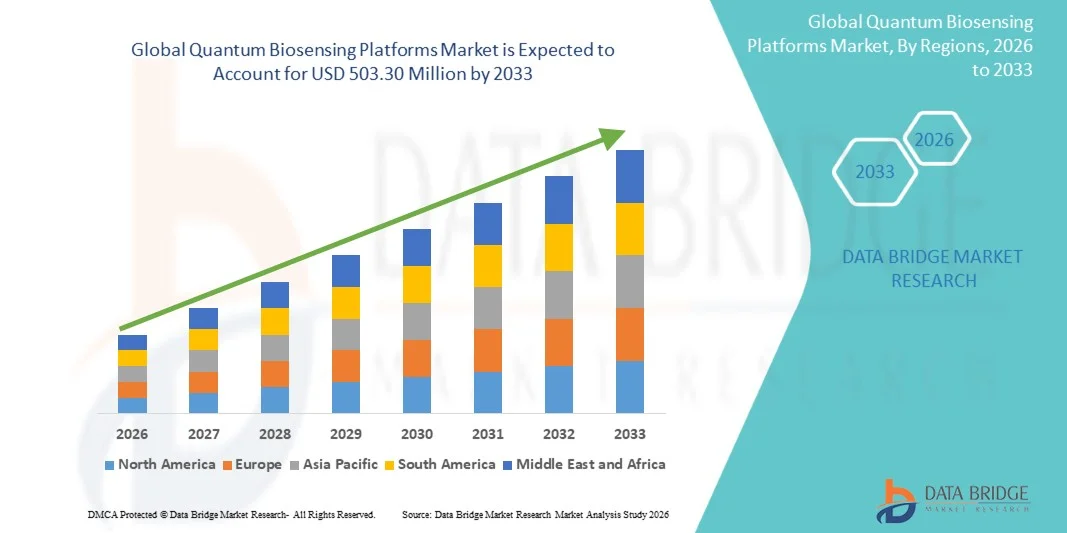
- The global quantum biosensing platforms market size was valued at USD 139.47 million in 2025 and is expected to reach USD 503.30 million by 2033, at a CAGR of 17.40% during the forecast period
- The market growth is primarily driven by increasing demand for ultra-sensitive, real-time biomolecular detection technologies, as quantum-enhanced sensors outperform conventional biosensing systems in precision, sensitivity, and detection limits
- In addition, rising investments in quantum technologies, expanding adoption of advanced diagnostics, and growing applications across healthcare, life sciences, and environmental monitoring are accelerating the shift toward quantum-enabled biosensing platforms, thereby significantly boosting the industry’s overall growth
Quantum Biosensing Platforms Market Analysis
- Quantum biosensing platforms, which utilize advanced mechanisms such as spin-defect sensors, cold-atom systems, trapped-ion platforms, optical quantum sensors, superconducting sensors, and quantum dot–based biosensors, are becoming increasingly essential in next-generation diagnostics and life-science research due to their unmatched precision, ultra-high sensitivity, and ability to detect biological signals at the single-molecule level
- The accelerating demand for quantum biosensing solutions is primarily driven by the rising need for earlier and more accurate disease detection, expanding adoption of point-of-care and rapid testing technologies, and the growing emphasis on precision medicine, along with increased global investment in quantum technologies supporting platforms such as integrated instruments, POC quantum biosensors, sensor modules, consumables, and software & analytics
- North America dominated the global quantum biosensing platforms market with the largest revenue share of 38.9% in 2025, supported by strong government and private funding for quantum R&D, a robust biotechnology and pharmaceutical ecosystem, and significant advancements in optical and spin-defect biosensing technologies, with the U.S. witnessing rapid deployment across hospitals, clinical labs, pharmaceutical R&D centers, and academic institutions
- Asia-Pacific is expected to be the fastest-growing region during the forecast period due to increasing healthcare modernization, rising investments in quantum innovation, and rapid expansion of biomedical research infrastructure across China, Japan, and South Korea, leading to higher adoption of quantum biosensing solutions for diagnostics, point-of-care testing, and environmental monitoring
- The clinical diagnostics segment dominated the quantum biosensing platforms market with a market share of 42.5% in 2025, driven by growing utilization of quantum optical and quantum dot–based biosensors for high-sensitivity biomarker detection, supported by strong demand from hospitals, clinical labs, pharmaceutical companies, CROs, and government research institutions seeking real-time, ultra-precise molecular analysis
Report Scope and Quantum Biosensing Platforms Market Segmentation
|
Attributes |
Quantum Biosensing Platforms Key Market Insights |
|
Segments Covered |
|
|
Countries Covered |
North America
Europe
Asia-Pacific
Middle East and Africa
South America
|
|
Key Market Players |
|
|
Market Opportunities |
|
|
Value Added Data Infosets |
In addition to the insights on market scenarios such as market value, growth rate, segmentation, geographical coverage, and major players, the market reports curated by the Data Bridge Market Research also include in-depth expert analysis, patient epidemiology, pipeline analysis, pricing analysis, and regulatory framework |
Quantum Biosensing Platforms Market Trends
“Advancements in Quantum-Enhanced Diagnostic Precision and Real-Time Biomolecule Detection”
- A major and rapidly accelerating trend in the global quantum biosensing platforms market is the integration of quantum technologies such as spin-defect diamonds, cold-atom sensors, and quantum dots into diagnostic workflows, significantly enhancing sensitivity, molecular resolution, and real-time detection capabilities across clinical and research settings
- For instance, NV–diamond spin-defect sensors used in quantum optical platforms enable ultra-sensitive detection of magnetic signals from individual biomolecules, allowing researchers to measure nanoscale biological interactions that are undetectable with conventional biosensors
- Quantum-enabled biosensors increasingly incorporate AI-driven signal processing, which improves noise reduction, enhances spectral analysis, and enables more accurate pattern recognition for biomarker detection; for instance, some research prototypes use AI to interpret quantum-generated signals and detect anomalies in molecular activity
- The seamless integration of quantum biosensing instruments with cloud-based analytical ecosystems enables users to centralize data interpretation, automate analysis pipelines, and connect biosensing modules with advanced computational tools, creating a unified and highly automated research and diagnostic environment
- This trend toward more intelligent, high-resolution, and interconnected quantum sensing platforms is transforming expectations for next-generation diagnostics, prompting companies such as Qnami and Quantum Diamond Technologies to develop advanced systems capable of single-molecule detection and automated real-time analysis
- Demand for quantum biosensing platforms that deliver unprecedented precision and integrated AI-enabled analytics is rising rapidly across clinical diagnostics, pharmaceutical R&D, and environmental testing, as institutions increasingly prioritize enhanced accuracy and advanced molecular insight
Quantum Biosensing Platforms Market Dynamics
Driver
“Growing Need for Ultra-Sensitive Diagnostics and Precision Medicine Applications”
- The rising requirement for earlier, more accurate disease detection and the expanding adoption of precision medicine approaches are major drivers accelerating demand for quantum biosensing platforms across healthcare and research sectors
- For instance, in March 2025, leading quantum technology groups announced advancements in NV-diamond–based biosensing systems designed to detect ultra-low concentrations of biomarkers, supporting new opportunities for clinical diagnostics and pharmaceutical screening
- As healthcare systems prioritize faster and more precise diagnostic methods, quantum biosensing offers unmatched capabilities such as real-time molecular monitoring, single-molecule analysis, and high sensitivity to weak biological signals, making it a compelling upgrade over conventional biosensing tools
- Furthermore, the rapid growth of smart laboratory ecosystems and connected diagnostic environments is positioning quantum biosensors as a critical component, enabling seamless integration with digital health platforms and advanced biomedical workflows
- The convenience of rapid molecular detection, remote data processing, AI-assisted interpretation, and the ability to integrate with cloud-based systems are key factors driving adoption across hospitals, research labs, and pharmaceutical companies seeking advanced diagnostic performance
- The increasing shift toward point-of-care testing, coupled with expanding availability of compact, user-friendly quantum biosensing modules, further contributes to accelerated market growth
Restraint/Challenge
“System Complexity, Calibration Demands, and Regulatory Approval Barriers”
- Concerns surrounding the complexity of quantum sensing systems, including calibration challenges, environmental stability requirements, and the need for specialized technical expertise, present a significant barrier to large-scale market adoption
- For instance, reports of measurement instability in early quantum platforms have created hesitancy among clinical users who require robust and repeatable diagnostic performance before deploying new technologies into routine workflows
- Addressing these challenges through improved system miniaturization, enhanced thermal and magnetic shielding, and automated calibration protocols is essential for building trust among end users, with companies emphasizing reliability improvements to support early-stage commercialization
- In addition, the high initial cost of advanced quantum biosensing instruments compared to conventional biosensors can deter adoption in budget-sensitive research and healthcare environments, particularly in developing regions or smaller laboratories
- While prices are expected to decrease as manufacturing scales and platforms mature, the perceived premium for quantum-enabled technologies remains a hurdle for institutions that do not immediately require ultra-high sensitivity or single-molecule detection capabilities
- Overcoming these challenges through broader technical standardization, improved regulatory alignment, and increased awareness of quantum diagnostic benefits will be vital for sustaining long-term market growth
Quantum Biosensing Platforms Market Scope
The market is segmented on the basis of platform, product, application, and end user.
- By Platform
On the basis of platform, the global quantum biosensing platforms market is segmented into spin-defect sensors, cold-atom platforms, trapped-ion platforms, optical quantum sensors, superconducting sensors, quantum dot–based biosensors, and hybrid classical–quantum platforms. The Optical Quantum Sensors segment dominated the market in 2025, driven by its higher technology readiness and widespread compatibility with existing biomedical optics. Optical quantum sensors benefit from mature photonic components, easier room-temperature operation, and seamless integration with fluorescence-based assays used in laboratories. Their ability to enhance detection sensitivity without requiring significant workflow changes has made them the preferred choice among early adopters. Many of the earliest commercial prototypes originate from optical architectures, further strengthening adoption momentum. Their strong alignment with imaging, microscopy, and biological readout systems reinforces their dominant share in the current market landscape.
The Spin-Defect Sensors segment is anticipated to witness the fastest growth rate from 2026 to 2033, fueled by rapid advancements in nitrogen-vacancy (NV) diamond engineering and nanoscale magnetic sensing. Spin-defect sensors offer unmatched sensitivity at the single-molecule and single-cell level, enabling biomedical measurements that classical technologies cannot perform. Improvements in diamond fabrication are lowering cost barriers, making the platform more attractive for commercial scaling. Their flexibility across instrument and compact sensor-module formats also accelerates adoption. Increasing translational studies in neural measurement, biomarker detection, and nanoscale NMR are driving strong demand, positioning spin-defect sensors as the fastest-growing platform category.
- By Product
On the basis of product, the market is segmented into integrated quantum biosensing instruments, POC quantum biosensors, sensor modules, assay kits & consumables, and software & analytics. The Integrated Quantum Biosensing Instruments segment dominated the market in 2025, supported by early commercialization strategies focused on full-system deployment. Integrated instruments provide turnkey operation, simplifying the complexities of quantum control and enabling use by non-quantum specialists across hospitals and research laboratories. These systems also command premium pricing, allowing vendors to recover development costs and build service-based revenue models. Their ability to deliver validated workflows attracts institutions seeking reliable, high-performance diagnostic and research tools. As a result, integrated systems remain the primary revenue-driving product type in the market’s early phase. Their comprehensive feature set and institutional acceptance reinforce their leading market share.
The POC Quantum Biosensors segment is expected to witness the fastest CAGR from 2026 to 2033, driven by the global shift toward decentralized and rapid diagnostics. Miniaturization of quantum sensing elements is enabling portable devices capable of delivering near-lab-grade accuracy at the point of care. These POC platforms offer strong commercial potential due to recurring consumable usage and scalability across clinics, emergency settings, and remote locations. Their compatibility with digital health and telemedicine ecosystems further accelerates adoption. As clinical validation progresses, POC quantum biosensors are set to become one of the most disruptive growth engines. The increasing demand for fast, ultra-sensitive testing positions this product category for the highest growth rate.
- By Application
On the basis of application, the market is segmented into clinical diagnostics, Point-Of-Care testing, drug discovery & pharma R&D, biomedical research, environmental & food safety monitoring, and security & biodefense. The Clinical Diagnostics segment dominated the market in 2025 with a market share of 42.5%, driven by the strong clinical need for high-sensitivity biomarker detection and early disease identification. Quantum biosensing platforms offer performance advantages that directly address gaps in oncology, infectious disease, and chronic illness diagnostics. Hospitals and diagnostic laboratories show strong interest in adopting technologies with demonstrated gains in detection limits and analytical precision. Initial commercial pilots and regulatory pathways have largely focused on diagnostic use cases, reinforcing segment dominance. Clinical diagnostics also benefits from established reimbursement structures that support capital equipment procurement. These factors collectively make clinical diagnostics the largest application segment in the market.
The Point-Of-Care Testing segment is expected to grow at the fastest rate during 2026–2033, driven by the push toward rapid, decentralized healthcare delivery. Quantum biosensing platforms enable high-accuracy results in compact formats, making them highly suitable for near-patient testing. Their integration with mobile computing and cloud analytics enhances real-time data interpretation and remote clinical oversight. Growing adoption of digital POC ecosystems worldwide further strengthens the outlook for this segment. The need for portable, sensitive diagnostic tools in resource-limited settings amplifies the growth trajectory. Consequently, point-of-care testing emerges as the fastest-expanding application area.
- By End User
On the basis of end user, the market is segmented into hospitals & clinical labs, point-of-care providers, pharmaceutical & biotechnology companies, academic & government research institutions, contract research organizations (CROs), and environmental & food testing labs. The Hospitals & Clinical Labs segment dominated the market in 2025, influenced by early adoption of high-performance quantum diagnostic systems within centralized facilities. These institutions have the resources, trained personnel, and infrastructure required to operate advanced biosensing instruments. Hospitals prioritize technologies that improve diagnostic accuracy and deliver clinical value, making quantum platforms highly attractive. Clinical labs also play a critical role in generating validation data required for regulatory pathways, accelerating adoption. Their procurement capacity for integrated instruments In addition strengthens their market influence. This positions hospitals and labs as the leading end-user segment.
The Pharmaceutical & Biotechnology Companies segment is anticipated to experience the fastest growth from 2026 to 2033, driven by expanding use of quantum biosensing in drug discovery and molecular analysis. Pharma R&D increasingly demands ultra-sensitive measurement tools to accelerate target validation and early-stage screening. Quantum platforms provide high-resolution biomolecular insights that can shorten development timelines. Companies in this sector are also more willing to invest in cutting-edge technologies that improve R&D efficiency. Collaborative partnerships between quantum technology developers and biopharma firms are further boosting adoption. As a result, pharmaceutical and biotechnology companies represent the fastest-growing end-user category.
Quantum Biosensing Platforms Market Regional Analysis
- North America dominated the global quantum biosensing platforms market with the largest revenue share of 38.9% in 2025, supported by strong government and private funding for quantum R&D, a robust biotechnology and pharmaceutical ecosystem, and significant advancements in optical and spin-defect biosensing technologies
- Institutions across the region prioritize ultra-sensitive biosensing solutions for clinical diagnostics, biomedical research, and pharmaceutical development, driving early commercial deployment of quantum-based systems
- The growing presence of quantum research hubs, technological startups, and government-funded innovation programs further accelerates the development and validation of quantum biosensing platforms, reinforcing the region’s leading market position
U.S. Quantum Biosensing Platforms Market Insight
The U.S. quantum biosensing platforms market captured the largest revenue share within North America in 2025, driven by strong federal funding, robust academic–industry collaborations, and early commercialization initiatives in quantum-enabled diagnostics. Demand is rising as healthcare systems seek ultra-sensitive detection technologies for oncology, infectious diseases, and precision medicine. The presence of leading quantum research institutions, combined with major investments from DARPA, NIH, and NSF, continues to accelerate development. In addition, the rapid expansion of biopharma R&D and the adoption of quantum-enhanced analytical tools contribute significantly to market growth.
Europe Quantum Biosensing Platforms Market Insight
The Europe quantum biosensing platforms market is projected to expand at a substantial CAGR during the forecast period, primarily driven by the region’s strong regulatory support for advanced diagnostic technologies and growing investments in quantum innovation. European healthcare systems increasingly prioritize high-precision biomarker detection, creating favorable conditions for adoption. The rise in academic research, supported by the EU Quantum Flagship program, boosts development. Growing applications across clinical diagnostics, environmental monitoring, and pharmaceutical R&D further catalyze market expansion across the region.
U.K. Quantum Biosensing Platforms Market Insight
The U.K. quantum biosensing platforms market is anticipated to grow at a noteworthy CAGR during the forecast period, supported by the country’s expanding quantum technology ecosystem and increasing emphasis on early disease detection. Government-backed initiatives and strong university research networks are driving advancements in spin-defect and optical quantum sensing technologies. The rising focus on next-generation diagnostics in hospitals and biotech companies fuels adoption. Growing demand for sensitive, rapid-testing solutions also positions the U.K. as a key contributor to Europe’s quantum biosensing expansion.
Germany Quantum Biosensing Platforms Market Insight
The Germany quantum biosensing platforms market is expected to witness a considerable CAGR over the forecast period, propelled by the nation’s technological leadership and commitment to digital healthcare innovation. Germany’s sophisticated research infrastructure and strong industrial base support rapid development of quantum biosensing prototypes and instruments. Demand is growing in clinical laboratories, pharmaceutical companies, and environmental testing sectors. The emphasis on precision, quality, and sustainability aligns well with emerging quantum sensing solutions, encouraging broader domestic adoption.
Asia-Pacific Quantum Biosensing Platforms Market Insight
The Asia-Pacific quantum biosensing platforms market is poised to grow at the fastest CAGR during the forecast period, driven by rapid advances in quantum research across China, Japan, and India. Expanding healthcare infrastructure, combined with rising adoption of next-generation diagnostic technologies, fuels growth. Government-backed quantum programs and increasing private-sector investment accelerate technological development. The region’s position as a global manufacturing hub supports cost efficiencies, making quantum biosensing technologies more accessible to a wider base of healthcare and research institutions.
Japan Quantum Biosensing Platforms Market Insight
The Japan quantum biosensing platforms market is gaining strong momentum due to the nation’s high-tech ecosystem, growing healthcare digitalization, and emphasis on precision diagnostics. Japan’s research institutions are advancing quantum optical and spin-defect sensing technologies, strengthening domestic innovation. The rising demand for early disease detection and integration of quantum tools with other medical IoT systems is driving adoption. In addition, Japan’s aging population is such asly to accelerate the deployment of high-sensitivity diagnostic solutions in hospitals and clinics.
India Quantum Biosensing Platforms Market Insight
The India quantum biosensing platforms market accounted for one of the largest shares in the Asia-Pacific region in 2025, supported by the country’s rapidly expanding healthcare infrastructure, strong biotech ecosystem, and growing governmental support for quantum technologies. Increasing adoption of advanced diagnostic solutions across hospitals and research institutions drives demand. India’s push toward digital health, combined with the emergence of domestic quantum startups and affordable innovation models, significantly strengthens the market. Rising interest in precision medicine and infectious disease surveillance further accelerates growth.
Quantum Biosensing Platforms Market Share
The Quantum Biosensing Platforms industry is primarily led by well-established companies, including:
- Qnami AG (Switzerland)
- Quantum Diamond Technologies Inc. (U.S.)
- AOSense, Inc. (U.S.)
- SBQuantum Inc. (U.S.)
- KWAN-TEK (France)
- Diasense (Denmark)
- Q.ANT (Germany)
- NVision Imaging Technologies (Germany)
- Adamas Nanotechnologies (U.S.)
- NKT Photonics (Denmark)
- Quantum Brilliance (Australia)
- M Squared Lasers Ltd (U.K.)
- Muquans SAS (France)
- QuSpin Inc. (U.S.)
- Robert Bosch GmbH (Germany)
- Skye Instruments Ltd. (U.K.)
- GWR Instruments Inc. (U.S.)
- Apogee Instruments Inc. (U.S.)
- QT Sense BV (Netherlands)
What are the Recent Developments in Quantum Biosensing Platforms Market?
- In August 2025, researchers published a study titled “Quantum biosensing on a multiplexed functionalized diamond microarray” describing the first scalable quantum-biosensor platform that integrates a 7×7 DNA microarray directly onto a diamond chip enabling simultaneous detection of 49 distinct biomolecular markers with high spatial resolution using nitrogen-vacancy (NV) centers
- In March 2025, a team at Lawrence Berkeley National Laboratory (in collaboration with UC Berkeley) demonstrated that nanodiamonds in microdroplets can be used for highly precise chemical (and by extension, biomolecular) detection. The method requires only small sample volumes and shows promise for sensitive, rapid biosensing in compact formats
- In February 2025, a startup QT Sense spun out from a medical research institution in Europe raised €6 million to further develop its “Quantum Nuova” sensing product aimed at single-cell level detection and early disease diagnostics. This funding marks a real move toward commercialization of quantum-enabled biosensing tools
- In December 2024, researchers (at Okayama University, Japan) announced the development of high-quality nanodiamonds with NV centers whose spin properties rival those of bulk diamond. These “quantum-grade” nanodiamonds show much stronger fluorescence and far longer coherence times making them highly promising for bio-imaging and quantum biosensing applications
- In May 2024, a research team at Georgia Tech reported a new quantum sensing platform based on color-centers in layered materials that can detect spin-wave excitations and environmental changes. This demonstrated the viability of quantum-sensor platforms beyond diamond, potentially broadening material choices for biosensing applications

- Interactive Data Analysis Dashboard
- Company Analysis Dashboard for high growth potential opportunities
- Research Analyst Access for customization & queries
- Competitor Analysis with Interactive dashboard
- Latest News, Updates & Trend analysis
- Harness the Power of Benchmark Analysis for Comprehensive Competitor Tracking
Data collection and base year analysis are done using data collection modules with large sample sizes. The stage includes obtaining market information or related data through various sources and strategies. It includes examining and planning all the data acquired from the past in advance. It likewise envelops the examination of information inconsistencies seen across different information sources. The market data is analysed and estimated using market statistical and coherent models. Also, market share analysis and key trend analysis are the major success factors in the market report. To know more, please request an analyst call or drop down your inquiry.
The key research methodology used by DBMR research team is data triangulation which involves data mining, analysis of the impact of data variables on the market and primary (industry expert) validation. Data models include Vendor Positioning Grid, Market Time Line Analysis, Market Overview and Guide, Company Positioning Grid, Patent Analysis, Pricing Analysis, Company Market Share Analysis, Standards of Measurement, Global versus Regional and Vendor Share Analysis. To know more about the research methodology, drop in an inquiry to speak to our industry experts.
Data Bridge Market Research is a leader in advanced formative research. We take pride in servicing our existing and new customers with data and analysis that match and suits their goal. The report can be customized to include price trend analysis of target brands understanding the market for additional countries (ask for the list of countries), clinical trial results data, literature review, refurbished market and product base analysis. Market analysis of target competitors can be analyzed from technology-based analysis to market portfolio strategies. We can add as many competitors that you require data about in the format and data style you are looking for. Our team of analysts can also provide you data in crude raw excel files pivot tables (Fact book) or can assist you in creating presentations from the data sets available in the report.













