


Radioimmunoassay Market Size
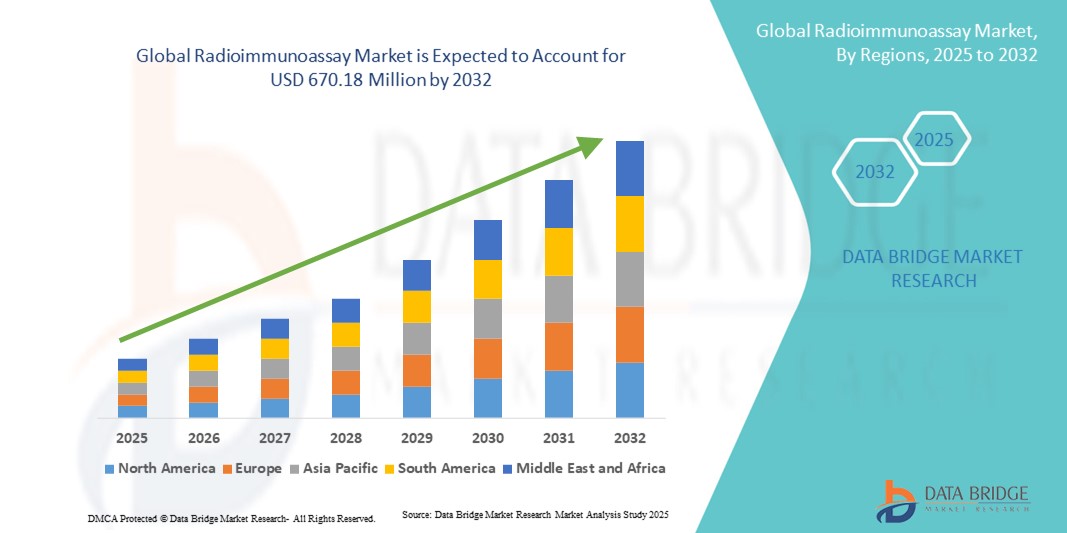
- The global radioimmunoassay market size was valued at USD 485.95 million in 2024 and is expected to reach USD 670.18 million by 2032, at a CAGR of 4.10% during the forecast period
- The market growth is largely fueled by the growing adoption and technological progress within diagnostic assays and immunoassay technologies, leading to increased digitalization and automation in both clinical and research laboratory settings
- Furthermore, rising demand for highly sensitive, accurate, and cost-effective diagnostic tools for detecting hormones, drugs, and disease markers is establishing radioimmunoassay as a preferred analytical method of choice. These converging factors are accelerating the uptake of radioimmunoassay solutions, thereby significantly boosting the industry's growth
Radioimmunoassay Market Analysis
- Radioimmunoassay, offering highly sensitive quantification of hormones, peptides, and other biological molecules, is an essential diagnostic technique widely used in endocrinology, oncology, and clinical research due to its unmatched accuracy and reliability. The method remains vital in both hospital laboratories and research institutes for detecting low-concentration analytes
- The growing demand for radioimmunoassay is primarily fueled by the increasing prevalence of chronic diseases, rising focus on early and precise disease detection, and continuous advancements in assay automation and safety protocols
- North America dominated the radioimmunoassay market with the largest revenue share of 45.2% in 2024, characterized by the presence of advanced diagnostic infrastructure, early adoption of novel assay technologies, and the strong presence of pharmaceutical and biotechnology companies. The U.S. leads the regional market due to the widespread use of RIA in clinical laboratories, academic institutions, and pharmaceutical R&D activities, alongside favorable reimbursement frameworks supporting diagnostic testing
- Asia-Pacific is expected to be the fastest growing region in the radioimmunoassay market during the forecast period, with a projected CAGR of 12.1% from 2025 to 2032, driven by rapid urbanization, increasing healthcare expenditure, and growing awareness of precision diagnostics. Countries such as China and India are heavily investing in healthcare infrastructure, while rising middle-class populations and government initiatives are further propelling the demand for reliable diagnostic assays, including RIA
- The clinical diagnosis segment dominated the radioimmunoassay market with the largest market revenue share of 71.4% in 2024, reflecting the critical role of RIA in the detection and management of complex diseases. Clinicians widely depend on RIA for accurate hormone profiling, tumor marker identification, and viral antigen measurement, as its sensitivity surpasses many other conventional diagnostic techniques
Report Scope and Radioimmunoassay Market Segmentation
|
Attributes |
Radioimmunoassay Key Market Insights |
|
Segments Covered |
|
|
Countries Covered |
North America
Europe
Asia-Pacific
Middle East and Africa
South America
|
|
Key Market Players |
|
|
Market Opportunities |
|
|
Value Added Data Infosets |
In addition to the insights on market scenarios such as market value, growth rate, segmentation, geographical coverage, and major players, the market reports curated by the Data Bridge Market Research also include in-depth expert analysis, pricing analysis, brand share analysis, consumer survey, demography analysis, supply chain analysis, value chain analysis, raw material/consumables overview, vendor selection criteria, PESTLE Analysis, Porter Analysis, and regulatory framework. |
Radioimmunoassay Market Trends
Advancements in Sensitivity and Clinical Applications
- A significant and accelerating trend in the global radioimmunoassay market is the continuous enhancement of assay sensitivity and specificity, enabling the detection of ultra-low concentrations of hormones, peptides, and biomarkers that are crucial for accurate clinical diagnostics. These advancements are improving disease detection and patient monitoring across multiple therapeutic areas
- For instance, modern RIA kits have been refined to deliver highly precise hormone profiling, particularly in endocrinology, reproductive medicine, and oncology. Similarly, the adoption of automation in laboratories has enhanced throughput, reduced human error, and improved overall assay reproducibility, making radioimmunoassay an indispensable tool in both clinical and research environments
- Continuous innovation in assay design is allowing the detection of emerging biomarkers for metabolic, immunological, and genetic disorders. For instance, advanced tumor marker RIAs are supporting early cancer diagnosis, while improved hormone assays are enabling better management of infertility and thyroid-related conditions. Furthermore, regulatory compliance and enhanced safety protocols for handling radioactive materials are driving wider adoption in accredited diagnostic laboratories
- The integration of RIA with advanced laboratory information systems and digital reporting platforms is streamlining workflows, allowing healthcare providers to quickly interpret test results and make informed clinical decisions. This digital enhancement is improving efficiency in diagnostic settings while maintaining the unmatched sensitivity of RIA methods.
- This trend towards more sensitive, automated, and clinically versatile radioimmunoassay solutions is fundamentally reshaping diagnostic practices worldwide. Consequently, companies and research organizations are investing heavily in developing next-generation RIA kits that focus on precision, reproducibility, and broader clinical applicability across chronic and rare diseases
- The demand for radioimmunoassay solutions is growing rapidly across both hospital laboratories and pharmaceutical research organizations, as clinicians and scientists increasingly prioritize reliable, sensitive, and validated diagnostic tools for accurate disease management and drug development
Radioimmunoassay Market Dynamics
Driver
Growing Need Due to Rising Prevalence of Chronic and Hormonal Disorders
- The increasing global burden of chronic diseases, hormonal imbalances, and cancers is a significant driver for the heightened demand for radioimmunoassay (RIA) tests. With their unmatched sensitivity and specificity, RIA techniques are widely used for detecting and quantifying hormones, antigens, and drugs at very low concentrations
- For instance, in March 2024, PerkinElmer announced the expansion of its immunoassay product line with enhanced RIA kits designed for endocrinology and oncology applications. Such strategic product innovations are expected to drive the growth of the radioimmunoassay industry in the forecast period
- As clinicians and researchers increasingly seek accurate diagnostic tools for conditions such as thyroid disorders, infertility, and certain cancers, RIA offers precise quantification that is often superior to other immunoassay methods. The ability of RIA to support early disease detection, monitor treatment effectiveness, and aid in therapeutic drug monitoring makes it a critical tool in modern diagnostics
- Furthermore, the growing demand for laboratory automation and standardized diagnostic procedures is making RIA an integral part of diagnostic workflows in hospitals and research labs. Its compatibility with large-scale testing and long-established reliability further reinforce its adoption in both developed and developing healthcare markets
- The ability of RIA to deliver results for a wide range of clinical applications — from metabolic disorders to oncology — is propelling its use across healthcare service providers, research organizations, and pharmaceutical companies. The trend towards early detection and personalized medicine is expected to further increase reliance on radioimmunoassay solutions worldwide
Restraint/Challenge
Concerns Regarding Radioisotope Handling and High Operational Costs
- Concerns surrounding the safe handling, storage, and disposal of radioactive isotopes used in RIA tests pose a significant challenge to broader market penetration. Since RIA depends on the use of radiolabeled substances, laboratories must comply with stringent regulatory standards for radiation safety, which increases operational complexity and costs
- For instance, strict regulatory requirements from bodies such as the U.S. Nuclear Regulatory Commission (NRC) and the International Atomic Energy Agency (IAEA) create additional hurdles for laboratories adopting RIA, particularly in regions with limited nuclear infrastructure. These compliance barriers can slow down adoption, especially in smaller diagnostic centers or low-resource healthcare settings
- Addressing these safety concerns through improved training, advanced shielding technologies, and the development of safer radiolabeled compounds is crucial for sustaining confidence in RIA. In addtion, the relatively high operational costs associated with isotope procurement, waste management, and specialized equipment can act as a barrier to adoption in cost-sensitive regions
- While alternative immunoassay technologies such as ELISA and chemiluminescent assays are gaining popularity due to their non-radioactive nature, RIA continues to hold strong value for its unparalleled sensitivity in specific diagnostic applications. Overcoming these challenges through innovation in reagent safety, cost optimization, and supportive regulatory frameworks will be vital for sustained growth of the radioimmunoassay market
Radioimmunoassay Market Scope
The market is segmented on the basis of product type, application, end user, and distribution channel.
- By Product Type
On the basis of product type, the radioimmunoassay market is segmented into radioimmunoassay reagents and kits and radioimmunoassay analyzers. The Radioimmunoassay Reagents and Kits segment dominated the largest market revenue share of 62.5% in 2024, primarily due to their indispensable role in routine diagnostic and research testing. These kits are widely utilized for hormone level assessment, cancer marker analysis, and infectious disease detection, offering laboratories a reliable and standardized testing solution. Their cost-effectiveness, ease of use, and consistent availability across healthcare facilities have further strengthened their market position. Additionally, continuous innovation by manufacturers—such as the introduction of highly sensitive reagents and disease-specific panels—is expanding their utility in both developed and emerging regions. The segment benefits greatly from high repeat purchases and recurring demand from hospitals and diagnostic labs.
The Radioimmunoassay Analysers segment is expected to witness the fastest growth rate of 18.3% CAGR from 2025 to 2032, driven by the rising demand for automation and high-throughput capabilities in modern laboratories. Analysers reduce manual intervention, minimize errors, and provide quicker turnaround times, making them increasingly important in large-scale testing facilities. Growing preference for fully automated systems among healthcare providers is also influenced by the global shortage of skilled laboratory professionals. Furthermore, advancements in analyzer technology, such as integration with data management systems and compatibility with a broader range of assays, are enhancing their adoption in clinical and research applications worldwide.
- By Application
On the basis of application, the radioimmunoassay market is segmented into scientific research and clinical diagnosis. The clinical diagnosis segment accounted for the largest market revenue share of 71.4% in 2024, reflecting the critical role of RIA in the detection and management of complex diseases. Clinicians widely depend on RIA for accurate hormone profiling, tumor marker identification, and viral antigen measurement, as its sensitivity surpasses many other conventional diagnostic techniques. The growing prevalence of endocrine disorders, cancers, and infectious diseases has significantly elevated the demand for such high-precision testing. In addition, healthcare facilities are increasingly integrating RIA into diagnostic workflows to enhance early disease detection and improve patient outcomes. This continued reliance on RIA ensures its dominance in diagnostic laboratories and hospital settings worldwide.
The scientific research segment is projected to register the fastest CAGR of 16.9% from 2025 to 2032, as research institutes, universities, and pharmaceutical companies expand the use of RIA in experimental and exploratory studies. RIA’s unparalleled accuracy in quantifying biological molecules makes it a preferred tool for biomarker validation, drug development, and molecular biology research. Increased funding for life sciences research, coupled with growing global interest in personalized medicine, is boosting demand. Furthermore, academic institutions and contract research organizations are adopting RIA for cutting-edge projects, thereby fueling the growth trajectory of this segment.
- By End User
On the basis of end user, the radioimmunoassay market is segmented into hospitals, clinical diagnostic laboratories, academic and research institutes, pharmaceutical and biopharmaceutical industry, contract research organizations (CROs), and others. The hospitals segment dominated the largest market revenue share of 39.8% in 2024, as hospitals remain the frontline facilities for patient testing and disease management. RIA plays a central role in hospital laboratories by enabling rapid, precise, and routine assessments of hormones, cancer markers, and infectious agents. With the global rise in chronic conditions such as diabetes, thyroid disorders, and cancers, hospitals have become key adopters of RIA kits and systems to support timely and effective patient care. The presence of in-house diagnostic laboratories within most hospitals also ensures a steady demand for RIA reagents, fostering long-term growth in this segment. Furthermore, hospitals often serve as referral centers for specialized testing, further strengthening their dominance.
The pharmaceutical and biopharmaceutical industry segment is anticipated to record the fastest CAGR of 17.5% from 2025 to 2032, owing to its expanding role in drug discovery and clinical development processes. RIA is extensively used by pharma and biotech companies for pharmacokinetic analysis, drug metabolism studies, and therapeutic drug monitoring. Its high sensitivity and ability to provide quantitative measurements are particularly valuable during preclinical and clinical trials. The increasing emphasis on precision medicine and biologics development is further driving adoption. As more global pharma companies invest heavily in research pipelines, the demand for RIA solutions in this sector is expected to grow significantly over the forecast period.
- By Distribution Channel
On the basis of distribution channel, the radioimmunoassay market is segmented into direct tender, online sales, third-party distribution, and others. The direct tender segment held the largest market revenue share of 48.6% in 2024, primarily because large healthcare institutions, government organizations, and laboratories prefer bulk purchasing through formal tenders. This channel ensures cost savings, steady supply, and long-term contracts with trusted suppliers, which is critical for uninterrupted diagnostic services. Many public hospitals and research institutes rely on government-funded procurement systems, further reinforcing the dominance of this segment. Additionally, direct tenders often include after-sales services and training support, making them more attractive to large institutions seeking reliability and operational efficiency.
The online sales segment is projected to grow at the fastest CAGR of 19.2% from 2025 to 2032, supported by the growing trend of digitalization in procurement practices. Online platforms allow buyers to compare a wide range of products, access technical information, and purchase directly with flexible payment options. Smaller diagnostic centers, academic labs, and even individual researchers increasingly prefer online ordering for convenience and quick access to diverse suppliers. The COVID-19 pandemic accelerated the shift towards online procurement in the healthcare sector, and this trend continues to strengthen as e-commerce platforms expand their offerings in specialized laboratory products.
Radioimmunoassay Market Regional Analysis
- North America dominated the radioimmunoassay (RIA) market with the largest revenue share of 45.2% in 2024, owing to its advanced healthcare infrastructure, early adoption of cutting-edge assay technologies, and the strong presence of leading pharmaceutical and biotechnology companies
- The region has been at the forefront of diagnostic innovation, with widespread integration of RIA in endocrinology, oncology, autoimmune disease testing, and infectious disease diagnostics
- A well-established reimbursement framework, combined with strong collaborations between academic institutions, diagnostic laboratories, and private research centers, further strengthens North America’s leadership in this market
U.S. Radioimmunoassay Market Insight
The U.S. radioimmunoassay market accounted for 65.7% of the North American revenue share in 2024, driven by its large-scale adoption of RIA across hospitals, independent diagnostic laboratories, and pharmaceutical R&D facilities. The country’s leadership is reinforced by high testing volumes, particularly in hormone profiling, drug monitoring, and early disease detection. The U.S. also benefits from strong governmental support, favorable reimbursement systems, and a culture of rapid technological adoption. In addition, the growing demand for precision diagnostics, coupled with rising investments in laboratory automation and research collaborations between pharmaceutical companies and diagnostic service providers, has positioned the U.S. as the global hub for RIA advancements.
Europe Radioimmunoassay Market Insight
The Europe radioimmunoassay market is projected to witness steady growth over the forecast period, fueled by stringent quality standards, a growing emphasis on early diagnosis, and increasing adoption of advanced diagnostic technologies across hospitals and specialized clinics. The region also benefits from active research networks and strong government initiatives to enhance diagnostic capacity. A rising prevalence of chronic diseases, along with growing investments in nuclear medicine laboratories, is accelerating the demand for RIA. Countries such as Germany, the U.K., and France are leading adopters, owing to their strong healthcare systems, established laboratory infrastructure, and focus on advanced clinical research.
U.K. Radioimmunoassay Market Insight
The U.K. radioimmunoassay market is expected to grow at a strong CAGR throughout the forecast period, supported by the nation’s increasing focus on early disease detection, healthcare modernization, and rising prevalence of metabolic and hormone-related disorders. The U.K. also serves as a hub for clinical trials and diagnostic research, which is driving the adoption of RIA in both research and clinical laboratories. Additionally, the expansion of healthcare digitization and the growing preference for precision medicine are further supporting market expansion.
Germany Radioimmunoassay Market Insight
The Germany radioimmunoassay market is set to expand considerably during the forecast period, driven by the country’s advanced healthcare infrastructure, widespread adoption of laboratory automation, and strong government emphasis on research and innovation. RIA is being increasingly utilized for endocrinology testing, cancer diagnostics, and autoimmune disorder management. Germany’s strong industrial base in diagnostics and biotechnology is also supporting the development and adoption of innovative assay kits. Moreover, a growing emphasis on sustainability and eco-conscious diagnostic solutions is aligning with local consumer expectations and enhancing market opportunities.
Asia-Pacific Radioimmunoassay Market Insight
The Asia-Pacific radioimmunoassay market is anticipated to grow at the fastest CAGR of 12.1% from 2025 to 2032, supported by rapid urbanization, rising healthcare expenditure, and the growing prevalence of chronic and lifestyle-related diseases. Countries such as China, India, and Japan are significantly scaling up investments in healthcare infrastructure and advanced diagnostic facilities. Government initiatives to promote affordable diagnostic testing, along with the expansion of public-private healthcare partnerships, are boosting the availability of RIA-based tests. The rising middle-class population, increased health awareness, and strong emphasis on early disease detection are further contributing to the robust growth of the regional market.
Japan Radioimmunoassay Market Insight
The Japan radioimmunoassay market is gaining traction due to the country’s strong focus on high-tech healthcare solutions, its rapidly aging population, and the increasing need for accurate and reliable diagnostic tests. RIA is being widely adopted for hormone disorder diagnosis, cancer research, and drug testing applications. Japan’s leadership in nuclear medicine research, coupled with its strong healthcare infrastructure, ensures continuous integration of RIA into both clinical and academic settings. The growing alignment of RIA with the country’s precision medicine initiatives further drives demand.
China Radioimmunoassay Market Insight
The China radioimmunoassay market held the largest revenue share within Asia-Pacific in 2024, fueled by its rapidly expanding healthcare system, increasing middle-class population, and widespread adoption of advanced diagnostic tools. China has emerged as one of the largest markets for diagnostic assays, supported by strong government backing for healthcare modernization and domestic production of RIA kits. The country’s growing emphasis on early disease detection, combined with a surge in pharmaceutical R&D and clinical trials, is accelerating RIA adoption. Furthermore, the availability of cost-effective diagnostic solutions from local manufacturers makes RIA more accessible to both urban and semi-urban populations, ensuring continued market growth.
Radioimmunoassay Market Share
The radioimmunoassay industry is primarily led by well-established companies, including:
- PerkinElmer (U.S.)
- Merck KGaA (Germany)
- Beckman Coulter, Inc. (U.S.)
- Abcam Limited (U.K.)
- Tecan Trading AG (Switzerland)
- EUROIMMUN Medizinische Labordiagnostika AG (Germany)
- KAMIYA BIOMEDICAL COMPANY (U.S.)
- Berthold Technologies GmbH & Co.KG (Germany)
- Demeditec Diagnostics GmbH (Germany)
- MyBioSource.com (U.S.)
- DiaSource (Belgium)
- Hidex Oy (Finland)
- MP Biomedicals (U.S.)
- IZOTOPE, INC. (Hungary)
- IBL America Online Store. (Japan)
Latest Developments in Global Radioimmunoassay Market
- In January 2021, ZenTech signed a strategic agreement to transfer its radioimmunoassay (RIA) product portfolio to DIAsource ImmunoAssays (part of BioVendor Group). This ensured continuity of RIA kit supply for laboratories and strengthened DIAsource’s position as a key RIA supplier
- In May 2021, PerkinElmer Inc. announced the acquisition of Immunodiagnostic Systems Holdings (IDS), a provider of specialty immunoassays including RIA and ELISA kits. This acquisition expanded PerkinElmer’s immunodiagnostics capabilities and reinforced its product portfolio in endocrinology and specialty testing
- In April 2024, Berthold Technologies launched the Colibri+ C and updated bioanalytics instruments (including tube and microplate luminometers). These instruments are widely used for radiometric and luminescence assays, supporting workflows in radioimmunoassay labs by enhancing sensitivity and throughput
- In July 2025, DIAsource ImmunoAssays introduced new Total Vitamin D (D2 + D3) ELISA and RIA kits along with a Free 25-OH Vitamin D ELISA. This launch highlights the company’s ongoing innovation and commitment to expanding its RIA diagnostic portfolio, especially for metabolic and endocrine disorders

- Interactive Data Analysis Dashboard
- Company Analysis Dashboard for high growth potential opportunities
- Research Analyst Access for customization & queries
- Competitor Analysis with Interactive dashboard
- Latest News, Updates & Trend analysis
- Harness the Power of Benchmark Analysis for Comprehensive Competitor Tracking
Data collection and base year analysis are done using data collection modules with large sample sizes. The stage includes obtaining market information or related data through various sources and strategies. It includes examining and planning all the data acquired from the past in advance. It likewise envelops the examination of information inconsistencies seen across different information sources. The market data is analysed and estimated using market statistical and coherent models. Also, market share analysis and key trend analysis are the major success factors in the market report. To know more, please request an analyst call or drop down your inquiry.
The key research methodology used by DBMR research team is data triangulation which involves data mining, analysis of the impact of data variables on the market and primary (industry expert) validation. Data models include Vendor Positioning Grid, Market Time Line Analysis, Market Overview and Guide, Company Positioning Grid, Patent Analysis, Pricing Analysis, Company Market Share Analysis, Standards of Measurement, Global versus Regional and Vendor Share Analysis. To know more about the research methodology, drop in an inquiry to speak to our industry experts.
Data Bridge Market Research is a leader in advanced formative research. We take pride in servicing our existing and new customers with data and analysis that match and suits their goal. The report can be customized to include price trend analysis of target brands understanding the market for additional countries (ask for the list of countries), clinical trial results data, literature review, refurbished market and product base analysis. Market analysis of target competitors can be analyzed from technology-based analysis to market portfolio strategies. We can add as many competitors that you require data about in the format and data style you are looking for. Our team of analysts can also provide you data in crude raw excel files pivot tables (Fact book) or can assist you in creating presentations from the data sets available in the report.













