


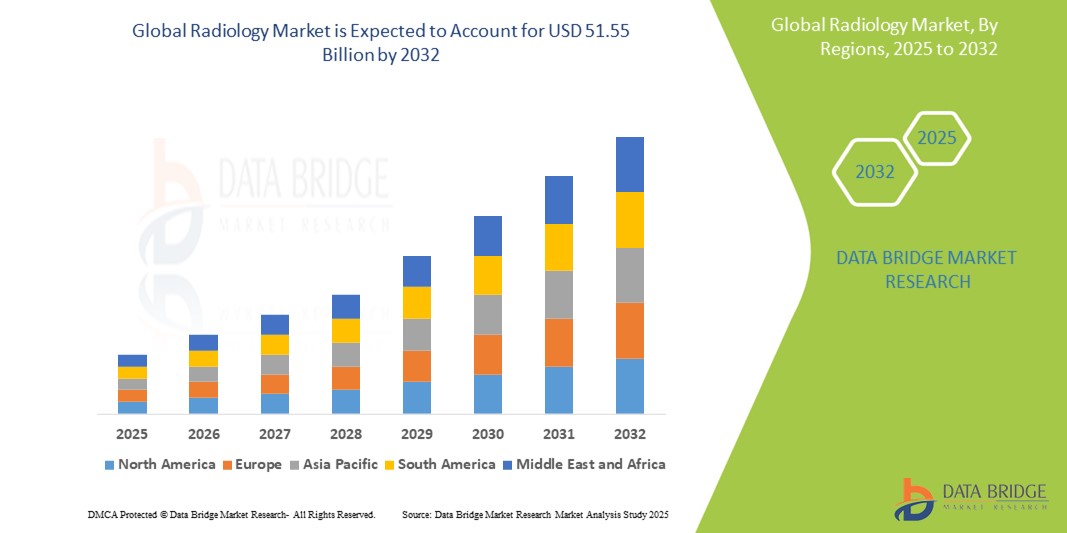
Radiology Market Size
- The global Radiology market was valued at USD 31.86 billion in 2024 and is expected to reach USD 51.55 billion by 2032
- During the forecast period of 2025 to 2032 the market is likely to grow at a CAGR of 6.20%, primarily driven by the rising prevalence of chronic diseases and the increasing adoption of advanced imaging technologies
- This growth is driven by factors such as the technological advancements in imaging modalities, increasing demand for early and accurate diagnosis, and a growing aging population worldwide
Radiology Market Analysis
- Radiology plays a foundational role in modern healthcare, offering non-invasive imaging techniques such as X-rays, CT scans, MRI, and ultrasound to diagnose and monitor a wide range of medical conditions across various specialties
- The growing global burden of chronic diseases, such as cancer, cardiovascular, and neurological disorders, is a major driver of demand for radiology services, along with the increasing need for early diagnosis and treatment planning
- North America continues to dominate the global radiology market, supported by robust healthcare infrastructure, high imaging procedure volumes, and early adoption of cutting-edge imaging technologies
- For instance, the U.S. sees a continual rise in diagnostic imaging procedures, from emergency rooms to outpatient diagnostic centers, significantly influencing global trends and innovation in radiology
- Globally, radiology systems are regarded as among the most vital diagnostic tools in medical facilities, second only to laboratory diagnostics in terms of frequency of use and clinical value, underpinning timely and accurate medical decision-making
Report Scope and Radiology Market Segmentation
|
Attributes |
Radiology Key Market Insights |
|
Segments Covered |
|
|
Countries Covered |
North America
Europe
Asia-Pacific
Middle East and Africa
South America
|
|
Key Market Players |
|
|
Market Opportunities |
|
|
Value Added Data Infosets |
In addition to the insights on market scenarios such as market value, growth rate, segmentation, geographical coverage, and major players, the market reports curated by the Data Bridge Market Research also include import export analysis, production capacity overview, production consumption analysis, price trend analysis, climate change scenario, supply chain analysis, value chain analysis, raw material/consumables overview, vendor selection criteria, PESTLE Analysis, Porter Analysis, and regulatory framework. |
Radiology Market Trends
Integration of AI and Advanced Imaging Technologies
- A prominent trend in the global radiology market is the rapid integration of artificial intelligence (AI) and advanced imaging technologies to enhance diagnostic accuracy and workflow efficiency
- AI-powered tools assist radiologists by automating image analysis, detecting anomalies with high precision, and prioritizing urgent cases for faster intervention
- For instance, AI algorithms are increasingly used in breast cancer screening and lung nodule detection, helping reduce false positives and improving early diagnosis rates
- Advanced imaging systems, such as hybrid PET/MRI and spectral CT, offer more detailed and functional imaging capabilities, enabling better disease characterization and personalized treatment planning
- This trend is transforming radiology from a purely diagnostic field into a central component of precision medicine, driving innovation and reshaping clinical practices globally
Radiology Market Dynamics
Driver
Rising Burden of Chronic Diseases and Demand for Early Diagnosis
- The increasing global prevalence of chronic diseases such as cancer, cardiovascular diseases, and neurological disorders is a major driver of the radiology market
- As these conditions often require early detection for effective treatment, the need for advanced imaging techniques such as CT, MRI, PET, and ultrasound has surged across healthcare systems
- Aging populations, lifestyle changes, and the rise in risk factors such as obesity and smoking contribute to the growing demand for diagnostic imaging services
- The technological advancements in radiology, including high-resolution imaging, functional imaging, and portable diagnostic devices, further enhance the efficiency and accuracy of disease detection and monitoring.
- Radiology plays a pivotal role in non-invasive diagnostics, enabling quicker and more informed clinical decisions, reducing hospital stays, and improving patient outcomes
For instance
- According to the World Health Organization, noncommunicable diseases account for nearly 74% of all global deaths, with cancer alone responsible for nearly 10 million deaths annually—underscoring the critical role of radiology in early detection and treatment planning
- As per a 2023 study published by The Lancet, the global cancer burden is expected to increase by over 60% by 2040, driving significant demand for imaging services to support early diagnosis, staging, and treatment monitoring
- The rising disease burden and the imperative for timely, precise diagnostics are fueling consistent growth in the global radiology market
Opportunity
Transforming Radiology with Artificial Intelligence and Automation
- The integration of artificial intelligence in radiology presents significant opportunities to enhance diagnostic accuracy, reduce workload, and streamline workflows in imaging departments
- AI-driven tools can rapidly analyze medical images, flag anomalies, prioritize urgent cases, and assist in detecting diseases such as cancer, stroke, and fractures with high precision—enabling faster clinical decisions
- In addition, AI supports predictive analytics and radiomics, allowing for more personalized treatment plans and better monitoring of disease progression over time
For instance
- In February 2024, a study published in Radiology: Artificial Intelligence showed that deep learning algorithms achieved diagnostic accuracy comparable to expert radiologists in detecting pulmonary nodules on chest CT scans, significantly improving early lung cancer screening efforts
- In October 2023, the European Society of Radiology reported that AI-assisted MRI interpretations reduced reading times by up to 30% and improved lesion detection sensitivity in breast imaging
- The ongoing development of AI-enabled imaging platforms and decision support systems is transforming radiology into a more efficient, data-driven specialty—enhancing diagnostic precision, improving patient outcomes, and expanding access to quality healthcare globall
Restraint/Challenge
High Equipment and Maintenance Costs Limiting Accessibility
- The substantial cost associated with advanced radiology equipment—such as MRI, CT, and PET scanners—poses a significant barrier to market penetration, especially in low- and middle-income countries
- These imaging systems can range from hundreds of thousands to several million dollars, not including the additional costs of installation, regular maintenance, software updates, and the need for trained personnel
- Smaller healthcare facilities and rural hospitals often struggle to afford or sustain such infrastructure, resulting in limited access to essential diagnostic services in underserved regions
For instance
- In September 2023, a report by the Global Health Innovation Center highlighted that over 60% of low-income countries have limited access to high-end radiology equipment, with affordability and service costs cited as the primary barriers
- In a 2024 article in The Lancet Digital Health emphasized that uneven distribution of imaging technologies globally continues to widen the diagnostic gap, delaying early disease detection and contributing to health inequalities
- Consequently, the high cost of radiology systems not only restricts market growth in developing regions but also contributes to disparities in the quality and timeliness of care, challenging the goal of equitable healthcare access worldwide
Radiology Market Scope
The market is segmented on the basis of type, services and end use.
|
Segmentation |
Sub-Segmentation |
|
By Type |
|
|
By Services |
|
|
By End Use |
|
Radiology Market Regional Analysis
North America is the Dominant Region in the Radiology Market
- North America leads the global radiology market, supported by its advanced healthcare infrastructure, high imaging procedure volumes, and early adoption of next-generation diagnostic technologies
- U.S. accounts for a major share, driven by the increasing burden of chronic diseases, widespread use of AI in radiology, and strong presence of leading imaging equipment manufacturers and software developers
- Robust reimbursement frameworks, growing investments in R&D, and the integration of imaging with electronic health records (EHR) systems further strengthen the region’s leadership
- In addition, the rising demand for outpatient imaging services and mobile diagnostic solutions across urban and suburban areas continues to fuel market expansion in the region
Asia-Pacific is Projected to Register the Highest Growth Rate
- Asia-Pacific is anticipated to experience the fastest growth in the global radiology market, fueled by rising healthcare expenditures, improving diagnostic infrastructure, and growing awareness of early disease detection
- Countries such as China, India, and South Korea are becoming key growth drivers due to their large populations, increasing incidence of cancer and cardiovascular diseases, and rapid adoption of advanced imaging modalities
- Japan remains a mature market with high per capita imaging rates and continued innovations in diagnostic equipment, while China and India are witnessing substantial investments in expanding radiology services to meet growing healthcare demands
- Supportive government initiatives, public-private partnerships, and the growing presence of international imaging equipment manufacturers are further boosting access to high-quality radiology services across the region
Radiology Market Share
The market competitive landscape provides details by competitor. Details included are company overview, company financials, revenue generated, market potential, investment in research and development, new market initiatives, global presence, production sites and facilities, production capacities, company strengths and weaknesses, product launch, product width and breadth, application dominance. The above data points provided are only related to the companies' focus related to market.
The Major Market Leaders Operating in the Market Are:
- Siemens Healthineers AG (Germany)
- GE HealthCare (U.S.)
- Koninklijke Philips N.V. (The Netherlands)
- CANON MEDICAL SYSTEMS CORPORATION (Japan)
- FUJIFILM Holdings Corporation (Japan)
- Hitachi High-Tech Corporation (Japan)
- Hologic, Inc. (U.S.)
- Carestream Health (U.S.)
- Agfa-Gevaert Group. (Belgium)
- Konica Minolta, Inc. (Japan)
- Samsung Medison Co., Ltd. (South Korea)
- Shenzhen Mindray Bio-Medical Electronics Co., Ltd. (China)
- Esaote SPA (Italy)
- PLANMED OY (Finland)
- Analogic Corporation (U.S.)
- Neusoft Medical Systems Co., Ltd. (China)
- Shenzhen Anke High-tech Co., Ltd. (China)
- Shanghai United Imaging Healthcare Co., LTD (China)
- Medtronic (Ireland)
- Elekta (Sweden)
Latest Developments in Global Radiology Market
- In December 2024, AGFA HealthCare partnered with Rad AI to integrate Rad AI Reporting and FHIRcast with AGFA's Enterprise Imaging platform, aiming to enhance radiology workflows and set new standards in radiology innovation
- In February 2024, DeepTek.ai launched Augmento X-Ray, an AI-driven chest X-ray solution, at the Radiology Society of North America's 109th Annual Meeting, showcasing advancements in AI applications for diagnostic imaging
- In January 2024, Hyperfine, Inc. introduced the eighth generation of its AI-powered Swoop system, the world's first FDA-cleared portable magnetic resonance brain imaging system, enhancing accessibility to neuroimaging
- In October 2023, Google Cloud launched a Medical Imaging Suite to improve accessibility and interoperability of healthcare imaging data, facilitating the development of AI-based imaging solutions
- In September 2023: I-MED Radiology Network expanded remote diagnostic imaging services in regional Australian communities by connecting MRI machines in remote areas to centralized "cockpits" operated by experienced technicians, addressing radiologist shortages and improving patient access

- Interactive Data Analysis Dashboard
- Company Analysis Dashboard for high growth potential opportunities
- Research Analyst Access for customization & queries
- Competitor Analysis with Interactive dashboard
- Latest News, Updates & Trend analysis
- Harness the Power of Benchmark Analysis for Comprehensive Competitor Tracking
Data collection and base year analysis are done using data collection modules with large sample sizes. The stage includes obtaining market information or related data through various sources and strategies. It includes examining and planning all the data acquired from the past in advance. It likewise envelops the examination of information inconsistencies seen across different information sources. The market data is analysed and estimated using market statistical and coherent models. Also, market share analysis and key trend analysis are the major success factors in the market report. To know more, please request an analyst call or drop down your inquiry.
The key research methodology used by DBMR research team is data triangulation which involves data mining, analysis of the impact of data variables on the market and primary (industry expert) validation. Data models include Vendor Positioning Grid, Market Time Line Analysis, Market Overview and Guide, Company Positioning Grid, Patent Analysis, Pricing Analysis, Company Market Share Analysis, Standards of Measurement, Global versus Regional and Vendor Share Analysis. To know more about the research methodology, drop in an inquiry to speak to our industry experts.
Data Bridge Market Research is a leader in advanced formative research. We take pride in servicing our existing and new customers with data and analysis that match and suits their goal. The report can be customized to include price trend analysis of target brands understanding the market for additional countries (ask for the list of countries), clinical trial results data, literature review, refurbished market and product base analysis. Market analysis of target competitors can be analyzed from technology-based analysis to market portfolio strategies. We can add as many competitors that you require data about in the format and data style you are looking for. Our team of analysts can also provide you data in crude raw excel files pivot tables (Fact book) or can assist you in creating presentations from the data sets available in the report.













