


Rathke’s Cleft Cyst Market Size
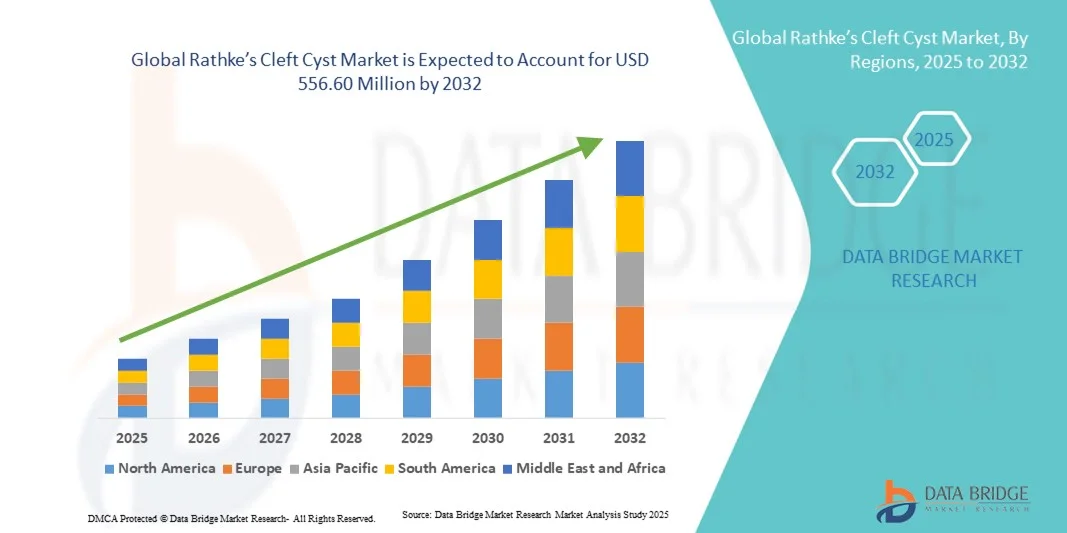
- The global Rathke’s cleft cyst market size was valued at USD 400.50 million in 2024 and is expected to reach USD 556.60 million by 2032, at a CAGR of 4.20% during the forecast period
- The market growth is primarily driven by the increasing prevalence of pituitary disorders and the rising adoption of advanced neuroimaging and surgical techniques for accurate diagnosis and effective treatment of Rathke’s cleft cysts
- In addition, the growing emphasis on minimally invasive neurosurgeries, coupled with heightened awareness among healthcare professionals and patients, is accelerating early diagnosis and treatment adoption. These converging factors are propelling the demand for specialized diagnostic and therapeutic solutions, thereby significantly boosting the industry’s expansion
Rathke’s Cleft Cyst Market Analysis
- Rathke’s cleft cysts, benign lesions of the pituitary gland, are gaining growing clinical focus due to their impact on endocrine balance, vision, and neurological health, driving increasing demand for precise diagnosis and targeted management solutions across healthcare systems
- The market expansion is primarily fueled by the rising prevalence of pituitary and visual disorders, technological advancements in neuroimaging techniques such as MRI and CT, and the increasing availability of specialized endocrinology and neurosurgery centers for effective treatment interventions
- North America dominated the Rathke’s cleft cyst market with the largest revenue share of 39.4% in 2024, attributed to the region’s strong diagnostic capabilities, high awareness among clinicians, and growing adoption of advanced MRI technologies for early lesion detection, particularly across the U.S. and Canada
- Asia-Pacific is expected to be the fastest-growing region during the forecast period due to rising healthcare expenditure, improving access to diagnostic imaging, and a growing patient population with pituitary-related dysfunctions in emerging economies such as China and India
- The MRI segment dominated the Rathke’s cleft cyst market with a market share of 44.7% in 2024, driven by its superior soft-tissue contrast and high diagnostic accuracy in identifying cyst size, structure, and associated pituitary abnormalities compared to CT and other imaging modalities
Report Scope and Rathke’s Cleft Cyst Market Segmentation
|
Attributes |
Rathke’s Cleft Cyst Key Market Insights |
|
Segments Covered |
|
|
Countries Covered |
North America
Europe
Asia-Pacific
Middle East and Africa
South America
|
|
Key Market Players |
|
|
Market Opportunities |
|
|
Value Added Data Infosets |
In addition to the insights on market scenarios such as market value, growth rate, segmentation, geographical coverage, and major players, the market reports curated by the Data Bridge Market Research also include in-depth expert analysis, patient epidemiology, pipeline analysis, pricing analysis, and regulatory framework |
Rathke’s Cleft Cyst Market Trends
Advancement in Neuroimaging and Minimally Invasive Techniques
- A significant and accelerating trend in the global Rathke’s cleft cyst market is the growing adoption of advanced neuroimaging technologies and minimally invasive endoscopic surgical techniques, enhancing diagnostic precision and patient recovery outcomes
- For instance, the increasing use of 3T and 7T MRI scanners provides superior visualization of pituitary microlesions, enabling more accurate differentiation of Rathke’s cleft cysts from other sellar and suprasellar masses. Similarly, endoscopic transsphenoidal approaches are gaining traction due to improved surgical access and minimal postoperative complication
- The integration of intraoperative imaging systems allows neurosurgeons to assess residual cyst tissue in real time, reducing recurrence rates and improving long-term treatment efficacy. Furthermore, the adoption of neuronavigation systems and endoscopic visualization tools facilitates safer, more precise interventions in delicate pituitary regions
- The seamless combination of advanced diagnostic imaging, surgical navigation, and minimally invasive techniques is revolutionizing the clinical management of Rathke’s cleft cysts, enabling earlier detection, targeted treatment, and faster recovery
- This trend towards precision diagnostics and patient-centric surgical approaches is fundamentally reshaping treatment outcomes in neuroendocrine and pituitary care. Consequently, companies such as Medtronic and Karl Storz are developing next-generation endoscopic and navigation solutions tailored for pituitary surgeries
- The demand for technologically advanced diagnostic and surgical tools is rising rapidly across tertiary hospitals and specialty centers as healthcare providers increasingly prioritize accuracy, safety, and minimally invasive procedures in managing Rathke’s cleft cysts
Rathke’s Cleft Cyst Market Dynamics
Driver
Increasing Prevalence of Pituitary Disorders and Improved Diagnostic Capabilities
- The rising incidence of pituitary abnormalities and hormonal dysfunctions, coupled with advancements in neuroimaging and endocrinological diagnostics, is a major driver of the Rathke’s cleft cyst market growth
- For instance, in March 2024, Siemens Healthineers introduced an upgraded MRI platform with enhanced pituitary gland visualization capabilities, improving early cyst detection rates across leading neurology hospitals
- As clinical awareness regarding pituitary cystic lesions increases, more patients are being accurately diagnosed and referred for appropriate surgical or medical management, contributing to market expansion
- Furthermore, the growing adoption of digital imaging repositories and AI-assisted interpretation tools is improving diagnostic accuracy and reducing misdiagnosis in cases of small or asymptomatic cysts
- The availability of comprehensive diagnostic options, including high-resolution MRI and endocrine function testing, is encouraging multidisciplinary collaboration between neurologists, endocrinologists, and neurosurgeons, thereby supporting wider treatment adoption. The trend toward patient-specific diagnostic pathways further boosts the clinical demand for advanced imaging tools
Restraint/Challenge
High Treatment Costs and Limited Clinical Awareness in Developing Regions
- The high cost associated with advanced diagnostic imaging and surgical procedures poses a significant barrier to broader market penetration, particularly in resource-limited healthcare systems
- For instance, patients in low- and middle-income countries often face limited access to MRI scanners and specialized pituitary surgery centers, delaying accurate diagnosis and timely treatment of Rathke’s cleft cysts
- Addressing these challenges requires the development of cost-effective imaging solutions, enhanced physician training, and improved infrastructure for pituitary and endocrine care. Companies such as GE HealthCare and Philips are focusing on scalable imaging technologies to expand diagnostic reach in emerging markets
- In addition, limited awareness among general practitioners about the subtle clinical manifestations of Rathke’s cleft cysts often leads to underdiagnosis or misdiagnosis, restricting early intervention opportunities
- While technological advancements are gradually improving accessibility, affordability and awareness gaps remain key hurdles, especially in developing regions where diagnostic imaging infrastructure is still evolving
- Overcoming these barriers through government-funded diagnostic programs, regional training initiatives, and lower-cost imaging technologies will be vital for ensuring equitable access to effective diagnosis and treatment worldwide
Rathke’s Cleft Cyst Market Scope
The market is segmented on the basis of disease indication, diagnosis, route of administration, and distribution channel
- By Disease Indication
On the basis of disease indication, the Rathke’s cleft cyst market is segmented into visual disturbances, pituitary dysfunction, and headaches. The pituitary dysfunction segment dominated the market with the largest revenue share in 2024, attributed to the high prevalence of endocrine abnormalities caused by cystic compression on the pituitary gland. These dysfunctions often manifest as hormonal imbalances such as hypopituitarism, irregular menstruation, or growth hormone deficiencies, prompting frequent medical interventions. The growing awareness among endocrinologists and neurosurgeons regarding cyst-related hormonal disorders is increasing diagnostic and treatment rates. In addition, the availability of advanced hormonal assays and MRI imaging further supports the accurate detection of pituitary dysfunctions. The rising clinical focus on restoring hormonal balance through surgery or hormone replacement therapy continues to drive the dominance of this segment.
The visual disturbances segment is anticipated to witness the fastest growth from 2025 to 2032, driven by the increasing incidence of optic chiasm compression in large or symptomatic cysts. Visual field defects are among the earliest presenting symptoms, leading to faster diagnosis and referral for surgical intervention. The growing integration of ophthalmic diagnostics in neurology departments is enhancing early identification of cyst-induced visual impairments. Moreover, technological advancements in endoscopic procedures allow surgeons to alleviate visual symptoms with minimal complications. Increasing awareness among patients regarding vision-related complications of pituitary cysts is also expected to accelerate this segment’s growth over the forecast period.
- By Diagnosis
On the basis of diagnosis, the market is segmented into CT and MRI. The MRI segment dominated the Rathke’s cleft cyst market with the largest revenue share of over 44.7% in 2024, owing to its superior soft-tissue contrast and ability to distinguish cystic from solid pituitary lesions. MRI remains the gold standard imaging technique for evaluating cyst size, structure, and proximity to critical neurovascular structures. Its non-invasive nature and high diagnostic accuracy make it the preferred choice among neurologists and neurosurgeons. The increasing use of 3T and 7T MRI scanners in leading hospitals further enhances detection sensitivity. Furthermore, ongoing improvements in MRI software and imaging sequences are helping clinicians achieve detailed visualization, reducing misdiagnosis and improving surgical planning.
The CT segment is projected to register the fastest growth during the forecast period, supported by its growing accessibility and affordability in emerging healthcare markets. CT scans are often used in emergency settings or for patients contraindicated for MRI, offering a reliable diagnostic alternative. The integration of advanced CT technologies such as cone-beam CT and 3D reconstruction enhances pituitary region visualization, aiding in surgical planning. Increasing installation of CT scanners in secondary hospitals and diagnostic centers across Asia-Pacific and Latin America is broadening access to imaging services. In addition, the shorter scanning time and lower operational costs make CT a preferred option for initial diagnosis in resource-constrained settings.
- By Route of Administration
On the basis of route of administration, the market is segmented into oral, injection, and transdermal. The oral segment dominated the market in 2024 due to its widespread use in hormonal replacement therapies following pituitary dysfunction caused by Rathke’s cleft cysts. Oral formulations are preferred for their convenience, patient compliance, and cost-effectiveness, particularly for long-term management of endocrine imbalances such as cortisol or thyroid hormone deficiencies. The rising prescription of oral corticosteroids and hormone supplements supports this dominance. Pharmaceutical advancements in oral hormone delivery and improved bioavailability are further strengthening the segment’s growth. In addition, increasing patient awareness and accessibility to oral medications through hospital and retail pharmacies continue to drive this segment forward.
The injection segment is expected to exhibit the fastest growth rate from 2025 to 2032, driven by the rising use of injectable hormone therapies and biologics for managing pituitary insufficiencies. Injectable formulations, such as growth hormone and gonadotropin analogs, are often preferred for patients requiring precise dosing or rapid hormonal response. The development of novel long-acting injectable therapies and prefilled auto-injectors enhances treatment adherence. Moreover, increasing adoption of injectable diagnostic contrast agents in imaging procedures contributes to this growth. Growing R&D investment by biopharmaceutical companies to develop sustained-release injectable hormones is expected to further accelerate the expansion of this segment.
- By Distribution Channel
On the basis of distribution channel, the market is segmented into hospital pharmacy, retail pharmacy, and online pharmacy. The hospital pharmacy segment dominated the market with the largest revenue share in 2024, driven by the concentration of cyst diagnosis and treatment in hospital-based settings. Patients with Rathke’s cleft cysts often require multidisciplinary care involving endocrinologists, neurosurgeons, and radiologists, making hospitals the primary point of treatment. Hospital pharmacies ensure timely access to critical medications such as hormone therapies, corticosteroids, and injectable drugs during both pre- and post-operative care. Furthermore, the growing number of neurosurgical centers and specialized pituitary clinics strengthens this distribution channel’s position. The integration of hospital-based diagnostic imaging and pharmacy services enhances patient outcomes and supports segment growth.
The online pharmacy segment is anticipated to witness the fastest growth over the forecast period, fueled by the increasing adoption of e-commerce platforms and digital health services. The rising comfort of patients and caregivers in purchasing prescription drugs online, combined with the convenience of home delivery, is driving rapid adoption. Online pharmacies are expanding access to hormonal therapies and maintenance medications for post-surgical patients. For instance, the growing availability of digital prescriptions and teleconsultation services enables easier refills and continuity of endocrine treatment. The segment also benefits from competitive pricing and discounts offered by major online pharmaceutical retailers. As regulatory frameworks for online drug sales strengthen globally, this channel is expected to record substantial expansion by 2032.
Rathke’s Cleft Cyst Market Regional Analysis
- North America dominated the Rathke’s cleft cyst market with the largest revenue share of 39.4% in 2024, attributed to the region’s strong diagnostic capabilities, high awareness among clinicians, and growing adoption of advanced MRI technologies for early lesion detection, particularly across the U.S. and Canada
- Patients and healthcare providers in the region place high value on early detection, precision imaging, and minimally invasive surgical techniques, which enhance treatment outcomes and reduce recurrence rates for pituitary cysts
- This dominance is further supported by increasing awareness of pituitary disorders, favorable healthcare reimbursement systems, and the active participation of leading medical device manufacturers and research institutions, positioning North America as the key hub for clinical innovation and advanced Rathke’s cleft cyst management
U.S. Rathke’s Cleft Cyst Market Insight
The U.S. Rathke’s cleft cyst market captured the largest revenue share of 83% in 2024 within North America, fueled by the widespread availability of advanced MRI and CT imaging systems and the presence of specialized neurosurgical and endocrinology centers. Patients increasingly seek early and accurate diagnosis due to growing awareness of pituitary-related disorders. The strong focus on minimally invasive endoscopic surgical techniques, coupled with robust healthcare reimbursement and research funding, continues to accelerate clinical adoption. Moreover, collaborations between academic hospitals and biotechnology firms are driving innovation in cyst management and post-surgical care, reinforcing the U.S. position as the regional leader.
Europe Rathke’s Cleft Cyst Market Insight
The Europe Rathke’s cleft cyst market is projected to expand at a substantial CAGR throughout the forecast period, primarily driven by the region’s advanced healthcare infrastructure and growing clinical emphasis on early pituitary disorder diagnosis. Increasing investment in neuroendocrinology research and the adoption of precision imaging systems are fueling the market’s progress. European countries are witnessing a rise in multidisciplinary pituitary clinics that combine endocrinology, ophthalmology, and neurosurgery expertise. The demand for minimally invasive endoscopic procedures is also strengthening, particularly in tertiary hospitals. Furthermore, favorable healthcare policies and awareness programs are supporting early patient referral and treatment.
U.K. Rathke’s Cleft Cyst Market Insight
The U.K. Rathke’s cleft cyst market is anticipated to grow at a noteworthy CAGR during the forecast period, driven by a growing focus on pituitary disease awareness and the adoption of high-precision diagnostic tools. The increasing prevalence of hormonal dysfunctions and visual disturbances associated with cystic lesions is leading to a higher rate of MRI screening and early diagnosis. Furthermore, the U.K.’s National Health Service (NHS) initiatives promoting advanced imaging access and specialist care centers are enhancing treatment outcomes. The country’s strong academic and clinical collaborations are also facilitating the development of improved surgical and diagnostic protocols.
Germany Rathke’s Cleft Cyst Market Insight
The Germany Rathke’s cleft cyst market is expected to expand at a considerable CAGR during the forecast period, supported by the nation’s leadership in medical technology and hospital infrastructure. Germany’s growing investment in neurosurgical robotics, neuronavigation systems, and imaging precision supports enhanced treatment efficacy. Increasing patient awareness of pituitary health and widespread access to advanced diagnostic equipment are major growth contributors. The country’s focus on evidence-based healthcare and the presence of leading medical device manufacturers are further strengthening market performance. In addition, collaborations between hospitals and research institutions are accelerating innovation in minimally invasive cyst management.
Asia-Pacific Rathke’s Cleft Cyst Market Insight
The Asia-Pacific Rathke’s cleft cyst market is poised to grow at the fastest CAGR of 24% during 2025 to 2032, driven by expanding healthcare infrastructure, rising healthcare expenditure, and growing awareness of pituitary disorders in countries such as China, Japan, and India. The region’s rapid advancements in diagnostic imaging accessibility are fostering early detection and intervention. Governments promoting healthcare modernization and digital diagnostics are contributing to market expansion. Moreover, increasing collaborations between hospitals and academic institutions in the region are improving clinical expertise. As neuroendocrine disorders gain more recognition, APAC is emerging as a significant market for diagnostic imaging and surgical advancements.
Japan Rathke’s Cleft Cyst Market Insight
The Japan Rathke’s cleft cyst market is gaining momentum due to the country’s advanced healthcare system, technological innovation, and emphasis on precision imaging. The prevalence of pituitary-related conditions and a highly skilled medical workforce are driving early detection and intervention. The integration of 3T MRI systems and neuronavigation tools enhances diagnostic accuracy and surgical precision. Moreover, Japan’s focus on aging-related endocrine health issues is fueling demand for better pituitary diagnostics. The collaboration between academic hospitals and device manufacturers is strengthening innovation in both surgical and diagnostic fields, further supporting market growth.
India Rathke’s Cleft Cyst Market Insight
The India Rathke’s cleft cyst market accounted for the largest market revenue share in Asia-Pacific in 2024, driven by growing healthcare investments, increasing awareness of neurological disorders, and the availability of cost-effective diagnostic services. The expanding middle class and urban population are contributing to higher demand for advanced medical imaging and specialist consultations. India’s government initiatives toward healthcare modernization and public-private partnerships in medical infrastructure are fostering accessibility. In addition, the rise of telemedicine and diagnostic imaging centers in tier-2 and tier-3 cities is broadening patient reach. These factors collectively position India as a rapidly growing market for pituitary cyst diagnosis and management.
Rathke’s Cleft Cyst Market Share
The Rathke’s Cleft Cyst industry is primarily led by well-established companies, including:
- Medtronic (U.S.)
- Stryker (U.S.)
- KARL STORZ (Germany)
- Olympus Corporation (Japan)
- B. Braun SE (Germany)
- Integra LifeSciences Corporation (U.S.)
- Brainlab SE (Germany)
- Siemens Healthineers AG (Germany)
- GE HealthCare (U.S.)
- Carl Zeiss Meditec AG (Germany)
- Leica Microsystems (Germany)
- Penumbra, Inc. (U.S.)
- NuVasive (U.S.)
- KLS Martin Group (Germany)
- Boston Scientific Corporation (U.S.)
- Zimmer Biomet (U.S.)
- MicroPort Scientific Corporation (China)
- Smith & Nephew (U.K.)
- Richard Wolf GmbH (Germany)
What are the Recent Developments in Global Rathke’s Cleft Cyst Market?
- In April 2025, a multi-center, data-driven management model for Rathke’s cleft cysts was published the authors correlated clinical, radiological and histological features and proposed a practical decision framework to help choose observation vs surgery. This paper emphasized using registry/diagnostic data to personalize follow-up and surgical planning
- In September 2024, a USC case-series reported spontaneous regression of RCCs with conservative management and a literature review showing many RCCs can shrink within months the paper highlighted that short-term surveillance may be appropriate before planned surgery for select patients (especially younger patients with headaches and favorable MRI signal). This strengthened the evidence base for conservative management in carefully selected cases
- In April 2024, a Surgical Neurology International paper introduced a novel classification + a diagnostic decision-tree for sellar cystic lesions to improve preoperative differentiation of RCC from cystic pituitary adenoma/craniopharyngioma — authors showed that combining imaging signs with the new classification can guide a less aggressive surgical plan (fenestration vs extensive resection). This work directly impacts operative strategy and preop counselling
- In September 2023, a 20-year pediatric multicenter retrospective cohort defined surgical indications in children with RCC (analysis of 93 pediatric patients): ophthalmologic abnormalities (visual field/chiasmal compression) were the clearest indication for surgery; headaches and partial endocrine abnormalities alone were not absolute indications. The study recommended endoscopic fenestration/partial wall resection as the preferred approach and stressed careful long-term follow-up
- In September 2022, a J. Neurosurgery report on the natural course and risk factors for progression of RCCs analysed large cohorts and identified imaging and clinical predictors of cyst growth the paper reinforced that many RCCs remain stable (supporting conservative follow-up) but that identifiable risk factors (size, certain imaging features) predict progression and may prompt earlier surgery. This study sharpened risk-stratification for surveillance vs intervention

- Interactive Data Analysis Dashboard
- Company Analysis Dashboard for high growth potential opportunities
- Research Analyst Access for customization & queries
- Competitor Analysis with Interactive dashboard
- Latest News, Updates & Trend analysis
- Harness the Power of Benchmark Analysis for Comprehensive Competitor Tracking
Data collection and base year analysis are done using data collection modules with large sample sizes. The stage includes obtaining market information or related data through various sources and strategies. It includes examining and planning all the data acquired from the past in advance. It likewise envelops the examination of information inconsistencies seen across different information sources. The market data is analysed and estimated using market statistical and coherent models. Also, market share analysis and key trend analysis are the major success factors in the market report. To know more, please request an analyst call or drop down your inquiry.
The key research methodology used by DBMR research team is data triangulation which involves data mining, analysis of the impact of data variables on the market and primary (industry expert) validation. Data models include Vendor Positioning Grid, Market Time Line Analysis, Market Overview and Guide, Company Positioning Grid, Patent Analysis, Pricing Analysis, Company Market Share Analysis, Standards of Measurement, Global versus Regional and Vendor Share Analysis. To know more about the research methodology, drop in an inquiry to speak to our industry experts.
Data Bridge Market Research is a leader in advanced formative research. We take pride in servicing our existing and new customers with data and analysis that match and suits their goal. The report can be customized to include price trend analysis of target brands understanding the market for additional countries (ask for the list of countries), clinical trial results data, literature review, refurbished market and product base analysis. Market analysis of target competitors can be analyzed from technology-based analysis to market portfolio strategies. We can add as many competitors that you require data about in the format and data style you are looking for. Our team of analysts can also provide you data in crude raw excel files pivot tables (Fact book) or can assist you in creating presentations from the data sets available in the report.












