


What is the Recreational Vehicle Rental Market Size and Growth Rate?
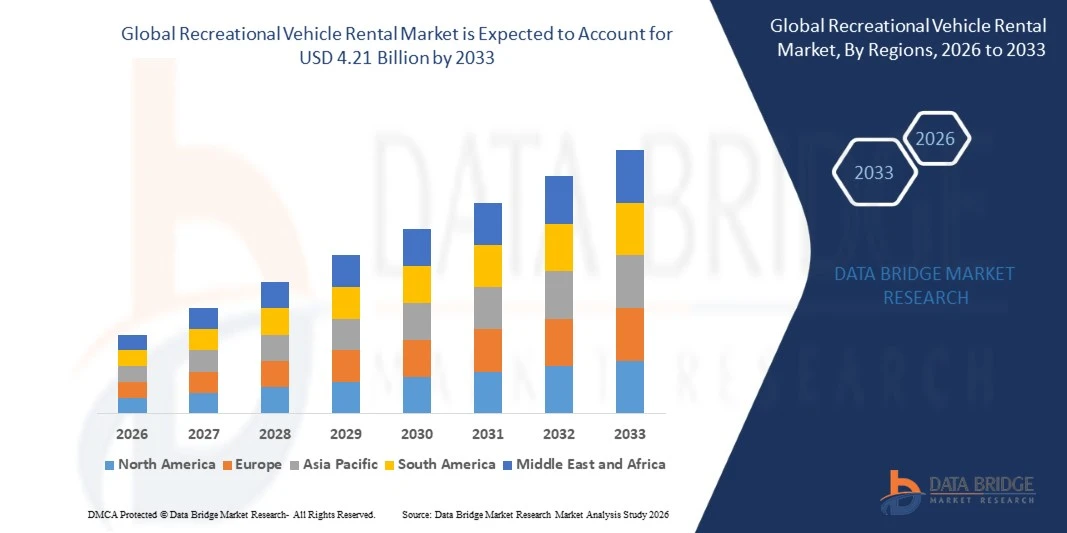
- As per Data Bridge Market Research analysis, the recreational vehicle rental market was valued at USD 2.70 billion in 2025 and is projected to reach USD 4.21 billion by 2033, growing at a CAGR of 5.70% from 2026 to 2033.
- The market is experiencing steady growth driven by rising interest in outdoor travel and road trips, increasing preference for renting over owning, and expanding availability of online booking platforms and delivered-to-campsite rental options across leisure and business use cases.
- The growing popularity of road-trip travel, remote and flexible work, and short-notice getaways, combined with rising participation in caravanning and national-park tourism, is supporting market adoption. Rental operators and peer-to-peer platforms are widening access to recreational vehicle travel for first-time users through delivery, insurance, and one-way options, while compact campervans and electric models are lowering barriers around driving and parking.
Market Size & Forecast
- Global Market Value (2025): USD 2.70 Billion
- Expected Market Value (2033): USD 4.21 Billion
- Forecast CAGR (2026–2033): 5.70%
- Leading Region in 2025: North America
- Fastest Growing Region: Asia Pacific
What are the Major Takeaways of the Recreational Vehicle Rental Market?
- North America dominated the recreational vehicle rental market with the largest revenue share of 41.26% in 2025, supported by a large camping population, extensive campground and national-park infrastructure, and well-established fleet-based and peer-to-peer rental operators.
- Asia-Pacific is expected to be the fastest-growing region at a CAGR of 8.47% from 2026 to 2033, fueled by rising domestic tourism, expanding campervan and caravan rental in Australia and Japan, and growing interest in outdoor travel across China and India.
- The motorhomes segment led the market with a 48.92% share in 2025, driven by their self-contained comfort, convenience, and suitability for families and longer trips.
- Campervans are the fastest-growing vehicle type, projected to register a CAGR of 8.15%, reflecting demand for compact, easier-to-drive vehicles that fit standard parking spaces and suit couples and solo travelers.
- The fleet-based segment dominated the rental model category with a 62.74% revenue share in 2025, led by large operators with national depot networks, standardized vehicles, and bundled insurance.
- Short-term rentals accounted for 57.38% of the market share in 2025, preferred for weekend trips, holidays, and event travel that do not require long commitments.
- The long-term segment is the fastest-growing rental duration category, with a CAGR of 8.92%, driven by extended road trips, seasonal stays, and flexible work-and-travel itineraries.
Report Scope and Recreational Vehicle Rental Market Segmentation
|
Attributes |
Recreational Vehicle Rental Key Market Insights |
|
Segments Covered |
|
|
Countries Covered |
North America
Europe
Asia-Pacific
Middle East and Africa
South America
|
|
Key Market Players |
|
|
Market Opportunities |
|
|
Value Added Data Infosets |
In addition to the market insights such as market value, growth rate, market segments, geographical coverage, market players, and market scenario, the market report curated by the Data Bridge Market Research team includes in-depth expert analysis, import/export analysis, pricing analysis, production consumption analysis, and pestle analysis. |
What is the Key Trend in the Recreational Vehicle Rental Market?
- Recreational vehicle rental is evolving from a depot-based seasonal service into a digital, multi-channel marketplace that combines fleet operators, peer-to-peer platforms, and travel partners, offering delivery to campsites, one-way routes, and bundled park and campground packages.
- For instance, in April 2026, according to RV PRO, RVshare introduced one-way rentals in partnership with providers including El Monte RV, Indie Campers, and roadsurfer, along with national park packages, citing its 2026 Travel Trend Report in which 71% of travelers said they would be more inclined to take an RV trip if a one-way option were available.
- Smaller, easier-to-drive vehicles and vehicle electrification are shaping fleet choices, as operators add compact campervans that fit standard parking spaces, require no commercial license, and appeal to first-time renters.
- Operators are also investing in software for fleet management, dynamic pricing, and digital check-in, while platforms integrate route planning, campsite booking, and insurance to reduce friction for renters.
- For instance, in May 2026, according to Woodall's Campground Magazine, Outdoorsy said it had reduced its RV rental inventory by about 45% over the previous year and a half to prioritize quality, while expanding into a broader mobility ecosystem that includes auto rentals and autonomous vehicle fleet management, highlighting the industry's shift toward curated supply and integrated travel software.
- As digital platforms, compact and electric vehicles, and packaged travel experiences continue to evolve, RV rental is expected to expand beyond traditional holiday use into flexible, short-notice, and longer-stay travel for a broader range of customers.
What are the Key Drivers of the Recreational Vehicle Rental Market?
- Rising interest in outdoor, flexible, and domestic travel, together with a preference among younger travelers for renting rather than owning vehicles, is increasing demand for recreational vehicle rentals across leisure and holiday segments.
- For instance, in April 2026, according to Kampgrounds of America (KOA), more than 52 million North American households camped in 2025, exceeding pre-pandemic levels, and 48% of campers said they were very likely to rent an RV in 2026, with Gen Z the group most likely to rent at 45%.
- Rental platforms are also reducing friction for first-time users through delivery to campsites, bundled insurance and roadside assistance, and guidance from rental advisors, which broadens the customer base beyond experienced RV owners.
- For instance, in August 2026, according to Tourism Holdings Limited (thl), its sale-of-services revenue, primarily rentals, rose 11% to USD 290.01 million in FY26, supported by a 10% increase in its closing rental fleet to 8,587 vehicles, demonstrating continued fleet investment by large rental operators.
- Growing availability of one-way routes, premium and compact vehicle options, and packaged national park trips is expected to keep rental operators and platforms adding fleet and attracting new customers.
What Factors Are Challenging the Growth of the Recreational Vehicle Rental Market?
- RV rental is a capital-intensive business, requiring operators to finance and insure large fleets, maintain vehicles to safety standards, and manage seasonality, which exposes margins to interest rates, depreciation, and utilization swings.
- For instance, in April 2026, according to Kampgrounds of America (KOA), cost remained the primary barrier to renting an RV, while one-third of those likely to rent cited a lack of driving or operating knowledge as a concern, indicating that price sensitivity and unfamiliarity can limit the conversion of interest into bookings.
- Damage, accident, and insurance claims, as well as variable owner quality in peer-to-peer models, can raise operating costs and affect customer trust, requiring platforms to invest in verification, protection plans, and customer support.
- Demand is also sensitive to fuel prices, travel disruption, and consumer confidence, and rental operators must manage fleet resale values and vehicle supply when RV sales markets are weak.
- For instance, in August 2026, according to Tourism Holdings Limited (thl), the Middle East conflict in March 2026 disrupted international travel and, through its effect on fuel prices, domestic tourism, creating a gap in forward booking intake that the company said was unlikely to be fully recoverable, while continued weakness in RV sales markets affected its FY27 earnings outlook.
- Regulatory requirements for emissions, driver licensing, and campground access, together with limited campsite availability at peak times, can further constrain growth and add compliance costs for rental operators.
How is the Recreational Vehicle Rental Market Segmented?
The recreational vehicle rental market is segmented on the basis of vehicle type, rental model, rental duration, and end user.
- By Vehicle Type
On the basis of vehicle type, the recreational vehicle rental market is segmented into motorhomes, campervans, and towable RVs. The motorhomes segment dominated the market with 48.92% share in 2025, supported by their self-contained design, with sleeping, cooking, and bathroom facilities that suit families and longer trips. Motorhomes require no towing vehicle, which makes them accessible to renters without trailer or hitch experience. Fleet operators offer a wide range of sizes and layouts, from compact Class C models to larger coaches. Strong demand during summer holidays, national-park travel, and international tourist seasons further supports utilization. Standardized fleets also simplify maintenance, insurance, and pricing for operators.
The campervans segment is projected to register the fastest growth at a CAGR of 8.15% from 2026 to 2033, driven by demand for compact, easy-to-drive vehicles suited to couples, solo travelers, and short trips. Campervans are easier to park, more fuel-efficient, and often do not require a special license. Younger renters and first-time users are attracted by lower rental rates and design-led interiors. Peer-to-peer platforms and one-way rental programs are increasing availability. Growing interest in van life and electric camper models is also encouraging operators to expand compact fleets across Europe, North America, and Asia-Pacific.
- By Rental Model
On the basis of rental model, the recreational vehicle rental market is segmented into fleet-based and peer-to-peer. The fleet-based segment dominated the market with 62.74% share in 2025, supported by large operators with national depot networks, standardized vehicles, and bundled insurance and roadside assistance. Fleet-based rentals offer predictable availability and service quality, which appeals to international tourists and first-time renters. Operators can negotiate vehicle purchases and resale programs and manage maintenance centrally. Partnerships with travel agencies, airlines, and tour operators further support booking volumes. Consolidation among operators is also expanding the geographic reach of fleet-based networks.
The peer-to-peer segment is projected to register the fastest growth at a CAGR of 8.43% from 2026 to 2033, driven by owners seeking income from idle vehicles and renters looking for varied, lower-cost options. Peer-to-peer platforms provide a wide choice of vehicle types and locations, including delivery to campsites. Digital identity checks, ratings, and integrated insurance are improving trust. Platforms can scale supply without owning vehicles, supporting rapid expansion into new markets. However, quality control and owner reliability remain important, and leading platforms are increasingly curating listings to improve consistency.
- By Rental Duration
On the basis of rental duration, the recreational vehicle rental market is segmented into short-term, medium-term, and long-term. The short-term segment dominated the rental duration category with 57.38% share in 2025, supported by weekend getaways, holiday trips, festivals, and sports events that typically require a vehicle for a few days. Short rentals suit renters testing RV travel for the first time. Online booking, delivery options, and flexible pick-up locations make short trips easier to arrange. Operators can also optimize utilization by combining short bookings across the peak season, although pricing is more sensitive to seasonality and local events.
The long-term segment is projected to register the fastest growth at a CAGR of 8.92% from 2026 to 2033, driven by extended road trips, seasonal stays, and work-and-travel itineraries. Remote and flexible work arrangements are allowing more travelers to combine work with extended time on the road. Long-term rentals offer higher utilization, lower turnover costs, and discounted rates for renters. Operators are developing subscription and monthly programs that include maintenance and insurance. Demand is also supported by retirees, relocating households, and temporary housing needs, although longer rentals require careful vehicle availability and maintenance planning.
- By End User
On the basis of end user, the recreational vehicle rental market is segmented into leisure travelers, corporate & business users, film & event productions, and others. The leisure travelers segment dominated the end-user category with 72.14% share in 2025, supported by holidays, family trips, national-park visits, and festival travel. Leisure renters value flexibility, privacy, and the ability to combine transport and accommodation. Growing domestic tourism and interest in nature-based experiences keep demand strong. Packaged trips, delivery to campgrounds, and online comparison of vehicles and prices are making RV holidays more accessible to first-time customers and international visitors.
The corporate & business users segment is projected to register the fastest growth at a CAGR of 7.64% from 2026 to 2033, driven by the use of rented RVs and vans as mobile offices, site accommodation, team-building trip vehicles, and hospitality for events. Organizations value the flexibility of short-notice, scalable fleets without ownership costs. Remote and hybrid work practices are encouraging companies to support workation and offsite programs. Corporate accounts also benefit from invoicing, insurance, and fleet management features offered by larger operators. Demand from project-based sectors and outdoor events provides additional opportunities.
Which Region Holds the Largest Share of the Recreational Vehicle Rental Market?
- North America dominated the recreational vehicle rental market with the largest revenue share of 41.26% in 2025, supported by a large camping population, extensive campground and national-park infrastructure, and well-established fleet-based and peer-to-peer rental operators.
- The region also benefits from strong consumer familiarity with RV travel, high domestic tourism, and the presence of leading rental brands and technology platforms. Rising interest among younger travelers, growth of one-way and delivery-based rental options, and increasing demand for national-park trips continue to strengthen North America's position in the global market.
U.S. Recreational Vehicle Rental Market Insight
The U.S. recreational vehicle rental market is witnessing strong growth due to rising interest in camping, road trips, and national-park travel, along with growing preference among younger travelers for renting rather than owning. A mix of fleet operators, peer-to-peer platforms, and campground networks provides wide access to vehicles. Delivery to campsites, one-way rentals, and packaged park trips are making RV travel easier for first-time renters. In addition, expanding use of digital booking, insurance integration, and dynamic pricing is supporting adoption across leisure and business use.
Asia-Pacific Recreational Vehicle Rental Market Insight
The Asia-Pacific recreational vehicle rental market is expected to witness rapid growth, driven by rising domestic tourism, growing interest in outdoor and nature-based travel, and expanding campervan and caravan rental networks in countries such as Australia, China, and Japan. Increasing disposable incomes, development of campsites and RV parks, and the popularity of self-drive holidays are supporting regional demand. In addition, international visitors to Australia, along with growth in online booking platforms, are accelerating adoption of RV and campervan rentals.
Australia Recreational Vehicle Rental Market Insight
The Australia recreational vehicle rental market is witnessing consistent growth due to a long-established campervan rental culture, popular touring routes, and strong inbound and domestic tourism. Operators offer a wide range of campervans and motorhomes, supported by one-way rental options between major cities and regions. Seasonal demand from international visitors and domestic holidaymakers sustains fleet utilization, while operators focus on fleet renewal, digital booking, and cost management. Moreover, interest in compact, self-contained vehicles and nature-based travel is further contributing to market growth in the country.
China Recreational Vehicle Rental Market Insight
The China recreational vehicle rental market is growing rapidly, driven by rising interest in self-drive travel, expanding campsites and RV parks, and increasing domestic tourism. Younger consumers are showing growing interest in outdoor lifestyles and are renting RVs before considering ownership. Online travel platforms and local rental operators are increasing the availability of vehicles and packaged routes. In addition, supportive policies for leisure and rural tourism, along with growing domestic manufacturing of RVs, are positioning China as a key growth market for RV rental across Asia-Pacific.
Germany Recreational Vehicle Rental Market Insight
The Germany recreational vehicle rental market is expanding steadily due to the country's strong caravanning culture, large domestic manufacturing base, and wide network of campsites across Europe. Fleet operators and peer-to-peer platforms offer motorhomes and campervans for holidays across Germany and neighboring countries. Operators are adding compact and design-oriented campervans and developing one-way and cross-border services. Moreover, growing interest in flexible travel, sustainable mobility, and van life is supporting adoption among younger travelers and families.
U.K. Recreational Vehicle Rental Market Insight
The U.K. recreational vehicle rental market is experiencing steady growth, supported by rising staycation demand, popular touring regions such as Scotland, and growing interest in campervan holidays. Operators are consolidating, with brands combining fleets and pick-up locations to improve coverage. Compact campervans, delivery services, and online comparison tools are making rentals easier to book. Furthermore, strong demand from both domestic and international visitors during the summer season is supporting market growth in the U.K.
Which are the Top Companies in Recreational Vehicle Rental Market?
The recreational vehicle rental industry is primarily led by well-established companies, including:
- Cruise America, Inc. (U.S.)
- Outdoorsy, Inc. (U.S.)
- RVshare, LLC (U.S.)
- Tourism Holdings Limited (thl) (New Zealand)
- Indie Campers (Portugal)
- roadsurfer (Germany)
- McRent Europe (Germany)
- Yescapa (France)
- Goboony (Netherlands)
- PaulCamper GmbH (Germany)
- Campanda GmbH (Germany)
- RVezy (Canada)
- Fraserway RV (Canada)
- Escape Campervans (U.S.)
- Camping World Holdings, Inc. (U.S.)
- Mighway (U.S.)
- Winnebago Industries, Inc. (U.S.)
- Thor Industries, Inc. (U.S.)
- JUCY Group (New Zealand)
- Travellers Autobarn (Australia)
What are Latest Developments in Recreational Vehicle Rental Market?
- In August 2026, Tourism Holdings Limited (thl) reported its FY26 results and disclosed two non-binding indicative proposals to acquire the company, at NZD 3.10 per share from the BGH consortium and at NZD 3.30 to 3.40 per share from a party the board considers a credible strategic acquirer, with due diligence in progress.
- In July 2026, Spot2Nite, a camping and glamping marketplace, completed its integration with Firefly Reservations and launched Fleetsync, a cloud-based park and RV fleet management platform, expanding the software tools available to campground and RV fleet operators.
- In April 2026, Cruise America was reported to have ordered more than 1,000 new vehicles for its 2026 rental fleet with an updated Scandinavian-inspired design, while offering special rates linked to its sponsorship of the Route 66 centennial celebrations.
- In February 2026, Indie Campers agreed to acquire the UK and Ireland business assets of Tourism Holdings Limited, including the Just Go and Bunk Campers brands, for about NZD 57 million, increasing its pick-up locations in the region to nine; thl completed the sale on 31 March 2026.
- In April 2025, Outdoorsy launched Outdoorsy Escapes in partnership with Spot2Nite, allowing users in select areas to choose from over 40,000 RVs for delivery to 24 destinations, including RV resorts in Houston, San Diego, Palm Springs, and Savannah.

- Interactive Data Analysis Dashboard
- Company Analysis Dashboard for high growth potential opportunities
- Research Analyst Access for customization & queries
- Competitor Analysis with Interactive dashboard
- Latest News, Updates & Trend analysis
- Harness the Power of Benchmark Analysis for Comprehensive Competitor Tracking
Data collection and base year analysis are done using data collection modules with large sample sizes. The stage includes obtaining market information or related data through various sources and strategies. It includes examining and planning all the data acquired from the past in advance. It likewise envelops the examination of information inconsistencies seen across different information sources. The market data is analysed and estimated using market statistical and coherent models. Also, market share analysis and key trend analysis are the major success factors in the market report. To know more, please request an analyst call or drop down your inquiry.
The key research methodology used by DBMR research team is data triangulation which involves data mining, analysis of the impact of data variables on the market and primary (industry expert) validation. Data models include Vendor Positioning Grid, Market Time Line Analysis, Market Overview and Guide, Company Positioning Grid, Patent Analysis, Pricing Analysis, Company Market Share Analysis, Standards of Measurement, Global versus Regional and Vendor Share Analysis. To know more about the research methodology, drop in an inquiry to speak to our industry experts.
Data Bridge Market Research is a leader in advanced formative research. We take pride in servicing our existing and new customers with data and analysis that match and suits their goal. The report can be customized to include price trend analysis of target brands understanding the market for additional countries (ask for the list of countries), clinical trial results data, literature review, refurbished market and product base analysis. Market analysis of target competitors can be analyzed from technology-based analysis to market portfolio strategies. We can add as many competitors that you require data about in the format and data style you are looking for. Our team of analysts can also provide you data in crude raw excel files pivot tables (Fact book) or can assist you in creating presentations from the data sets available in the report.













