


What is the Remanufactured and Refurbished Imaging Equipment Market Size and Growth Rate?
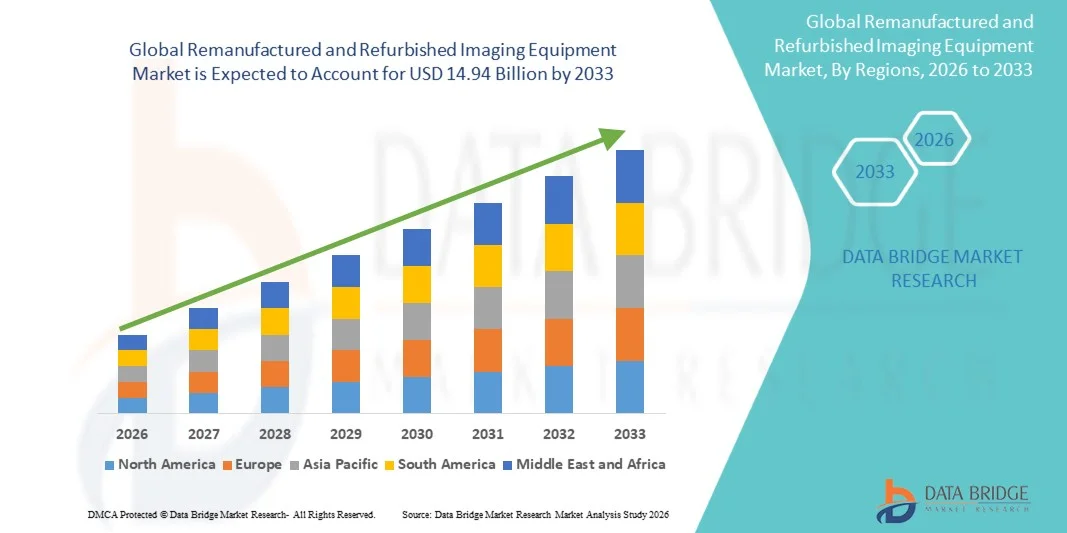
- As per Data Bridge Market Research analysis, the remanufactured and refurbished imaging equipment market was valued at USD 8.42 billion in 2025 and is projected to reach USD 14.94 billion by 2033, growing at a CAGR of 7.20% from 2026 to 2033.
- The market is expanding steadily on the back of the persistently high acquisition cost of new diagnostic imaging systems, growing budget constraints across public and private healthcare providers, and rising recognition of refurbished imaging equipment as a clinically validated, cost-effective, and increasingly sustainability-aligned alternative to new capital equipment purchases.
- Remanufactured and refurbished imaging equipment encompasses MRI, CT, ultrasound, X-ray, PET, and mammography systems that have been restored to original manufacturer performance, safety, and cosmetic specifications through certified refurbishment processes, either by the original equipment manufacturer or by qualified independent providers. As healthcare systems worldwide face simultaneous pressure to expand diagnostic imaging access and control capital expenditure, refurbished systems are increasingly positioned not as a compromise but as a validated pathway to modern imaging capability, further reinforced by original equipment manufacturers’ own circular economy and sustainability commitments.
Market Size & Forecast
- Global Market Value (2025): USD 8.42 Billion
- Expected Market Value (2033): USD 14.94 Billion
- Forecast CAGR (2026–2033): 7.20%
- Leading Region in 2025: North America
- Fastest Growing Region: Asia-Pacific
What are the Major Takeaways of the Remanufactured and Refurbished Imaging Equipment Market?
- North America dominated the global remanufactured and refurbished imaging equipment market with the largest revenue share of 36.74% in 2025, supported by a large installed base of ageing imaging systems eligible for refurbishment, well-established OEM-certified refurbishment programs, and a mature network of independent third-party dealers.
- Asia-Pacific is expected to be the fastest-growing region at a CAGR of 9.6% from 2026 to 2033, driven by rapidly expanding diagnostic imaging infrastructure needs in India, Southeast Asia, and China, where refurbished systems offer a cost-effective route to expanding access to advanced imaging in price-sensitive healthcare markets.
- The MRI systems segment led the product type category with a 28.63% share in 2025, owing to the exceptionally high acquisition cost of new MRI systems, which makes refurbishment a particularly attractive route for hospitals and imaging centers seeking to add or upgrade MRI capacity.
- CT scanners are the fastest-growing product type, projected to register a CAGR of 8.7%, reflecting steady replacement demand from a large global installed base and rising diagnostic imaging volumes in oncology and emergency care.
- The OEM-certified refurbished segment dominated the refurbishment grade category with a 54.28% revenue share in 2025, favoured for the manufacturer warranty coverage, guaranteed parts availability, and clinical confidence that OEM-backed programs provide relative to independent third-party remanufacturing.
- Hospitals accounted for 47.92% of the market by end user in 2025, reflecting the concentration of imaging equipment purchasing within hospital radiology departments, while diagnostic imaging centers represent the fastest-growing end-user segment at a CAGR of 8.9%, as standalone imaging providers expand capacity cost-effectively.
- The field-upgraded/in-place refurbished segment is the fastest-growing refurbishment grade category, with a CAGR of 9.3%, driven by rising adoption of onsite modernization programs that upgrade existing systems to current software and hardware specifications without requiring full system replacement.
Report Scope and Remanufactured and Refurbished Imaging Equipment Market Segmentation
|
Attributes |
Remanufactured and Refurbished Imaging Equipment Key Market Insights |
|
Segments Covered |
|
|
Countries Covered |
North America
Europe
Asia-Pacific
Middle East and Africa
South America
|
|
Key Market Players |
|
|
Market Opportunities |
|
|
Value Added Data Infosets |
In addition to the insights on market scenarios such as market value, growth rate, segmentation, geographical coverage, and major players, the market reports curated by the Data Bridge Market Research also include in-depth expert analysis, patient epidemiology, pipeline analysis, pricing analysis, and regulatory framework. |
What is the Key Trend in the Remanufactured and Refurbished Imaging Equipment Market?
- Original equipment manufacturers are increasingly promoting refurbished and in-place upgrade offerings explicitly through a sustainability and circular economy lens, reframing refurbishment from a lower-cost alternative into an environmental and lifecycle value proposition in its own right.
- This repositioning is being reinforced through formal partnerships with clinical and professional bodies that lend scientific credibility to the environmental case for refurbishment and system upgrades.
- For instance, in February 2025, Siemens Healthineers and the European Society of Radiology issued a joint statement at ECR 2025 in Vienna highlighting that a refurbished CT system can save up to 86% of the materials-related CO2e emissions compared with a new system, equivalent to 24 tons of emissions, while a single MRI system upgrade to the latest generation can reduce CO2e emissions by up to 71%, equivalent to 33,400 kg saved.
- Manufacturers are also extending the circular modernization concept beyond MRI and CT into interventional imaging, offering onsite upgrade pathways as an alternative to full system replacement for high-value capital equipment.
- For instance, at ECR 2026 in March 2026, Siemens Healthineers introduced its Fit Upgrade for angiography systems, allowing customers with an existing Artis Q system to upgrade onsite to the latest ARTIS icono.vision platform rather than replacing the entire system, providing access to AI-powered imaging capability and improved return on investment through a circular hardware and software modernization approach.
- As OEMs continue to formalize refurbishment and in-place upgrade programs around explicit sustainability and lifecycle value messaging, and as professional radiology bodies lend increasing scientific credibility to these claims, sustainability positioning is expected to become an increasingly important purchasing consideration in the refurbished imaging equipment market through the forecast period.
What are the Key Drivers of the Remanufactured and Refurbished Imaging Equipment Market?
- The persistently high acquisition cost of new diagnostic imaging systems, which can range from several hundred thousand to several million dollars depending on modality and configuration, continues to make refurbished equipment an essential capital planning option for budget-constrained hospitals, diagnostic centers, and healthcare systems in both developed and emerging markets.
- Original equipment manufacturers are actively expanding the breadth of their certified refurbishment offerings, broadening the range of systems and configurations available to cost-conscious buyers while reinforcing confidence in the refurbished channel through manufacturer-backed quality assurance.
- For instance, GE HealthCare reported in its 2025 annual report that its GoldSeal refurbishment program extended the life of imaging and ultrasound systems by adding 22 new refurbished offerings during the year, reflecting sustained OEM investment in expanding certified refurbishment as a core commercial channel.
- Rising diagnostic imaging demand in emerging and price-sensitive markets, where new equipment costs remain prohibitive for the majority of healthcare facilities, continues to expand the addressable base of buyers for refurbished and remanufactured imaging systems.
- For instance, a single new 128-slice CT scanner typically costs between USD 800,000 and USD 1.5 million while a new 1.5T MRI system ranges from USD 1.2 million to USD 3 million, a cost structure that has driven strong demand for certified refurbished alternatives among hospitals, clinics, and diagnostic centers across India, Nigeria, Ghana, and the Caribbean.
- With capital budget pressure persisting across both mature and emerging healthcare markets, and with OEMs continuing to expand and formalize their certified refurbishment portfolios, demand for remanufactured and refurbished imaging equipment is expected to grow steadily throughout the forecast period.
Which Factors are Challenging the Growth of the Remanufactured and Refurbished Imaging Equipment Market?
- Regulatory uncertainty regarding the distinction between routine servicing and remanufacturing has historically created compliance ambiguity for third-party providers and healthcare facilities performing modifications on imaging equipment, with significant differences in regulatory obligation depending on how an activity is classified.
- This ambiguity has required sustained regulatory attention to clarify obligations and reduce compliance risk for entities operating in the refurbished equipment value chain.
- For instance, in May 2024, the U.S. Food and Drug Administration issued its final guidance on Remanufacturing of Medical Devices, clarifying the criteria used to determine whether servicing or refurbishment activities performed on a finished device, including imaging systems, constitute remanufacturing under 21 CFR 820.3(w), and detailing the resulting registration, premarket authorization, and reporting obligations that apply once that threshold is crossed.
- Regulatory frameworks in other major markets continue to evolve as well, requiring refurbishment providers to track jurisdiction-specific requirements as they expand internationally.
- For instance, a 2026 proposed amendment to the EU Medical Device Regulation introduces the specific term “fully refurbished medical devices” to describe reprocessed and remanufactured equipment, reflecting a terminological and regulatory shift in the European framework that refurbishment providers operating in the region will need to track and comply with.
- The combination of historical regulatory ambiguity, the compliance burden associated with formal remanufacturing classification, and continuing jurisdiction-by-jurisdiction regulatory evolution continues to raise the cost and complexity of operating in the refurbished imaging equipment market, particularly for smaller independent providers without dedicated regulatory affairs capability.
How is the Remanufactured and Refurbished Imaging Equipment Market Segmented?
The remanufactured and refurbished imaging equipment market is segmented on the basis of product type, refurbishment grade, field strength, end user, application and distribution channel.
- By Product Type
On the basis of product type, the global remanufactured and refurbished imaging equipment market is segmented into MRI systems, CT scanners, ultrasound systems, X-ray systems, PET/PET-CT systems, mammography systems, and C-arms & cath lab systems. The MRI systems segment dominated the market with a 28.63% share in 2025, owing to the exceptionally high acquisition cost of new MRI systems relative to other modalities, which makes certified refurbishment a particularly attractive route for hospitals and imaging centers seeking to expand or replace MRI capacity.
The CT scanners segment is projected to register the fastest growth at a CAGR of 8.7% from 2026 to 2033, driven by a large global installed base reaching replacement age, rising diagnostic imaging volumes in oncology screening and emergency care, and the relatively shorter refurbishment cycle achievable for CT systems compared with MRI.
- By Refurbishment Grade
On the basis of refurbishment grade, the global remanufactured and refurbished imaging equipment market is segmented into OEM-certified refurbished, third-party remanufactured, and field-upgraded/in-place refurbished. The OEM-certified refurbished segment dominated the market with a share of 54.28% in 2025, favoured for the manufacturer warranty coverage, guaranteed parts availability, and clinical confidence that OEM-backed programs such as GoldSeal, ecoline, and Diamond Select provide relative to independent third-party remanufacturing.
The field-upgraded/in-place refurbished segment is expected to witness the fastest CAGR of 9.3% from 2026 to 2033, driven by rising adoption of onsite modernization programs that upgrade existing systems to current hardware and software specifications without requiring full system replacement, reducing both capital cost and clinical downtime.
- By Field Strength
On the basis of field strength, applicable primarily to the MRI product category, the global remanufactured and refurbished imaging equipment market is segmented into low-field, mid-field, and high-field systems. The mid-field (1.0T–1.5T) segment dominated the market with a share of 58.74% in 2025, reflecting the established clinical acceptance and broad diagnostic applicability of 1.5T systems, which represent the single largest category within the global refurbished MRI installed base.
The high-field (above 1.5T) segment is expected to witness the fastest CAGR of 9.8% from 2026 to 2033, driven by growing availability of refurbished 3.0T systems as newer-generation units reach the secondary market, and rising clinical demand for the higher image resolution and faster scan times these systems provide.
- By End User
On the basis of end user, the global remanufactured and refurbished imaging equipment market is segmented into hospitals, diagnostic imaging centers, ambulatory surgical centers, and academic & research institutes. The hospitals segment dominated the market with a share of 47.92% in 2025, reflecting the concentration of imaging equipment purchasing decisions within hospital radiology and diagnostic departments across both developed and emerging healthcare systems.
The diagnostic imaging centers segment is expected to witness the fastest CAGR of 8.9% from 2026 to 2033, driven by the continued expansion of standalone and chain diagnostic imaging providers, who rely on refurbished equipment to cost-effectively scale capacity across multiple sites.
- By Application
On the basis of application, the global remanufactured and refurbished imaging equipment market is segmented into oncology, cardiology, neurology, orthopedics, and general diagnostic imaging. The general diagnostic imaging segment dominated the market with a share of 34.18% in 2025, reflecting the broad, cross-specialty utilization of refurbished X-ray, ultrasound, and CT systems across routine diagnostic workflows.
The oncology segment is expected to witness the fastest CAGR of 8.5% from 2026 to 2033, driven by rising global cancer incidence and the resulting demand for expanded CT, PET/PET-CT, and MRI imaging capacity to support diagnosis, staging, and treatment monitoring, particularly in cost-constrained healthcare systems.
- By Distribution Channel
On the basis of distribution channel, the global remanufactured and refurbished imaging equipment market is segmented into OEM direct refurbishment programs, independent third-party dealers, and online/auction marketplaces. The OEM direct refurbishment programs segment dominated the market with a share of 51.36% in 2025, reflecting growing original equipment manufacturer investment in formalized, branded refurbishment offerings as a core commercial and sustainability strategy.
The independent third-party dealers segment is expected to witness the fastest CAGR of 7.9% from 2026 to 2033, driven by the multi-brand flexibility, competitive pricing, and broader inventory selection these dealers offer relative to single-brand OEM refurbishment programs, particularly for buyers in emerging markets seeking the widest possible range of options.
Which Region Holds the Largest Share of the Remanufactured and Refurbished Imaging Equipment Market?
- North America dominated the remanufactured and refurbished imaging equipment market and accounted for the largest revenue share of 36.74% in 2025, supported by a large installed base of ageing imaging systems eligible for refurbishment, well-established OEM-certified refurbishment programs from regionally headquartered manufacturers, and a mature, competitive network of independent third-party dealers.
- The region also benefits from an established secondary market infrastructure, including specialized refurbishment facilities, parts suppliers, and logistics networks that support efficient sourcing, restoration, and redeployment of used imaging systems. Continued OEM investment in expanding certified refurbishment portfolios is expected to reinforce North America’s leadership through the forecast period.
U.S. Remanufactured and Refurbished Imaging Equipment Market Insight
The U.S. remanufactured and refurbished imaging equipment market holds the leading position within North America, underpinned by the scale of the domestic hospital and diagnostic imaging center network and the concentration of major OEM-certified refurbishment programs and independent dealers in the country. U.S. healthcare providers show strong and sustained demand for certified refurbished MRI and CT systems as a capital-efficient route to maintaining and expanding imaging capacity. Continued regulatory clarity from the FDA regarding remanufacturing obligations is supporting more confident participation by both OEM and independent refurbishment providers in the domestic market.
Canada Remanufactured and Refurbished Imaging Equipment Market Insight
Canada’s remanufactured and refurbished imaging equipment market is expanding, driven by tight provincial healthcare budgets, aging hospital infrastructure, and rising diagnostic demand. Restored CT, MRI, and ultrasound systems offer public healthcare providers cost-effective access to advanced diagnostic capabilities while supporting sustainability and electronic waste reduction goals. Growth centers on OEM-certified recertification programs. However, stringently enforced Health Canada safety regulations, import tariffs on replacement components, and hospital preference for new technologies remain key market restraints.
Asia-Pacific Remanufactured and Refurbished Imaging Equipment Market Insight
The Asia-Pacific remanufactured and refurbished imaging equipment market is expected to witness the fastest growth globally, driven by rapidly expanding diagnostic imaging infrastructure needs in India, Southeast Asia, and China, where refurbished systems offer a cost-effective route to expanding access to advanced imaging in price-sensitive healthcare markets. Rising healthcare investment, growing diagnostic imaging demand outside major metropolitan centers, and expanding regional distribution networks from both OEM and independent refurbishment providers are accelerating market growth across the region.
China Remanufactured and Refurbished Imaging Equipment Market Insight
China’s remanufactured and refurbished imaging equipment market is accelerating, driven by government healthcare cost-containment efforts, hospital budget constraints, and expanding tier-2/3 regional clinic networks. Restored CT, MRI, and ultrasound systems provide cost-effective access to high-end diagnostic capabilities. Growth centers on OEM-certified recertification programs and local refurbishment partnerships. However, adoption faces friction from strict NMPA regulatory quality standards, import tariffs on replacement components, and strong domestic preference for "Made in China" new hardware.
India Remanufactured and Refurbished Imaging Equipment Market Insight
The India remanufactured and refurbished imaging equipment market is expanding rapidly, supported by the substantial cost gap between new and refurbished imaging systems relative to the budget constraints faced by the majority of the country’s hospitals and diagnostic centers. Growing numbers of specialized refurbishment providers now serve the domestic market with multi-brand portfolios spanning CT, MRI, ultrasound, and X-ray systems, supported by OEM-trained service engineers and extended warranty options, expanding access to advanced diagnostic imaging capability across both urban and semi-urban healthcare facilities.
Which are the Top Companies in Remanufactured and Refurbished Imaging Equipment Market?
The remanufactured and refurbished imaging equipment industry is primarily led by well-established companies, including:
- GE HealthCare Technologies Inc. (U.S.)
- Siemens Healthineers AG (Germany)
- Koninklijke Philips N.V. (Netherlands)
- Canon Medical Systems Corporation (Japan)
- Fujifilm Holdings Corporation (Japan)
- Hitachi, Ltd. (Japan)
- Shimadzu Corporation (Japan)
- Mindray Medical International Limited (China)
- United Imaging Healthcare Co., Ltd. (China)
- Neusoft Medical Systems Co., Ltd. (China)
- Agito Medical A/S (Denmark)
- Block Imaging International, Inc. (U.S.)
- Soma Technology, Inc. (U.S.)
- Avante Health Solutions (U.S.)
- US Med-Equip, LLC (U.S.)
- Everx Pvt. Ltd. (India)
- Integrity Medical Systems, Inc. (U.S.)
- Radiology Oncology Systems, Inc. (U.S.)
- Master Medical Equipment (U.S.)
- Amber Diagnostics (U.S.)
- DMS Health Technologies (U.S.)
- Centura Imaging (U.S.)
- Global Diagnostic Imaging, LLC (U.S.)
- Auxo Medical, LLC (U.S.)
- Prizmed Imaging (U.S.)
What are Latest Developments in Remanufactured and Refurbished Imaging Equipment Market?
- In March 2026, at ECR 2026 in Vienna, Siemens Healthineers introduced its Fit Upgrade programme for angiography systems, enabling customers with an existing Artis Q system to upgrade onsite to the latest ARTIS icono.vision platform rather than replacing the entire system, providing access to AI-powered imaging capability, automated motion reduction, and improved return on investment through a circular hardware and software modernization approach.
- During its fiscal year 2025, GE HealthCare reported that its GoldSeal refurbishment programme extended the life of imaging and ultrasound systems by adding 22 new refurbished offerings, reflecting continued original equipment manufacturer investment in expanding certified refurbishment as a core commercial and sustainability channel.
- In February 2025, Siemens Healthineers and the European Society of Radiology issued a joint press release at ECR 2025 in Vienna highlighting the sustainability case for refurbished and upgraded imaging equipment, citing that a refurbished CT system can save up to 86% of materials-related CO2e emissions compared with a new system, equivalent to 24 tons of emissions, and that a single MRI system upgrade to the latest generation can reduce CO2e emissions by up to 71%, equivalent to 33,400 kg saved.
- In May 2024, the U.S. Food and Drug Administration issued its final guidance on Remanufacturing of Medical Devices, clarifying the criteria for determining whether servicing or refurbishment activities performed on a finished device, including imaging systems, constitute remanufacturing, and detailing the resulting regulatory obligations, providing greater compliance clarity for both OEM and independent refurbishment providers operating in the U.S. market.
- In January 2026, a proposed amendment to the EU Medical Device Regulation introduced the specific term “fully refurbished medical devices” to describe reprocessed and remanufactured equipment, reflecting continued regulatory evolution in the European framework governing the refurbished imaging equipment channel.

- Interactive Data Analysis Dashboard
- Company Analysis Dashboard for high growth potential opportunities
- Research Analyst Access for customization & queries
- Competitor Analysis with Interactive dashboard
- Latest News, Updates & Trend analysis
- Harness the Power of Benchmark Analysis for Comprehensive Competitor Tracking
Data collection and base year analysis are done using data collection modules with large sample sizes. The stage includes obtaining market information or related data through various sources and strategies. It includes examining and planning all the data acquired from the past in advance. It likewise envelops the examination of information inconsistencies seen across different information sources. The market data is analysed and estimated using market statistical and coherent models. Also, market share analysis and key trend analysis are the major success factors in the market report. To know more, please request an analyst call or drop down your inquiry.
The key research methodology used by DBMR research team is data triangulation which involves data mining, analysis of the impact of data variables on the market and primary (industry expert) validation. Data models include Vendor Positioning Grid, Market Time Line Analysis, Market Overview and Guide, Company Positioning Grid, Patent Analysis, Pricing Analysis, Company Market Share Analysis, Standards of Measurement, Global versus Regional and Vendor Share Analysis. To know more about the research methodology, drop in an inquiry to speak to our industry experts.
Data Bridge Market Research is a leader in advanced formative research. We take pride in servicing our existing and new customers with data and analysis that match and suits their goal. The report can be customized to include price trend analysis of target brands understanding the market for additional countries (ask for the list of countries), clinical trial results data, literature review, refurbished market and product base analysis. Market analysis of target competitors can be analyzed from technology-based analysis to market portfolio strategies. We can add as many competitors that you require data about in the format and data style you are looking for. Our team of analysts can also provide you data in crude raw excel files pivot tables (Fact book) or can assist you in creating presentations from the data sets available in the report.













